Sunday, December 11, 2022

"Checks" Mix

In 1978, this 11 year-old went to see Every Which Way But Loose, starring Clint Eastwood and, among others, a captivating orangutan sidekick who pretty much stole the show. The $5-million film was derided by critics, but audiences adored it and the makers cried all the way to the bank with their $104-million take and soon developed a sequel. By 1996, viewers weren't unfamiliar with the monkey business that can come from an orangutan costar, but a generation had passed, so why not truck it out once more? Hopping on board the Home Alone series bandwagon of slapstick and pratfalls, 20th Century Fox banked on Dunston Checks In to place butts in seats for the new year. Unfortunately, the $16-million production didn't even bring in $10-million after the dust settled. (The truly awful and cheap-looking poster seen here surely couldn't have helped any!) I went to see Dunston for one reason alone... The movie contained a costarring appearance from my favorite post-1960 actress, Faye Dunaway. I looked for nothing more than that, but as the movie started, I was more than surprised at what was being presented to me.

The hotel in the movie, obviously modeled after 1920s architecture, bears no resemblance to the skyscraper on the poster.

Having taken note of said poster, and by now long-weary of the then-popular "Seattle grunge" and virtual absence of glamour in the world, I was very unprepared for the elegant settings and other accoutrements that were about to be displayed before me.

The opening credits feature a flurry of activity as the (fictional) old-school 5-star hotel The Majestic readies for another day of business. Then in the restaurant biz for 14-years, I could take interest in that aspect of it. And as a big fan of Arthur Hailey's Hotel, it was fun to see a vaguely similar sort of establishment on screen once more.

The costume designers and art directors went all in to create a logo and a whole battery of accessories which bore it or employees who wore it. It recalled those days of Airport (1970), when fictional Trans Global Airlines had the logo all over along with a battery of flight crew uniforms to coordinate with it.

I bet there are some young folks out there who don't even realize/recognize exactly what this is, times have changed to such a degree since 1996.

Into this art-deco inspired marvel comes the persnickety Glenn Shadix and his beloved pooch Neil (after the astronaut, Neil Armstrong.)

It became clear rather early on that there was at least going to be an attempt at some creative style here. The concierge is looking into the mouth of this fountain, which has suddenly stopped spouting.

When it bursts back on, a complete melee is created in the hotel lobby. (In the interest of not spoiling every stunt setup or bit of slapstick, I am not revealing all the details of the various antics which occur during Dunston.)

The fountain hasn't malfunctioned. It's just the the manager's two young sons (Eric Lloyd and Graham Sack) have been mischievously wrangling with it to seek revenge on an employee they dislike and the result is total havoc.

Keeping calm under duress, the clerk phones said manager and informs him that he may want to come down to the lobby to check things out...

The manager is one Jason Alexander. And if he thinks he's got problems, well, this is merely an appetizer of things to come.

After seeing to the comfort of Shadix and Neil...

Alexander informs his misbehaving boys that they are grounded. 

There are worse places to be relegated to than a 5-star hotel, however. Despite this hiccup, the family (mom is sadly deceased) is planning a family vacation to take place the following week. First Alexander has to get the hotel's social event of the season, The Crystal Ball, behind him.

Ever-inquisitive Lloyd spots a well-traveled steamer trunk in the lobby. It seems to be emitting some unusual sounds.

He's soon interrupted by the trunk's owner, Rupert Everett (doing his best - or worst? - Terry-Thomas impersonation.)

Everett is then accosted by socialite Jennifer Bassey, who's met him before and who happens to be in New York City without her husband. Everett seems interested...

But he's more preoccupied with what's on her than her!

Up in his suite, he brings Bassey up on his desktop computer and we see he has a run-down on her assets.

He also has an unusual accomplice! Sam the Orangutan plays the title character of Dunston. (I will break from tradition and refer to Dunston instead of Sam, for clarity's sake.)

Everett dons a bellman uniform in order to do some reconnaissance work for the job at hand and Dunston informs him of what he thinks of the plan.

Meanwhile, the hotel is tossed into a tizzy. One after another, employees play a game of telephone, warning the next person in turn of a "Dubrow Alert!"

Staff members freeze in place, unable to fully grasp the terror that is about to befall them...

The DuBrow Alert refers to Elena DuBrow, co-owner of The Majestic line of international hotels, played by the one and only Ms. Dunaway.

Carrying a pocket recorder, she makes notes to herself about every detail she's come across since entering the premises (the door is still directly behind her!) including that the lobby is 3 degrees, no, make that 4 degrees too cold...! La Dunaway acknowledged that she was playing a part that was inspired to a degree by Ivana Trump, but she also cited Mike Ovitz. The truth is that her character is more a combo if Ivana and hotel baroness queen Leona Helmsley, complete with aged, inert husband who she treats like a pesky child.

On her way to Alexander's office, she is gently run into by a hotel employee who is carting Neil around. (Note actor Nathan Davis as Dunaway's rather doddering spouse.)

Alexander is busy grappling with his youngest son when he gets the call that Dunaway is on the premises. He's about to toss the child out, but it's too late, she's energetically making her way down his hall!

Once inside, she makes a beeline to his wall where a plaque signifies their 5-star status in the industry. Removing her golden, star-like brooch, she augments the display.

It seems like Le Monde Traveler is assessing hotels all around the world in order to assign a coveted SIXTH star to only one. She's convinced that it will be the Majestic as they prepare for The Crystal Ball.

Certain that they will earn this award, she informs Alexander that she wants him by her side at the ceremony next week. When he protests that he's taking his boys on vacation, having already canceled the prior one, she's having none of it.

Lloyd, tucked under the desk, begins to protest to his put-upon father.

Thus Dunaway is perplexed, as is her husband, when Alexander begins carrying on a conversation with his own lap!

Finally, boss lady spells it out. If he doesn't bring home the sixth star, "time off won't be a problem..." She then wants to liven up the staff a little by having someone fired. She chooses the young lady who ran into her in the corridor.

Alexander soon calls the gal in and tells her he will give her one week's paid time off with the caveat that she has to run out of his office crying, which she does. Dunaway won't recall her specifically beyond that.

Unaware of Everett's burglary schemes, Alexander runs into him and is given a less than stellar appraisal regarding the hotel's operation.


Back in the room, Dunston is entertaining himself with a movie on TV... Planet of the Apes (1968)! - a 20th Century Fox film.

He's under strict instructions as to what the do when the time comes and as he's looking in his trunk, we spy an old poster with Everett, him and his older brother, now sadly deceased (and likely at the cruel hand of his unfeeling master.)

The signal delivered, Dunston heads out the window and goes to Bassey's room, where a red ribbon marks the spot.

On her dressing table, we spy some of the necessary items Bassey needs to pull it together (though no one leaves her contacts sitting out this way....)

Some items are more startling than others...! I presume they figured that the silicone falsies would zip right over the head of most kiddies in the theater.

Dunston looks through all her things, having some fun along the way.

He also tries on the better part of her large hat collection!

Finally! The promised land.

During this escapade, Lloyd is on a rooftop dog run with Neil and suddenly the canine senses something amiss. Soon Neil has rocketed off the roof into space (like Armstrong, the astronaut!)

While searching for his projectiled pup, Lloyd comes into contact with Dunston for the first time, albeit briefly.

Fortunately, Neil has landed into a dumpster rather than the pavement, but Shadix is still nonplussed... and no tip will be forthcoming!

With the ball on the horizon and Lloyd claiming to have seen a monster, Alexander is at his wit's end with his sons and now wants them to stay confined to their suite altogether.

Bassey returns to her rooms and is horrified at the disarray and the absence of her jewelry.

Meanwhile, as Dunston is reluctant to turn over his loot to the dastardly Everett, we see just how nasty he is capable of being if pushed too hard.

Luckily, the orangutan makes a swift escape out the window and into a ventilation shaft.

Even with the necessary discipline, Alexander shows affection towards his sons, who are still trying to adjust to the death of their mom.

Dunaway, suspecting Everett of being the Le Monde agent, mistakes his snooping for Dunston as a thorough inspection of their establishment.

Trying to take his mind off the evening's events, Lloyd flips on the TV... to King Kong (1933!)

He hasn't been imagining things, though. In the night, Dunston comes in and explores around, eating the bananas that have been left for him in the process.

The next morning, realizing that the orangutan is in the ventilation system, Lloyd talks Sack into lowering himself into the vast array of tunnels to try to locate him.

He needn't have bothered, since the simian makes his presence known topside!

Dunaway, secreted amidst a pile of luggage on a rolling rack, tells Alexander that Everett is their man and that he should focus on pleasing that guest in particular.

There's more trouble in store, though...

Dunston makes his way through all the facilities, usually to disastrous effect.

Bassey is receiving a sensuous rubdown from masseur Alexander Walters (then of As the World Turns, whose voice here was overdubbed by another actor!)

When he steps away from her for a moment, she starts to get monkeyed with by Dunston!

Without looking, she thinks that her usual masseur has gone ape-shit on her... and she likes it!

Next, Dunston finds himself interested in the cucumber beauty masks on a pair of gals in the spa.

Alexander finds Everett skulking though the spa as well as getting tongue-lashed by young Lloyd for his treatment of the orangutan. Trying to make the best of things for the hotel's sake, he attempts to smile his way out of the misunderstanding.

Against his will, Lloyd is compelled to apologize.

Dunston's latest trip through the shafts has brought him to a rooftop greenhouse where he reaches for a stray green leaf, clearly missing his natural habitat.

Inside, hooty character actresses Lois De Banzie and Natalie Core are waiting for Alexander to come in and discuss an upcoming charity venture.

Their pet cause is only so because "the good diseases were already taken."

This moment, when Alexander finally lays eyes on Dunston himself, contains a surprising (for a kids movie) curse word that I thought was fall-down funny.

Out he goes to the greenhouse to see for himself.

Meanwhile, the ladies enjoy booze out of a flask...!

Now it's time to get serious. Buck LaFarge is called in to rid the place of this unwanted beast.

This deranged creation is portrayed by one Paul Reubens, making a return on-screen after four years in the wake of his arrest scandal. (Reubens was discovered - oh my god, no way! - masturbating in an adult theater! I mean, who does that?!) 

Alexander and Dunaway can hardly believe their ears as Reubens describes how orangutans can make their way into establishments such as theirs. Mommie Dearest (1981) and Pee Wee's Big Adventure (1985) are movies I practically know by heart. There was no way I was going to pass up the alternate reality universe which had the title characters from each one performing together, even if the subject matter had been tectonic plates...!

As a life-long Dunaway fan, I'm well aware that this was her new(-ish) face, but I think she looks incredible throughout this movie (as well as 1993's The Temp.) It was a controversial decision to make, but I have to concur that her doing so slapped a couple of decades of viable movie work onto her resume.

Reubens plans to use a tranquilizer dart on Dunston, yet remains aware that on the simian's 4' frame, it will more than likely him him.

Lloyd has managed to find Dunston in the greenhouse and wants to get him out asap, but it's too late.

Reubens is on the prowl...!

After a bit of excitement, Dunston has made his escape!

"I like obsessive people... they get things done!"

The orangutan did hurt himself while fleeing, but Lloyd's big brother Sack helps to put him back together with a bandage. Now having to protect Dunston from both his maniacal owner and the animal control agent, the two kids come up with a scheme.

Randomly selecting a name from the phone book, they disguise their furry friend and check him into his own room at the hotel! (Dunston checks in!)

It's just as well because The Crystal Ball is upon them and Dunaway wants Alexander to lock his boys into their room for the night. Nothing can spoil the evening and the La Monde reviewer has to be impressed enough to warrant that sixth star.

Up in Dunston's suite, all sorts of monkey business is taking place. He and Lloyd are taking a bath together while Sack orders all kinds of menu items from room service which feature bananas!

They play frisbee and have all kinds of fun in the luxurious room until time for a nap.

Preparations are under way for the gala event and Alexander is inspecting each aspect...

...and this is the icing on the cake.

If you think this monstrosity of a cake makes it to the end of the movie unscathed, I suggest you watch more slapstick comedy... Ha ha!

Upstairs, Lloyd explains to Dunston what a zoo is (presumably the Central Park Zoo is visible from the window) and how it might be a better place for him to live.

Still believing Everett to be the La Monde critic, Dunaway is all over him at the ball.

Having cut my teeth two decades prior with The Towering Inferno (1974), I'm all in on watching a decked-out Dunaway roam around a garish celebration.

Speaking of garish, Reubens shows up (along with a bloodhound!) in this get-up.

And, of course, it wouldn't be a party without Dunston.

Alexander can hardly believe his horrible luck when the boys show up to tell him that their simian pal is once again on the go...!

Everett, though, is first to spot him. He dives under a banquet table to reach his unwilling accomplice.

"God, he's thorough..."

Everett pleads with Dunston to give in and come with him.

But instead a series of unfortunate events begins to unfold.

A roomful of elegant partygoers and an orangutan on a chandelier. What could go wrong? The movie is available for viewing here should you choose to check it in, er, out!

Alexander had perfected his craft on the stage and was a rather constant presence on Broadway in the 1980s. Shows included Merrily We Roll Along, The Rink, Broadway Bound and Jerome Robbins' Broadway, for which he won the Tony. He also won bit parts in movies until landing his most identifiable role of George Costanza on Seinfield in 1989. Nominated for seven Emmys without winning, the series shot him to mainstream fame. The year before this, he'd performed in a TV version of Bye Bye Birdie opposite Vanessa Williams. Since the end of Seinfeld, he's remained busy, yet able to choose the projects he wishes to work on. He's currently 63.


Oscar-winner La Dunaway had endured movie career trauma after the squalor of Mommie Dearest (1981) and the coffin nail that was Supergirl (1984), both managing to typecast her as deranged divas. In an attempt to switch gears, she played almost everything else on TV and in lesser movies, but few of them resonated. Barfly (1987) came closest to restoring her reputation during this period with The Handmaid's Tale (1990) also helping to a degree. Don Juan DeMarco (1994) with Johnny Depp and Marlon Brando helped to bring her before mainstream movie audiences again, as did The Chamber (1996), but her hey-day as a cinematic leading lady was over. One of her finest moments from this time was an exquisite episode of Columbo, written by Peter Falk, which brought her an Emmy. The tireless actress has worked successfully on stage, on TV and in the occasional movie. She is currently 81. 


Young Lloyd was already a veteran performer by the time of Dunston. He'd done an episode of The Wonder Years in 1989 and several shows after that. He also had appeared in The Santa Clause (1994) and would return for that film's sequels. He also worked for Woody Allen in Deconstructing Harry (1997.) Though he continued to act (notably in the Christina Applegate sitcom Jesse), he ultimately segued more into the area of sound design, where he's found success. Currently 36, he's still popping up in the latest incarnation of The Santa Clauses. 


Like Alexander, Everett had also begun on the stage in the early-1980s. He burst in films with Another Country (1984) and Dance with a Stranger (1985) before experiencing a setback which was partially rectified with The Comfort of Strangers (1990.) In something of a slump at the time of this film, he scored a showy supporting role in the smash-hit My Best Friend's Wedding (1997) with Julia Roberts and proceeded to An Ideal Husband (1999) and The Next Best Thing (2000) opposite Madonna, which was not a hit, but unlike many of her movies did manage to break even. He's since kept busy with a return to the stage, roles on British TV and a well-received movie The Happy Prince (2018), which he wrote, directed and starred in as Oscar Wilde. He is currently 63.


Sack had gotten started on Broadway with Lost in Yonkers and worked a bit on television, but acting wound up not being his thing in the end. Pursuing an extensive education, which includes a PhD in English & Literate from Columbia University, he's been involved in virtual reality film-making, including writing and directing several projects. He is currently 41.


Reubens was a member of the improvisational comedy troupe The Groundlings wherein he created a variety of zany characters, not the least of which was the zany man-child Pee Wee Herman. After a successful stage show featuring the character, the world was handed Pee Wee's Big Adventure (1985), which became a cult classic. Pee Wee's Playhouse followed in 1986 and ran for five seasons. Reubens receded from view for a time following that adult cinema arrest, but eventually returned with guest roles on Murphy Brown and character parts in movies. Caught up in another scandal in 2002, he was inaccurately accused of possessing child pornography. The lifelong collector of, well, almost anything(!), had scads of vintage erotica that had been characterized as something it was not. Scratching back in the wake of this second incident, he continued to voice-act, pop up in further colorful roles and revisited his most famous character in Pee Wee's Big Holiday for Netflix in 2016. Reubens is currently 70.


Alabama-born Shadix was also a member of The Groundlings and parlayed that into showy appearances on various TV shows (the first being The Golden Girls as a cross-dressing band member) and in movies such as Beetlejuice and Heathers (both 1988.) His distinctive voice was put to use on many programs and also in the film The Nightmare Before Christmas (1993.) Returning to Alabama after his sojourn to Hollywood, he was working only when he chose to while enjoying a Victorian home with all the trimmings. But a series of mishaps began to wreck things. The house and everything in it was destroyed in a 2008 fire and in 2010, he suffered a fall in his condominium which ultimately cost him his life at only 58 years of age.


Bassey was a daytime television veteran, having worked on Love of Life, Somerset, The Edge of Night and, most notably, All My Children, where she played libidinous socialite Marian Colby. That role won her Soap Opera Digest Awards as Favorite Scene Stealer and Favorite Couple (with costar David Canary.) This long tenure on the show was balanced by prime-time guest roles and the occasional movie such as The Bonfire of the Vanities (1990.) Always busy, she eventually went to work on General Hospital and still appears in other projects still to this day at age 80.


Sam had come from a Miami tourist attraction, having been sold to a Los Angeles animal trainer at age 1-1/2. He appeared in a number of TV shows, commercials and movies prior to starring in this film. Later retiring to breed with a fellow great ape, he died of heart failure in 2010 at age 21. His performance as Dunston is remarkable and surely took untold hours of preparation and training. Today, much of the heavy-lifting would most likely come courtesy of CGI enhancement. He certainly did provide some remarkable expressions at the proper times in this sometimes touching movie. 

I called this post "Checks" Mix because it's got one seriously mixed bag of cast members and it also was met with mixed reviews. It's not going to be for everybody, but I think time has generally been kind to it (especially since I have so little interest in the offerings we're given at today's multiplex.) Failing at the box office, it did become a hit on home video, turning a healthy profit that way.

Tuesday, December 6, 2022

TinselTales: Everyone Into the Van!

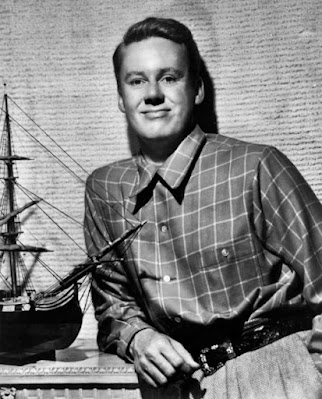
Hollywierd is and really always has been the sort of epicenter of crazy situations, not to mention scandals. The overheated, over-hyped and over-dramatic people who either flock there or are drawn there seemingly just can't help but become caught up in the melee. And over the years, more than a few sensible performers have instead opted to live elsewhere and commute to Tinseltown only when necessary.  But in the golden era of movie-making, sometimes it wasn't just the misbehavior of the stars themselves that generated jaw-dropping scenarios, but the studio heads with their chess-like, behind-the-scenes engineering, who helped fuel head-shaking acts. Today's Tinseltale falls mostly in that vein. It concerns the sunny star of MGM comedies and musicals, Van Johnson.

Johnson, only child to an alcoholic, absentee mother and a spartan, distant father, headed from his Rhode Island home to The Big Apple while still in his late teens in order to pursue a stage career. Soon enough, he was dancing in Broadway shows and understudying the leads in productions such as Too Many Girls with Desi Armaz and Pal Joey, which starred Gene Kelly. He was brought to California to dance in the film version of Too Many Girls (1940), during which he met Lucille Ball, who became a key friend. (She also fell in love during the film with leading man Arnaz, leading to a momentous marital pairing on and off screen.) Ball was responsible for introducing Johnson to a casting director who opened the door for studio screen tests. Johnson first signed with Warner Brothers, but was ultimately all wrong for the home of gritty gangster/crime flicks, which were its bread & butter. He only appeared in one feature and one short. Fortunately for him, MGM picked him up and began to groom the still unseasoned actor with their battery of on-site classes.

Even MGM, though, had not yet realized his potential for musical roles. Then again, the year was 1942 and the US had just suffered the bombing of Pearl Harbor, leading the country into the thick of WWII. Morale-building propaganda films were much the order of the day and so Johnson's first turn before the cameras was Somewhere I'll Find You (1942), a three-cornered romance set partly against the Japanese invasion of the Philippines. In real life Clark Gable lost his beloved wife Carole Lombard just as filming had begun (her plane crashed as she was heading home from a war bond drive) and he would enlist in the army directly after its completion. Johnson showed up near the climax as a soldier fending off the oncoming enemy the best he can.

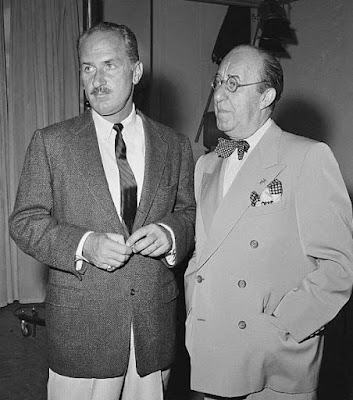
For this sequence, Johnson was paired with a newcomer to films, making his big-screen debut. The actor in question was one Keenan Wynn, son of vaudeville, Broadway and radio star Ed Wynn. (The young actor's unusual first name came courtesy of his mother, Hilda Keenan, who was an actress herself.) The two young men had instant chemistry with one another. Only one month apart in age, they soon established a camaraderie at their shared dreamland of a movie studio. Wynn had been married since 1938 to a highly dynamic, ambitious fellow performer, Evie Abbott, who had helped steer her new husband's career in the right direction, offering advice and moral support along the way. They had one son together, Ned, and would produce another one Tracy Keenan, by 1945. 

Despite their nearly identical age, Wynn and Johnson were hardly alike in terms of looks or performance style. Johnson was soon being molded into the bright, wholesome leading man type while Wynn had darker, more malleable looks along with a wide gallery of facial expressions that proved him adept at virtually any sort of role from the comic to the threatening and everything in-between. He was destined to become a skillful, but rarely above-the-title, character actor.

While Wynn continued to show his versatility in supporting roles, Johnson was soon being featured in Dr. Gillespie's New Assistant (1942) and Dr. Gillespie's Criminal Case (1943), which were part of the highly successful Dr. Kildare series. The star of those, 34 year-old Lew Ayres, was in the midst of being drafted into the military where he drew some degree of controversy over declaring himself a conscientious objector. (He did, though, serve more than three years as a medic and earned three battle stars in the process.) Johnson, who was 26 and unmarried, didn't show any interest in joining the cause and worked steadily in movies as the war continued. But that would soon become a moot point in any case.

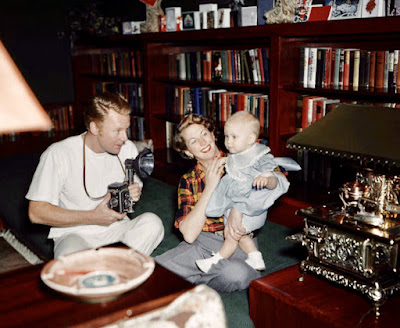
In what was certain to count as a career boost, Johnson was cast alongside one of the movies' top stars, Spencer Tracy, and popular leading lady Irene Dunne in A Guy Named Joe (1943.) In the middle of filming, though, Johnson was involved in a tremendously harmful automobile accident, which damaged his head and face. He was threatened with replacement, but Tracy, who'd taken a shine to the young actor, along with Dunne insisted that the production be halted for three months until Johnson could complete the movie. So he was able to hold onto the part (in a top ten movie of that year), but forever after had a steel plate in his head as well as some scars which could only be partially repaired. (You can see some of the unretouched remnants of this in the color photo at the top of this post.)

During his considerable convalescence, Johnson resided with Keenan and Evie and young Ned. As he began to come out of the worst of his injuries, the popular movie rags of the day took advantage of the publicity opportunities that this threesome afforded. Here, the two gents are haranguing her over some burnt toast. Johnson and Wynn had become the closest of friends and Wynn's wife was in their swinging as well. But were they by some chance swinging...?? Speculation began to arise, not squelched by the times a still-single Johnson used his best pal's wife as an escort to shindigs and premieres or parties at The Wynn's with Johnson and Wynn clipping flowers together and Evie giving Van birthday whacks on his rear end. 

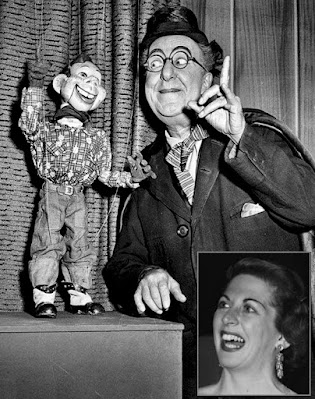
Even Wynn's famous father Ed had a devil of a time figuring out the situation. He was once (in)famously quoted as saying, "I can't keep them straight. Evie loved Keenan. Keenan loves Evie. Van loves Evie. Evie loves Van. Van loves Keenan. Keenan loves Van."


Meanwhile, Johnson and Wynn began to appear in several MGM movies together. Wynn had a supporting part in the latest in the Gillespie series, Between Two Women (1945) and they were both featured in Weekend at the Waldorf (1945.) Soon, though, they began to play off the notoriety of their interpersonal relationship in light comedies of misunderstanding, typically ending up in a battle over the same feminine love interest. 
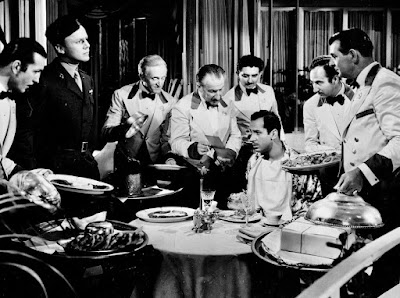
 

Weekend at the Waldorf was a more lighthearted, postwar rendition of the 1932 sensation Grand Hotel.

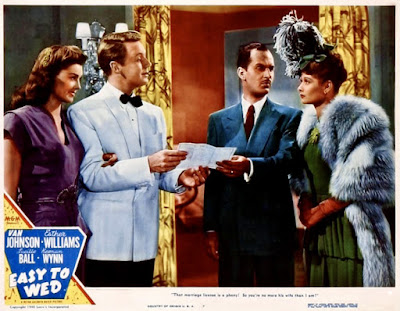
In 1946 came Easy to Wed, another remake (this time of Libeled Lady, 1936.) Johnson had done Thrill of a Romance with Esther Williams the year prior and it was a smash, so the two were reunited here. At this stage, Johnson was top-billed and his mentor and pal Lucille Ball was placed third in the credits! As this movie entered production, Wynn was involved in an accident of his own. He'd crashed his motorcycle, had his jaw wired shut for a month and lost 30 lbs. This time it was Johnson's loyalty that could ensure he wasn't replaced. He was back on set in a month. 

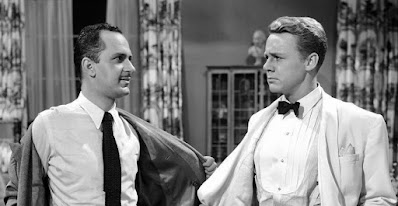
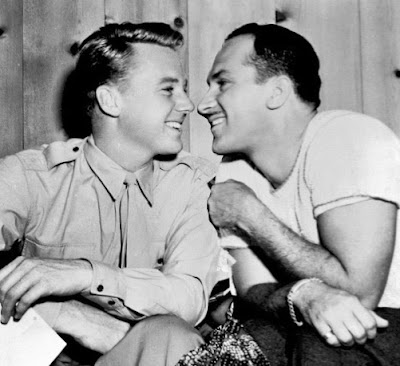
The seemingly inevitable co-starring film with Johnson and Wynn came in 1946's No Leave, No Love. No matter what the situation, real or imagined, between these two pals, there's no question that the publicity stills of the time, innocent as they might have been, lend a hilariously suggestive tinge to the relationship now.


And things were about to become dicey. I mean seriously dicey. Johnson was the idol of countless young movie fans. They couldn't wait to see him on screen and read about him in movie magazines. He was MGM's golden boy. But at 31 for him to still be unmarried in the 1940s was something of a red flag. And... much to studio head Louis B. Mayer's dismay, he'd been discovered in some compromising homosexual situations, which the lion-like Mayer successfully kept out of the press. Something had to be done. And done fast.
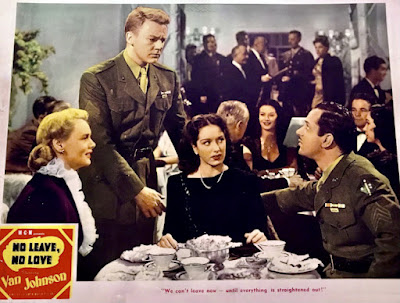
"We can't leave now... until everything is straightened out!"

"That marriage license is a phony! So you're no more his wife than I am!"

Mayer wanted Johnson to be married. ASAP. Not only did he not wish to be married, there was no woman in Hollywood to whom he would even consider wedding... except for Evie Wynn! Finally, Evie was called into Mr. Mayer's office for a life-altering meeting. The offer was on the table. If she divorced Keenan, the father of her two sons, Keenan's contract would be renewed with added perks, ensuring security for their children. She'd also be "trading up" in terms of her own position as the wife of an A-List leading man with a well-paying contract of his own. It took the better part of a year for her to make a determination about it (or for the three of them to!), but in 1947 she and Wynn drove to Mexico for a divorce and four hours later, she was Mrs. Van Johnson.  
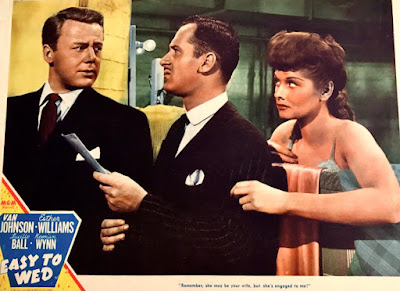
"Remember, she may be your wife, but she's engaged to me!"

Suddenly things were ship-shape.

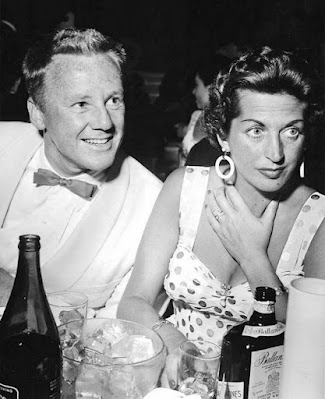
It's almost surreal sounding. Not that a Hollywood star would wed the moment a divorce became final - that was nearly common! But that a star would marry the wife of his best friend and that they'd continue to remain friends. And it also would seem a risk that the public might decry this and spoil the star's image that the action in question was designed to uphold. But the result was that Van and Evie Johnson became a popular couple in the film capital. They were out and about constantly while also hosting lavish get-togethers of their own. 
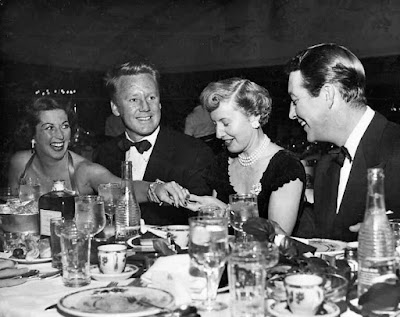
Good Lord...! Of all couples to be hanging with, Barbara Stanwyck and Robert Taylor. Babs admires Evie's ring while Van admires Barbara's husband!

As you can see, booze with plenty of ice was also the order of the day!

If I'm being frank, I always thought that  Evie Wynn Johnson looked more like her (ex) father-in-law Ed Wynn than Keenan did! If Ed was baffled before, he was surely confused now.

But, for some amount of time anyway, the marriage was a real one and a seemingly happy one. The newly-formed couple produced a daughter together, Schuyler Johnson, in 1948. The picture-perfect image was captured by the publicity department and all the ever-present movie magazines.

Whatever the situation, whatever deal was struck, both men's careers continued to flourish.

Wynn amassed a staggering number of movie and TV credits. When his famous father ran into career despair after his zany, costumed persona faded out of fashion, he helped encourage him to try more conventional acting. They worked together on Playhouse 90, among other shows, and the elder Wynn gleaned an Oscar nomination for his work as the cranky dentist Dr. Dussel in The Diary of Anne Frank (1959.) Hugh Griffith won that year for Ben-Hur.
 
Johnson, meanwhile, proceeded to costar in hits like The Bride Goes Wild, State of the Union, Command Decision (all 1948), In the Good Old Summertime, Battleground (both 1949) and many more. He and Wynn even reunited on film in 1954's Men of the Fighting Lady, a successful Korean War naval picture. That same year, Johnson changed gears in order to play a far more serious role than he was typically called upon to portray in The Caine Mutiny.
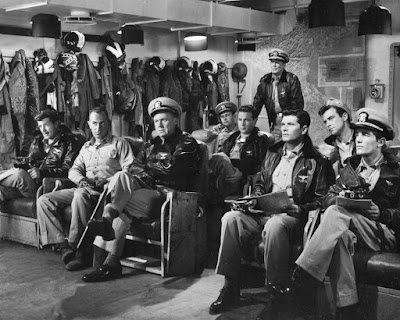
Right back where they'd begun a dozen years prior in Somewhere I'll Find You. Wynn and Johnson, side by side and in uniform for Men of the Fighting Lady.

1954 was a pretty sterling year for Johnson as not only did he have The Caine Mutiny, but there was also The Last Time I Saw Paris, a considerable hit opposite Elizabeth Taylor, and Brigadoon, a popular musical with Gene Kelly, who he'd once been understudy to back in NYC. (This same year, his mother came out of the woodwork to demand financial support, which he agreed to pay despite her absenteeism during his childhood. An out-of-court settlement of $400/month was agreed upon.) He continued to make movies through the late-'50s, acting for the first time on TV as well in a 1955 episode of I Love Lucy in order to repay his longtime pal Lucille Ball (playing himself.) His MGM contract now over, he worked at various studios, took part in productions overseas and headlined the first made for TV movie, 1957's The Pied Piper of Hamlin.  As the 1960s dawned, Johnson began to work steadily on stage, appearing in productions of Bye Bye Birdie, Damn Yankees, Guys and Dolls and...
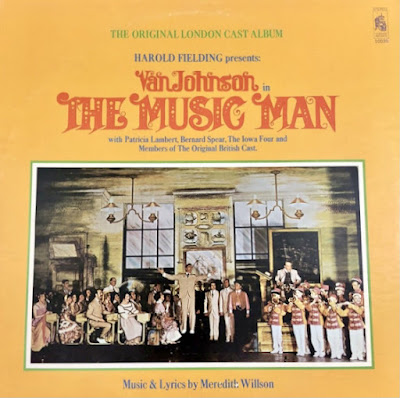
...in 1961, Johnson found great success in the London production of The Music Man, eventually touring it all over the place for nearly two years.

By this time, signs of rust had begun to appear of the marriage of Van and Evie Johnson. There had been some squabble, some separation and a general air of malaise within the situation as it existed. Regardless of the built-in issues, the couple repeatedly tried to make a go of it (and remained popular as both hosts and guests at many Tinseltown events.) Evie joined Van during his stint as Professor Harold Hill, which might have led to a happier period in their relationship except...
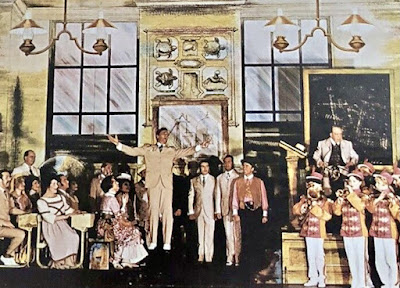
He left her for another man. He took up with one of the male dancers in The Music Man and that was the final nail in the coffin of his marriage. This other man is never (?) named that I can find, but I can tell you that Ben Stevenson, a noted ballet dancer-turned-instructor (seen just under Johnson's arm in the pale suit) grew close to Johnson during the run and was part of his inner circle. He was one of a select few cast-mates to get to dine with Judy Garland when she was in town.

Thus followed a highly acrimonious divorce, with the once seemingly happy couple going to the mat over the various details of their marriage dissolution. The situation dragged on until 1968! Keenan Wynn, meanwhile, had wed for a second time (1949-1953) and finally a third (in 1954), which lasted until his demise in 1986 and produced three more children. Evie and Keenan's son Ned, a sometime actor and screenwriter, eventually wrote a funny/sad book about growing up in such unusual circumstances. Their other son Tracy became a successful screenwriter (of The Longest Yard, 1974, and The Deep, 1977, among others.) Though there had been some ups and downs along the way with her father, Evie and Van's daughter also produced a book of her mother's photos from their time in Hollywood with anecdotal commentary to go with.

Wynn's motion picture and TV resume was nothing short of staggering. He remained a busy character actor in movies like The Patsy (1964), The Great Race (1965), Point Blank (1967), Finian's Rainbow (1968), Pretty Maids All in a Row (1971) and many, many others. He also had a memorable run on Dallas as Digger Barnes and was a guest on countless hit programs (including the inevitable The Love Boat, as seen here with Henry Gibson.) He died in 1986, still working regularly, of pancreatic cancer at age 70 and doubtlessly would have acted for far longer had he not become ill. He had three daughters with his third wife, one named Hilda after his own mother. His granddaughter, Jessica Keenan Wynn, continues the more than 100-year family tradition today as an actress of stage and screen.

Johnson kept busy as well with the occasional movie such as Wives and Lovers (1963), Yours, Mine and Ours (1968, again with Lucille Ball) and Where Angels Go, Trouble Follows (1968) along with many TV-movies and guest spots on his shows. (He's seen here with Ray Danton during an installment of McCloud.) He also continued to work on stage in things like How to Succeed in Business Without Really Trying, No, No Nanette and Showboat. He spent nearly a year on Broadway as a replacement Georges in La Cage aux Folles in 1985. Retiring in 1992, he passed away of natural causes in 2008 at age 92. Evie had passed away four years prior at age 90 after breaking a hip. Neither of them had wed again after the end of their own union. 
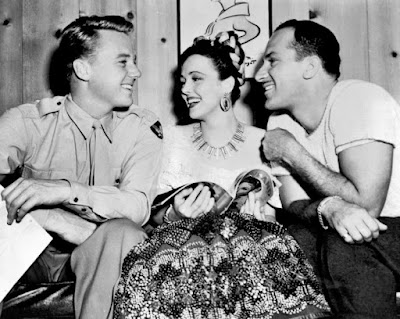
It's unlikely that we'll ever truly know the extent of what did or did not transpire between instant best friends Johnson and Wynn. Their unusual circumstances certainly raised eyebrows in the 1940s. I can say on a personal note that I have had many heterosexual married male friends and nothing ever happened between us (and I've never taken one of their wives as my own! Ha ha!)

I do think it's safe to say, however, that no matter the reality of the situation, there was indeed a deep and profound affection between these two men. It comes across in countless candids and even in staged photos with other people present. In a dog-eat-dog town like Hollywood, real friendship can mean everything when the chips are down.

"A couple of keyhole snoopers see eye-to-eye!"