

Considering all the ingredients
present, it seems unlikely that anything other than the recipe for a
perfect storm could be the result for today's featured film. Not only
have several cinema notables been quoted as bemoaning the fact that
Hollywood too often remade the good films when they should have been
redoing the bad ones, but also, in the case of this movie, the
situation was compounded by having a producer determined to – no,
let's say obsessed with the notion to – outdo his earlier crowning
achievement, 1939's Gone with the Wind.


Throw in an awkwardly-cast leading
lady, endless behind-the-scenes conflict and supremely complicated
set-ups featuring hundreds of extras and equipment and its a wonder
1957's A Farewell to Arms was completed at all! All this aside, the
works of source novelist Ernest Hemingway rarely made their way to
the screen without compromising issues of some sort. As it was, it
did manage to make back most of its cost, but the producer David O.
Selznick never produced another movie.


Selznick, whose triumphal Wind led him
to forever try to match that film's success, had been wanting for
years to remake the fondly-remembered 1932 classic A Farewell to
Arms, which starred Broadway luminary Helen Hayes and the impossibly
beautiful Gary Cooper (who was fifteen inches taller than her!)

Though the two never worked together again, they created a romantic
teaming that was, for many cinema fans, unforgettable and indelible.
They were virtually the same age as each other as well.

The only way Selznick could obtain the
rights to Arms was by bartering with Warner Brothers, whose property
the story was. Since they wanted to remake a movie of his themselves
(Selznick's A Star is Born, 1937) in order to feature Judy Garland, a
trade was made with Selznick chipping in $25K additional for the
ability to launch his project. Selznick then obtained an agreement
with 20th Century Fox to release and assist with the
picture and hired (against the advice of several onlookers) John
Huston to direct.

These two gentlemen, while creative and
innovative, were stubborn and single-minded. They clashed from the
start over where the focus of the movie should lie (the horrors of
war or romance against the backdrop of turmoil.) There was little
doubt where Selznick stood on the matter since the whole point of the
project was to provide a juicy part for his own wife, the
Oscar-winning Jennifer Jones! Huston had directed Jones twice
already, so there was no conflict there, just in the fact that a) he
wanted the story to be more about the vagaries of battle between
nations and b) he was too meticulous in pre-planning for the
all-important shooting timeline to be maintained. Selznick has
assured 20th Century Fox that the project would remain on
schedule and arrive on time.

Just before filming was to begin,
Selznick fired Huston and brought in Charles Vidor (shown here
directing Hudson on a cafe set.) Vidor certainly didn't get off easy,
with Selznick endlessly micro-managing the production with both his
infamous memos and his on-set interference. Among Selznick's worries
were the lighting and cinematography of his wife and the prominent
Adam's apple of Hudson, which he insisted be camouflaged with makeup
at all times. (In another ironic twist, Vidor had been married to
Gone with the Wind actress Evelyn Keyes from 1944-1945, but she
divorced him and married John Huston in 1946, the marriage ending in
1950!)

Hemingway, the author of the famed
source novel, was aghast that the heroine of the film (a character
based on a real woman he knew and loved) was to be played by a
thirty-eight year-old. The male lead Rock Hudson, in fact, was more
than five years her junior, changing the dynamic from a soldier
winning the heart of an emotionally fragile virgin (whose fiance was
killed) to a soldier falling for an older woman who'd spent many
chaste years with a man (who was killed in action) and is now a
neurotic near-spinster!


The film itself proceeded this way.
Just as Gone with the Wind had boasted a title that swept across the
screen from right to left, never appearing whole all at once, A
Farewell to Arms did the same thing, while lush music and scenery
filled in the wide-screen frame. This was followed by a historically
mood-setting scrawl, just like Wind. It was a calculated (and, in
hindsight, rather foolish) bid to set the tone for lightning to
strike twice. What resulted was more of a sprinkle.


Hudson (top-billed after the roaring
success of 1956's Giant) plays an American serving in the Italian
forces as an ambulance driver during WWI as they are resisting the
encroaching German army. Just back from a leave in Milan, he joins
his superior officer Vittorio De Sica and fellow drivers Kurt Kasznar
and others before they are to partake in a sojourn to the front,
waiting only for the snow to thaw.


De Sica tells Hudson of a new British
hospital that is stocked with pretty English nurses, one of who
(Jones) he has his eye on. He takes Hudson there and before long
comes upon Jones restocking clean linens in a large pantry. Hudson
strikes up a conversation with her and swiftly learns that she had
been in love with a young man for eight years who has now died in the
war and she is questioning whether it was right or not to have never
married or at least made love to him. (This is only one of several
startlingly frank moments for a mid-'50s movie to make it into the
final cut.)


Sensing a chemistry with this stiff,
but tender, lady, Hudson returns to visit her just before he is to
ship out to the front. She is clearly cut from the most ladylike and
reticent cloth, but when a cloudburst sends them careening into a
small greenhouse, her reserve is dampened and the next thing you
know, they've abandoned their senses of propriety and gotten down to
business on the floor! (A rather phallic cane of her deceased love's
that she'd been carrying around, is left lying limp on the floor
after the night of passion.)

By the way, it is during the storm at
the greenhouse that we learn of Jones' irrational fear of rain. She
says she always pictures herself dead in the rain and cries
practically every time it falls.


While the troops are preparing to head
out and stave off the invading Germans, Hudson wonders if he will see
Jones for a fond farewell. As their rendezvous in the garden didn't
end on a particularly happy note, despite their lovemaking, he fears
that she may have decided not to see him again. However, in a scene
vaguely reminiscent of Scarlett O'Hara's traipse through war-torn
Atlanta to find a doctor, Jones valiantly makes her way through
hordes of bustling soldiers and onlookers in order to see Hudson
before he departs.

They share a meaningful kiss in front
of God and everyone, with her promising to see him when he gets back,
in fact imploring him to make it back.


Next, the Italian army is shown
diligently making its way up and across the Alps in a scene that is
staggering in how much it encompasses. Hundreds of soldiers on foot
and dozens of vehicles are wending their way along the mountain
roads. No CGI here, folks! And there is no way to convey the scope of
these scenes in screenshots. It must be seen in motion to be
appreciated.


Gorgeous snow- capped mountain ranges
are the site for an oncoming battle. Hudson is forced to flee when a
barrage of explosives starts to hit the Italians and he hops aboard a
hand-cranked trolley that takes him down a mountain by cable. After
an explosion, he watches in horror as one of his fellow drivers dies,
though he is severely injured in the leg himself.


He's shuttled off in one of his own
ambulances along with another victim in the berth above him. In
another rather graphic (for 1957) moment, the injured man above him
begins to hemorrhage, dripping blood onto him as the vehicle bounces
over the treacherous terrain.


Because he is American, he is sent to a
newly-formed American hospital in Milan. In a disarmingly humorous
interlude, Hudson's 6'5” frame continually presents a problem for
the men assigned to transport him. He's repeatedly crammed and
crushed, dropped and dumped until finally making his way to the
safety of the nurses on staff (both of them!) at the facility.


The hospital is overseen by the
deliciously severe and persnickety Mercedes McCambridge (who played
Hudson's rugged sister in Giant the year before this.) The
no-nonsense McCambridge has an amusing reaction to Hudson's refusal
to have his temperature taken after he's thrown the thermometer
across the room. She whips out a rectal thermometer and asks her
assistant nurse to turn him over and see if he can “break this
one!” (A similar scenario had already appeared in Hudson's 1954
film Magnificent Obsession!)

That assistant nurse is the engagingly
frank and wry Elaine Stritch, of all people, who adds a welcome dose
of winking levity to the pro- ceedings. She and McCambridge make an
amusing combo with Stritch gleefully bending all the rules while her
boss sternly expects everything to be run her way and no other. (It
could be argued that their gently comic shenanigans are at odds with
the otherwise serious subject matter, but I think they add greatly to
the film and wouldn't have it any other way.)


Hudson uses his influence with De Sica
to have Jones transferred from her own hospital to the American one
in Milan, even though Hudson is the only patient there! Needless to
say, he receives round the clock care. If it isn't Stritch sneaking
bottles of liqueur into his room, tucked away in her bosom, it's
Jones giving him “healing” back massages.


Before he's even close to being fully
recovered, he grasps Jones and takes her to bed (his hospital bed!)
The morning after their first tryst, the otherwise crisp and starchy
Jones is seen lounging against a balcony in her uniform, sans the
apron, which is surprisingly curve-hugging; her hair undone around
her shoulders. Who knew that the grey wool dress underneath her white
coverlet was so clingy and sensuous-looking? It's a neat turn by the
costumer.

The happy couple would love to be
married, but they know that if they should proceed on that course,
she will be shipped back to England and that she cannot bear. They
continue their clandestine meetings, covered up by her duties with
him as a nurse, with the aid of a sympathetic Stritch.

Occasionally, the couple enjoys an outing, whether to a restaurant or, as in this case, a boating. Jones (whose character, it must be said, spoils practically every single moment the pair has together by posing endless, annoying, neurotic questions about their relationship!) grabs hold of Hudson's oar and manipulates it around, all the while jittery and ecstatic in the water... Finally, he reels her in and the boat is shown rocking back and forth as the two of them get it on! (I'm not making this up.)

One day, the repressive McCambridge
looks everywhere for Jones only to find her reading the American
newspaper to him, but with her headdress off. Later, she discovers
that Hudson has been drinking alcohol while in his “sickbed” and
storms into his room to see Jones lying atop Hudson in an embrace and
furiously announces that she is going to have Hudson sent back to
active duty.

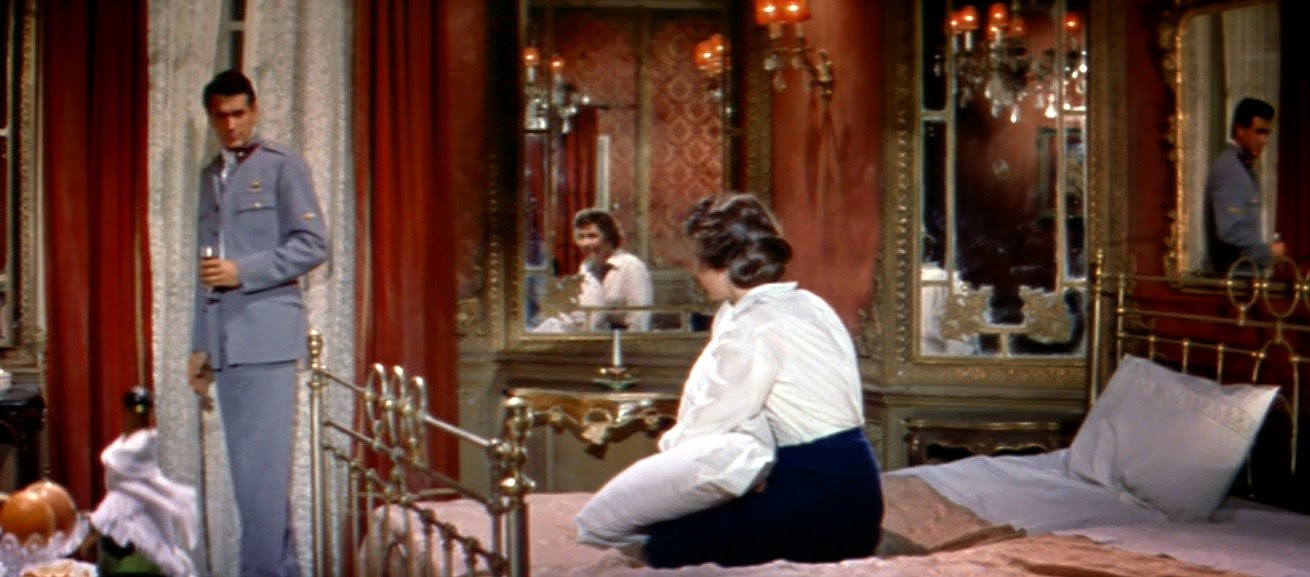
Trouble is, now Jones is pregnant!
Still, Jones resists marrying Hudson, wishing to remain nearby as he
heads back into service and, surprisingly, bucking the conventions
that she and many others have clung to up to that point. Before he
leaves once more for the fields of battle, they share a night
together in a garishly decorated motel (that rents by the hour.) (PC
purists will be horrified at the way she continues to toss back
alcohol during her condition.)

The once-lively town that Hudson
reports back to is now a bleak, dingy, oppressed place. He discovers
his old pal De Sica in a state of depression and despair over the
mounting poor conditions of the hospital in which he futilely tries
to mend and save the wounded. The previously gregarious and
optimistic De Sica is 180 degrees different now.

With the Germans breathing down their
necks, the town is ordered to be evacuated, with De Sica, Hudson,
Kasznar and others ordered to get out, even though it means leaving
behind the rows and rows of injured and ill patients. Only local
priest and friend to De Sica, Alberto Soldi (shown here with Hudson), opts to stay behind,
though the others have scarcely left the building before the hospital
is fatally shelled.

Now the soldiers, doctors and displaced
residents have embarked on a harrowing journey across mud-caked,
rubble-strewn roads, with desperate people clinging and clawing for
life. (In still another remarkable moment for a 1957 film, a woman is
shown dead or unconscious on the side of the road with a living baby
still suckling on her bare breast!) Kasznar meets with an untimely
end during a scuffle and before long De Sica begins to become
slightly unhinged.


While De Sica is passionately and
loudly rambling about the horrors around him, he is overheard by some
zealous Italian soldiers stationed in the next town who accuse him of
insurrection and of being a German spy! They arrest both Hudson, who
had attempted to defend De Sica, and him, transporting them to a
makeshift court-martial chamber.


In a stark sequence, Hudson watches in
disbelief as his comrade De Sica is swiftly found guilty and
instantly assassinated in a nearby courtyard! The committee of
officers, obviously in the mood to kill anyone they please, begin to
come down on Hudson, but he makes a break for it, narrowly escaping
death himself by throwing himself in the river amid a hail of
gunfire.

Washing ashore and afraid to be spotted
in his uniform as the deserter he's now become, he dons the wet,
bullet-hole-ridden sweater and pants from a body he finds along the
river and sets out to find Jones. He has to skirt McCambridge at a
hectic train depot, but manages to wrangle Jones' location out of a
disapproving yet still sympathetic Stritch.

This production still, taken during a
break in filming, shows “fugitive” Hudson casually enjoying a
smoke as McCambridge looks on from a rail car!


Hudson finds Jones situated in a
secluded hotel where she is ecstatic to be reunited with him.
Blissfully, they renew their
acquaintance with one another, though she is by now showing from her
condition. She (hilariously in hindsight) describes to him the “gay”
times they'll have together. (This shot of them below shows how
youthful and contemporary he seems while her styling and manner give
off a motherly vibe, something that stymied many critics and viewers
of this film.)


(In this shot, we get a good glimpse of
the Adam's apple that haunted David O. Selznick and which he wanted
to be obscured under any conditions. In fact, Selznick once bumped
into Hudson early one morning on the set and rather than offer, “Good
morning” he blurted something like, “Your Adam's apple isn't made
up...”)

The couple's happiness is short-lived,
however, when he tells her he is going to have to get out of Italy,
lest he be tried (and likely killed!) as a deserter. They opt to
procure a boat and sneak across the gigantic lake to Switzerland
during the night. As it is a twenty-mile trek and she is in no
condition to row, this is no easy feat. Naturally, there is a
rainstorm during the journey and we all know how Jones feels about
the rain. Somehow, in the presence of Hudson, she seems to have lost
her fear of it, though.

A near miss with a German patrol boat
finds them hunkered down among some reeds until it is safe to emerge
again. (It was during this sequence of the movie that Selznick and
associate producer Arthur Fellows (who'd worked on Gone with the Wind
and Duel in the Sun) clashed. Selznick ultimately slapped Fellows
across the face, which prompted Fellows to strike back, breaking
Selznick's glasses and cutting his eyes! Jones even got into the fray
requiring crew intervention and Fellows' resignation.)
Once free and clear of the enemy, they
emerge to a Swiss cafe where they are informed of delightful bed &
breakfast where they can retreat and wait out the birth of their
baby.


At this point, we're subjected to some
rather sticky scenes of their bliss and frolic amidst the
snow-covered hills and valleys of the region and in their fairy-tale
chalet. I'm on record as not disliking montages in movies, but this
section of Farewell is just a touch too gooey for me for some reason.

It's not forever, though, since when
Jones' time comes to deliver the baby (overseen by craggy, but
well-meaning doctor Oscar Homolka), problems start to kick in.


In yet
still another instance of this 1957 film pushing the boundaries,
Jones' is depicted on the operating table (with Hudson inside the
delivery room!) enduring prolonged agonies related to childbirth.
This and the other instances I've mentioned beforehand would soon be
benign and commonplace, but generally these sorts of things were
referred to rather than shown and usually with less emphasis on them.


In any case, Jones suffers interminably
until Homolka decides that a Caesarian delivery is necessary. He
sends a distraught Hudson out of the room so that he can have the
proper conditions with which to perform the surgery. Later, he has to
inform Hudson that things didn't go at all smoothly during the
precarious procedure as the rain has begun to fall...


Rock Hudson was a clear example of a
manufactured star; a strapping, yet docile, truck driver named Roy
Scherer renamed, refashioned and hammered into a matinee idol by
notorious talent agent Henry Willson. In time, he grew from a
stumbling, insecure player into a confident, multi-talented actor who
could headline a motion picture.


He'd toiled as a Universal contract
player for five or six years with ever-increasing success until
1954's Magnificent Obsession shot him to fame. After All That Heaven
Allows (1955), Giant (for which he landed an Oscar nomination, losing
to Yul Brynner for The King and I) and Written on the Wind (1956) he
had his pick of films. In order to star in Farewell, he bid adieu to
the leading parts in The Bridge on the River Kwai and Sayonara (both
1957) as well as consideration for the much-stalled Ben-Hur (1959),
thus he considered doing this film the biggest misstep of his career.


Hudson's own favorite movies of his
were Giant and Seconds (1966), which was a critically-acclaimed, but
non-box-office art film. For me, A Farewell to Arms is the film in
which Hudson never looked better. Maybe it's because I'm a sucker for
the uniform, but more likely it's that he frequently escapes from the
overly-groomed look of a '50s man and is shown unshaven, disheveled
and with his curly locks in disarray (i.e. - the way many men look
now, giving him a contemporary appearance.)

He's also just photographed beautifully
throughout most of the picture. (The entire movie is staggeringly
photographed with many gorgeous and inventive wide-screen
com- positions.) Even more, I think I am drawn to Hudson here because I
feel like this is the best acting he was ever permitted to do. He has
a bedside breakdown scene opposite Jones that comes across and so raw
and real. (In fact, it was reported that once Vidor was able to
convince Hudson to cry in the scene, no one was able to get this
constrained and restricted actor to stop!)

During the filming of Arms, Hudson was
in the final stages of his brief makeshift marriage to Phyllis Gates.
She was in Italy for part of the production, but not for long. He had
taken a young Italian actor as a lover during the location filming.
Two years after this movie came Pillow Talk with Doris Day, which
opened up an entirely new realm for the actor in comedy. He worked
steadily, though increasingly on TV, until his headline-making death
from AIDS in 1985 at age fifty-nine.

In the case of Jones, I had to work my
way backwards, having first experienced her as the heroic Lisolette
Mueller in The Towering Inferno (1974), the end of her screen career.
Though many believed that her Oscar-winning role in The Song of
Bernadette (1943) was her debut, she had actually appeared in several
things beforehand using her real name of Phyllis Isley.
(Incidentally, the year she won her award, she beat Ingrid Bergman
who was up for the Ernest Hemingway story For Whom the Bell Tolls,
her costar in that being Gary Cooper of the 1932 version of Arms!)


Jones' first husband was the brilliant,
but troubled Robert Walker (of Strangers on a Train, 1951, and many
others), though she left him for Selznick in the mid-'40s, marrying
the producing zenith in 1949. Under his guidance, she maintained an
illustrious career with additional Oscar noms for Since You Went Away
(1944), Love Letters (1945), Duel in the Sun (1946) and Love is a
Many-Splendored Thing (1955.) (The statuettes went to Ethel Barrymore
in None But the Lonely Heart, Joan Crawford in Mildred Pierce, Olivia
de Havilland in To Each His Own and Anna Magnani in The Rose Tattoo.)

By the time of Farewell (or earlier!),
Jones had developed a peculiar habit of over-accentuating the
movements of her mouth, resulting in some contortionistic expressions
that hampered her effectiveness as a leading lady. Her fans could
forgive it, but her detractors were horrified by the effect this
gave. She also in this film seemed not to have completely shaken off
the staid, reserved quality that she'd given her Eurasian character
in Splendored Thing, which served to make her even more matronly
opposite Hudson than her age and WWI styling dictated.

Jones' life was punctuated with sudden
deaths, with first husband Walker dying at thirty-two of drug
interaction, son Michael Walker dying of a drug overdose, David
Selznick dropping of a heart attack at sixty-three and their daughter
Mary Selznick jumping from a window to her death at twenty-two.
Jones' second husband, industrialist-philanthropist Norton Simon,
lost a son to suicide not long before their marriage and even Jones
attempted suicide herself when her close friend, actor Charles
Bickford, died suddenly of a blood infection! (Even novelist Hemingway shot himself to death in 1961,one of five people in four generations of his family to do so.)

Retiring after Inferno to help manage
her husband's many interests (and continuing to do so after his death
in 1993), Jones shied away from interviews and most movie industry
occasions, though she did take part in the 70th and 75th
anniversary tributes at those Oscar ceremonies along
with a few other occasions. She lived to be ninety years old, passing
away of natural causes in 2009.

Whatever problems this production incurred or the perceived lack of connection between the leads was perceived, Hudson and Jones got along very well throughout the filming and beyond. Except for some awkward portraits taken prior to filming, they most often were found enjoying each other's company and sharing funny moments together.


Selznick, as noted above,
never produced another movie after Arms. His legendarily lengthy
memos, in which he berated and niggled at associates over the details
of his film projects were collected into a 1972 book (reissued in
2000) called “Memo from David O. Selznick.” (The famous “O”
was added by him to distinguish himself from an uncle with the same
name and because he liked the imposing sound of it. He died in 1965
at sixty-three.

Vidor never completed
another film after this one either. His final project, Song Without
End (1960) was completed by George Cukor after Vidor suffered a fatal
heart attack at only age fifty-eight. Among his better-known movies
are Cover Girl (1944) and Gilda (1946), both starring Rita Hayworth,
and the James Cagney-Doris Day film Love Me or Leave Me (1955.)
Vidor's career had previously been adversely affected by his
unsuccessful lawsuit against Columbia Pictures studio head Harry
Cohn over mistreatment.

De Sica was not only a
prolific Italian actor, but a director in his own right, The Bicycle
Thief (1948), one of many accomplishments. He had, in fact, directed
Ms. Jones and Montgomery Clift in 1953's Indiscretion of an American
Wife. Later, he directed Sophia Loren to a Best Actress Oscar in Two
Women (1961.) His dynamic work in Arms led to an Oscar nomination,
though the award went to Red Buttons for Sayonara. In 1974, he died
at age seventy-three following surgery for a cyst in his lung.


Homolka was a delightfully
craggy Austrian character actor who worked in movies such as Sabotage
(1936), Ball of Fire (1941) and I Remember Mama (1948), for which he
scored an Oscar nomination. (Walter Huston won for The Treasure of
the Sierra Madre.) He worked in movies and on TV through the mid-'70s
before dying of pneumonia in 1978 at age seventy-nine.

McCambridge was a highly
distinct character actress, short at 5'3”, with a snub-nose and an
unusual voice that sounded as if she were speaking despite the onset
of strangulation. (In 1973, she famously lent that voice to The
Exorcist for use as that of a little girl possessed by Satan.) 1949's
All the King's Men brought her an Oscar, though she was nominated
once more for 1956's Giant (losing to Dorothy Malone in Written on
the Wind.) McCambridge, who had tangled famously with Joan Crawford
in Johnny Guitar (1954) worked through the late-'80s before retiring,
dying of natural causes in 2004 at age eighty-seven. One piece of
gruesome trivia is the fact that her son, John Markle, killed his
wife, two daughters and himself in 1987 after being caught in a
complex embezzling scheme.

One of the very few people
in Arms to still be drawing breath today is Ms. Stritch, who is
eighty-nine at present. Gaining considerable fame on stage, she
eventually segued to film and TV, though never entirely turned her
back on Broadway. Having led a colorful life (to say the least), her
one-woman show “Elaine Stritch at Liberty” won a Tony in 2002.
She also has three Emmys to her credit. A gravel-voiced,
scene-stealing, much-beloved character in every sense of the word,
she is still at it today whenever possible.

Austrian actor Kasznar is
remembered for his many supporting parts in movies like Valley of the
Kings (1954), Anything Goes (1956), Legend of the Lost (1957) and 55
Days at Peking (1963) along with his hammy villainous role on Land of
the Giants (1968-1970.) Having originated the roles of “Uncle”
Max Detweiler in “The Sound of Music” (for which he scored a Tony
nomination) and Victor Velasco in “Barefoot in the Park” on
Broadway, he performed on stage many times. He passed away in 1979 of
cancer at age sixty-five.

Alberto Sordi, cast in the
role of an amiable, devoutly dedicated priest was actually best known
in his Italian homeland for his comedic abilities. In fact, one of
his early assignments was providing the Italian voice for Oliver
Hardy in many slapstick Laurel & Hardy movies. Later he went on
to a prolific, acclaimed career in his country's cinematic output.
His funeral in 2003 attracted a crowd of over a million! He was
eighty-two and had been felled by a heart attack.

While A Farewell to Arms
is loathed by many fans of Hemingway (as well as by many classic film
fans in general), it was not exactly a box office flop. It just
failed to entirely make back its considerable expenses. (20th
Century Fox recouped its expenses, Selznick did not.) Selznick
offered Hemingway a $50,000 gift as he was making nothing on this,
having signed away the film rights long ago, but the always-thorny
author basically told him he could convert it into nickels and stick
them, well, you know where....!

While I recognize its
flaws (one being over- ength - it is 152 minutes while the original
ran a mere 88!), I can't help but have a fondness for it for reasons
which border on the fetishistic. For one thing, I have a weakness for
love stories set against the backdrop of war, with passionate
reunions included. The tragedian in me also appreciates an unhappy
ending. But beyond all that is the striking color scheme of the
movie. The gunmetal grey uniforms and the pristine, sterile white
offset by the never-ending signal of the red cross (here at times the
hue of nearly-dried blood.) I also have a thing for
imposing nurses (see Joan Crawford in The Caretakers, 1963, and
Elizabeth Ashley in Coma, 1978.) But would you believe I have never
once seen anything but brief clips of One Flew Over the Cuckoo's Nest
(1975)?!

Then there is the stunning art direction, location scenery and spectacle. While I am not a fan of much of the
back- ground music of the film, I do think that the love theme is very
beautiful and memorable. It does justice to the (intended) romantic
highs of the story.

I've mentioned throughout
this post the way the movie pushed certain limitations, be it
premarital relations, blood-letting, partial nudity (all of which are
incredibly tame by today's standards), but there is also no shortage
of suggestiveness, be it in the frank depiction of prostitutes or the
nude murals and busts in the hospital building. The one thing that is
practically eliminated – surely due to Hudson's real-life
orientation – is the hint of homo/bisexuality that had been hinted
at in the original 1932 film between Hudson's and De Sica's
characters.


Finally, there is the
sound of the movie. Though many viewers have railed that Jones and
Hudson lack chemistry, I find that it is there, just uneven.
Sometimes the relationship seems phony and forced, but other times it
is more than palpable. I love the way the movie sounds when Hudson is
in his hospital bed, feverishly whispering for Jones to go and lock the door.
There's a clammy, intense, voyeuristic quality to it that is very
fascinating for a 1957 movie.

This version of the story
is certainly not the definitive one, though it is also not the most
obscure. The events had previously been re-set to WWII and
Americanized for 1951's Force of Arms, starring William Holden and
Nancy Olson (considered hot together from the prior year's Sunset
Boulevard) and also presented as a episode of Climax! in 1955
starring Guy Madison and Diana Lynn. A 1966 BBC miniseries featured
the unlikely duo of George Hamilton and Vanessa Redgrave! Then, of
course, came the film In Love and War (1996), which cast Chris
O'Donnell as Hemingway himself and Sandra Bullock as his nurse.


It might well bore you to
tears (it doesn't me, obviously!), though in wide-screen high-def it
is undeniably beautiful to look at, whether it be the lush scenery or
the towering Rock Hudson at or near the peak of his handsomeness.


