I have been wanting to write about this movie since this blog began nearly 13 years ago, but never have! So the title of this post is quite accurate. I first saw
The Last Voyage (1960) on TNT in the mid-1990s with cropping, pan & scan, faded images and commercial interruption. Even then it was captivating. When the execrable
Poseidon (2005) came out,
Voyage made its way to DVD (along with
Beyond the Poseidon Adventure, 1979) thanks to increased interest in disaster at sea. Thus, I was able to enjoy it in widescreen. Now in the time of high-definition, the movie is a revelation, for it was virtually all filmed aboard an actual (and famous) ocean liner, the movie now serving as stunning documentation of its accoutrements. (I say virtually because, regardless of the claim on the poster, one terrific set was built for the movie so it was
entirely filmed on the ship.) This is going to be a graphics-heavy post because I wanted to share the interiors of the ship with you as I go along. Using the real, recently-retired liner the
SS Île de France provides the film with a priceless amount of verisimilitude that could never have been duplicated to the same extent otherwise.
 |
Renamed The Claridon for the purposes of the movie, this liner had an amazingly storied history that is worth reading up on. It was first an art deco marvel, then during WWII served as a storage ship, then a POW transport (!) - during which it was gutted of much of its decor, and then was refurbished and placed back in cruise service until its 1959 retirement.
|
 |
As the movie begins, a portentous narration informs us that this ship, due to make only 5 more crossings, will in fact be making "the last voyage!"
|
 |
No one can accuse this movie of dragging its feet to get started with the storyline. As ship's captain George Sanders is lunching with first class passengers, he is slipped a note.
|
 |
As he exits the room, we get some great glimpses of the artwork that was part of the ship's design scheme.
|
 |
Take note of the sculpted wall behind them, reclining nudes dotting the concept.
|
 |
Down they trek to the engine room, with smoke already wafting upwards.
|
 |
Here we meet crewman Woody Strode, who will emerge as a key player as the movie continues.
|
 |
It's not bad enough that the aged liner has a fire in the first place, but there is fear that if any of the infrastructure has rusted out, then flames may burst through up in the passenger areas.
|
 |
And that's just what happens...! The cabin class dining room becomes engulfed in flames!
|
 |
It is thankfully unpopulated at the time of the fire, but the whole scenario is nonetheless alarming to crew members Edmond O'Brien and Jack Kruschen.
|
 |
Though we catch a brief glimpse of them dining earlier, this point is where we meet the stars of The Last Voyage. Robert Stack and Dorothy Malone are traveling to Tokyo for his new job with their little girl Tammy Marihugh.
|
 |
Malone and Stack had played warring siblings in Written on the Wind (1956) and unhappy spouses in The Tarnished Angels (1957), but were permitted to portray a deeply devoted couple here. By now they had built-in chemistry and comfort level. This tinted lobby card gets the color of her dress wrong, a common occurence of the time.
|
 |
They are all playing bingo and Marihugh wins the grand prize, $40.10! (For those interested, that translates to close to $400.00 in today's money!)
|
 |
O'Brien is deeply concerned about the state of the ship in the wake of the engine room and dining room fires, but Sanders feels that the situation has been handled.
|
 |
Our family next heads to a room full of children (and some elaborate wallpaper.)
|
 |
Therein a puppet show is taking place and the kids get to watch it while seated on various riding toys!
|
 |
While Marihugh is having her fun, her parents have theirs on a nearby dance floor. Nothing says romance like fluorescent overhead bulbs (!), though it's hard to make Malone look bad in any lighting.
|
 |
Remind you of anything... like perhaps a movie that came out a dozen years later?
|
 |
There's really only one brief exchange between the featured family and the captain. Both Malone and Sanders had Oscars to their credit by this point.
|
 |
Below the sunny decks, Strode is expressing concern about the perilous reading on a pressure valve.
|
 |
If he can't get it to budge, it's unlikely to be moving at all!
|
 |
The incredible detail of the ship's mechanisms and gauges would be near-impossible to duplicate and also costly. (Though, in truth, the producer-director Andrew Stone had to pay $1.5 million in order to rent the ship serving as his set!)
|
 |
Nothing can get the handle of this valve to turn. Note that, unlike The Poseidon Adventure, there is often plenty of sweaty, muscled beefcake on display in this movie.
|
 |
As the crew is working below to prevent an explosion, unaware passengers are enjoying their day with a drink in the salon.
|
 |
Or perhaps an elegant lunch. (Dare I compare the way the occupants are dressed in comparison to today's mega-liners?)
|
 |
The on-board movie theater is packed.
|
 |
The star triad is headed back to their two-room suite to change into their swimwear for an afternoon dip.
|
 |
As she's about to slip out of that dress, Malone asks if the steward would mind coming back a little bit later to finish up their room. She's gone and forgotten her purse back at the lounge, so Stack trots down to get it for her.
|
 |
Meanwhile, Kruschen is desperately trying to relieve the pressure in the pipes below before disaster strikes. He passionately orders O'Brien out of the area, even though technically it is O'Brien's job to be performing the task.
|
 |
While Malone is readying her swimsuit, Marihugh has lost the dime from her $40.10 bingo jackpot and has to crawl behind her bed to retrieve it.
|
 |
Then BAM! The explosion occurs and passengers are (or dummies, in this case!) are blown to smithereens while having their lunch!
|
 |
Several floors of the ship are affected as the explosion rips its way upward.
|
 |
Forgetting all about Malone's handbag once the blast occurs, Stack is on his way back when he's confronted with a precariously tottering grand piano overhead!
|
 |
In what will be the first of many extraordinary hurdles he'll be making, he has to avoid being crushed by the monstrosity while trying to get back to his family.
|
 |
Sanders is bombarded with reports, suggestions and questions, but is hell-bent on staying calm, even after this latest debacle.
|
 |
Upon returning to his cabin, Stack is horrified to see it rendered apart and in complete shambles.
|
 |
He manages to locate Malone, painfully trapped under a solid steel piece of debris, but her only concern at this point is for their 8 year-old daughter.
|
 |
He tries to make his wife more comfortable with a throw below her head, then sets off to locate Marihugh.
|
 |
He finds the floor of her room almost completely gone and the poor child stuck on a small ledge of it on the opposite side!
|
 |
He attempts to console and reassure her...
|
 |
...but she is understandably petrified.
|
 |
And why not? There seems to be no bottom to the pit between them and there is even a corpse lying just below!
|
 |
Striking out with the right side of the room, Stack tries to get to her on the left, along the tremulously-attached headboards.
|
 |
He nearly topples to his death as the pieces give way beneath him. (Stack performed all of the stuntwork involved in this sequence himself.)
|
 |
No matter what he tries, Marihugh remains just out of reach.
|
 |
All the way down in the engine room, the crew is ass-deep in water and when they look up, they can see the sky through the smoke. (One crewman informs O'Brien that there wasn't enough of Kruschen after the blast "to scoop up!")
|
 |
Malone, helpless, can only listen as her husband tries to rescue their daughter.
|
 |
This can't be good. O'Brien locates the source of the water in the engine room.
|
 |
He gives orders to shore up the bulkhead and get every available man on it.
|
 |
Increasingly proud and stubborn Sanders will not panic the passengers and won't give the order to evacuate (or even prepare for them to do so.)
|
 |
Back at the stateroom, Stack tries the last resort of a makeshift bridge to get to his daughter, but it won't support his own weight.
|
 |
Fashioning a safety harness out of a bedspread, he coerces her across the wobbly plank in what is truly a nail-biting sequence. Marihugh's terror is palpable and believable throughout.
|
 |
Unsure of where to go or what to do, the passengers are scrambling all over the place.
|
 |
Down below, the crewmen are busy trying to secure the bulkhead as water sprays through relentlessly.
|
 |
Aware that he cannot free his wife along, Stack asks their steward for help, but he claims he cannot do anything like that at this point.
|
 |
Managing to enlist some male passengers to give him some assistance, Stack tries to move the steel plate, but it's hopeless.
|
 |
One compassionate man realizes that it will take an acetylene torch to free her and darts through the crowd to get to the bridge and ask for help.
|
 |
The man is informed that the torch is below deck, inaccessible and that he cannot spare anyone to help with it.
|
 |
Marihugh, Stack and Malone are a trio to root for as they endure everything from calamity to callousness.
|
 |
Not ready to give up on his wife, Stack proceeds to the engine room to look for the necessary torch.
|
 |
While men work feverishly to bolster the bulkhead, Stack can't get anyone to help him with the equipment.
|
 |
Everything topside is a melee of panicked passengers scurrying around.
|
 |
Though no official word has been given to evacuate, the boats are being readied and passengers are darting around on deck, too.
|
 |
Finally, Stack spies the much-needed torch, way down in the belly of the engine room.
|
 |
Now begins the incredibly arduous task of getting the massive tank and its hoses back up to the room where Malone is pinned down! (Again, no set could provide the amazing detail found in the actual use of a real ship.)
|
 |
Stack is handed shattering news once he is discovered with the tank by Strode. It seems that an acetylene torch is a two-part system. The tank Stack has is only one half of what is needed!
|
 |
Nevertheless, Stack finally gets a hand with the heavy, unwieldy tank and they press onward though the maze-like innards of the ship.
|
 |
At one point, Strode is ordered to drop the tank and get with the other men bolstering the leaky bulkhead, but after a moment of thinking it through, he decides that the bulkhead will go, with or without his aid.
|
 |
The ship is sinking, something that is clear to almost everyone except the obstinate Sanders.
|
 |
Despite their best efforts, the power of the sea is too much for the crewmen to contend with.
|
 |
A distraught Malone is losing hope and Marihugh can do nothing to help her mother. And there is no one around who can pitch in either. Even if they were willing, they could do nothing.
|
 |
Finally the bulkhead gives way and the remaining crew members scramble for their lives.
|
 |
Again, the effects are superlative as the compartment is bombarded with water.
|
 |
At last the order to evacuate has been given and lifeboats are being lowered into the water. We're treated to a tracking shot of the entire side of the ship with boats in varying degrees of escape.
|
 |
Finally Stack and Strode have made it back to the cabin, but there is still no viable way of freeing Malone.
|
 |
Despondent, she implores her husband to take their daughter and get off the ship while there is still time. He does agree to take Marihugh on deck and place her in a lifeboat, but vows he will not leave her to die alone.
|
 |
While Stack is gone, she gathers up the guts to ask Strode if he will kill her so that Stack will escape and leave their daughter with one living parent, at least.
|
 |
Strode will have none of this. I have to mention the potency of this image for 1960, with Strode lying next to Malone (shirtless, even!) After all, in 1966 the producer of Mission: Impossible was asked not to have Greg Morris and Barbara Bain in close proximity on that hit series! Creator Bruce Geller's response was to film them together more often.
|
 |
Stack is desperate to both place his child into a lifeboat and also to locate the acetylene. Once again, he is defeated at practically every turn and put off by one crewman after another.
|
 |
In order to go to the captain and plead his case, he entrusts Strode with Marihugh. This does not go well at all since Marihugh doesn't want to leave her parents. There is misunderstanding and a chase before he can get the girl back!
|
 |
He's finally able to toss her into a boat (where, again, Marihugh performs her own stuntwork!)
|
 |
As the boat lowers into the water, he pleads with them to return from the rescue vessel with some acetylene.
|
 |
Time is ticking away, though, and there isn't even an hour left to this ship's life.
|
 |
Strode lays it all out for Stack, but also vows that he will not leave the ship while Malone remains trapped.
|
 |
Stack confronts the captain about help for his wife. Granted there is a lot going on as they're trying to keep the ship afloat, but he can't get anywhere. Meanwhile, O'Brien is pleading for help of his own for men of his trapped below Malone.
|
 |
Stack grapples with O'Brien about the life of his wife versus the seamen when suddenly an explosion blasts another part of the ship apart!
|
 |
Now an exasperated O'Brien lays into Sanders, regardless of the consequences, and gets slapped in the face. This only leads to further venom from the frustrated engineer.
|
 |
During all this, an agonized Malone struggles to figure out a way to get her husband off the ship so that he can survive to raise their daughter.
|
 |
She spies a shard of broken mirror across the way and uses a nearby stick to draw it closer to her.
|
 |
In an excruciating scene, Malone prepares to cut her wrist and bleed to death in order to ensure her husband's safety.
|
 |
Stack has not given up yet, though. He and Strode are still on the hunt for some acetylene and make their way through the now-flooded dining hall.
|
 |
They futilely attempt to close the portholes against the relentless sea in order to preserve their route back, but it's hopeless and Stack's head is injured in the process. (Allegedly, the actor was truly injured during the filming of this sequence. In any case, the man took a physical beating throughout the bulk of the shoot.)
|
 |
Unable to bring herself to suicide, Malone is reunited with Stack, who will not leave her to perish alone.
|
 |
With the ship lurching and certain to sink, Strode finally convinces O'Brien to come and see what can be done to help the trapped woman.
|
 |
But without that second tank, there just isn't anything to be done. All he can do is try to put a life jacket on Stack as the inevitable comes. And now the water has begun to enter the floor of their cabin!
|
 |
The hits just keep coming. Now one of the smokestacks comes apart and crashes!
|
 |
The crippled liner, with one of it's stacks rendered open, continues to dip into the ocean.
|
 |
O'Brien is frantic, Stack is resolute and Malone is resigned to her fate.
|
 |
And still the sea water continues to rise...
|
 |
An already tense situation gets even more extreme as Malone struggles to keep her head above water.
|
 |
There was probably no other viable actress at that time whose luminous eyes could have captured the panic and despair of the scenario than Malone. Her eyes were large blue pools themselves. I won't proceed with how the movie ends, but I will tell you that there is still plenty of action and drama left after this point! A beautiful version of the film can be seen here.
|
 |
The Île de France had already seen its share of drama before this. It was one of the primary rescue vessels in the wake of the famous Andrea Doria collision, which killed 46 people, many of them women and children. Over 700 terrified passengers were placed upon the ship from the Andrea Doria's lifeboats. That disaster was in 1957 and was still fresh in the public's minds when The Last Voyage was being filmed in 1959.
|
 |
Malone's predicament was inspired by an actual episode on board the SS Andrea Doria. A Dr. Peterson tried in vain to free his trapped wife Martha after the ship had been struck by the Stockholm cruise liner at a 90-degree angle.
|
 |
Writer-director Andrew Stone, who virtually always collaborated with his editor wife Virginia, saw his own share of drama during the production. The Japanese salvage company wanted the ship undamaged and put up countless roadblocks during production, even to the extent of hiring thugs to intimidate members of the crew. Much finagling and brushes with danger ensued as The Stones strove to complete filming.
|
Stack's role had initially been earmarked for
Stuart Whitman, with whom the director had just worked on
The Decks Ran Red (1958.) Stack had been Oscar-nominated for
Written on the Wind (1956) and was already beginning his famous run on TV's
The Untouchables. Often accused of woodenness and stony expressions, I felt he was natural, believable and palpably distressed throughout
Voyage. Watching the film, one can only marvel at the things he was called upon to do physically. It was a memorably challenging assignment for him. He helped parody the disaster genre in 1980's
Airplane! Later, he gained fame as the host of
Unsolved Mysteries and acted up through the early-2000s until claimed by prostate cancer and a heart attack at age 83 in 2003.
Malone, always a favorite of ours, had won her Oscar for
Written on the Wind and continued costarring in movies for several years after, but soon became best known for starring in the 1964 prime-time soap
Peyton Place. You can see and read a whole lot more about her in her Underworld tributes
here and
here. After a cameo in Basic Instinct (1992), she retired, but lived until 2018 when she died of natural causes at 93.
 |
| As noted earlier, Malone and Stack had, by now, grown to know each other well and could instantly develop the couples' devotion to one another. Malone also guest-starred on The Untouchables in 1962. |
Sanders also has his very own tribute
here in the Underworld. Suave, sneering and elegant, he lent valuable support to many movies (and rightly earned an Oscar for his signature role in
All About Eve.) His character here is not exactly sympathetic with his willful stubbornness and pride, though there were likely captains just like that in seafaring history. It's revealed close to the end of the film that his character was to be promoted to commodore prior to the disastrous fate of the Claridon. Sanders grew tired of life on this earth and practically walked through some of his later roles. In 1972, he took his own life via a drug overdose at age 65.
O'Brien, still another Oscar-winner in this cast (for
The Barefoot Contessa, 1954), had begun in movies with
The Hunchback of Notre Dame in 1939. Not conventionally handsome in the manner of a matinee idol, he made his mark in crime thrillers, military dramas and a variety of other genres. Meant to appear in
Lawrence of Arabia (1962), a heart attack led to Arthur Kennedy taking the part. He continued working up through the mid-1970s, but partial blindness and the onset of Alzheimer's disease caused him to leave
Black Christmas, 1974, in which John Saxon replaced him. That affliction led to his death in 1985 at age 69.
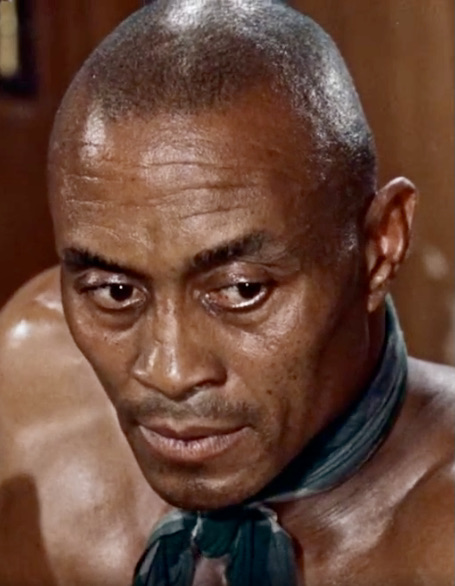
The heroic and physically commanding role of Strode had initially been earmarked for Sidney Poitier! Needless to say, had Poitier been cast, Whitman and he would have shared star-billing. Strode, while a busy captivating performer, did not possess that level of star power. (Director Stone had a long history of utilizing minority performers in starring parts and perhaps initially envisioned a pairing that could capitalize on the success of 1958's
The Defiant Ones.) Toiling on screen since the early-1940s, the athletic Strode worked in many notable movies. This was his year, though, with not only a featured part in
Voyage, but a memorable role in
Spartacus and the title role in
Sergeant Rutledge. He remained in demand up through the early-1990s when lung cancer claimed him in 1994 at age 80.

I can probably count on my hands the number of child actors I like (and I am no fan of children who aren't related to me by blood or close friendship either!), so there was clear and present danger of me really disliking the Shirley Temple-ish Marihugh. (Though Temple is one of the kids I adore!) A cute little imp whose smile won contests and whose work in ads brought wealth to her family, Marihugh demonstrated some true grit in this part. Her fear, distress and emotional pain is highly palpable and realistic, even quite heart-wrenching at times. Having worked on the final season of
The Bob Cummings Show in 1959 and later to play John Gavin's daughter in
Back Street (1961), her success in movies and TV was pretty brief. She was out of the biz by 1963 except for one final part in 1969 and eventually became an exotic dancer..! In a "truth is stranger than fiction" turn of events, she wed a decade-younger bodybuilder who was violent and abusive and one night was shot to death by her. She was given probation on an involuntary manslaughter charge. She did remarry to a Paul Osborne and was presumably happy until her death at 68 in 2020 (as Tamra M. Osborne.)
 |
What a whirlwind life little Tammy Marihugh lived! From success as a child model/actress to the Las Vegas strip and then to domestic violence and a journey through the justice system. This lobby card went the extra step in airbrushing the little moppet's nether regions, so it's amazing to think she later made a living wearing even less. I hope she found peace in the end.
|


