We've visited the shadowy, mysterious
world of actress Merle Oberon, who is an Underworld favorite not only
for some of her great 1930s and '40s films, but for her glitz-laden,
hair-iffic work in
Hotel (1967), before right
here. But today we
take a closer look at one of her late-career efforts, one in which
she clung to her position of a romantic leading lady rather than
devolve into a mistress of horror as many of her contemporaries were
doing at the time.
Of Love and Desire (1963) was Oberon's
first appearance in front of a movie camera in seven years (following
the less-than-amazing thriller The Price of Fear in 1957 with Lex
Barker.) By this time, Oberon was firmly entrenched at her luxurious
Mexican home, a stunning, elaborately appointed piece of property
that she and her husband, Italian industrialist Bruno Pagliai, had
forged and designed for themselves. The locale would serve as a
backdrop for her return to the screen.
The movie opens with a small private
plane arriving in Mexico City, operated by its only occupant Steve
Cochran. Cochran has come on business to install smelting machines
near the site of a mine run by the wealthy Curt Jurgens. Cochran
takes a taxi ride through town on the way to Jurgens' estate
(affording views of various sites such as the Angel of Independence –
no rear-projection shots here. In a nice dose of verisimilitude, he
really was in a car in Mexico.)
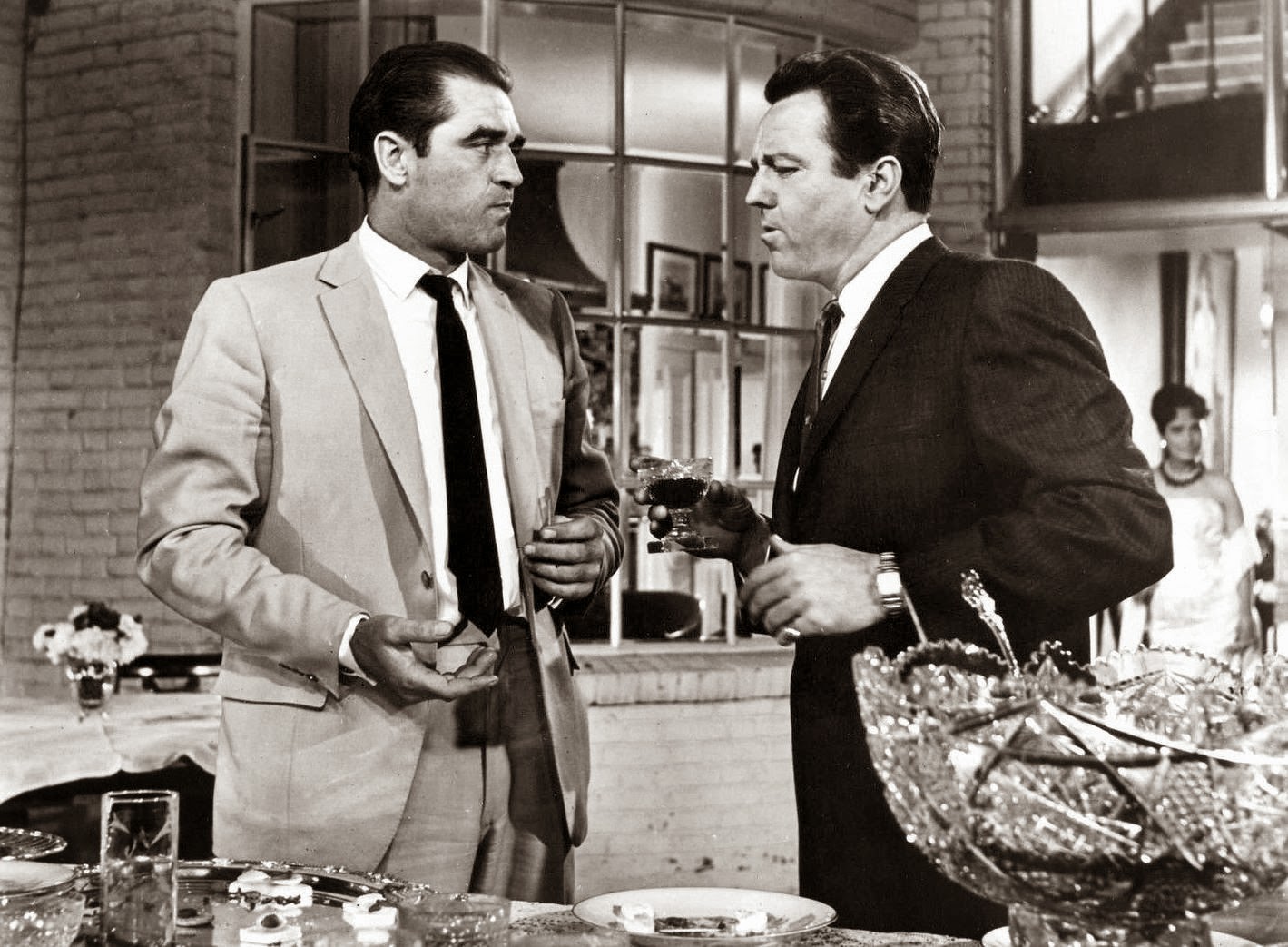
Cochran is spirited away to Jurgens'
mansion where a glamorous party is in full swing. There he runs in
to a business acquaint- ance (Steve Brodie) who's been working for the
family himself. He also meets Jurgens' half-sister, the regal
Oberon, who descends the home's staircase and sets in motion the
wheels of the movie's tormented plotline.
Cochran discovers from Jurgens that he
suddenly has two weeks to wait before his equipment is going to be
trucked in to the factory, but since Oberon is so attentive to him,
it doesn't seem as if it's going to be too torturous a wait. She
dances with him, shows him to the food and then insists on walking to
his guest suite with him.
However, not yet ready to say good
night, she requests that he see her to her own spectacular home
nestled a few blocks away and hidden from the street by a wall and a
heavy door. Inside is a sprawling paradise with foliage galore, a
beautiful pool and an open-air living area (that somehow, despite the
late hour and what seems to be an absence of awake servants, has a
freshly-lit fire going, burning candles everywhere and even ice for
their drinks at the ready!)
She tries to keep it in check, but the
wheels soon come off and it's clear that she is primed and ready for
action. (Cochran's buddy Brodie, seen at left before departing, had already told
him that she was ripe for the taking if he pushed the right button!)
However, Cochran's hesitancy causes her to back away and have a showy
meltdown in which she berates herself and cries despondently over her
animal desires.
This tender side of her piques
Cochran's interest all over again and before you know it, he's in her
arms again and proceeds to spend the night with her. He awakens the
next morning (sporting an endearingly tousled head of hair and
ostensibly naked under the sheets) to the sounds of splashing
outside.
Cochran comes out to join her and is
told to grab a swimsuit from the nearby changing room. First he
reaches for a pair of large, floppy trunks, then for a suit
embroidered GC before (thank you, Jesus!) settling on a skimpy olive
green Speedo which amply shows off his own well-preserved, forty-six
year old physique.
One thing that impressed me about Steve's humpy body is just how attractive this mid-forties man's back is...
The couple's water-logged flirtations are cut
short by the arrival of Jurgens, who is dismayed to see that Oberon
has had Cochran's luggage brought over to her home. He reminds
Cochran that the two of them are supposed to be touring the mine that
morning, so Cochran has to doff the cute green trunks and get
changed. We see that Jurgens has a less-than-comfortable interest in
his sister Oberon's love life, one that borders on the obsessive.
Cochran heads to the mine where
symbolic columns of machinery pound into the holes under-ground.
Cochran takes a break from excavating Oberon to explore some of the
mining operations. However, this respite is brief, for Oberon pops
up unexpectedly with a picnic basket, offering Cochran chicken salad
or tuna. When he expresses a preference for tuna, she tells him
that's what she'll be, his tuna fish! He schnuggles up to her in a highly sensuous manner prompting her to remark about him rubbing her the right way!
Cochran doesn't even go back in to the
mining facility, but instead whisks away with Oberon on an extended
jaunt through the Mexican beaches, villages and hideaways. One
brief, baffling scene shows her lying in bed with her long hair
cascading around her face, bringing up uncomplimentary comparisons to
one of her greatest roles, that of Cathy in Wuthering Heights (1939)!
The couple enjoys an idyllic adventure
together, comfortable enough to bathe and shave in front of one
another though Oberon comes perilously close to spoiling everything
when she inadvertently calls Cochran by the wrong name as they are
tussling on the bed!
A mysterious figure from her past seems
to be haunting her thoughts. In any case, all is soon forgiven and
the two traipse through a local (and crowded!) town. On a whim,
Oberon decides to make herself into a new woman for Cochran and
proceeds to have her Morticia-like hair hacked off by a street
barber. He is reluctant to chop the hair, but she insists. In an
instant, her long tendrils are gone and she suddenly has a thick,
curly bouffant!
This new 'do is supposed to allow
Cochran to run his fingers through her hair, but in the very next
scene and thereafter it would take a John Deere combine to make its
way through the teased, curled, back-combed and shellacked fixture on
top of her head!
Back home, Jurgens is horrified to
learn that this two-week-long affair has gotten serious and that
Oberon intends to marry Cochran. His outrage seems less about her
reputation than the fact that it sparks a sort of uncomfortable obsession of his
own with her, his own half-sister (different mothers, but the same
father.)
Jurgens conspires for Oberon to join
him and some friends on the sizeable family sailboat for a spin
around the ocean. Thing is, Cochran isn't able to join them right
away since the absent equipment is now on hand and needs to be
installed. What's more, Jurgens has deliberately arranged for one of
Oberon's prior squeezes (the “GC” of the monogrammed swimsuit),
John Agar, to be on board.
Oberon is distraught to find Agar on
the boat and attempts (with precious little success) to avoid him.
She starts to drink and he begins to put the moves on her, eventually
chasing her to her cabin and all but raping her, though after a
certain point, she gives in and takes what it is he's giving.
The morning comes hard when she sees
Cochran through a portal, arriving on a launch to join them all. Her
guilt and shame take over and she races to the bathroom to grab a
razor blade and cut her wrists! Cochran comes upon her bleeding on
the floor of her cabin.
Now convinced he will have nothing more
to do with her, she shuts herself away in her walled estate, refusing
to see him even though he has somehow worked through his anger and
disappointment at her behavior and wants to at least say goodbye.
Realizing her own unfairness in the
situation, she goes to see him at his hotel where the couple
ultimately realizes that they actually can make a go of things,
despite all the drama, turmoil, unfaithfulness, etc... She darts
back home to pack, ecstatic that things might actually work out, but
then spots her own wrist bandages and begins to falter again. That's
not all, though. Her half-brother Jurgens is now on the scene and
launches into a major diatribe, one that reveals just how deep his
feelings for her are.
With this, she is totally unhinged and
goes careening out of the house, out of the grounds and into the
swirling, whirling city, which, for some reason, seems practically
devoid of any other women. She runs and runs, always banging into
one man after another, some offering help, some leering. She comes
upon maybe one or two women in the frame during this histrionic
hilarity, with crazed music emphasizing each overheated encounter,
until finally she is trapped in a revolving door and collapses.
This climax of the movie has to be seen
to be believed with the zany music, the endless wave of men, men, men
and (my own favorite) Merle - never one to be particularly sure on
her feet anyway - garbed in a tight, gray pencil skirt, running
frantically from place to place. I will leave it to you to find out
how this nymphomaniacal drama plays out in the end.
One interesting thing about
Of Love and
Desire is that the year of release was 1963. That is early for a
mainstream movie with a name brand star in it to be shown cavorting
half-naked with a lover and being the love object of her own half-brother. Oberon is shown straddling Cochran's bare
back with no doubt in the slightest that they have been carrying on a
steamy affair. Contrast this with 1965's
A Rage to Live in which
much of sexually-obsessed Suzanne Pleshette's behavior is more
implied than depicted.
Of course the movie's progressive,
permissive attributes (baby-crib tame by today's standards) were
acknowledged by many theater owners who slapped a “RESTRICTED”
tag on it, allowing admittance to those only eighteen and older.
Even though it was not included in the
final cut of the movie, a climactic kiss between Jurgens and Oberon
was apparently filmed. In the end, a shot of her tear-filled,
horrified eyes appears instead, but never one to deny my readers
anything, I give you a still photo of the big smooch.
Also apparently snipped from the movie was this encounter with still another unidentified lover, a comparatively young one! Busy gal in this one, our Merle!
This shot is not from the actual movie either, but taken during a break in filming on the sailboat with a rather peckish visitor taking advantage of a snack that must have been available on board.
As soon as I saw this the first time
and noticed Richard Rush's name as writer-director I figured I was in
for several bits of campy fun. Though he has directed some
well-received films including The Stunt Man (1980), it's his
side-splitting wreck Color of Night (1994) that endeared him to me.
The combination of his hot-house style and the
desperate-to-stay-glamorous Oberon is rather irresistible.
Incidentally, no one will ever make me
believe that this poster art is of Merle Oberon. I don't know where
this picture originated, but it brings Ruth Roman to mind more than
Oberon (though I don't believe it's Ruth, either.) I have no idea
who it is or why it is on the poster, but it is simply not our girl!
Merle Oberon had been known for years
as one of the cinema's most exotically exquisite looking people.
(This photo at left is from the colorful 1946 movie Night in Paradise.)
Countless photos of her in elaborately-appointed gowns and
accessories can be found on the web and in books. Her (long-hidden)
mixed race looks lent themselves well to austere, elegant characters.
In real life, she enjoyed fabulous
wealth and was often found on best- dressed lists. Though she gave
extravagant parties and hobnobbed with many of the rich and famous,
she also enjoyed everyday life at her eye-popping home in Mexico.
She was in no way going to belittle her image by chopping people up
with an axe or screaming in terror as a disembodied head rolled down
the steps near her.
No, her final three roles (this movie,
then
Hotel, 1967, and finally
Interval in 1973 – oh, and we can't
forget that cameo in 1966's
The Oscar!) had her still doing
everything possible to look attractive and glamorous. I'm still
waiting to see her at the 1973 Academy Awards ceremony in which she
presented a special award to
The Poseidon Adventure for its special
effects, emerging onstage aboard a partial replica of the deck! Can
you imagine?!? Ms. Oberon suffered a stroke and passed away in 1979
at age sixty-eight.

Mr. Cochran only made a few more film
and TV appearances after this because he became ill during the
filming of Mozambique (1965) and a resultant lung infection killed
him while he was sailing with three curvaceous Mexican passengers.
They drifted for ten days with his body on board until finally being
rescued. Oberon, who'd been his lover during Desire, pressed
authorities to look into his death further, but no foul play was ever
uncovered. (The photo below is from an earlier excursion, not the one in question, but is eerily prescient!)


Jurgens was a German-born journalist
who entered acting at the encouragement of his first wife, who was an
actress herself. After being interned in a concentration camp for
his anti-Nazi stance, he became an Austrian citizen, eventually
continuing a stage career and essaying effective villainous roles on
screen (a notable time being The Spy Who Loved Me in 1977.) In
1971's The Mephisto Waltz, he dabbled in apparent incest again,
making out with “daughter” Barbara Parkins.
Jurgens was married five times and his
third wife, the highly-colorful Eva Bartok, gave birth to a child
AFTER their divorce, naming her Deana Jurgens. However, it was later
revealed that not only was the child not his (he'd been rendered
sterile in a long ago accident), but that the girl was allegedly the
offspring of Frank Sinatra! Jurgens died of a heart attack in 1982
at age sixty-six.
Agar is famous as the first husband of
child superstar Shirley Temple. Having met her in 1944 through his
sister, who went to school with Temple, they wed in 1945 when she was
but seventeen. The unhappy marriage ended in 1950 and Agar's
once-promising career (unaided by a drinking problem) morphed into a
series of leads in campy sci-fi flicks. This movie was a welcome
reprieve for him from aliens, monsters and giant spiders. His second
marriage was a far happier one, lasting until her death after nearly
fifty years. Agar passed away only two years later in 2002 at age
eighty-one of emphysema.
The song “Katherine's Theme” is
sung over the opening credits by none other than Sammy Davis Jr.
Time was, all the fancy romantic movies had lush themes crooned by
anyone from Vic Damone to Jack Jones to Frank Sinatra, so it's only
natural that Sammy had his turn.
Not everyone is going to be able to
comfortably immerse themselves in a movie like Of Love and Desire,
but for fans of the colorful, the glossy, the overbaked and for
anyone with an affection for either Ms. Oberon or Mr. Cochran, it's a
no-brainer. For years it was one of those holy grail films I felt
I'd never see (it's never been released on home video), but
thankfully Fox Movie Channel unearthed it and airs it from time to
time.