Fix it, Jesus...! I'm still caught in the
TV Movie Time Tunnel. The truth is, my life is crazy (as always) and I can do these posts completely from work, thanks to youtube and photo programs on my computer. But nevertheless, this one -
The Letters (1973) - is an awesome entry that I highly recommend. Nearly ALL of the old movies of the week go down like buttah because they are only about 72 minutes long without commercials (being filmed for a 90-minute spot versus the obligatory 2-hour movies that were to follow, often annoyingly padded to fill out the running time.) P.S.-Don't touch that dial before the post is over because there's a fun Designer Douple-Dip at the tail end!
The Letters was a TV series pilot that didn't sell. (Oddly enough, Aaron Spelling produced two movie-length pilots - the other being the second
Letters From Three Lovers, which aired later that year! The concept just didn't catch on despite a promising premise.) In it, US postman Henry Jones introduces three different stories (a series would have had two) involving letters that were delayed from delivery for one year, with personal consequences being the result in most instances.
Up first, we see a suburban couple heading out to the station wagon, loading luggage into the back.
The man turns out to be John Forsythe (later the voice of Charlie on
Charlie's Angels and the star of
Dynasty, both Spelling productions.) He's about to head off to Mexico for a business trip.
The wife is Miss Jane Powell! My pea brain had so much trouble picturing these two in the same universe as I always thing of her as a 1940s and early-'50s movie star while he is more of a late-'50s and 1960s personality to me, yet he is indeed ten years her senior.
Anyway, they have a poignant farewell at the airport as he readies himself to fly off on another trip. She is particularly emotional about it for some reason, perhaps sensing some tension or dissatisfaction in their relationship despite having two young children together.
Turns out there is some good reason...! He sidles in next to another passenger, the almost thirty years younger Lesley Ann Warren and they immediately clasp hands!
Cinderella is all grown up now and has landed herself a successful businessman...
They enjoy one of those oh-so-'70s romantic montages full of bike-riding, horseback and seaside sunsets. (Didn't anyone just go to Mexico and create a two-headed monster in their hotel room?? LOL) Despite their bliss, Warren is miffed that he didn't tell his wife about them, but he promises to in a letter.
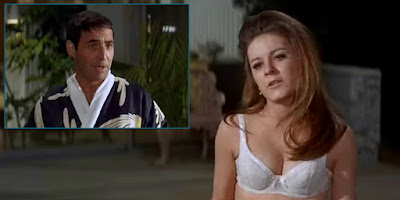
Sadly, he comes down with what appears to be a killer case of Monte- zuma's Revenge and cannot take her to dinner with another couple as they'd planned. This being the nearly always staid Forsythe, he wears dress slacks under his goldenrod robe even as he is presumably heading into the bathroom every few minutes!
Next day on the beach, the "happy" couple is situated in rather circus-like cabana with Forsythe in the same robe (...) and Warren becoming bothered by some roughnecking children who've kicked a ball into their space.
Forsythe, who has two snot-nosed brats already, isn't particularly bothered by it, but Warren is a bit ticked, especially when the point is raised that he already has his children and she has none yet, nor does he seem interested in more.
Later on, they have another (or perhaps the same) disagree- ment and he has informed her that they are basically through already... She accuses him of never having truly planned to leave Powell and of never having even written the "Dear Jane" letter. He whips it out (the letter) to prove that he had.
As he goes to slip it into his suit jacket pocket, he misses and the letter hit the (fugly) carpet unnoticed instead.
She, as Ms. Warren often was in her many 1970s miniseries, is overcome and overwrought by his lack of willingness to continue their relationship. After he walks out on her, she signs for the dinner they were to have together, then spots the letter and, even knowing that he's headed back to Powell, mails it! (Warren had worked for Spelling in the prior telefilms
Love Hate Love (1971) and
The Daughters of Joshua Cabe (1972) and would appear in other TV projects of his in the '70s.)
Cut to... the second story. We see a concert pianist tinkling the ivories before a small crowd.
The performer turns out to be Leslie Nielsen, a talented, but career-frustrated, artist who longs to be put on tour. (He's a prematurely gray forty-four at this point! What's he been doing all this time?)
He has an ardent fan in
Miss Dina Merrill, who is clearly besotted with him. (Merrill had worked in a few Spelling TV shows as a guest and would later pop up on
The Love Boat and
Hotel.)
She implores him to have faith in himself, explaining that she will aid him in fulfilling his dream of a professional tour in which he can show off his pianissimo talents.
He heads over to her home the following day, a mansion to be precise, and looking over the contents (including fingering a low-hanging crystal chandelier) cannot help but mentally note that he's picked a winner!
But, as Popeye used to say, "There's a fly in the oinkment!" Before he can see Merrill again, a mystery woman in a fur-collared coat comes wafting in looking like she owns the place...
It turns out, she does! Miss Barbara Stanwyck, in full-on glamour bitch mode, strides in and looks over Nielsen like he's on the appetizer menu.
Nielsen takes note of her, but sees no reason to alter his devotion to Merrill as a lover and potential meal ticket.
Merrill is jarred and highly uncomfortable by the arrival of Stanwyck. It seems the older dame was to gone for a longer time than she has been, but has suddenly returned and it threatens Merrill no end. She begs Stanwyck not to ruin things as she has before.
Just when we think Merrill may exclaim, "Oh, mother....!" she instead informs us that this is her SISTER! Now, not to knock Stanwyck, who looks dazzling, but she is sixteen years Merrill's senior. I guess the director felt that Merrill's Mar-a-Lago sun damage paired with gauze over the lens for Missy Stanwyck would help to bridge the age gap somewhat. (And having Nielsen, who was one year younger than Merrill, but with Babs' white hair, helped as well perhaps.)
We soon find that Stanwyck indeed wants what Merrill has and makes no bones whatsoever about planning to take it (as she clearly has countless times before...) Again, though, I ask... at sixty-three why hasn't Stanwyck already figured out who and what she wants? Or maybe they all ran away in fear.
Later, Stanwyck explains to Nielsen that the gals' father seemed to have a sick sense of humor. He gave all his love to Merrill, but left all his money (except a paltry $10,000/ year trust fund) to Stanwyck.
$10K went a hell of a lot further in 1970 than it does now, but Merrill still comes up practically penniless when compared to her big sis.
Sure enough, Stanwyck moves right in, mostly claiming Nielsen because she can... She buys out the concert hall just so he can play his piano solely for her, to Merrill's eternal chagrin.
She lays it all on the line with Merrill and, not long after, marries the man in the gardens of the estate.
We are never shown the blissful couple except from behind in the movie because of the way the situation is revealed, but you didn't think I was going to let that stop me did you? I found this press photo of the bride and groom which shows their faces. (The image was watermarked by the current possessor, but you get the idea...)

Now wed to millions, Neilsen can presumably have the high-toned career he wants. However, a new wrinkle comes in the fact that Stanwyck actually does like him and wants him around! Or, at least, likes having "a" man around full time. She forbids him from touring. Oh, and she also sends her sister a letter!
This ticks him off after all the trouble he's gone to dumping Merrill for Stanwyck, so he devises a scheme to get rid of his new wife which partly includes dumping copious amounts of alcohol down her throat! (As one imdb.com reviewer put it, "never a good sign.")
Now we come to leg three of
The Letters. We meet up with young lovers having a discussion about their future.
The female, Pamela Franklin, wants to make it legal with hunky Ben Murphy (who figured into our recent profile of
Runaway! and later worked on
The Love Boat,
Fantasy Island,
Hotel and other Spelling shows.) He loves her quite significantly, but there's a problem...
In a flashback we find that he, a one-time auto racer, was prodded by Shelly Novack, into racing one on one. The cocksure jerk goaded Murphy into it, feeling it would be a breeze to beat him.
Unfortunately for Novack, the race ends in a fiery conflagration which he doesn't survive!
His brother and friend swear vengeance and report Murphy as having crashed into Novack deliberately, killing him, which turns Murphy into a fugitive when he runs away to another city and takes up work as an auto mechanic.
One of the cars he's working on belongs to Miss Ida Lupino, who happens to be the mother of his young love Franklin.
Lupino has had him checked out and knows that he is a fugitive from justice and not at all suitable as a husband for her daughter. She tells him to forget about her and never try to contact her again.
Murphy, miserable after this beat-down, decides to leave this town, too, and start over again, though his feelings haven't changed and his heart is crushed.
Lupino tells Franklin that Murphy is gone for good and that she won't ever see or hear from him again. Under- standably, this crushes Franklin's heart, too.
Murphy contin- uously calls, trying to convince Lupino to relent but she will not. (Apparently, she sits on the phone like a hen on an egg since he can never ever get Franklin to pick up!)
The last time he calls, he begs Lupino to listen to him, but she will have none of it and hangs up angrily, threatening to involve the police if she dials her number even once more.
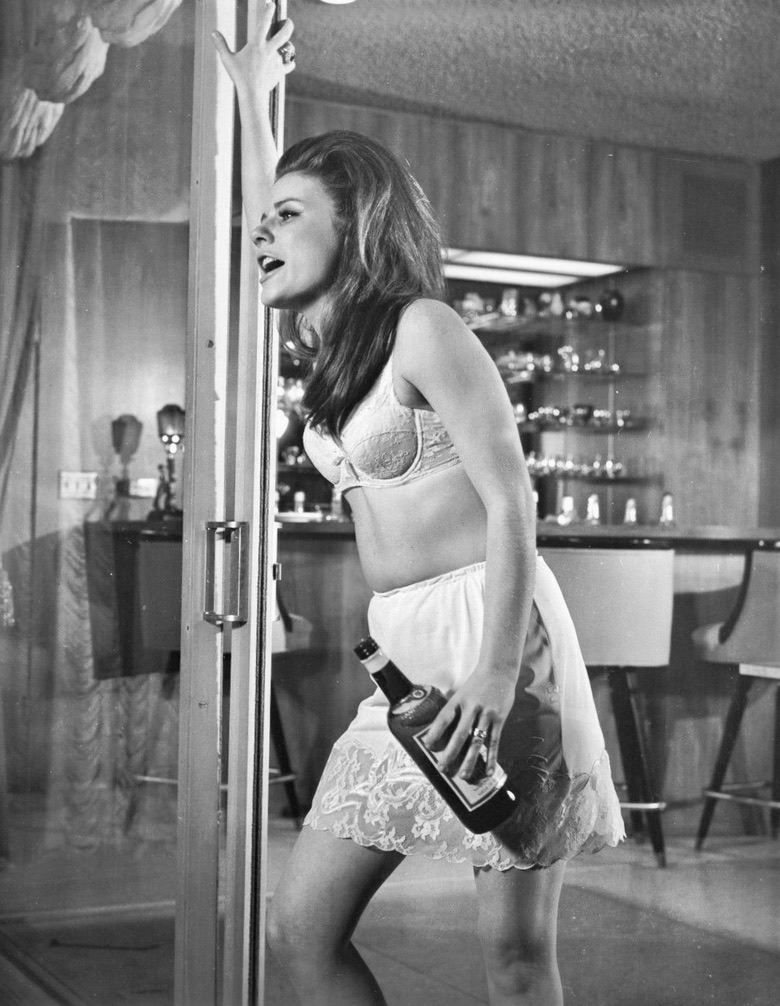
Lupino has just slammed the phone down when Franklin enters and informs her mother that she wishes Murphy would call or come home... because she's pregnant with his child! A distraught Lupino realizes that she doesn't even have Murphy's number to call him back. And Franklin is keeping the baby. (I do wish that Franklin would have stood in a way that put one crystal bottle stopper over each boob, just to make this movie even hootier - hooterier? - than it is!)
Murphy doesn't even know about the upcoming bundle of joy, but has decided that he's going to go to work on clearing his name, no matter the risk or cost. He writes a letter to Franklin (in care of her mother since she'll intercept in no matter what) explaining his plans and lets his landlady know of his intentions, too.
Problem is, the lovesick youth walks right out into the street in front of a passing car and is mowed down and killed...! The landlady picks up the letter and calls the addressee (with help from an operator) to inform her of Murphy's death.
Lupino must now tell a shell-shocked and very pregnant Franklin that Murphy is truly gone for good...
The letters from all three authors are seen making their way through the U.S. Postal Service. Now, you know they aren't going to allow us to believe that any mail was misplaced or mishandled, despite the existence of a "dead letter office" that was probably packed to the rafters...
No. Here we get DISASTER! A plane carrying sacks of mail crashes in the mountains, exploding the craft, but sending one full bag of letters careening off to the side of the explosion.
About a year later, a pair of mountain climbing hikers stumbles upon the wreckage and the long-lost mail. (I guess when the plane crashed, presumably killing to pilot or pilots, no one bothered to look around the scene at all then?)
Thus, here comes Jones the postman with these delayed missives, each of which must be signed for by the addressee thanks to their "special circumstances." First he shows up at Forsythe's home, where the businessman - now safely ensconced back in his wife Powell's good graces - tries to intercept the letter he wrote himself a year ago and believed gone.
There's no swaying Jones, though, so Powell is handed a year-old letter in which her husband wrote that he was leaving her for another, younger, woman...! What will happen now?
One sort of gets the idea that Forsythe was only capable of so many colors in his acting. This persona is awfully close to the one he demonstrated in
Madame X (1966) a few years earlier (his last name is even Anderson again!) and not so far afield from his later Blake Carrington, though I guess he did run something of a gamut of emotions on
Dynasty.
Though she was but forty-four at this point, Powell just somehow seems older since she began in movies as a very young girl. She would practically recede from view in the mid-'70s, only to pop up on Spelling's
The Love Boat and
Fantasy Island along with a recurring part on
Growing Pains and a series of successful Polident commercials.
In the second storyline, we find Nielsen fully ensconced at the mansion he inherited from his marriage to the late Ms. Stanwyck. He's busy on the phone with his agent, refusing to play Carnegie hall again unless he gets a European tour first.
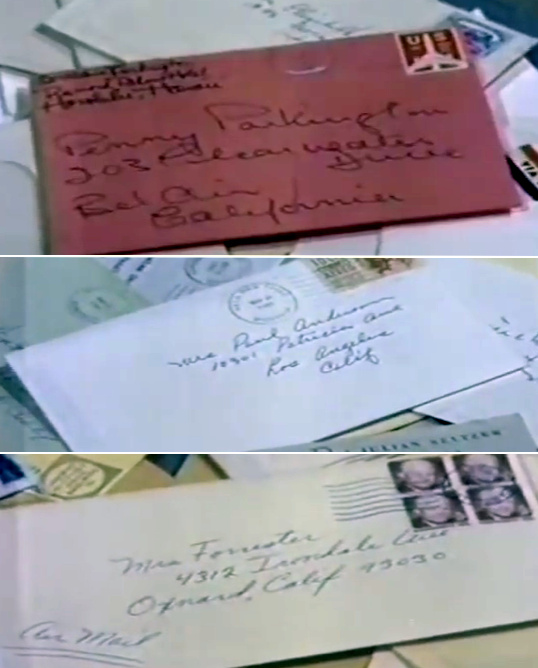
Meanwhile, the letter Stanwyck wrote to her sister Merrill is finally delivered to her by Jones. (Her character's amusingly upper crust name in this, by the way, is "Penelope Parkington!")
Merrill now wears her hair curled under, rather than flipped out, but retains an 8x10 glossy of Nielsen in her compar- atively modest apartment living room.
After reading its contents, she heads over to her old digs and confronts Nielsen with its contents. It seems that Stanwyck, even before Nielsen got her drunk and did her in, had suspicions about him and his motives and wrote them all down for her little sister...
How does it all wind up for shifty Nielsen and the put-upon Merrill?
Finally, Lupino is shown with the newborn baby girl of Franklin's. The cranky li'l tyke is all but ignored by her mother, leaving Lupino to be not only the granny to it, but the mommy as well!

Lupino tries to break through to Franklin how much the baby needs the attention of its mother, but the words fall on deaf ears. Franklin cannot completely accept the baby because she feels that her father didn't really love her and the child is a bitter reminder of this...
(Franklin, who was a fairly ubiquitous presence during the 1960s & '70s, abruptly retired from the screen in 1981 at age forty-one and never acted on TV or in the movies again! She had also done
The Love Boat &
Fantasy Island tour of duty and her last role was on Spelling's
Vega$.)
Just then the letter from Murphy arrives and Lupino reads it with keen interest and pointed emotion. In my estimation Lupino has the most demanding role in this TV-movie and handles it with alomb and skill. In real life, she had become an accomplished director, though she would wind up her movie days with low-rent screamers like
The Devil's Rain (1975) and
The Food of the Gods (1976), her final TV role coming with Spelling's
Charlie's Angels as a reclusive movie queen.
Jones wraps things up with an address to viewers, presumably the format that would have been present had the concept wound up going to series.
Fifteen years earlier, these stars would have been able to work in or even carry a feature film of their own, but as time goes by, "best if sold by" dates tend to creep in for most performers. One reason I adore TV-movies like these is the fact that they utilize stars we once knew and loved for earlier projects and they allow them to shine again, if perhaps in a dimmer spotlight.

As mentioned previously, Miss Barbara Stanwyck was costumed elegantly and rather dazzlingly in this TV appearance. The reason for it is that she had developed a working relationship with one Nolan Miller, who'd assisted with clothing on
The Big Valley in the late-1960s.
She used him in her two prior telefilms
The House That Would Not Die (1970) and
A Taste of Evil (1971) and he was the resident designer on
Charlie's Angels when she guested there and later on
Dynasty and
The Colbys, where he kept her dressed to the nines prior to her sudden retirement in 1986.
Less fortunate, though she still looked pretty great throughout, was Miss Dina Merrill. In this scene, she wears a burgundy velvet skirt and vest combo with a vivid pink blouse. Something about this look was just niggling at me mercilessly. Finally, I was able to ascertain why....
Two years prior, albeit with a different blouse, Kim Hunter wore this very same get-up in
Escape from the Planet of the Apes!!! You can bet your ass that the heiress to the Post cereal and E.F. Hutton brokerage firm fortune had no clue during
The Letters that one of her costumes had previously been sported by a chimpanzee!! And there you have one of our most amusing Designer Double-Dips yet...! (
The Letters can be viewed
here.)