For whatever reason, TCM has been digging up some rather obscure feature films lately, allowing a new generation to see movies that would otherwise be either forgotten or more than a little faded in the memory. This is wonderful news to me as I always enjoy checking out a flick that I've either heard of, but thought I'd never see or, better yet, one I've never even heard of! Such was the case with today's featured film,
Look in Any Window, released in 1961.
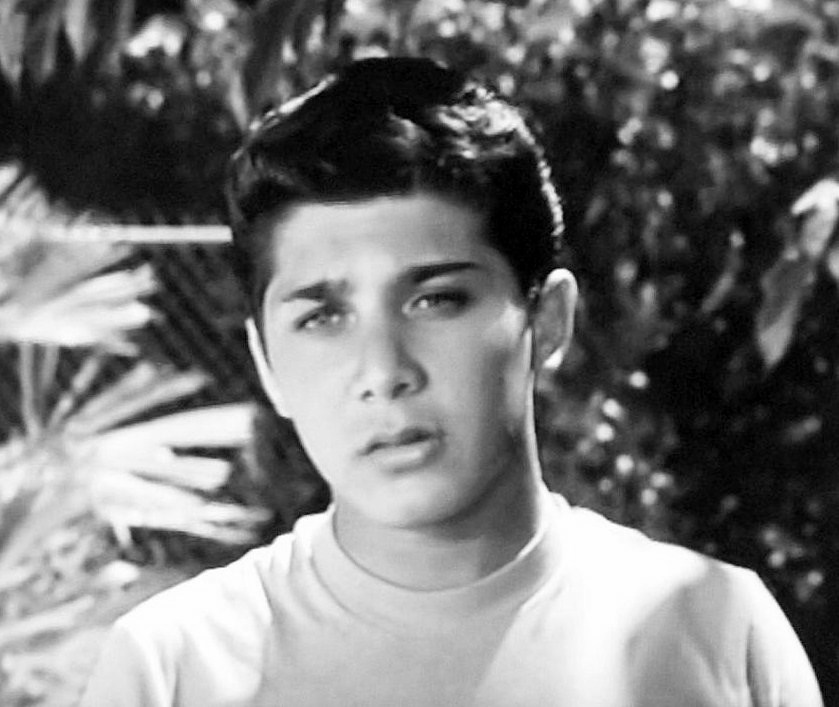
Window was the first and only time that teen singing sensation Paul Anka received top-billing in a movie. In it, he plays the tormented young son of a dysfunctional couple whose percolating frustration causes him to act out in his neighborhood. He makes anonymous calls, prowls through people shrubbery to look into their windows and climbs their roofs in order to spy on them when they're swimming.
There's quite a bit to see, too, since the neighborhood is like an episode of
Leave it to Beaver on Ecstasy. (As you'll soon see, every other lobby card, poster or promotional photo features a couple in a climactic clinch!) Anka's mother, Ruth Roman, is a warm-blooded feline who's desperately disappointed in her alcoholic husband Alex Nicol. Nicol has just lost his middling job as an aircraft engineer and can hardly stay sober for a few minutes at a time. Roman is left wanting in the love department when he passes out at first base, so she eventually sets her sites elsewhere.


Their neighbors next door (the wife of whom is apparently Roman's friend, but with friends like these...) are no better off. Jack Cassidy and Carole Mathews are the figurative “Joneses” who everyone is trying to catch up with. He's a slick car salesman with a fondness for gambling and womanizing while she is a deeply regretful former diving champion who is only with Cassidy in order to provide stability (of a sort) for their daughter. The daughter, Gigi Perreau, struggles with being a good girl in a bad girl world. Like a moth to a flame, she flirts with danger, though she knows she shouldn't. As shown above and elsewhere, there are plenty of swimsuits in this movie. They're even given credit at the start as being from Rose Marie Reid (a task she provided for other projects including 1964's
Muscle Beach Party.)

Another neighbor is newly-relocated George Dolenz, an Austro-Hungarian widower who is awaiting the arrival of his two teen children and in the meantime has managed to catch the eye of the lonely and neglected Mathews. He's first seen swimming in a pair of clam-diggers, his suit apparently not having made the trip to sunny California yet.
With reports of a prowler haunting the area, two police detectives are called in to investigate and to stake out the streets until they find the culprit. They have their own set of issues with one (Robert Sampson) a relative newcomer who tries to apply his psychology training to the case while the other is a hardened veteran (Dan Grayam) who believes in roughing suspects up first and then determining guilt later.
At one point, the young one asks the vet about his wife, to which he responds that he's never been married, but has spent nineteen years on the force. He then proceeds to pull out his gun, puff on it with his breath and polish it!! Whatever works for you, bud.
Nicol, who really was almost seven years older than Roman, somehow looks younger than her in this movie, even with his drunken and disheveled appearance! He's also quite tan for someone whose supposed to have been in Alaska for a month. At one point, he is on the floor crying about the loss of his job and does a slow rise, coming eyeball to eyeball with Roman's bullet breasts. (Naturally, this fleeting moment was placed in at least one of the sizzling advertisements for the movie.)
Once he collapses, she goes outside to water the lawn and spies Cassidy pulling out of his driveway after a nasty argument with his wife Mathews. In one of many hysterically campy moments in the film, he pulls up alongside her and she drops the hose without even bothering to turn it off, gets inside the car and they begin devouring each other right there in the street! He pulls out of the subdivision for a jaunt to Las Vegas and still her hose is running!
Mathews, who has hurled all of her diving trophies to the floor in a fit of angst, goes out back to her pool and begins to dive away some of her heartache. New neighbor Dolenz comes by and persuades her to come to his place next door for coffee and chocolate cake. He's not even really moved in, with just boxes, suitcases and some stray objects sprinkled about, but this two-layer chocolate cake was allegedly baked by his daughter back east and delivered (in showroom-like condition) to him in California!
Before long, Mathews begins to feel the heat between her and this widower (who emphasizes that his wife has been dead for a year, the implication being that he hasn't gotten his rocks off in at least that long himself!) They start to make out, but she can't bring herself to give in all the way (the way her husband and her best friend can and did!)
It's giving nothing away to say that Anka is the prowler (his last name is even Fowler in the movie!) because that fact is shown in the opening credits. He sings the title tune as well, though I would have sworn on my life that it was a female vocalist! For some of his antics, he dons a truly creepy false face that resembles a cross between Eric Stoltz in
Mask and Rondo Hatton (shown below.)
By today's standards, much of what he does is tame, though its true that most of us would not want someone perched in our landscaping, watching us watch TV (thus a voyeur watching another voyeur living vicariously through the folks on the boob tube – and if we're watching this movie, it's a three-fer!) Then again, today, most of us tend to keep our blinds drawn. Much is made in
Window about how the new-era houses of the time have big picture windows, making it easier for creeps to snoop. This shot of Anka, by the way, is not present in the final cut (I don't believe!)
Anka does cross the line at one point when he goes to Perreau's house late at night while she's swimming. True, they are friends, but he shows up uninvited (thankfully in a pair of painted-on trunks) and tipsy from swilling several sips of his dad's unfinished drink.
It starts out playful, with the teens splashing around in the pool, then turns flirtatious, with the kids pouncing onto a round, trampoline-like pool chair. Here, we get a great glimpse of Anka's round, wet, rather eye-popping bubble butt.
The kids begin to kiss and snuggle, but soon Perreau feels like it's going to far and she attempts to evacuate. Unfortunately, in her haste she takes a leap onto and into a glass side table, which shatters into a hundred pieces and manages to knock her unconscious! The sound of its crashing brings forth the neighbors and the police detectives. Surprisingly enough, semi-understanding Perreau decides not to finger Anka as the cause of her accident.
The next morning, Cassidy has come back from Vegas, Perreau is bandaged up and recovering from her accident and Mathews is trying to decide how to proceed with her shambles of marriage. The police come into their house to try to question Perreau, but she begs off. Scenes like this one offer a great glimpse into the décor and furnishings of houses of this era with the cast framed within the kitchen “pass-through.”
Meanwhile, a moderately remorseful (very moderate!) Roman tries to cheer up Anka with breakfast in bed. He's reclined on his bed wearing only some tiny shorts. It must be said that at this stage, Anka was a complete babe, with beautiful skin, soulful eyes, pouty lips and a magnificent crop of thick, dark hair.
He's miffed at her for having gone off with Cassidy (though the only proof he ever had was that he came home to find the garden hose still running.) She tries to get through to him to little avail, but can't help but notice scratches on his back. He says it's from a trampoline, but of course the marks are from Perreau. As she dabs him with peroxide, we are afforded yet another look at Anka in his prime.
One good shot deserves another I say!:
And another (the same, but in color!):

Remarkably, even though Cassidy and Roman have spent the night in Vegas together, Nicol has been passed out since the evening before, Mathews has been canoodling with Dolenz and Perreau was presumably attacked by the local pervert, Cassidy and Mathews decide to proceed with their annual Fourth of July pool party! The policemen ask if they can attend as well in street clothes.

Here, things heat up further with Cassidy not even bothering to hide his attraction to Roman. They cha-cha and sashay all over the patio, finally coming to rest around the corner where they embrace passionately. Dig their cute little his and her adultery outfits. Mr. Cassidy has pantylines from hell here in his clingy trunks. Though he certainly isn't “fat,” slender even, he has a pooch below the belt-line that isn't covered up by most of the clothes he's given to wear. I always think of a line George says in Who's Afraid of Virginia Woolf? about having not gained weight during his marriage except for a slight distension below the waist.
When Nicol arrives, already loaded for bear, but drinking more and more, Cassidy and Roman not only do not hide their love-making, but the slightly sadistic Cassidy spins her around to be certain Nicol sees them. Then they even plop into the pool together and start kissing in front of God and everybody!
Nicol passes out completely in a lounge chair and the other revelers pick it up with him on it and stage a mock Viking burial at sea, complete with dirge and torches! (What is it with 1960s movies – such at
The Chase, for one – that depict such uniformly unfeeling, unsympathetic people in them?) They lower him further and further into the pool until he's shaken back into consciousness. In a scenario that is long since gone, I'm afraid, one of the neighborhood men is dressed in tiny, clingy trunks.
All this debauchery sets Anka off again and he departs the party, dons his mask and sets out to wreak more havoc. Everything comes to a head with Nicol and Cassidy brawling, Anka running on (and jumping from) roofs and a bedraggled Roman chasing after him, having realized that it's her troubled son who is the peeping Tom.
Roman, who has been coiffed and powdered carefully throughout the entire film, is suddenly shown at her lowest ebb. Her hair is a ratty mess and her mouth has a smear of blood at the side. This is apparently effective punishment for her misdeeds and we're left to believe that she, Anka and Nicol will somehow work out their considerable difficulties together.

The director of this film, William Alland (seen here with
Roman and the humpy Anka in a shot of his li'l swimsuit that is sadly absent from the movie!), had never directed anything before and never directed another film after despite demonstrating more than a few clever touches in
Look in Any Window. An actor in the 1940s, he turned to writing in the 1950s and spent the late-'50s and early-'60s producing. His chief contributions as a producer were the three
Creature from the Black Lagoon films, with his final movie being 1966's
The Rare Breed with James Stewart and Maureen O'Hara. He died in 1997 of heart disease at the age of eighty-one.
As I've tried to make clear throughout this post, Anka is a doll baby in this movie (and diminutive at 5' 6”.) Born in Canada, he began singing at age twelve, but unlike so many other young music idols he composed the bulk of his output. His 1958 hit Diana was a huge success and most folks are familiar with Put your Head on My Shoulder as well. Faced with The British Invasion in the world of music, he segued to adult contemporary music and ultimately found even greater success as a songwriter, penning Tom Jones' She's a Lady and the lyrics for Frank Sinatra's immortal My Way.

Married in 1963 to a Lebanese model, the couple had five daughters (Amelia, Anthea, Alicia, Amanda and Alexandria.) They divorced in 2000 and in 2008 he married again to his personal trainer (twenty-nine years his junior!) who bore him a son, Ethan. That married only lasted two years. The wondrous hair is long gone and the creamy skin is now toughened, but he still performs at age seventy and has composed hundreds of songs. His daughter Amanda has been a working actress for years and is the wife of Jason Bateman, making for interesting Thanksgivings and Christmases I'm sure!
Roman had costarred with Kirk Douglas in 1949's
Champion and with Farley Granger in the 1951 Alfred Hitchcock classic
Strangers on a Train, followed by other movies. By 1961, she and her young son had managed to survive the maritime disaster of the Andrea Doria, but her film career was approaching a halt. She wasn't even forty when
Window was made, which seems unreal to me now. Following this, she would keep busy on television, but did have a featured role in the colorful camp spectacular
Love Has Many Faces, paying Hugh O'Brian for sex in Acapulco. Her last roles included a stint on
Knots Landing and a recurring part on
Murder, She Wrote.
In
Window, she sometimes resembles her onetime costar (in 1950's
Three Secrets) Eleanor Parker (though her husky, baritone voice and distinctive accent could never be confused with Parker's.) Compare Roman in this shot from
Window to Parker in 1959's
A Hole in the Head (below)! Married three times, the third marriage in 1976 lasted until her death in 1999. Though she was seventy-six, young-ish by today's standards, she died in her sleep of natural causes.
Nicol was a Broadway actor who made the transition to films, his most notable role coming as the villain in James Stewart's
The Man from Laramie in 1955. At the time of
Window, he'd been doing some foreign-made films and trying his hand at directing. In the coming years, he would direct episodes of
Tarzan (the Ron Ely version) and
The Wild Wild West. Departing the biz in 1976, he lived until 2001 when he, like costar Roman, died of natural causes at age eighty-five. He'd been married to the same woman since 1948 and they had two sons and a daughter together.
Perreau was born to a French father (who'd fled the country at the outset of WWII) and an American mother who gave her the more than considerable name of Ghislaine Elizabeth Marie Thérèse Perreau-Saussine. I can't fathom why it was shortened when she began her screen career... Bilingual as a toddler, she was picked to play Greer Garson's daughter in
Madame Curie in 1943. She emerged as a highly effective child actress, but, like so many before (and after) her, she found difficulty transitioning to adult parts. She kept busy on TV during the 1960s, but finally segued to the stage and to teaching in the mid-'70s. Married and divorced twice, she had two children with each husband. Now seventy-one, she has been doing voice work in films and even had an on-screen role in an independent movie in 2011.
Mathews had toiled in films as a dancer and bit player from the late 1930s, graduating to featured parts in the mid-'40s. Never what one might term a “star,” she nonetheless kept busy as a working actress. Her deep voice and high-cheekboned face recalled Ann Sheridan to a point. By 1961, she'd done a healthy number of TV guest spots and even had a semi-regular role on the San Francisco-set western
The Californians (1958-1959.) She would make a few more movie and TV appearances before retiring in the late '60s. If imdb.com is to be believed, she is still alive today at age ninety-one.
Dolenz (of Slovene descent, but born in Austria-Hungary) started out as an early-'40s bit player before graduating briefly to leading man status and then to supporting roles in films such as
My Cousin Rachel (1952) and
The Last Time I Saw Paris (1954.) Married since 1943 to former actress Janelle Johnson, he died not long after Window in 1963 from a heart attack at only age fifty-five. As a result, he never lived to see one of their four children, Mickey Dolenz, experience a meteoric sensation as one of
The Monkees in 1966! That's Mickey below.
Cassidy has a major part in this film, but since this was his film debut he had to settle for seventh billing. Prior to this, he'd experienced several hits (and a few misses) on Broadway and worked on several television programs. Married from 1948 to 1956 to Evelyn Ward, they had a son (and his own lookalike) David Cassidy of
The Partridge Family, meaning that both he and Dolenz had sons who grew up to be major 1960s and '70s music and TV idols. Latter day David is shown below.
In '56, Cassidy married Shirley Jones who bore him three more sons. Though he would continue to make television and film appearances, he also kept at it on Broadway, earning four Tony nominations for his performances in musicals, winning once for 1964's She Loves me. He and Jones divorced in 1974 and two years later he died rather horrifically at the age of only forty-nine in a fire at home.
Sampson enjoyed a fifty year-long career as a useful supporting actor in dozens of TV shows and movies. Grayam, on the other hand, had made his debut here and was finished in the business completely by the following year after just two TV guest roles.

Campy to be sure (and rife with snappy dialogue that brings a smile to one's face), this little drama also brings to light some interesting ideas about what's important to us. Is it really worth it to work like dogs to have the latest car, stereo console or in-ground swimming pool when none of those things can bring true happiness? It certainly never helped most of the people in this story. What's really fun about it, though, apart from an interesting cast of players, is the chance to see young Paul Anka really try his hand at acting (and though he's no Laurence Olivier, he's also no Tony Bennett! See The Oscar for that debacle...) It also helps that he's frequently unclothed! And what a coinky-dink that I'm putting this Fourth of July-set movie up on the evening before. If you (presumably U.S. readers only) celebrate this day, make it a safe, but fun one!

 I recall Joan Rivers saying something like that from time to time on her outrageous awards show fashion re-caps on E! This post is unrelated to that, but has a similar trajectory to it. I'm a big fan of Richard Lamparski's series of books, "Whatever Became Of...?" in which he visited nearly (or almost completely!) forgotten celebrities and caught up with them. He'd ask about their careers, what they've been up to since the spotlight faded and then provide a current (often shocking, to be honest) photo of said persona. He usually also asked if the celebrity in question had any unpleasant memories of their time in La La Land (such as when diminutive Mexican comic actor Pedro Gonzalez-Gonzalez recalled missing the chance to play a regular role - a gardener - on the 1960 sitcom Pete and Gladys when costar Cara Williams vetoed it or when Danny Kaye deliberately sidelined him away from the camera during a number on his variety show.) We're merely relying on their side of the story, of course, but if something stood out to the point where they still feel the bitterness decades later, perhaps there is at least a kernel of truth to be found in what they are recalling. And after all the time in-between, they often felt no need to remain silent about it. So, in an effort to get another post up, I have sifted through one of
these books (the 11th one in the series) to excavate some tidbits of
testiness to be found among the participants. I don't know why I find it
amusing when stars reveal their animosity for each other, but I do!
I recall Joan Rivers saying something like that from time to time on her outrageous awards show fashion re-caps on E! This post is unrelated to that, but has a similar trajectory to it. I'm a big fan of Richard Lamparski's series of books, "Whatever Became Of...?" in which he visited nearly (or almost completely!) forgotten celebrities and caught up with them. He'd ask about their careers, what they've been up to since the spotlight faded and then provide a current (often shocking, to be honest) photo of said persona. He usually also asked if the celebrity in question had any unpleasant memories of their time in La La Land (such as when diminutive Mexican comic actor Pedro Gonzalez-Gonzalez recalled missing the chance to play a regular role - a gardener - on the 1960 sitcom Pete and Gladys when costar Cara Williams vetoed it or when Danny Kaye deliberately sidelined him away from the camera during a number on his variety show.) We're merely relying on their side of the story, of course, but if something stood out to the point where they still feel the bitterness decades later, perhaps there is at least a kernel of truth to be found in what they are recalling. And after all the time in-between, they often felt no need to remain silent about it. So, in an effort to get another post up, I have sifted through one of
these books (the 11th one in the series) to excavate some tidbits of
testiness to be found among the participants. I don't know why I find it
amusing when stars reveal their animosity for each other, but I do!