Showing posts with label Shirley MacLaine. Show all posts

Friday, May 10, 2024

Reunited: "Turning" to "Steel!"

Considering how impactful the movie (and its parent play) Steel Magnolias (1989) has been on my life, it's remarkable that I've really referred to it or written about it precious little here in Poseidon's Underworld. But it you come here much, you know I most often dig up buried "treasure" versus focusing on projects that everyone already is more than familiar with. I did dig something up, which I'll share in a bit, though it's debatable how close to treasure it is! First, though, I'll mention my recent trip to the cinema in order to attend the 35th anniversary screening of the movie (a 4K video release has also made its way onto the market.) A close, longtime friend of mine suggested that we take it in and we enjoyed great, comfortable seats for what was an expansive view of the picture. This allowed me to see all sorts of little details in the background (or elsewhere) that I have missed over the years, especially those cropped VHS ones! Steel Magnolias was the very first DVD I purchased and was the reason I made the leap to DVDs from my VCR. It's because it contained deleted scenes and I just HAD to see those asap. Would you believe I'm so blond that after decades now of owning the disc, I only found out the other evening that there was a second "page" of excised scenes that I had heretofore not watched!! How do I make through each day, I ask you... Anyway, the movie was a visual delight from start to finish and still packs an emotional punch, too, amid all the hilarious moments. Trivia tidbit: The photo shown above right (which seemingly every community theatre group in the country has aped ever since when promoting their renditions of the play) has a secret. Olympia Dukakis wasn't there...! She couldn't attend the shoot, so Shirley MacLaine had to cling to a body double and, later, the real star's face was pasted in.

In the film, Shirley MacLaine and Tom Skerritt play warring neighbors. There's a dispute over ownership of a magnolia tree, compounded by Skerritt's endless antagonizing of her hyper-sensitive yet nonetheless rambunctious St. Bernard.

While she's reached an age when she no longer cares to hold her tongue nor filter her thoughts for those around her, she considers him horrendously uncouth in his own right. As he needles her for a piece of groom's cake at his daughter's wedding, the irascible MacLaine hacks off a large portion of the armadillo-shaped cake's tail end!

Taking the grey-iced piece of red velvet cake with tail attached, he lets her know he always did like a nice "piece of ass!" Of course, we all know that even amid their considerable differences, there is buried affection there. I always enjoy a later, brief, moment when, at his daughter's funeral, she walks by him and gives him a knock along his shoulder. It's the closest she was ever going to get to a hug with him, and it's understood.

Somehow out of the blue it occurred to me during this most recent screening that Skerritt and MacLaine were well-acquainted from a prior project. In fact, the same director Herbert Ross, was at the helm for both movies. Seen here, the two played a married couple in The Turning Point (1977), about a dozen years before sparring in Magnolias.

As Skerritt and Sally Field fretted over their daughter with the long, auburn hair in Magnolias, Skerritt and MacLaine had their own child whose future was very much in the forefront of their minds in Point.

I saw The Turning Point in the theater when I was ten (!), so most of its dramatic weight likely sailed right over my head. So revisiting after watching the more familiar Magnolias, it's fun to observe these two as a devoted couple versus portraying feuding cranks.

Drum and Ouiser as an intimate married couple.

The characters both play retired ballet dancers and it was intriguing to watch them discuss the fact that she felt that having his baby would prove to the world that he wasn't gay -- only to have him announce that he also needed to prove this, to himself!

Get a load of the way director Ross blocked this moment in the movie...! Both my pal and I noticed the use of mirrors as we re-watched Magnolias at the screening, but there was nothing on the level of this shot!

Regardless of the animosity they demonstrated in Magnolias, Skerritt and MacLaine were good friends and she was elated to be reunited with him on Donahue during a publicity appearance for the film with all the ladies except Darryl Hannah. (The perennially shy Hannah refused to come and face a live crowd or answer their probing and sometimes inappropriate questions.)

Those familiar with the movie will recall the climactic scene at the grave site in which Field finally suffers an emotional breakdown after having held it together for the longest time.

Her friends are powerless in the face of all this unbridled rage and confusion.

In an effort to release the tension, Dukakis puts forth MacLaine as a potential punching bag for Field to use as a stress reliever! A small scuffle breaks out. Interestingly, this "laughter through tears" moment (from the play) was not unfamiliar to director Ross.

In The Turning Point, the story climaxes with a blistering argument between MacLaine and her longtime frenemy Ann Bancroft, culminating in a wild cat fight. But, finally, after kneeing, clawing and even spanking one another, the two women dissolve into laughter.

Bancroft even borrows MacLaine's comb in order to try to repair some of the damage. ("I don't know how you're doin' on the inside, but your hair's holdin' up beautifully...")

The Turning Point was nominated for 11 Academy Awards, but was left empty-handed at the end of the evening. (Is that about the worst conceivable rendering of MacLaine imaginable?!)

Magnolias landed but ONE nomination (for Julia Roberts, who lost to Brenda Fricker in My Left Foot.) One might have thought at minimum that it's deliberately tacky production design and art direction might have been nominated, not to mention the unforgettable music by Georges Delerue. Regardless of what any of the ladies said to the press or to interviewers, filming was for the most part a horrible nightmare thanks to the taciturn, cruel, demanding behavior of director Ross, who was acting out after the recent death of his wife and lost a lot of his prestige as a result. But the finished product doesn't betray this, with the actresses delivering memorable performances.

I mentioned earlier how so many community theatre groups aped the famous shot of the six actresses embracing in a row. When I directed the show in 1988, I eschewed that concept (because otherwise how else could I get my own fat face into the shots!? Ha ha!) This photo was taken at an early dress rehearsal before the set decor was applied and without all of the makeup and hair details being done. The ladies were DYNAMITE and at the time set a record for the number of local awards won for that small, less-prominent theatre troupe. Three of them won acting certificates and the ensemble won as a whole (which went to me.)

I also told you at the beginning of this post that I'd done a little digging... Who among you remembers this?!?! I had to have either forgotten about it entirely or blocked it out of my mind like some traumatic event. It was a 1990 television pilot for a half-hour series of Steel Magnolias. It aired once on CBS and was rarely seen again. (Are you seriously telling me that this is the headstone that the Eatentons and her lawyer husband installed for Shelby?!?!)

The program hasn't even gotten underway before the horror begins. Having been told that his mother is in the nearby grave, her toddler son Jack Jr exclaims, "Then dig her up...!" This dour, misguided retread was written by the same author as the play and the movie, but it did not sell as a series.


Even realizing that the video quality of the YT upload is substandard and that it surely looked better than this upon airing, it's still a gauzy, dimly-lit fiasco with recycled humor and situations. She might look the part all right, but Kirland is too New York for this role and her deep voice and lack of effervescence lies in start contrast to the inimitable Dolly Parton.

Likewise, Bergen and Stritch seem like solid casting, but I could only roll my eyes when Stritch handed Bergen a magazine about cosmetic surgery and suggesting that maybe she try it when Bergen has clearly already undergone eye work and probably several other things...!

In this version, M'Lynn wasn't a mental health counselor, but instead worked at a brewery called Shotz. (I'm kidding... that's a lame Laverne & Shirley joke. Actually, Ms. Williams was trying, and wasn't bad, but this was mostly a non-starter no matter what.) You can watch it and see what you think right here.

One of the more fascinating trivia tidbits was in the casting of the soon-to-be new Mrs. Jackson Latcherie. (In real life, Susan Harling's - the basis for Shelby - widower remarried within a year of her death.) This new character was played by Dana Morosini. Her own life would play out at or beyond the level of the story behind Magnolias.

Already by that time, she was the girlfriend of handsome Christopher Reeve. They would wed in 1992 after she became pregnant with their son. In 1995, Reeve suffered the accident that would paralyze him until his death in 2004 at 52. Dana Reeve passed away of lung cancer (attributed to secondhand smoke from her singing career in nightclubs) at 44 in 2006. It was a tragedy worthy of a movie in its own right! Their legacy lives on, though, through the Christopher and Dana Reeve Foundation, which seeks cures and treatments for neurological disorders. 

And that brings down the curtain on this post!

Saturday, February 18, 2017

Fulfilling the Quote Quotient

This series of celebrity quotes (about themselves or others) has been popular, though I confess it's often a means of keeping something new up on the blog before or after more labor-intensive posts. These are comparatively easy to assemble, even though I always create a new picture montage to go with each blurb. You may or may not have noticed that these generally lean towards an alphabetical order, though sometimes for effect I will move one or two around. That's because I'm burning my way through a book on the subject. So as you'll see, we're still in the "M"s! That means I'm far from finished with this, though I hope you enjoy them nevertheless. On we go...!
"He has extraordinary instinct. He's almost infallible." - LEE REMICK on JACK LEMMON (costars in Days of Wine and Roses, 1962, and Tribute, 1980.)
"Lewis used to be one of my heroes. When I was a kid, I did pantomimes to his records. He was an enormously talented, phenomenally energetic man who used vulnerability very well. But through the years, I've seen him turn into this arrogant, sour, ceremonial, piously chauvinistic egomaniac. I'm just amazed at his behavior." - ELLIOTT GOULD on JERRY LEWIS
"I'm a multi-faceted, talented, wealthy, internationally famous genius. I have an IQ of 190-that's supposed to be a genius. People don't like that. My answer to all my critics is simple: I like me. I like what I've become. I'm proud of what I've achieved, and I don't really believe I've scratched the surface yet. - JERRY LEWIS
"Working with her was an education. She was an out and out 'pro'-no retakes for Maggie, no hint of temperament. She turned out to be a most down-to-earth lady with a delicious sense of irony, mostly directed at herself." - MICHAEL WILDING on MARGARET LOCKWOOD (costars in Dear Octopus, 1943, and Trent's Last Case, 1952.)
"Gina's personality is limited. She is good at playing a peasant, but is incapable of playing a lady. That said, I don't think she's positively mad about me. Because I'm bigger than she? It's possible. Who knows?" - SOPHIA LOREN on GINA LOLLOBRIGIDA
"I do not talk about Sophia. I do not wish to make for her publicity. She has a talent, but it is not such a big talent." - GINA LOLLOBRIGIDA on SOPHIA LOREN
"She is not the most attractive lady in the world at first glance but, my God, two seconds late you felt you were in a dream world. Just for her to say 'Hello' was enough. You just capitulated. For me she is the most beautiful person I've ever met." - STEPHEN BOYD on SOPHIA LOREN (costars in The Fall of the Roman Empire, 1964.)
"You could toss a bolt of fabric at Carole Lombard and however it would land on her she would look smart." - Costume designer TRAVIS BANTON on CAROLE LOMBARD
"She overwhelmed me completely. There was just something about her that I found uncannily wonderful...She was the only Hollywood legend I found totally accessible and felt I could shake hands with. The others, like Garbo and Hepburn, were polite and friendly, but somehow in the early 1940s, untouchable." - GENE KELLY on CAROLE LOMBARD
Then there was the question of Shelley's hair [during Hello Again, 1987]. We had to re-shoot the first ten days because it was wrong. All I can say about Shelley is that she is a perfectionist. - GABRIEL BYRNE on SHELLEY LONG
"It's unbelievable that anyone could work as hard as she does, be on her toes always, accomplish things with dispatch and efficiency, buck the exhausting nervous strain of stardom...Her charm is that she never tries too hard. She is what she is; her freckles are honest, and so is her appraisal of herself. What she possesses, she exploits. What she does not have, she does not claim. That's the nicest thing I can say about anyone." - WILLIAM POWELL on MYRNA LOY (costars in fourteen films together!)
"That silly horse, Jeanette MacDonald, yakking away at wooden-peg [Nelson] Eddy with all that glycerine running down her Max Factor." - JUDY GARLAND on JEANETTE MACDONALD
"We always had lots of laughs, and we've shared a few sorrows, too. But I'd never worked with her. I heard she was a tough nut. Terms of Endearment (1983) was an important movie, and the work was tough. But tough and interesting. And playing with Shirl-like in the love scenes, which are funny, but also touching-was great." JACK NICHOLSON on SHIRLEY MACLAINE
"She just behaved badly-like she was competing with me (on the set of Terms of Endearment, 1983.) I understand that Shirley grew up in a different era, when women had flesh under their fingernails from competing with one another, but I'm not like that. I was actually forever grateful when she won [the Oscar] because I thought that would shut her up for a while. Imagine my dismay when she just kept having 50th birthdays and doing interviews. Jack Nicholson called me up and said, 'Didn't we celebrate her 50th birthday in Texas?'" - DEBRA WINGER on SHIRLEY MACLAINE
"Dramatic art in her opinion is knowing how to fill a sweater." - BETTE DAVIS on JAYNE MANSFIELD

Friday, April 22, 2016

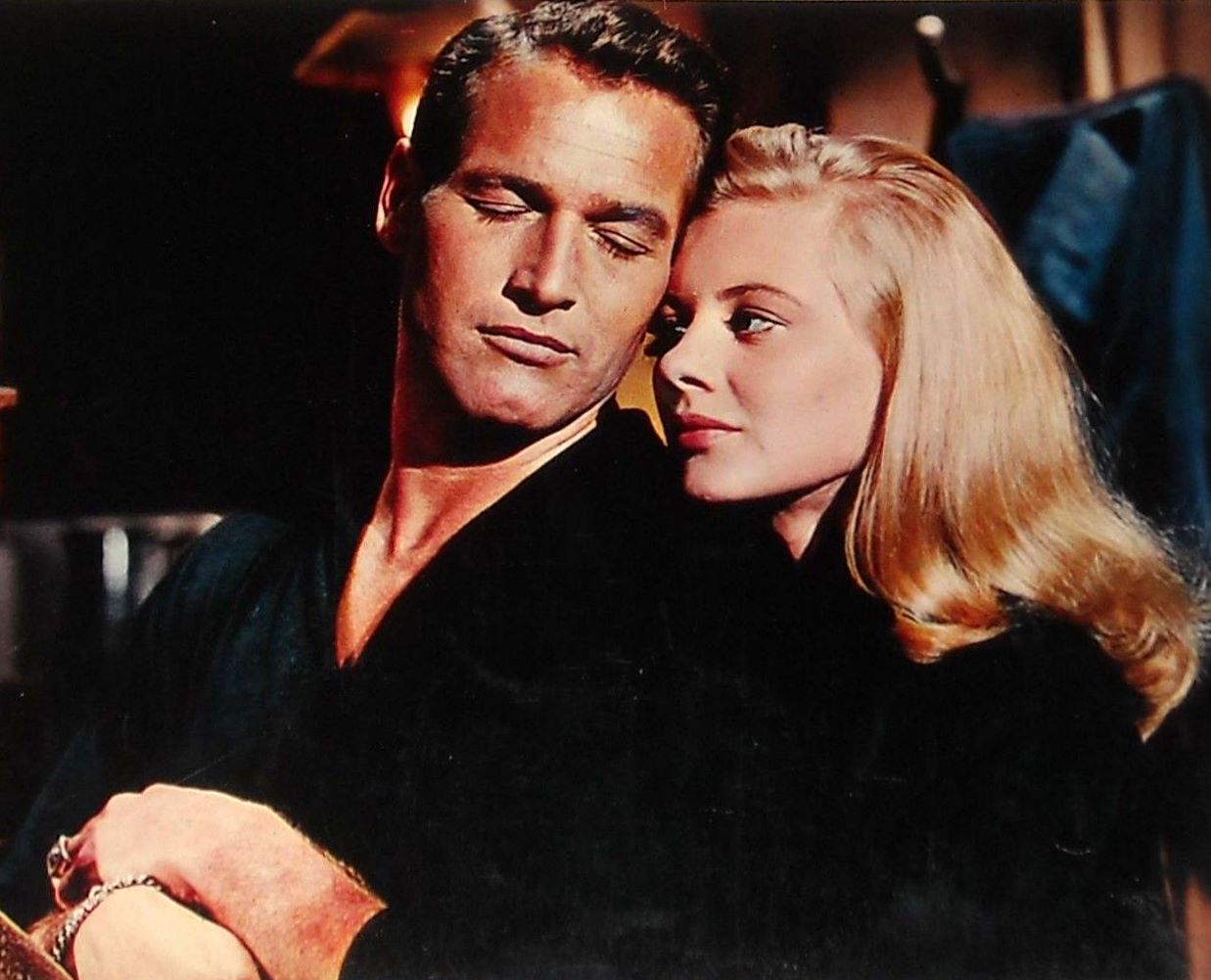
Aaahh... I Feel Like a Newman...

Surprise, surprise! Things have once again become overwhelming in The Underworld. Almost two weeks ago, one of our fellow employees was escorted off the premises by the police, not in handcuffs, mind you, but nevertheless dramatic. And guess who gets to do her job as well as my own?  That's right! So as I mire through the scads of work that keep pouring my way, I'm going to provide a photo essay, which is always a little easier than an in-depth written post. It's really shocking, when you think about how much I've babbled on here, that there has never been a tribute to Paul Newman, who is easily one of my favorite actors. I have included him in quite a few posts along the way, but today it's all his. I hope you like the pictures I'm sharing of Mr. Blue Eyes. And stay tuned near the end for a hooty Underworld Extra bonus photo!
Born on January 26th, 1925 in an upscale suburb of Cleveland, Ohio, Newman took an early interest in acting and performed in school plays from age seven on.
The world nearly lost Newman in 1945 at age twenty before he'd ever made his mark. As a radioman-tailgunner in U.S. Navy planes during WWII, his aircraft was prevented from joining others on a carrier due to the pilot's ear infection. A few days later the ship was the target of kamikaze attacks and the rest of his unit was decimated.
Newman, majoring in drama and economics, married first wife Jackie in 1949 and by 1951 was living in New York City attempting to act for a living. He worked in live TV to supplement his income, but landed a hit in 1953 when the Broadway play Picnic, with a can't miss cast, ran for well over a year.
Newman had been thisclose to winning the role of James Dean's brother in East of Eden (1955), but instead had to settle for a cinematic debut in The Silver Chalice (1954) opposite Pier Angeli and Virginia Mayo. His first (and last!) experience in a period epic was a huge disappointment to him and it was two years before he worked on the big screen again.
Loathing the material and feeling foolish in his togas (not to mentioned embarrassed by his legs which, in retrospect, really aren't bad!), he famously took out an ad years later apologizing for his performance in the film when it ran on television. Meanwhile, he continued to act on TV in many programs including a notable color, musical rendition of Our Town (1955) which also starred Frank Sinatra as The Stage Manager and Eva Marie Saint as Emily.
He also worked on Broadway again in the successful drama The Desperate Hours, which ran for half a year. Newman's return to the big screen was facilitated by the premature death of James Dean. He inherited Dean's role in the bio-pic of boxer Rocky Graziano, Somebody Up There Likes Me (1956), this time winning acclaim for his work.
Now underway in earnest with a film career, he could back off of television appearances as he appeared in a string of movies including The Rack (1956), The Helen Morgan Story (1957) and Until They Sail (1957.)
Big changes in his personal life were on the way as well. He ended his marriage to Jackie and wed Joanne Woodward, who'd been in Picnic with him (as an understudy.) The two proceeded to work together on many a film project - the first being The Long, Hot Summer (1958) - and were married until Newman's death fifty years later.
Another role he inherited from James Dean was The Left Handed Gun (1958) about western outlaw Billy the Kid.
A huge career stride came, however, with the movie Cat on a Hot Tin Roof (1958) in which he played an alcoholic ex-football player mourning the death of his best friend and anticipating the death of his overbearing father.
Complicating things further was his wife (Elizabeth Taylor) who wanted to have his baby, but was getting nowhere. The story, wrought from the Broadway play, danced around a homosexual subtext due to the constrictions of the time. He earned an Oscar nomination for his work, though it went to David Niven for Separate Tables. To my mind, there has never been a more beautiful cinematic couple than Newman & Taylor. They are just gorgeous together.
In an entirely different direction, he also did the comedy Rally 'Round the Flags Boys in 1958, costarring Woodward, but also featuring their friend Joan Collins. Comedy and Newman were never very easy bedfellows and his were rarely big hits, but he did know how to cut loose and have fun on occasion such as in this drunken scene.
He may even have taught the saucy Collins a thing or two if this pose indicates anything!
In 1959 he did The Young Philadelphians, playing an aspiring lawyer. Here he gets the once over from older woman Alexis Smith.
And in this shot, she closes in for the kill. His real love interest in the movie, however, was played by Barbara Rush. In 1959. Newman went back to Broadway for a third success, this time in Sweet Bird of Youth, which ran for just under a year.
1960 brought the slick soaper From the Terrace, with Woodward, but also the epic Exodus, opposite his costar from Our Town Eva Marie Saint, all about the emergence of the country of Israel. Newman was half-Jewish by birth on his father's side.
To be perfectly honest, though I always found him attractive, Newman's body type is not the kind I am typically drawn to. I am unlike most people in that I don't really like to see the muscles through one's torso. Today that is the standard and anyone without it is labeled "fat," but I always felt like I was seeing someone's insides when I could make out every ripple. LOL!
Speaking of ripples and seeing things from the inside on the outside, Joanne seems to have discovered something in Paul's trunks here. I'm surprised this one made it to the cover of a magazine with no censoring or airbrushing!
1961 brought another key career role, that of Eddie Felson in The Hustler, a pool shark drama costarring Jackie Gleason and George C. Scott. For this, Newman was again Oscar-nominated, but the statuette went to Maximilian Schell for Judgement at Nuremberg.
His other film that year was Paris Blues, with wife Joanne as well as Sidney Poitier.
in 1962, he was permitted to recreate his stage role in Sweet Bird of Youth along with Geraldine Page, though his love interest, initially portrayed by Diana Hyland, was essayed in the film by our beloved Shirley Knight.
One more of his key roles, this one being one of the most iconic of his, was Hud (1962.) He played a man that he himself considered deplorable, yet audiences gravitated to him, many finding him sexy and some even considering him a role model of sorts! The Oscar went to his recent costar Sidney Poitier for Lilies of the Field.
One of the best things about The Prize (1963), a mystery involving the Nobel prize, was the sequence in which he had to infiltrate a meeting of nudists (!) and wore only a towel for a lengthy period of time. His other movie that year was the colorful romp A New Kind of Love, opposite Woodward.
1964's What a Way to Go had him appearing opposite Shirley MacLaine as one of her bevy of husbands, each one dying and leaving her a wealthy woman. His character was a modernistic painter living in Paris.
Unquestionably, my favorite part was when he and MacLaine took part in a romantic montage during which they lollygagged in a large bathtub, then a smaller bathtub, then a washtub before finally showering together!
His career continued to chug along with movies such as The Outrage (1964), in which he was a Mexican bandit and rapist, Lady L (1965) opposite Sophia Loren, and Harper (1966), with him portraying a rather down and out detective surrounded by an all-star cast. In 1964, he and Woodward headed to Broadway for the cat burglar comedy Baby Want a Kiss, which hinted with bisexuality, but it was only a qualified success at best.
He was selected, along with Julie Andrews, to star in Alfred Hitchcock's 50th film Torn Curtain (1966), but the movie and the pairing did not exactly elicit fireworks. Nevertheless, I like both of these two so much I still like to watch the movie every now and again.
After Hombre (1967), still another important role came with the prison comedy-drama Cool Hand Luke (1967.) I like this foreign poster art.
His role as the star-crossed prisoner and victim of circumstance landed him yet another Oscar nomination, but that year the award was won by Rod Steiger for In the Heat of the Night.
Newman continued starring in movies such as The Secret War of Harry Frigg (1968) and Winning (1969), but also directed Woodward in the acclaimed drama Rachel, Rachel (1968.) The movie was even nominated for Best Picture, but lost to Oliver!
Winning awakened in him a love of car racing and he continued to get behind the wheel for many a risky competition, much to his wife's dismay.
In 1969, he paired up with Robert Redford for the blockbuster Butch Cassidy and the Sundance Kid. It was a monumental success that put him into the top tier of movies stars of the time.
With some less successful/memorable movies in-between such as WUSA (1970), Sometimes a Great Notion (1970), Pocket Money (1972), The Life and Times of Judge Roy Bean (1972) and The Mackintosh Man (1973), Newman and Redford teamed up again for another smash hit, The Sting (1973.)
Thus Newman was a top box office draw when he was selected to star in Irwin Allen's mammoth production of The Towering Inferno (1974), the story of a fire in the world's tallest building which required the historic cooperation of two major studios in order to be made. Costarring with him - with staggered billing and the same number of lines down to the sentence - was Steve McQueen, who'd once had a bit role in Newman's Somebody Up There Likes Me and had been eager to match the star's success ever since.
This movie was my introduction to Paul Newman as my seven year-old face sat rapt with attention for 2-1/2 hours in a theater seat as he struggled to save various inhabitants of The Glass Tower. From then on, he would be my ideal movie leading man.
That his love interest was Faye Dunaway, in a goddessy, gossamer dress, only cemented my fixation on the movie. While Newman and Taylor remain my idea of the screen's most beautiful couple, Newman and Dunaway represent a meeting of my two favorite "contemporary" actors (now vintage, since the movie and I are growing ever older!) and are my favorite couple, period, despite a limited amount of screen time together.
Newman was at that sweet stage when his name on a project meant that it would be made and he could balance fun movies that he wanted to so with more serious fare that expressed his personal sentiments. He also continued his ever-increasing interest in auto racing.
After The Drowning Pool (1975), the sequel to Harper, a cameo in Silent Movie (1976) and Buffalo Bill and the Indians, or Sitting Bull's History Lesson (1976), he enjoyed the popular success of the (then) raunchy hockey comedy Slap Shot (1977.)
The perplexing arctic mystery Quintet (1979), a box office bust, was followed up by a picture he owed producer Irwin Allen from their prior Inferno contract. When Time Ran Out... (1980) was a dismal failure that threatened his position as a movie star to contend with.
Fortunately, he was back on track the very next year with two well-received films, the crime drama Fort Apache the Bronx and Absence of Malice, in which he played a man tormented by the journalistic endeavors of reporter Sally Field. The second film won him his first Oscar nomination for acting in fourteen years. This time he lost to Henry Fonda in On Golden Pond.
The Verdict (1982), about an alcoholic lawyer trying to redeem himself, truly seemed as if it would be the one which finally won him an Oscar as Best Actor. However, it was still not to be as Ben Kingsley took home the prize for Gandhi. In 1986, the Academy bestowed Newman with an Honorary Oscar for his body of work, likely feeling - as he did by now - that a competitive award would never come his way for whatever reason.
In a bizarre turn of events, however, the very next year brought forth a sequel to The Hustler in which Martin Scorcese directed Newman to an acclaimed performance as his character from a quarter of a century before. The Color of Money (1986) resulted in a Best Actor Oscar for Newman.
Newman continued to work in projects that appealed to him, still working with Woodward whenever possible, and also working hard on a charitable company, Newman's Own, that he had begun back in 1982 with a bottled version of a salad dressing he'd perfected at home. The staggeringly successful enterprise branched out into other food products and has raised over $430 million for a wide variety of causes since its inception.
In 1992, Newman reunited with Elizabeth Taylor to present that year's Best Picture Oscar (to Silence of the Lambs.) I have always wished that the producers would do more of this with the presenters, such as pairing up Beatty & Dunaway, Douglas & Close, Streep & Redford - WHOEVER - instead of trotting out flavors of the month playing dress-up, awkwardly delivering horrible scripted banter. Look how fun it was the year Fred & Ginger got back together momentarily. These are moments.
So I promised to provide a little bonus to my faithful readers. Ever since I first saw Cat on a Hot Tin Roof in 1988 (which was brought to my attention by - of all things - Michael Jackson's video for "Leave Me Alone"), I was captivated by the look of the film and its stars. Years later in 2001, a local theatre group was doing the show and by then I'd been acting for several years. I thought, "Wow! I should audition for Gooper!" thinking I'd have no trouble at all portraying an unloved, misfit son.
You can imagine my surprise when the director wanted me to play Brick and would not take no for an answer. It wound up being, if not the most-fulfilling role of my on-stage career, then certainly among the top three. It also gave me a momentary, albeit far-removed, brush with my adored Paul Newman in some way. I didn't (couldn't!) be like him in the part, but my costar and I found our own groove and it was a big success with all four leads winning awards for "Excellence in Acting."
Now back to the real star at hand... Newman was given the Jean Hersholt Humanitarian Award in 1994 for his incredible charity endeavors. Then with 1994's Nobody's Fool, earned yet another Best Actor nomination (which went to Tom Hanks in Forrest Gump.) A Supporting Actor nod came later for Hanks' movie Road to Perdition (2002), but that went to Chris Cooper for Adaptation. That same year, he headed back to Broadway to perform as The Stage Manager in Our Town. Paul Newman, a lifelong smoker, died of lung cancer in 2008 at the age of eighty-three. He left behind a massive legacy of screen work and social work and will always have a special place in our heart at Poseidon's Underworld.
The End