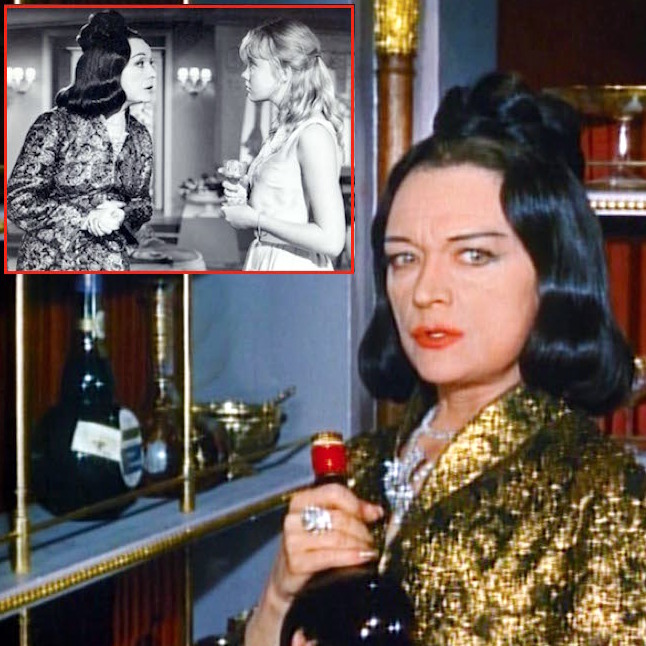
Today, we're taking note of a dozen film actresses (most of who could probably be considered divas, others perhaps not!) who once reigned supreme on the big screen, but then took an extended hike from the movies, whether they liked it or not, only to come back again years later (sometimes - but not always - with dire results.) We don't care whether the movies were any good or not, though. We just love to see the old mares back in action again! More on our cover girl shown on the left in a moment...
First we find Miss Janet Gaynor, the first actress ever to receive an Oscar (for
Seventh Heaven,
Street Angel and
Sunrise: A Song of Two Humans! Soon after, the award would be dedicated to a single performance instead of a whole season of them.) In movies from the mid-1920s, she enjoyed considerable popularity through 1938 (with 1937's
A Star is Born gleaning her another Oscar nom, though she lost to Luise Rainer for
The Good Earth.) She married famed costume designer Adrian in 1939 and retired from the screen.
Though she made a rare, but occasional, appearance on TV, she was coaxed out of retirement in 1959 (the same year Adrian died) to anchor the film debut of Pat Boone in
Bernardine. She played the mother of costar Dick Sergeant and was the caring den mother of his college cronies including Boone. The guys had created a fictional female (Bernardine) and entered "her" in a contest, which "she" won! Most folks considered the movie "cute" or "nice" and it was Gaynor's last, though she did pop up for a requisite trip on
The Love Boat in 1981 (passing away three years later from complications of a nasty taxi accident she'd suffered along with Mary Martin. She was seventy-seven.)
Miss Alice Faye morphed from a Jean Harlow-esque copycat to one of the most popular singing movie actresses of her time. Her deep, alto voice was featured in hit after hit musical, often alongside Don Ameche or Tyrone Power. Her song-filled movies had made money hand over fist for her home studio 20th Century Fox (which she nicknamed "Penitentiary Fox") and she eventually longed to try out a dramatic career, finally getting a shot at it with
Fallen Angel in 1945, but when she discovered that studio head Darryl F. Zanuck had mercilessly edited her performance down to a shadow of what she'd shot, she got in her car, drove off the lot without any of her possessions and ended her career in movies on the spot.
She'd married comedian Phil Harris in 1941 and didn't need the hassle any more. She and Harris enjoyed a popular radio program together and raised their two children. In 1962, she was enlisted to portray Pat Boone's mother (what is it with Pat Boone?!) in a remake of
State Fair. Cast opposite Tom Ewell, who she found less handsome than some of her costars of old, she was shocked at the demise of the business as she'd known it during the intervening 16 years and said so. She occasionally took on tiny parts in movies (including The
Magic of Lassie in 1978) and like most other folks rode
The Love Boat (in 1980), but stayed mostly retired until her death in 1998 of stomach cancer at age eighty-three.
Miss Claudette Colbert began acting in films in the late-1920s and started to make a name for herself in Cecil B. DeMille epics like
The Sign of the Cross (1932) and
Cleopatra (1934) while also proving to be highly adept at the soap operatics of
Imitation of Life (1934) and romantic comedy such as
It Happened One Night (1934), for which she won an Oscar. She was a considerable leading lady of the movies, but by 1955 was finding it hard to maintain her status. She did a bit of TV here and there, but was absent from movie screens.

In 1961, she returned to feature films with top-billing, but secondary publicity and promotion, as the mother of Troy Donahue in
Parrish. Gone were costars like Clark Gable, Ronald Colman and Charles Boyer and in their place was... Karl Malden. Colbert still looked fit and lovely in the movie, but disappeared from screens again for a quarter of a century, popping up as Ann-Margret's nemesis in
The Two Mrs. Grenvilles (1987), a well-heeled TV-movie in which she still looked great. Colbert lived to be ninety-two until a series of strokes claimed her in 1996.
Polish siren Miss Pola Negri began making films in 1914 when she was but a teenager. One 1919 silent
Madame Du Barry, in which she was the title character, caused a sensation in Europe as well as in the U.S. when it was released in 1922 as "Passion." She and its director Ernst Lubitsch were drawn to America where he prospered and she became a vamp akin to Theda Bara. A highly-public romance with Rudolph Valentino was also in the cards, but her intense overreaction to his death (complete with public fainting spells) put a bad taste in the public's mouth. The one-two punch of film censorship regarding sinful behavior on-screen and the advent of sound, in which her heavy accent was a handicap, helped lead to the end of her career in the early-1930s, though she worked in German and European films until 1943.

In 1964, she burst out of obscurity to take on the role of a glamorous woman of mystery in
The Moonspinners (1964), starring Hayley Mills. Walt Disney himself approached Negri about taking on the part in this "Hitchcock for Kids"-style thriller. Her character had a pet cheetah (as suggested by her versus the everyday house cat the script called for!) Just prior to this movie, she'd been living with a female oil heiress for six years until the woman's death and had never remarried after her second divorce in 1931. Negri never acted on-screen again, but lived until 1987 when she died of pneumonia and the effects of an untreated brain tumor at age ninety.

One of many highly-flamboyant and at times scandalous silent film actresses was Alla Nazimova, who also went as simply Nazimova. A student of Konstantin Stanislovski and his "Method" acting, she in time broke away from that practice and developed her own ways of conveying extraordinary tragedy, a specialty of hers. On film from 1916, her career was hampered by the Production Code, which was dampening the type of sexually charged roles she'd perfected. She also suffered bad publicity when one of her marriages was revealed to have been a sham from the start. (She was a lesbian who, despite one earlier "real" marriage, had always maintained relationships with women. By 1925, it was all over in Hollywood.
After fifteen years away from the movies, she returned in 1940 to play Robert Taylor's mother in
Escape. Her character was in a Nazi internment camp awaiting extermination with Taylor and his glamorous friend Norma Sheared struggling to get her freed. She followed this up with
Blood and Sand (1941) as Tyrone Power's mother and continued to act until her death from coronary thrombosis in 1945. She was sixty-six and had been living with a woman since 1929 at The Garden of Allah, which had once long before been her own estate The Garden of Alla!
Hedy Lamarr was (and still is) considered to be one of the cinema's most beautiful and photogenic actresses of all time. The Austrian beauty had made a splash, literally, in 1933 at age eighteen when she filmed a nude bathing sequence in
Ecstasy. (She was also shown in an implied orgasm sequence!) Marriage to what turned out to be a Nazi caused her to flee to Paris where MGM's Louis B. Mayer spotted and hired her. She became a hot property thanks to her glamorous looks, though her roles tended to be thin on character depth and dialogue. As the 1950s dawned, things career-wise became dire and she was finished in Hollywood after 1951's Bob Hope comedy
My Favorite Spy.
Lamarr did a few projects in Italy and filmed a scene in
Slaughter on Tenth Avenue (1957) which was cut before release, but was finally seen again briefly (along with a raft of other stars) in the 1957 Irwin Allen debacle
The Story of Mankind as Joan of Arc. (That's her at the top of this page with a pre-toupee Allen!) In 1958, she played Jane Powell's adoptive mother, a glamorous actress, who is romantically involved with the same man (scantily-clad
George Nader) as Powell! The movie was
The Female Animal. It was the last movie she'd make. She intended to work in
Picture Mommy Dead (1966), but an eyebrow-raising autobiography and an arrest for shoplifting led to her being replaced by Zsa Zsa Gabor. No dummy she, Lamarr patented a sound spectrum/frequency-hopping method that laid the groundwork for today's wi-fi signals! Her colorful, roller-coaster life ended in 2000 when a myriad of heart problems claimed her at age eighty-five.
You could search the world and the annals of history and be hard-pressed to find a more brazenly candid, outrageous or sexually-voracious actress of talent than Miss Tallulah Bankhead. Chiefly a contributor to Broadway theatre, she had a stop & start career in movies beginning in 1918 (when she was but sixteen years old!) After establishing herself more significantly on The Great White Way, she had another round of film work, but often had to stand and watch as Bette Davis recreated her stage successes on celluloid. (Many folks felt that Davis also channeled Bankhead in 1950's
All About Eve.) Already a bit of a comeback kid the time she made Alfred Hitchcock's
Lifeboat (1944) after twelve years without a role in the cinema, she was again absent from the big screen by 1953.
In 1965, after a long stretch away from the movies (and some significantly hard living, dallying in vices of all sorts), Bankhead startled the world by traveling to England and portraying a staggeringly devout, careworn, plain-faced old bat named Mrs. Trefoyle in
The Fanatic (called
Die! Die! My Darling! in the U.S.) The deranged character was holding her deceased son's fiancee Stefanie Powers captive in order to keep his soul pure. She threw herself into the juicy part full throttle and knocked it out of the park, though most audiences at the time wrote the enterprise off as just another excursion into hag horror. By 1968, Bankhead was dead from the triple whammy of pneumonia, the flu and emphysema, aged sixty-six, but appearing older. The year before she died, she managed to turn in a two-part
Batman episode playing the campy villainess The Black Widow.
Another comeback queen with more than one instance was the ultra-glamorous silent movie legend Gloria Swanson. After nine years away from movie screens, she took a starring role that many other old-timers turned down in
Sunset Blvd (1950), playing a washed-up, out-of touch actress craving a comeback. Swanson earned an Oscar nom (losing to Judy Holliday in
Born Yesterday), but was unable to parlay her regained fame into many more movie roles. By 1956 she was all gone again except for the occasional guest role on television.
She swept back onto movie screens in 1974 with
Airport 1975, the first sequel to the blockbuster hit
Airport (1970.) The role of a famous actress traveling on a red eye flight was initially offered to long-absent Greta Garbo, who unsurprisingly turned it down. Swanson opted to play the part but make it a version of herself instead of a fictional role! She wrote all of her own hooty dialogue and even managed to work in publicity for her mammoth autobiography "Swanson on Swanson." This proved to be her final acting role on-screen, though she lived to be eighty-four, passing from a heart ailment in 1983 (after having led a life of extremely careful nutrition.)
Sleek, eye-poppingly stylish, German actress Miss Marlene Dietrich was another unique persona who rarely, if ever, held back her thoughts on life and on other people she encountered. Having kicked around in German movies for the better part of a decade, she scored big in 1930 with
The Blue Angel and the film's director Josef Von Sternberg guided her to Hollywood and considerable success there in a string of films. A top female star during the 1930s, '40s and '50s, she in time began taking glamorous cameo roles, though 1957's
Witness for the Prosecution allowed her a pretty meaty leading part. After 1961, she concentrated more heavily on her career as a nightclub entertainer than as a movie actress.
Seventeen years after having last been featured in a movie, Dietrich popped up for a sequence in the 1978 David Bowie film
Just a Gigolo. She shared a scene with the star and then proceeded to sing a song (the title number.) Seventy-seven years old, she managed to appear far younger than that, but the image-conscious actress (who'd once allowed her skintight bodysuits to cut into her wrists and ankles until they bled!) was done. She offered her voice to the documentary
Marlene (1984), but wouldn't appear on camera. She died of kidney failure at age ninety in 1992, having been bedridden for a dozen years in the wake of a fractured leg. Dietrich, who was known for her open sexuality (with men and women) was married only once (for fifty-two years!), but had only lived with the man for five years.
America's favorite "good girl" in musicals and as the wife of assorted heroes, June Allyson recovered from four years of rehabilitation from a childhood accident to become a Broadway chorus singer and dancer. Catching a break when Betty Hutton developed the measles, Allyson parlayed her understudy appearance into a role in a subsequent show and when that second show was filmed as a movie (
Best Foot Forward, 1943), she was on her way. Many starring roles followed through the late-1950s whereupon she turned to the stage and TV for work. A tumultuous off-screen life (including alcohol abuse, an affair with Alan Ladd and the death of her husband Dick Powell) was at odds with her movie persona.
In 1972, Allyson returned to the big screen in a role that was utterly at odds with her usual array of portrayals! True, she'd made one attempt at being a villain (in 1955's The Shrike, a box office bust), but this time she jumped off the cliff as a dour, tough, lesbian murderess in
They Only Kill Their Masters. The film starred James Garner and Katharine Ross, but also featured an array of veteran players in supporting roles (one of whom was a dissipated Peter Lawford, who'd costarred with Allyson in far sunnier pictures like
Good News, 1947, and
Little Women, 1949.) Allyson worked through 2001 (becoming a highly visible spokesperson for Depends undergarments), but died of respiratory failure in 2006 at age eighty-eight.
Easily one of the most exotic and striking actresses of 1920s and '30s cinema was Miss Anna May Wong, who cut a dazzling figure in beautiful costumes and had talent to spare. She, however, was only ever able to rise to a certain point in fame because it was then the practice to cast Caucasians in Asian roles even when a capable, in this case Chinese, one was on hand! Thus she found herself in supporting parts or with leads in lower-budget fare and without the ability to perform love scenes against a white costar. Having maintained a film career through 1942, she made only one more motion picture in 1949 before departing for television and radio.
In 1960, Wong was brought back to movie screens to play the imperious, possibly nefarious housekeeper of Lana Turner in the glossy Ross Hunter-produced mystery
Portrait in Black. She next appeared as a guest on
The Barbara Stanwyck Show and with a role set for her in Hunter's upcoming production of
Flower Drum Song (1961) seemed primed for a prolific comeback, but illness followed by a massive heart attack claimed her before she could work on the musical (Juanita Hall played her part.) She was fifty-six.
A lifelong pusher of the sexual envelope, first on stage and then on screen, Miss Mae West was a curvaceous, wise-cracking pistol who always seemed to be generating controversy and public unrest whenever she performed. In the early-1930s, she embarked on a film career that, while successful, was consistently hamstrung by the moral codes of the day. She did her best to allow her famed double entendres to slip through the censors' eyes, but rarely without difficulty. By 1943, she had retreated from the movies and returned to her spicy and flavorful stage extravaganzas which often featured a bevy of musclemen at attention.
1970, however, twenty-seven years after her previous movie, found her back in action again.
Myra Breckinridge featured her as a lascivious talent agent, bedecked in Edith Head costumes (the same designer who'd created many of her earlier looks at Paramount) and spouting a lot of the same sort of one-liners that had gleaned her attention decades earlier. The movie was quite a mess, but she reveled in the newfound attention it afforded her. She might have quit while she was ahead, but instead came back again eight years later for
Sextette (1978), a dazzlingly bad musical that tarnished her reputation (with the 73 people who happened to see it, that is!) Within two years she was dead from complications of a series of strokes at age eighty-seven.
The title of this post is, of course, a play on
Come Back, Little Sheba (1953), but it turns out that quite a few of these gals were little in stature if not in fame. Marlene Dietrich and Anna May Wong were tallest at reportedly 5'7" and 5'6," but no one else went above 5'5" and four of the gals were 5' even! There may be some others who didn't get singled out this time, but if there are enough of them, perhaps I'll revisit the subject again in the future.