
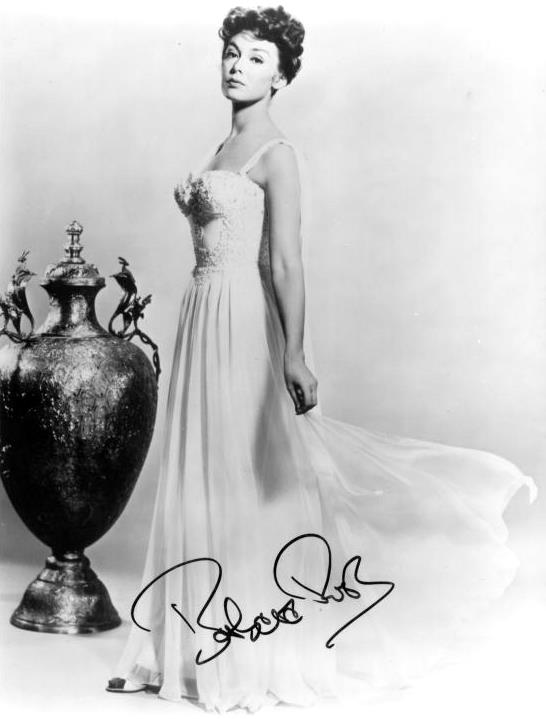
 Born with that same marquee-friendly name in Denver, Colorado on January 4th, 1927, Rush was blessed with large, liquid eyes and full lips (she was born with the type of lips people inject themselves to try to achieve now!), perfect for use on the silver screen. After high school, she enrolled at the University of California where she sought to hone her acting skills. Additionally, she worked with the University Players and enrolled as a student at the Pasadena Playhouse. It was here that she caught the eye of a Paramount Pictures talent scout who started the ball rolling to a contract with the studio in 1950.
Just as her movie career was about to unfold with a featured part in The Goldbergs, she met a fellow actor who was under contract at 20th Century Fox, the deliriously beautiful Jeffrey Hunter. The Goldbergs (a feature based on the highly popular radio show-turned-television series) gave her a featured role as a young girl torn between two gentlemen.
 By December of 1950, she'd appeared in her first movie and married her first husband, Hunter.
She was next placed in the period film, Quebec, which was filmed on location and starred John Drew Barrymore (billed at the time as John Barrymore Jr.) and Corinne Calvet. The story concerned the revolt of Canada against England in the 1830s. Following this, she was lent to director Douglas Sirk for use in his film The First Legion, all about the effects of a miracle on a select group of people. She played a disabled girl, driven by faith and it marked the first of four occasions that she would act for the gifted filmmaker.
 Back at Paramount, Rush was the leading lady in the sci-fi classic When Worlds Collide. Concerning a newly discovered planet that is hurtling towards Earth, a cache of scientists decide to send a rocket ship filled with young men and women (a sort of contemporary version of Noah's ark) to the new planet since it is expected to survive the collision while Earth is decimated. As the daughter of one of the scientists, she is able to secure an aisle seat .
 Her third film of 1951 was a western called Flaming Feather with Sterling Hayden and Forrest Tucker. Her role was mostly decorative as one of an Arizona settlement which is being terrorized by some renegade Ute Indians (led by a duplicitous white man.)
Rush gave birth to her and Jeffrey Hunter's son Christopher in 1952 and was offscreen that year due to the pregnancy. When audiences next saw her, it was in 1953's Prince of Pirates, a low-budget period picture costarring John Derek. She was lent to Columbia Pictures in order to make the lackluster affair that had her playing a Spanish princess.
Restless at the way Paramount was handling her career, she switched to Universal Studios in 1953 and was promptly placed in another sci-fi film that has since become something of a classic as well, It Came from Outer Space.
 Costarring with Richard Carlson, she played a pretty schoolteacher in a remote Arizona desert town. They witness a meteor crash that turns out to be the arrival of a spaceship that contains a hideous alien life form.
The '50s are dotted with creepy films of this type, some of which are dreadful and some of which are highly memorable (Invasion of the Body Snatchers and War of the Worlds, for example.) Rush was fortunate to be cast in two that were decent and not ridiculously shabby and campy. In fact, this last one, It Came From Outer Space, earned Rush the Golden Globe for Most Promising Newcomer-Female of 1954. (She shared the honor with both Pat Crowley and, um, Bella Darvi.)
1954 brought two more films for Douglas Sirk
 (and they couldn't be more far apart in subject matter or setting!) First, there was Taza, Son of Cochise, all about an uprising of recently peaceful Apaches with Rock Hudson as the title figure and Rush as his beloved Oona. Hudson's actually the good guy here, battling his brother Rex Reason, the newly arrived Geronimo and a bigoted member of the U.S. Cavalry. Hudson is slathered with body makeup and the sophisticated Rush is wildly miscast as an Indian maiden. Despite the campy aspects and the lunacy of the casting, this was reportedly Sirk's own favorite film due to his always having wanted to direct a western.
Later that year, the far more appropriate and enduring (if unrealistic in its own ways as well!) Magnificent Obsession
 was released. Jane Wyman starred as a young widow whose husband dies when a local playboy has tied up the use of a vital resuscitator. When the playboy (Rock Hudson) tries to approach Wyman (to simultaneously apologize and sort of put the moves on her!), she is accidentally injured, perhaps irrevocably.
Rush plays Wyman's step-daughter (in the source novel, the same age as Wyman's character, but here a tad younger than her.) She is steadfast in her loathing of Hudson and blames him for her father's death and her step-mother's injury. It's only when she finally realizes
 the true depth of Hudson's feelings and his desire to make everything right that she relents and treats him favorably.
I may have noted elsewhere in The Underworld that one of my surefire tear-inducements is the depiction of someone either forgiving another person for an injustice or otherwise burying the hatchet after a prior conflict. Maybe it's because I tend to be a fairly unforgiving person myself and am touched to see others doing it. I don't know. I just know that I find myself moved by these scenarios more often than not and this is one of the cases in which I am.
 Relating to nothing is the fact that this movie also contains quite possibly the most fantastic lipstick I have ever seen. I don't know what it is, but both Wyman and Rush sport rich, saturated lip color throughout, enough to make me notice it significantly more than in virtually any other movie.
While Magnificent Obsession
 put Hudson on the path to superstardom (just as it had Robert Taylor in the original 1935 version), Rush was given little similar career momentum. Still incredibly lovely no matter what she was placed in, she was given fourth billing (behind Tony Curtis, his wife Janet Leigh and David Farrar) in the period film The Black Shield of Falworth, her third film of 1954. This was the year that also saw Rush's television debut on a program called Lux Video Theatre.
 She made her fourth and final appearance in a Douglas Sirk film (as well as her third and final appearance opposite Hudson) in 1955's Captain Lightfoot. The story of an Irishman turned highwayman, Rush was prettily situated as the love interest yet again. At this same time, Rush's marriage to Jeffrey Hunter was unraveling. One of the town's most sparklingly attractive couples was no more.
 Universal cast her in 1955's Kiss of Fire as, once again, a Spanish princess (there is nothing remotely Spanish about Barbara Rush!) This time, her leading man was Jack Palance, though Rex Reason and Martha Hyer (shown with here to the right) were also on board. Palance played a rogue named Il Tigre, who is employed by Reason to help get Rush back to Spain in order to claim her place on the throne, but trouble ensues when she begins to fall for Palance (in an uncharacteristically romantic and traditional part, especially on the heels of Shane, in which he was a cruel, heartless gunslinger.)
 In 1956's The World in My Corner, Rush played an appealing society girl who is loved by a boxer from the wrong side of the tracks, but who is desperate to make good in order to marry and support her properly. The boxer was played by Audie Murphy, a much-decorated WWII hero-turned-actor. God only knows what sort of contortions were necessary for Rush to appear this much shorter than the diminutive Murphy.
 One of Rush's more prestigious projects
  came along in Bigger Than Life. The story of James Mason's struggle with, first, arterial inflammation followed by a mind-altering and violent addiction to cortisone offered plenty of dramatic conflict since she played his frightened and concerned wife. Mason repeatedly abuses their young son mentally and worries Rush with his drug-addled antics. Walter Matthau plays a neighbor and friend who ultimately helps contain the dangerous husband.
 Next, Rush starred opposite Rory Calhoun in Flight to Hong Kong, a B-movie about the title trip that involves a hijacking of diamonds, followed by a romance between Rush and Calhoun. The following year, she was part of a star-packed, but disappointing, adaptation of a Broadway comedy. Oh, Men! Oh, Women! put her with David Niven, Dan Dailey, Tony Randall and Ginger Rogers, but the result was a series of colorful, but shrill and grating histrionics.
She was now working at ex-husband Jeffrey Hunter's studio, 20th Century Fox and,
 as a result, was in a film that also featured him – No Down Payment! Their relationship was amiable, however. He was already remarried to his second wife, Dusty, with whom he would father three children. In this soap opera story of four married couples in a California housing development (precursor to Knots Landing, anyone?), she was married to Pat Hingle and Hunter to Patricia Owens. The other stars were Joanne Woodward, Sheree North, Tony Randall and Cameron Mitchell. In the story, Rush's character pressed her husband to conform to the standards set by others. It was not the last time she'd be utilized as the straight-laced, traditional sort of wife.
 1958's The Young Lions featured the trio of Marlon Brando, Montgomery Clift and... Dean Martin. While May Britt and Hope Lange paired up with the first two gentlemen, Rush portrayed Dino's wife. Martin's dramatic capabilities paled somewhat in comparison to the other, more celebrated actors in the film, but Clift worked with him behind the scenes and Rush's solid support showed her in a strong light during her limited screen time. Ads for Lux soap (whose television program she'd worked on previously) announced her appearance in the movie.
 For that same year's Harry Black and the Tiger, she portrayed the plucky girlfriend of hunter Stewart Granger, who accompanies him on safari. She was featured prominently in some of the artwork of advertisements for the film, though it is practically forgotten today. What little acting accolades there were to be found were reserved for East Indian costar I.S. Johar, who nabbed a BAFTA nomination.
 She worked with Paul Newman (who she had gotten to know through his wife Joanne Woodward during the filming of No Down Payment) in the Warner Brothers film The Young Philadelphians. As Newman's society girl fiancee, the role was initially meant for Natalie Wood, but she refused to play it and went on suspension. Newman portrayed an upwardly mobile lawyer who puts off his marriage to Rush, costing him her love. The star-filled drama featured Brian Keith, Alexis Smith, Billie Burke, John Williams, Adam West and an Oscar-nominated Robert Vaughn.
This same year, Rush married for the second time to Warren Cowan, a top-notch publicist. Their marriage would last for a decade and produce one daughter, Claudia, who is today a television news reporter.
 Now working at Warner Brothers, Rush found herself cast in plush melodramas with high-level talent surrounding her. First came The Bramble Bush, a Richard Burton film based on a novel of the same name. He played a doctor who commits euthanasia in order to help a childhood friend (Tom Drake) escape the horror of terminal illness. He falls for the friend's lovely wife (Rush) while in the meantime, a shapely nurse (Angie Dickinson) pines after him as well. She's involved with troublesome Jack Carson, however. So the bush was indeed full of brambles! The lovely ladies, Rush and Dickinson, have a tet a tete in the street as bemused gentlemen of the small town look on.
 She also starred as Kirk Douglas' wife in Strangers When We Meet, a beautiful soap opera about an architect (Douglas) who falls for a local housewife (Novak) whose husband is (implied) impotent or gay, take your pick. Rush was, as usual, elegant and pretty, but couldn't quite glean the same attention as curvy, lavender blonde-haired Novak was able to. In a reverse of an earlier scenario (in Bigger Than Life), Walter Matthau here played a neighbor who savagely and crudely injects himself upon Rush, rather than helping her.
Now thirty-three years of age, she began appearing more frequently on television than in movies. She had already appeared in the two-part Sunday Showcase production of What Makes Sammy Run?
 and now proceeded to pop up on Frontier Circus, The Eleventh Hour, The Dick Powell Theatre and several episodes of the Nick Adams investigative show biz reporter show Saints and Sinners. In 1963, she was one of several ladies placed alongside Frank Sinatra in the movie Come Blow Your Horn, based on a Neil Simon play. It was about this time that she switched from long brunette locks to the fluffy, forward-combed frosted look that she kept (with occasional, minor variations) for a very long time thereafter, rendering her almost unrecognizable from the dark-haired girl she'd been previously.
 Frankie thought enough of her to use her in practically the only female role in the following year's Robin and the 7 Hoods. A throwback to the Prohibition Era, it concerned (in a light-hearted way) the gangster shenanigans of Sinatra and fellow Rat Pack members Dean Martin and Sammy Davis Jr. (Peter Lawford was out by this period, per Sinatra's dictum, and was replaced by Bing Crosby.) Peter Falk also starred. The characters each took their names from the personalities in the story of Robin Hood so Rush was, of course, named Marian.
  Her appearance in this film warranted the creation of a wax figure as there were ones of each of the lead actors used in a promotional campaign. Here she poses for the sculptress amid various disembodied noggins.
More television continued including an episode of The Outer Limits with Vera Miles, a pair of episodes of Dr. Kildare and a two-part episode of The Fugitive, notable in that she played the wife of regular character Lt. Gerard (Barry Morse), the pursuer of the title character, played, of course, by David Janssen. She, like so many other great stars, appeared on the game show Password and was visibly concerned about doing whatever was best to aid her partners.
 In 1967, she joined an all-star cast and was reunited with Paul Newman in the western Hombre. Newman played a white man, raised by Apaches, who is on a stagecoach full of disparate types eventually held up by a sadistic criminal. Rush's haughty, condescending character was the wife of Fredric March and gets a horrible comeuppance when she is taken hostage and tied up in the blistering heat. It was a somewhat rare role for her in that she was a) mostly unsympathetic and b) decidedly unglamorous by the end.
She joined the ranks of other
 celebs before her when she appeared on Batman as a guest villainess. As Nora Clavicle, a women's rights activist who takes over Gotham City and replaces the men in positions of power with female counterparts, she was in one of the more lackluster entries of the series. Since Batman would never strike a woman, there isn't even a “Batfight” in this installment, though Batgirl was on the scene to help take the bad lady down.
 Neil Hamilton, who played Commissioner Gordon on Batman, figured into her next movie as well. He was third-billed behind Rush and hunky Hugh O'Brian in Strategy of Terror, a minor tale of a policeman and a reporter teaming up to investigate a potential assassination attempt against a U. N. ambassador.
By now, Rush had also joined the cast of the popular nighttime soap Peyton Place for a limited engagement. She made the rounds of other shows like Mod Squad, Rod Serling's Night Gallery, Marcus Welby, M.D., McCloud, Ironside and even Maude, as Bunny Nash, one of Maude's old school chums whose looks and lifestyle
 bring out a hint of jealousy in her. She also embarked on a stage career, winning The Sara Siddons Award for her work in Forty Carats in Chicago in 1970.
She was making periodic TV-movie appearances as well. There were 1972's The Man, about how freak circumstances lead to a black man (James Earl Jones) winding up as President of The United States, The Eyes of Charles Sand, about a young man with ESP trying to solve a mystery, and Moon of the Wolf, with David Janssen and Bradford Dillman.
 By 1973, her movie career amounted to working for Walt Disney in the dreadful Bob Crane comedy Superdad. While she was still lovely to look at, the weak project offered little to no challenge as an actress (other than trying to get through it without looking preposterous!) A four-year marriage (her last) to bit actor Jim Gruzalski stretched from 1971 to 1975.
 Dick Van Dyke had a sitcom, practically forgotten now, that aired between 1971 and 1974 called The New Dick Van Dyke Show. He played a talk show host in Arizona (where Van Dyke actually lived. In fact, a studio was built there in order to film this series, which was very much desired by CBS!) Barbara Rush made three appearances along the way, always as the same character, and one such event was deemed important enough to warrant the cover of a newspaper TV schedule.
 Throughout the remainder of the '70s, Rush continued to work on episodic TV whether on Mannix, Ellery Queen, The Bionic Woman or The Love Boat. Always elegant, always fresh and pretty, though frequently troubled or in danger. Do read the ludicrous caption of this promo shot from a stint on The Eddie Capra Mysteries in which she appeared with Troy Donohue, of all people. Barbara Rush an ex-prostie?! Never. Somehow, she was hornswaggled into playing Steve Guttenberg's mother in the craptastically heinous Can't Stop the Music, the disco-flavored story of the creation of The Village People. It seems that this must surely be the nadir of her career, but I haven't seen everything she's ever done, so maybe there's something worse out there. At least it's good for some unintentional laughs!
 Rush had filmed several unsold pilots in the mid 1960s and had done a ton of TV through the years, but in 1980, she landed a regular role on television for the first time since Peyton Place. She played matriarch Eudora Weldon on the prime time soap Flamingo Road. The stars of the show were really Mark Harmon, Morgan Fairchild and Cristina Raines, but the performances of stalwarts like Howard Duff, Kevin McCarthy and Barbara Rush added much to the tawdry goings on. John Beck and Stella Stevens also starred. In the second season, Rush's character grappled with an addiction to painkillers. It only ran less than two seasons, though, before being cancelled. NBC was never able to get a proper foothold in the genre that other networks had excelled with.
 Rush's final feature film role came in 1982 with Summer Lovers, a sun and sand-filled story set in Greece with Peter Gallagher and Darryl Hannah taking on a third sexual partner (Valerie Quennessen) while Rush (as Hannah's mother) and pal Carole Cook show up in shock. It was a small role, mostly meant as comic relief, and not a particularly fitting way for her to wind up a thirty-year movie career. In 1984, she appeared in a one-woman show, first in Los Angeles and then on Broadway, called A Woman of Independent Means, a recollection-driven story of a remarkable woman. (This same material, based on a book by Elizabeth Forsythe-Hailey, was also the basis for a 1995 miniseries starring Sally Field.)
 Television continued to offer more work and a variety of roles, though, again, it was seemingly impossible for Rush to appear as anything other than graceful and attractive. Then again, this was the '80s and glitz was the order of the day. Grunge wasn't even on the radar. She made the rounds on Fantasy Island, Hotel, Murder, She Wrote and Magnum, P.I. (on one occasion, playing Tom Selleck's aunt.) She also had a brief stint on All My Children as a character called Nola Orsini.
 When she worked on the 1998 revival of The Outer Limits, she joined an exclusive club of only five actors (with her being the only female) to have done both the original series and the reincarnation. She played, appropriately, an older woman who is made younger through the use of an age-reducing machine developed by a doctor trying to cure cancer.
 At age seventy, it seemed there was little room for Barbara Rush on TV anymore, but she wasn't quite finished yet. The family drama 7th Heaven, which starred Stephen Collins and Catherine Hicks (and a gaggle of children) employed her periodically (ten times in all) to portray Collins' mother. During most of her episodes, she was joined by Peter Graves as her husband “The Colonel.” Following her last appearance in 2007, Miss Rush (now eighty) retired from acting, seemingly for good.
 That's not to say that she doesn't occasionally get out! Recently, (at age eighty-four) she was a guest at a TCM film festival where she was interviewed by beloved host Robert Osborne. Not surprisingly, she still looks amazing and was dressed immaculately. A gracious, charming star who never landed that one role that would give her iconic fame, she nevertheless added so much to the many film and TV projects she worked on during her nearly sixty-year career.
 Considering, too,
 that she worked alongside Hudson, Douglas, Sinatra, Martin, Burton, Newman and so many others, along with being married to the tragic Jeffrey Hunter and worth for the great Douglas Sirk, one would have loved to read a book by her, but none has ever come forth. It's not to late, Miss Rush, get a collaborator and start reminiscing!


