Considering how much we adore the
cinematic output of
Ross Hunter and worship the shellacked gloss that
comes with most any Lana Turner performance, there really haven't
been that many tributes done in The Underworld to the movies of Miss
T., be they produced by Hunter or not. Today, we're making up for
that with a closer look at the deliciously, relentlessly overwrought
Portrait in Black from 1960.
The story told in this film first saw
the light of day in the form of a stage play in the mid-1940s,
featuring Geraldine Fitzgerald. A Broadway production of it ran
during the late spring-early summer of 1947 and starred Claire Luce,
an elegant, beautiful blonde actress who'd been one of Fred Astaire's
favorite dancing partners until a hip injury drew that part of her
career to a close.

The rights to the play were snapped up
by Universal and over the years there were various attempts at
turning the property into a movie. One planned rendition around 1950
would have been directed by Carol Reed and starred Joan Crawford. By
1959, the property was being dusted off again with Laurence Harvey in
mind as the male lead, but after several shifts in casting options
(with Louis Jourdan, Van Johnson, Richard Burton and Peter Finch
being bandied about) that was not to be. Instead, Anthony Quinn,
known for playing rugged, earthy ethnic parts, was placed opposite
glamour queen Lana Turner in the 1960 Ross Hunter production.

From the moment the credits begin, we
know we're in for drama, drama, drama (and laughs, laughs, laughs!)
Each principle cast member has their face shown, then the picture
flips to a negative, rendering him or her “black” as they then
form a sort of “line-up.” The always rapturous (and always
gleefully unrestrained!) music of Frank Skinner plays along, though
it must be noted that the “theme” for this film was composed by
two other people. No matter. Skinner's score is its own character
throughout the piece, especially when anything dramatic happens
(which is about every 45 seconds!)
We meet San Francisco shipping magnate
Lloyd Nolan, an embittered, driven, bedridden man who forcefully
exerts his will over the minions around him from his Nob Hill home.
He barks out memos and letters to faithful secretary Virginia Grey
and demands explanations from second-in-command Richard Basehart for
the most benign offences or irregularities.
He's also impatient with his
seemingly-loyal doctor Anthony Quinn, who isn't allowed to let a
medical emergency stand in the way of his daily intravenous shot of
pain medicine and sedative to the crotchety Nolan. He has two
children, Sandra Dee and Dennis Kohler, but we don't witness any
tenderness towards them either.
Mostly, though, he saves his venom for
his stunning wife Lana Turner. She makes attempts to see to his
needs, fluffing his pillow and providing water, etc...but he'll have
none of it, snarling at her that she's suffering from a “love
deficiency” and describing himself as being “half alive” right
about the time she's crossing by his crotch, at which she does sneak
a peek!
She soothes her anguish in the arms of
their little boy Kohler, (Dee is her stepdaughter, a child from
Nolan's first wife) though that hardly fills the bill. Turner has
several servants, the two primary ones being chauffeur Ray Walston
and housekeeper/governess Anna May Wong. Neither one is particularly
felicitous to Turner, either. Walston has a considerable gambling
problem and Wong seems more loyal to her prior mistress,
now-deceased, in a vague nod to Judith Anderson in Rebecca (1939.)
Turner, all decked out in one of her
many fabulous Jean Louis get-ups, has Walston bring the car around.
(What on earth is more glamorous than asking someone to “bring the
car around?”) As she readies to leave, she meets Dee on the stairs
and has to defend herself for wanting out of the suffocating
environment she exists in and has for three straight days. Dee clearly cannot stand her.
Then Walston drives Turner downtown
where she heads into I. Magnin, a famous department store of the
time. But she scarcely looks at the items before scurrying out
another exit to hail a cab and race to Quinn's apartment where the
two embrace in love. He's been offered an amazing opportunity in
Zurich, Switzerland and has decided to take it, leaving her
crestfallen.
After some tormented exchanges of love,
regret and even some finger chewing (they can't chew the scenery
because Quinn's apartment is liberally decorated with “Paintings
from the Martin Lowitz Gallery “), they come to the horrifying
conclusion that while they can't be together, they also can't be
apart. The one thing standing in their way is the craggy, nasty
Nolan.
Quinn determines that with just one
tiny air bubble in the syringe he uses each evening to administer
Nolan's medicine, they can be rid of the impediment to their
relationship. Turner is mortified, but not to the extent that she
dissuades Quinn from proceeding with the homicidal plan.
The next morning, a Gregorian-gowned
Turner leads Quinn into Nolan's room where the dastardly deed is to
take place. As Quinn heads up the stairs, the combination of visuals,
acting, object proportion and peerless Frank Skinner score combine to
form a staggeringly divine camp overload!
Meanwhile, Dee has been entertaining a
romance with young tugboat owner John Saxon. It seems Saxon's father
was cheated by Nolan, leading to a suicide via carbon monoxide. Now,
though, Dee tells Saxon that her father has agreed to give him a
hefty shipping contract, more or less confirmed by the smiling wink
of Nolan's secretary Grey as Dee left his office. In fact, Nolan had
called Saxon personally that morning to offer it as well.
(I nearly croaked when I saw this
horrendous get-up on Miss Dee because, though she wears it for
speedboating in this movie, it was
worn a year later by Connie Stevens in
Susan Slade, 1961, as a horseback-riding ensemble! Howard Shoup merely tacked a large button on the lower front. It's an
all-occasion atrocity that somehow was shifted from the costume racks
of Universal to the ones at Warner Brothers and is unforgettably
hideous!)
Trouble is, while Dee and Saxon are
prematurely celebrating, she can see her father's office building and
the flag is being lowered, signalling that Nolan is no longer with
us. A surreal graveside funeral service has the black-clad,
umbrella-wielding cast being drenched in rain as they pose in front
of a clearly artificial backdrop painting right out of the Hitchcock
playbook.
Turner, despite having helped to
dispose of the horrible Nolan, is climbing the walls in guilt and
anxiety. Early one night while tossing and turning and unable to
sleep, she hears Nolan's mechanical bed being raised and lowered,
calling for some amusingly wide-eyed emoting from our leading lady.
She then cannot prevent herself from
calling up Quinn and declaring, panic-stricken, that she must see him
as soon as possible even though he has told her it's too dangerous a)
for her to call him and b) for them to see each other so soon after
Nolan's demise. She won't take no for an answer, though, so he says
he'll drop by soon.
The next morning, Turner opts to
conduct business with the newly-advanced Basehart in her bedroom,
complete with sleeveless, fur-accented nightie. He wants her to sign
over Nolan's power of attorney to him, but doesn't stop there. He
also professes his attraction to her and makes it clear he'd like to
replace Nolan not only in the boardroom but in the bedroom! Needless
to say, with Quinn already on deck, she isn't at all interested in
this and does her best to shoo him away.
Anyway, Saxon's dreams of achieving
financial success with his inherited company and, ultimately, marrying Dee are stifled when
Nolan's death occurs and with it his supposed contract. Saxon
indignantly confronts the cutthroat new head of the company, Basehart, and is
told that the deal is going through with another company.
When Saxon calls upon Grey to confirm
that the contract was his, she is intimidated by Basehart into
backing up his shady story. Saxon leaves, disgusted and highly
threatening towards Basehart.
Quinn stops in to visit Turner where
they can scarcely scrape out an uninterrupted moment together. Dee,
in fact, comes upon them during his visit which Turner explains away
with a rash of severe headaches. Quinn emphasizes to Turner that in
order for them to ultimately be together, they must try to stay apart
for now. However, as he's leaving the house, Turner squeals his name
and reveals a shocking piece of mail that's come to her from Carmel,
CA.
The printed note reads:
“Congratulations on the success of your murder.” This sends our
illicit lovers into a tizzy as they struggle to figure out who is now
potentially going to blackmail them! Quinn is feverish with angst
over this recent development and has to back out of surgery when he
looks upon the patient and instead sees Nolan's face. (The surgery scene, by the way, evolves into a hilarious symphony of bad eyebrows popping up over the participants surgical masks!)
Secretary Grey has had second thoughts
about the way she helped to give Saxon the shaft, so she secretly
obtains papers that reveal that it was not Nolan, but Basehart, all
along who had helped to wreck Saxon's father's business, leading to
suicide. She meets Saxon and Dee to hand over the papers, tearfully
revealing that she'd carried something of a torch for Nolan, whose
tender side few people (including the viewer!) ever got to see.
Quinn and Turner meet in a park (with
our gal wearing what appears to be a charred hunk of leafy cabbage on
her head) to discuss their sticky situation. By now, Quinn has
decided that it is the arrogant and devious Basehart who sent Turner
the blackmail letter and determines that the time has come to perform
another murder!
Turner gives the servants the night off
and lures the smitten Basehart to her house under the guise of giving
him her proxy for a pending board meeting. He comes bearing a large
corsage and its all she can do to tolerate him until he's gone.
Once he's exited the house, Turner
hesitates before using the drapery cord to signal a waiting Quinn
that the time has come, essentially pulling the plug on Basehart as
she tugs the cord of the curtain. Basehart heads off in his car to a
spot where Quinn has prepared to shoot him dead. Unfortunately, with
the timing off, Quinn misses and Basehart heads back to Turner's to
call the police.
She is beyond stunned to see him arrive
and tries to delay calling the police, pretending that a call from
Quinn is actually one from Dee so that it will give Quinn the clue
that Basehart is there and planning to involve the authorities.
Basehart even has the make of the car and part of its license number!
Unfortunately for Turner, Basehart sees that the corsage he gave her
is lying in the fireplace, having survived on her shoulder about
three nanoseconds after his departure.
When he then finds out that it was not
Dee who called before, he explodes and begins roughing Turner up all
over the living room. Quinn arrives in time to dispose of Basehart,
but all the scuffle wakes up Kohler. Turner shuffles him off to bed
before Quinn informs her that in order to shift the blame from
themselves, they need to drive him up the coast where his car can be
knocked over a cliff onto the rocky shore.
Since Quinn needs someone to follow him
up there in his own car while he drives Basehart's, he turns to his
true love to do it only, surprise, Turner doesn't know how to drive!!
An already shaky plan becomes rather lunatic now as a stop-'n-start
Turner rumbles and rattles her way on to the street.
Of course the drive up the coast cannot
be without event. First, she has to contend with a zooming streetcar.
Next, the couple is separated by a train crossing, with Quinn trapped
on one side with a patrol car nearby. Then Turner careens around the
Pacific Coast Highway with no regard for the painted lines on the
road.
Finally, her trials become even more
horrendous when it starts to pour rain and she has no earthly idea
how to turn on the windshield wipers!! (Rumor has it that this is the
level of diffusion Lucille Ball requested during Mame, 1974, but she
only got about 80% of it!) Turner just happens to give up and
frantically pull off the road right where Quinn is waiting to dump
poor, hapless Basehart.
By now, she is hysterical, but Quinn is
able to get the two of them back home. The next day, Saxon finds
himself in hot water because his threats against Basehart were
captured on a dictaphone he'd been using in his office that day and
now that he's been killed, Saxon is the chief suspect.
The police also question Turner,
though, and while she is trying to peddle her version of the previous
night to the police, Kohler interrupts to ask about “Petah Gunn”
and Dee interjects that she knows Turner is wrong about some of the
timing of the events.
Dee runs to Quinn, unaware that he's a
part of anything, and tries to convince him of Turner's involvement
in a murder plot. He manages to sway her somewhat with an emphatic denial. Quinn then becomes distraught and, as the Hippocratic
Oath is read aloud on the screen, he wanders around full of aguish at
what his life has become. He decides that he has to leave, even
without Turner.
He goes to see Turner in person once
more only to find that another blackmail letter has arrived! This
one congratulates her on the second “venture,” i.e. murder! So
Quinn knows that there is still an extortionist lurking out there
somewhere and it wasn't even Basehart. When he sees Walston packing
up the trunk of a car for a slick getaway, he begins to believe that
he's been the one all along.
Things come to a dramatic head as
Quinn, Walston and Turner confront one another, followed by Dee
getting involved in the whole mess as well. Before the story has
ended, Turner is left standing in a window frame (dressed in dark
red, not black!) forming something of a portrait, having painted
herself into a corner from which she cannot escape.

No fan of
glossy, unintentionally amusing melodramas can afford to miss
Portrait in Black. It is so
lavishly appointed throughout, with splendid art direction, David
Webb jewelry and all the other customary Ross Hunter attributes.
Hunter was at the height of his powers here, having just done
Pillow
Talk the year before (whose director, Michael Gordon, took the helm
here) and
Midnight Lace this same year. Of course, the monster hit
Imitation of Life (1959) had also starred Turner, marking a fast
reunion for these two. In 1966, they'd do a third and final
collaboration,
Madame X. Unusually, for a film of this type, the cinematography (by the skillful Russell Metty) is loaded with darkness, shadows and silhouettes, though most of my pictures don't depict it.

These were whirlwind times for Ms.
Turner. Her Oscar nomination for
Peyton Place (1957) was followed by
a sordid homicide scandal in her home in which her abusive lover was
killed by her daughter, all played out in the newspapers and on
television. Her career in danger of imploding, she soared back to the
top with Imitation, whose plot line included mother-daughter
troubles.
Portrait reunited her with Dee, who'd played her daughter
in
Imitation.

Though her career wouldn't remain at
such a level for long, she continued to appear sporadically in movies
and limited TV appearances until the mid-'80s, dying of throat cancer
in 1995 at age seventy-four. Movie fans tend to be divisive over Miss
Lana's talent or lack thereof, but to me she is a perfect movie star;
glitteringly beautiful, emotionally-committed and with a carriage and
demeanor that dares you to look away. (If she had a big weakness in
my book, it was that the stylized, studied quality that made her
dramatic acting so effective could be dastardly forced and stiff
whenever she was playing “intentional” comedy.)


For a woman who had some considerable
real-life challenges with her daughter (which mended happily in the
end), she had a tendency to connect very lovingly with on screen
sons, as she does here and in Madame X. She also elicits a degree of
sympathy for this character, while someone like Joan Crawford would
probably have been harder, stronger and less believable as the
put-upon wife. Let's put it this way: it's not that hard to picture
Lana as a neurotic, desperate woman possessed with passion! In fact,
some scenes in Portrait probably hit a little close to home, such as
Basehart knocking her around.

Many folks simply could not buy Quinn
in this part, as they were used to him playing Indians, gypsies,
bandits and other assorted rough-hewn types, but he really gives his
all to the part. I do believe he even tears up at times, which was
not exactly the norm for a 1960 studio film leading man. Some might
say he gave the role and the movie more than it was worth. Soon after
this, he had a string of memorable movies including The Guns of
Navarone (1961), Lawrence of Arabia (1962) and Zorba the Greek that
propelled him to the upper echelon of movie stardom. He'd already won
one two Supporting Actor Oscars by this time (for Viva Zapata!, 1953,
and Lust for Life, 1957) and been nominated for Best Actor for Wild
is the Wind (1958), losing to Alec Guinness for The Bridge on the
River Kwai. Zorba would also net him a nomination, but that went to
Rex Harrison in My Fair Lady. Quinn worked right up until his death
in 2001 at age eighty-six, also from complications of throat cancer.

Basehart had begun working in movies in
the mid-1940s, making marks with He Walked by Night (1948), Fourteen
Hours (1951) and La Strada (1954) among many others. He was
admittedly ill-suited to conventional leading man roles and so
pursued parts with increased character or villainy to them. However,
he is probably best known by many as the star of TV's Voyage to the
Bottom of the Sea (1964-1968.) He worked right up until his death in
1984 at age seventy from a series of strokes.

Dee is another actress who tends to be
an acquired taste. Highly skilled at a young age and very fresh and
effervescent, she segued from modeling and commercials into films in
1957. What followed was a brief period of intense popularity with
Gidget, Imitation of Life and especially A Summer Place (all 1959!)
among the hits. Still only eighteen at the time of Portrait, she was
attempting to move into more adult parts, but sort of looked like a
girl playing dress-up in the often-stodgy clothes she was given. (She
also was a longtime anorexic, impossibly skinny for much of her young
life.)

A roller-coaster marriage to singing
sensation Bobby Darin kept things humming, but her type of appeal was
completely out of favor by the latter part of the 1960s. With her
career and marriage both on the rocks, she endured a lot of personal
trauma and heartache, resulting in alcohol and drug problems. She
died, all too soon, at sixty-two in 2005 of kidney disease, but not
before pulling things together enough to do the play Love Letters
with John Saxon, a three-time former costar.
Saxon began working in films in the
mid-1950s and was something of a teen idol, too, but unlike many, he
proceeded to a lifelong career rather than being tossed aside when
tastes shifted. (His dark, potentially-threatening, looks might have
helped with that regard versus the blond beach types who ran adrift.)
Still working today at seventy-nine, he has enjoyed a sixty-year
career in movies and TV by this point.

Walston was a successful Broadway actor
who debuted in films with 1957's Kiss Them for Me with Cary Grant
before immortalizing himself in two big-screen musical adaptations in
1958, South Pacific and Damn Yankees!, for which he'd previously won
a Tony Award. In 1963, he costarred with Bill Bixby on My Favorite
Martian, which ran until 1966 and became an iconic role for him
(though he regretted the typecasting that came with it afterwards.)
Later in life, he won two Emmys (and was nominated for a third,
losing to costar Fyvush Finkel) for his curmudgeonly work on Picket
Fences. He died in 2001 at the age of eighty-six from lupus.

The staggeringly slim Grey, as has been
mentioned here before, was producer Hunter's “good luck charm”
and he used her as often as he could in supporting roles. (The one
notable time he didn't was the 1973 debacle
Lost Horizon!) Having
worked in movies since the late-1920s, she retired after the
Hunter-produced miniseries
Arthur Hailey's The Moneychangers in 1976.
She was eighty-seven when heart failure claimed her in 2004.
Kohler enjoyed a brief but reasonably
steady career as a child actor, mostly on television, from 1955-1960.
While he was appealing enough in appearance, his voice and delivery
ranged from mildly annoying to downright grating, though it must be
said that this style of acting for youngsters was the standard for
the time. 1960 was the last year he is credited with anything on
screen and one presumes that Quinn and Turner didn't just add him to
the body count of Portrait in Black! LOL

Nolan had portrayed the fair and
concerned doctor in Peyton Place (1957) with Lana Turner before
appearing as her sour husband here. Having begun film work in the
mid-1930s, he continued to act right up until his death from lung
cancer in 1985 at age eighty-three, his final film being Hannah and
Her Sisters (1986.) Like several other folks in this movie, he soon
segued to a successful TV series afterwards, his being Julia,
opposite Diahann Carroll from 1968-1971 and for which he was
nominated for an Emmy (losing to Don Adams of Get Smart.) He'd
already won one previously, though, for playing Captain Queeg in a
1955 televised version of The Caine Mutiny Court-Martial.

Of special interest in this cast is
Wong, who was rare indeed, for she was an Asian star of the Hollywood
silver screen when such a thing was practically unheard of. Working
in silents from 1919, she carved out a career for herself even though
at the time she was severely limited in what roles she could play due
to her Chinese heritage. In fact, it was against the law then in many
states for mixed races to marry, thus she wasn't eligible for most
leading lady roles since the films would be shown nationwide and such
romances were deemed inappropriate for the most part.

She found herself portraying a lot of
colorful character roless like delicate blossoms or dragon ladies,
though what she wanted most was just a real, true role; a person, not
a type. Probably the biggest let down/insult of her career was when
the 1937 epic The Good Earth was being produced and a role she seemed
born to play was given to Austrian Luise Rainer (who won an Oscar for
it.) Wong was told she was “too Chinese looking to play a Chinese
character!”


She did successfully work in Europe for
a time, including an appearance on stage opposite Laurence Olivier,
and work in several films, but could never catch much of a break in
the U.S. unless in exotic parts (which, ironically, offended her own
fellow Chinese, meaning she simply couldn't win.) Her small role in
Portrait seemed to signal a comeback in the movies after an eleven
year absence for Hunter planned to use her in Flower Drum Song
(1961), but Wong died of a heart attack at only age fifty-six before
she could play the part. She was replaced by Juanita Hall (of Bloody
Mary fame in South Pacific.)

I cannot say enough about the tremendously insane music of Frank Skinner in this movie. It truly is another character, punctuating everything and anything, but also oftentimes creating something out of nothing. There are bound to be critics of it, but for me it's all just part of the big, glitzy, overdone package and has no equal. Interesting to note, though, is that many years later, Jerry Goldsmith adopted a few of the ideas found here into his Basic Instinct (1993) score, which was gripping, but also at times over the top as well.
Lastly, I give you a glimpse at the
tie-in book for this movie. As this began as a play before being
turned into a film, a third party was hired to forge the material
into a novel, but note how the text on the cover seems to convey that
this was an existing novel now being turned into a movie... clever!
Miss Lana never shows that much skin in the movie either.
The back cover has a description so
over-the-top sultry as to be hilarious. It's almost as if Blanche
Devereaux took a crack at writing it. The closest the movie ever
comes to any of this is Turner gnawing at Quinn's hands as if he had
cookie dough smeared on them!


 In 1961, she returned to feature films with top-billing, but secondary publicity and promotion, as the mother of Troy Donahue in Parrish. Gone were costars like Clark Gable, Ronald Colman and Charles Boyer and in their place was... Karl Malden. Colbert still looked fit and lovely in the movie, but disappeared from screens again for a quarter of a century, popping up as Ann-Margret's nemesis in The Two Mrs. Grenvilles (1987), a well-heeled TV-movie in which she still looked great. Colbert lived to be ninety-two until a series of strokes claimed her in 1996.
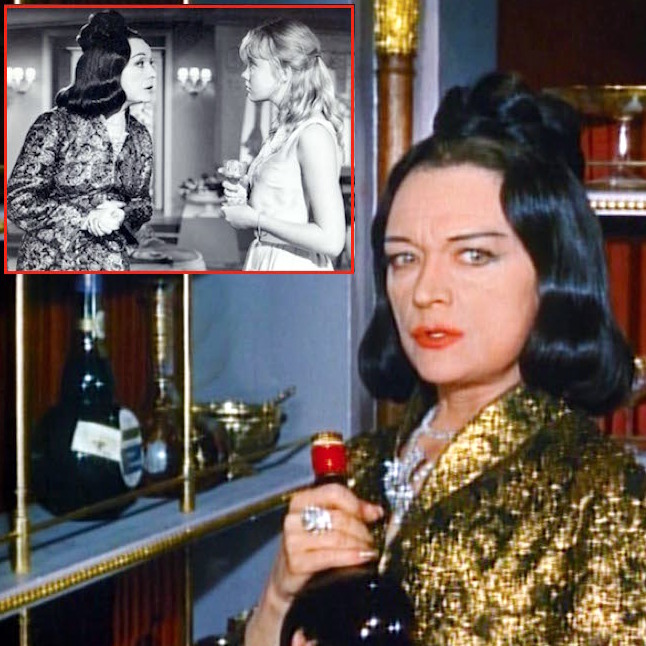 In 1964, she burst out of obscurity to take on the role of a glamorous woman of mystery in The Moonspinners (1964), starring Hayley Mills. Walt Disney himself approached Negri about taking on the part in this "Hitchcock for Kids"-style thriller. Her character had a pet cheetah (as suggested by her versus the everyday house cat the script called for!) Just prior to this movie, she'd been living with a female oil heiress for six years until the woman's death and had never remarried after her second divorce in 1931. Negri never acted on-screen again, but lived until 1987 when she died of pneumonia and the effects of an untreated brain tumor at age ninety.


