In the earliest days of The Underworld,
I did small (by current standards!) tributes to most of the 1970s
disaster movies that I have loved and been obsessed with since my
childhood. Since, in the grand scheme of things, they wound up
getting somewhat short shrift, I have occasionally revisited them
(such as when my first post about
Airport 1975 got a
supplemental one
later.)
Today, we're re-landing on '
75's
offspring, the glossy, preposterous, but thoroughly entertaining,
Airport '77. I've recently, and very belatedly, read the paperback
novelization of the screenplay, which fills in some interesting
blanks along the way, which I will be sharing! The third installment
in the four-part Airport series,
'77 involves a 747 jumbo jet,
completely overhauled and customized at the expense of about $40
million (per the novel, $25 mil for the plane and $15 mil to redo it)
by a wealthy business magnate, crashing into the ocean near the
Bermuda Triangle.
The business giant is portrayed by
Oscar-winning screen legend James Stewart in one of a handful of final films he made. For reasons known only to
the movie's composer, John Cacavas, Stewart's first appearance in a
helicopter (helicopters were HUGE in 1970s cinema) is punctuated by a
truly awful synthesized blurp of music that sounds perilously close
to a fart...
Once the credits roll, however, we find
that Cacavas has actually fashioned a truly beautiful and memorable
piece of theme music for the film. It's lush, classy and foreboding
all at once. These movies needed lots of credit music because the
cast lists were hilariously long! And any time one might think that
the list of names may be finished, another “And George Kennedy as
Petroni” or some such thing pops up!
To recap the plot for a moment, the
plane is loaded down with priceless artwork which is being
transported to Stewart's soon-to-be-opened museum on the grounds of a
family estate. In anticipation of the grand opening, a huge party is
planned and Stewart's guests, all close friends or folks otherwise
associated with the art world, are being flown down in the same
luxurious plane.
The three-story plane has a galley, an
office, two bedrooms, a library and a large lounge complete with
gaming tables, a bar and a large-screen television, all done in
endless shades of tan and brown. The stewardess uniforms are also
tan and brown, though this is one flight in which the ladies are
rarely shown doing anything but hobnobbing! The men (a bartender, a
wine captain and a fleet of stewards) do all the work.

Head stewardess Monica Lewis does at
least make a brief announcement before turning on the large TV and
inserting a huge laserdisc into a player that contains a greeting
from Stewart to his esteemed guests. Here's the irony. In the
late-1980s, this gargantuan disc looked hysterical both due to its
size and also its style since that video format never truly caught
on. By then we'd moved on to VHS tapes. However, the look, at
least, is not as jarring now that we have come around to DVDs and
Blu-Ray discs. Technology seems to be outdated in all cases within
just a couple of years! (Incidentally, though the uninitiated would
hardly know it, an imdb.com member felt the need to state in the
Trivia section for this movie: “Monica Lewis uses the player
incorrectly. She doesn't shut the lid completely and presses one of
the 'audio' buttons instead of the 'Play Forward' button.”)

Anyway, the plane is flying all this
artwork and the gallery of guests to Palm Beach, Florida, but there's
a fly in the ointment. An elaborate heist has been planned in which
several of the employees working on the craft intend to gas all the
passengers, land the plane on a small island off course, remove the
artwork - transferring it to another waiting plane - and depart to
South America, leaving the dazed people stranded on an old airstrip
to figure out what happened.
This last part never happens because,
after all the passengers pass out from the gas, the villainous
copilot Robert Foxworth bangs one of the wings of the plane into an
oil derrick during some pea-soup fog and then can't make the aircraft
right again before plunging it, whole, into the water! The craft
bobs for a few moments before sinking about fifty (?) feet or so. So
everyone is trapped as if they are within a disabled submarine, with water pressure building and oxygen diminishing by the minute.

In a lengthy opening sequence, we see
Monte Markham (later to portray Blanche's gay brother Clayton on The
Golden Girls in two episodes) arriving at the airport as a phony
captain, then picking up the gas and a gun and proceeding to alter
his appearance with jaw pads, a fake mustache and a wig! This is so
he can pose as a freight loader long enough to get inside the plane
and prepare it with the gas, then later still pose as a waiter on the
flight! Remarkably, Markham is shown walking through a busy, crowded
airport, yet the locker room and bathroom where he makes his
transformation is dead empty and completely silent!!

The pilot of the plane, Jack Lemmon,
and the designer, Darren McGavin, are shown looking things over
pre-flight. I have often wondered if this next thing I'm about to
mention is a good thing or a bad one. As the men are heading away
from the plane and in conversation, McGavin searches for his shirt
pocket to retrieve a cigarette, then stops, then a few moments later
does it again. His character is trying to quit. I can't tell if
McGavin was trying to indicate how much he wanted one or if he jumped
the action and then had to wait (because Lemmon makes reference to
the cigarette and still had a bit of dialogue to go yet.) I suspect
the latter because so little time passes in between that it seems odd
that he'd flip-flop on his decision so quickly.

McGavin, by the way, who allegedly
could be a real meanie in real life, gives one of my favorite
performances in the movie. He's a rare combination of colorful and
sarcastic, yet understated and believable. He registers convincing
worry about the plight of the aircraft while occasionally lobbing
snarky one-liners, but never to an annoying degree. He's not an
actor that I've ever been very heavily drawn to in other projects, but I really
like the person he created here.
The film was shot in a version far
longer than what made the final cut and, as a result, there are
subtle continuity problems throughout. As the plane is almost
completely finished boarding, a car speeds up to the ramp containing
arts patroness Olivia de Havilland and her assistant Maidie Norman.
No other passenger is on the ramp or nearby, yet the movie
immediately cuts to Stewart's daughter Pamela Bellwood and her young
son, just entering the plane!

(This is because the final cut departs
from the script in which the plane was completely boarded, but
Stewart's employee Brenda Vaccaro insisted on waiting just a while
longer to see if his estranged daughter Bellwood would indeed show
up. In the movie, she boards before de Havilland, but initially, she
was to be the dead last arrival.) As an aside, one of my Underworld buddies bemoans the fact that Bellwood and Vaccaro are both in beige, but Bellwood is really in pale, baby bottom pink, though the difference is so minor with the lighting for the film that it scarcely matters!
Only those with quick eyes will note
that when de Havilland zips to the ramp in her chauffeured car, she
has hilariously brought along her huge DOG to the airport! Norman is
in the front passenger seat and Liv is in the back with a big ol'
canine. Presumably, he isn't a shedder since she is garbed entirely
in black!
The book details the relationship of
these ladies just a touch more, explaining that Norman had been de
Havilland's social secretary early on before evolving into a close
friend and companion, sticking it out through her one-time boss'
three failed marriages (kind of an imitation of Imitation of Life, 1959!)
De Havilland has a hooty moment when
she (seemingly having borrowed Swifty Lazar's eyeglasses) approaches three gentlemen to play cards and seems all Melanie
Wilkes polite at first before launching into an iron-clad sort of
saloon proprietress recitation of her rules for playing! It's
delicious. Her poker buddies are played by gentlemen of considerable
acting experience, though they are hard-pressed to make much of an
impression in the deep pool of performers that was hired for this
project.

George Furth, as a rather snivelling
art critic, was a writer, a Tony-winning actor and had appeared on TV
and in films like The Best Man (1964), A Rage to Live (1965), Butch
Cassidy and the Sundance Kid (1969), Myra Breckinridge (1970) and
Shampoo (1975.) M. Emmet Walsh, as Stewart's racehorse veterinarian,
began in small character parts in 1969, but proceeded to provide
terrific, quirky turns in What's Up, Doc? (1972), Slap Shot (1977),
The Jerk (1979), Brubaker (1980) Blade Runner (1982) and the
sensational Blood Simple (1984) as well as Raising Arizona (1987),
both for The Coen Brothers. English actor James Booth stayed busy in
many movies, perhaps the best known of them, the hair-raising 1964
Zulu, in which he and others were holed up in a besieged fort. His
character has few lines, but pops up often and was intended to be
featured more than it ultimately was.

Since The Poseidon Adventure (1972) and
The Towering Inferno (1974) both took home Oscars for Best Song, it
became fashionable for a time for 1970s disaster movies to include a
number in a bid to nab some Academy Award glory. Most of us recall
Helen Reddy as a guitar-wielding nun in Airport 1975! For '77, blind
musician Tom Sullivan was enlisted to perform his own concoction
entitled “Beauty is in the Eye of the Beholder.” He's looked on
lovingly by Vaccaro's pretty assistant Kathleen Quinlan (who somehow
landed a vibrant red dress amid all the beige and black in the
movie!)

Sullivan is severely injured during the
crash and isn't around long after that. Even though I saw Airport
'77 first, Sullivan never really registered on my radar until 1982
when a movie based on his life hit theaters. It was called If You
Could See What I Hear and starred the humpy Marc Singer as Sullivan.
Needless to say, after witnessing him in the part, the real Tom
Sullivan rather paled in comparison when I saw him again later.
What's that? You say you wish you
could see a little bit more of Singer from that bottom right photo of
him in the shower? Since when have I ever denied my readers anything
they want?? (You don't have to answer that. I know that I don't
always do as I'm told!) Ahhh... He was so cute!
Another looker who is actually in
Airport '77 is Gil Gerard. He is part of a hate triangle between his
boss Christopher Lee and his boss' wife Lee Grant. It seems that
while oceanographer Lee was busy developing endless plans to harvest
food from the sea, his wife Grant became bored, resentful and
embittered. She got her hooks into Gerard and they engaged in a
sexual affair, which he now regrets. Thing is, since Lee is as
enmeshed in his studies as ever, Grant is eager to reignite her
romance with the younger man, even by means of blackmail!
The CLASSIC sequence that takes place
between these three is so wonderful I swear I could watch it over and
over and over and never get even slightly tired of it. Lee (who had
several times played the very dangerous Count Dracula, along with
many other screen villains) is uncharacteristically meek and demure.
Gerard is indignant, frustrated and embarrassed. Grant is
everything! Harpy, seductress, desolate, lonely wretch. She's just
to die for.
I don't know if it was Grant, herself,
or who, but the dialogue she (and Gerard, to an extent) delivers in the movie is more
nuanced, blistering and varied than the lines her character spouted
in the book. The whole scene is better fleshed out and realized than
the novelization. Amazingly enough, I was watching The Chase (1966)
not too long ago and was floored to see that a very similar sequence
occurs between characters in that movie from a decade earlier.

Bitchy wife Janice Rule visits her bookish husband Robert Duvall at the bank in which he works and tries to get
his attention, to no avail. She proceeds to his friend and associate
Sam Bradford with whom it is revealed that she has had an affair.
She tries to come on to him, even leaning across his desk and blowing on his hair, just like Grant does in '77! Then she
proceeds to basically blackmail him into seeing her again. Unreal
the way this was lifted and reused. (Then again, Airport '77 is
itself a waterlogged redux of 1965's Flight of the Phoenix, a film
which starred James Stewart and George Kennedy along with several
others.)

Gerard had been a soap opera actor (on
The Doctors from 1974-1976), but 1977 was his breakout year. Not
only did he have a featured part here, but he also starred in a
TV-movie and appeared on several major series as a guest star. In
1979, he was tapped to star in Buck Rogers in the 25th
Century which lasted until 1981. (That's a young, zoned-looking Jamie Lee Curtis with him in the inset!) He's worked ever since, in both
good and not-so-good projects with a serious weight gain coming into
play for a while. But in the late-'70s, he was at his peak of
amiable handsomeness.

Back to de Havilland for a moment. She
had turned down Irwin Allen's offer to costar in The Towering Inferno
(1974), which netted Jennifer Jones a Golden Globe nomination and
which had scored a Best Picture nomination, so she didn't take a pass
when contacted by Jennings Lang to work on this potential blockbuster (nor did she
when Allen came calling again for the woeful The Swarm in 1980.)
Thing was, she was not first choice. Greer Garson was contacted
initially, but turned it down. Then Miss Joan Crawford was offered
the part.

She, however, was horrified that
producers wanted her to show up in California within a week and,
amazingly, provide her own clothing for the part! She had also
wanted to wrangle Joel McCrea into playing her love interest, but it
was not to be. So, de Havilland (who had famously stepped into
Crawford's role in 1964's Hush...Hush, Sweet Charlotte opposite
Joseph Cotten) won the part and as her love interest again got Joseph
Cotten! Not only that, but Maidie Norman had worked with Crawford
twice (on Torch Song, 1953, and What Ever Happened to Baby Jane?,
1962), so they likely would have had a certain level of connection
together.
De Havilland and Cotten must have
really gotten along well. Not only did they work on Charlotte and
Airport '77 in tandem, but they also worked together in the 1972
telefilm The Screaming Woman and then four years after '77 portrayed
an elderly pair of newlyweds on The Love Boat!
According to the novelization, he's
supposed to be bringing a pair of “Russian icons” to Stewart's
museum, but in the movie, it's a single, large piece of jewelry that
doesn't, to me anyway, appear in any way Russian.
Some day I would love to get Kathleen
Quinlan's recollections of having worked in a film with such names as
Lemmon, Grant, Vaccaro, Lee and de Havilland, among others. Here she
was, at twenty-two years of age, being rocked and comforted by
Melanie Fucking Wilkes, for crying out loud! There were no less than
five Oscar-winners in Airport '77 and I wonder if Quinlan ever
dreamed at that time that she would herself someday be nominated for
one (for 1995's Apollo 13, losing to Mira Sorvino in Mighty
Aphrodite......)
Bartender Robert Hooks is injured
during the crash when a heavy piece of equipment falls on and smashes
his leg. In the book, bone is protruding through his pants leg and
when Cotten goes to cut his pants, he says it's “going to hurt,”
but in the movie, the wound is less gory and when Cotten goes to make
the cut he assures Hooks that it WON'T hurt.
The book also says that Hooks' pregnant
wife, about to deliver twins at home, has toxemia, though that was
abandoned for the finished movie. Perhaps they thought he'd suffered
enough trauma since almost all he gets to do in the movie is scream
in agony over his leg, which people keep seeming to bump into!
Most of you (those of you who even know
this film I'm babbling on about!) are probably aware that there was a
four-hour (including commercials) TV version that aired in which
close to an hour of additional footage was inserted. A smidge of new
footage was shot, but most of the unseen footage was captured during
initial filming. We see more of the arrivals onto the plane in this
cut.

Also among the additions were a
sequence with Lewis training new stewardesses (not, however, for
underwater escape!), George Kennedy taking his teenage son for a spin
though the airport hangar (in a nice touch, it's the same young actor
– Brian Morrison - who played his son in Airport 1975. He also
played Bea Arthur's grandson on Maude!) and McGavin chatting with
those two. In the finished film, Kennedy is isolated from most of
the primary cast except Stewart. The longer version also spoils one
of the feature cut's not-so-big surprises by having Markham and
copilot Foxworth shown collaborating together prior to takeoff.

Foxworth and Grant both played
unpleasant characters here and would reunite in 1978 for Damian: Omen
II, in which Foxworth was again a real baddie. He backed out of
playing the internationally-famous role of J.R. Ewing on Dallas
because he felt the role was too cruel and devious, opting instead in
1981 to star in Falcon Crest as a good guy. Incidentally, even
though it is never specified in the movie, Foxworth's character is
supposedly in debt to a loan shark and that's why he's a turncoat,
though that doesn't explain how he can so adeptly and coldly kill one
of his coworkers! (The flight engineer, whose fate is left
undetermined in the feature, but who is shown clearly dead in the
elongated version.)

There is also in the extended version a
series of flashbacks, four in all, showing some of the passengers
prior to the flight. We see a romantic evening between Quinlan and
blind Sullivan, with his guide dog in tow. There's also a memory of
Arlene Golonka's in which we see her little girl, ecstatic about
being chosen to present student art to Stewart (their reason for
being on the plane) and even meet her husband, unseen in the feature
version. Other scenes include an exchange with Bellwood and Booth
and a happier time in Lee and Grant's marriage when she brings a
packed lunch to him before one of his maritime excursions. There is
a lot of additional footage of the rescue effort as well.

Speaking of the rescue effort, one of
the more pleasant things about it is that the divers and navy crewmen
are in good shape and are in some cases tan and blonde. They also
wear abbreviated shorts and in the course of their duties often stick
their behinds in front of the camera (if that happens to be your
thing! Ha!)
There's a HUGE gaffe in the movie,
though, which I only caught for the first time last week (and I've
seen this movie no less than twelve to fifteen times!) Lemmon is
floating in the ocean and picked up by a couple of crewman in a
power-raft. When the raft arrives at the huge carrier that is
handling the rescue operations, the two crewman are totally,
completely different in looks, build and coloring!! The only
explanation is if, in true airline fashion, Lemmon had a stopover in
the middle of his journey and had to switch rafts. :::snort:::

The thing with Lemmon and his (lemon)
yellow raft is also a little irksome. He holds a meeting in the
cabin of the airplane and explains that all he has to do is get the
raft out of the plane and that when it surfaces it will
“automatically” begin to send out a radio rescue signal.
However, he's later seen having to inflate the raft, climb on board,
dig out the trasmitter, pull up the antenna and then switch the
device ON in order to send out the S.O.S.!!
The radio man who picks up Lemmon's
signal (“We have a beeper!”) is none other than Chris Lemmon,
Jack's son, who was making his screen debut as an actor. The father
and son must have noted the way Paul Newman arranged for his son
Scott to land a featured bit part in The Towering Inferno and thought
it might be good to follow suit (albeit on a smaller scale.)
The effort to get Lemmon out of the
plane and up to the surface is a dangerous one indeed. He is offered
assistance by “trained scuba diver” Lee, but when the door bursts
open unexpectedly, things get ugly fast.
Grant gets another of her patented, wonderful, shut-down moments when she is staring out the cabin window for signs
of her husband's escape and instead sees his lifeless frame floating
upwards. Nothing can console her as people try to fill her with more
scotch, cover her with a blanket or otherwise comfort her. She's
having none of it.
Incidentally, the book includes a scene
between Lee and Gerard which is cut from the film itself except for a
brief glimpse. Lee comes down to the cargo hold area and Gerard
helps him off with his shirt. In the book, Gerard takes this time to
confess to Lee his affair with Grant whereupon Lee tells him he's
known since practically right after it happened, but he wasn't going
to hold one mistake (which is not exactly a little one!) against
Gerard after so many years of close friendship. I'm glad this was
cut as it's all a little pat and not particularly realistic.

After a little while following Lee's
demise, Grant starts to compose herself again, though in a rote,
zombie-like way thanks to shock, and proceeds to try to open up the
door of the plane and “leave!” Vaccaro has to step in and stop
her, but starts to get pummeled in the process, leading her to deck
Grant right in the face! This climax to the fight is cut off
abruptly and one reason may be that (again!) in the book, the script
called for lines (and a split lip) from Grant following this. (“Why
did you do that? Look what you did to me?”) In the book, Grant
scratches Vaccaro's face with her nails prior to being punched.

If you're a fan of Airport 1975, you
might recall Gloria Swanson's stunt double showing a hilarious flash
of white panties as she zooms down and exits the rescue shoot.
Airport '77 has a similar moment, this one belonging to Golonka, who
flashes the camera her pantyhose-covered crotch when getting into the
rescue raft! Hopefully, the steward directly above her isn't
offering a review, but just has sea water in his eyes... A few moments later, Monica Lewis falls and her legs come apart, too, but her golden age studio training must have taught her well because by the time she's plopped into her raft, she's drawn her knees closely together!
There is a ton of water in this movie,
which I completely love, and the cast was pummeled with it at times.
Vaccaro, in fact, came down with pneumonia thanks to her series of
scenes in the drink and here and there she does look a little green
around the gills as she tried to power through it.
Jack Lemmon (who is not the first name that springs to mind for a role like this in a film like this, but who does a great job) said he regretted making this movie. I guess he felt it was a commercial sell-out, but he took the part in the first place feeling like he wanted to try to make a pure popcorn movie (a cartoon, as he referred to it) and it was successful, so I don't know why he regretted it.
Airport '77 was a considerable hit at
the box office (costing $6 million, but making five times that back –
and helping to spawn the God-awful The Concorde: Airport '79!) It
was nominated for two Oscars, one for its Art Direction (losing to
Star Wars, gee how did that happen?) and another for its Costume
Design. Edith Head was in charge of costumes except for Ms. Grant's
which is easily the most arresting one! As was often the case, Grant
was clothed by Burton Miller. They lost to Star Wars, too. (Maybe
Grant should have had a black helmet on over her ensemble?)

I have always thought that the blue
dress on the lady to the left in this photo was rather horrible. I
also wondered for a long time if it was the same dress – or at
least material – as one woman wears in Earthquake who takes some
glass to the face, but it is neither. The lady in blue at the right
is, for me, the most annoying person in the movie and I loathe her
outfit. I have never, ever understood what in the hell she is
wearing! She always seems to be swaddled in a variety of white and
blue cloak-y things, all of it ranging from unremarkable to ugly!
Most of the filler passengers are stunt people posing as actors
anyway and few of them survive the ordeal.

Grant's outfit is just perfection
incarnate as far as I'm concerned. It's like Barbra Streisand's
infamous, sheer, Scassi Oscar pajamas meets The Child Catcher from
Chitty Chitty Bang Bang with a dash of Van Cleef and Arpel! In the
novelization that I keep bringing up, Lemmon asks Grant for the belt
from her outfit in order to make a tourniquet, but this doesn't come
to pass in the movie despite her having a fun black belt with a
rhinestone-crusted buckle on it.

One last thing about the novel. During the watery climax, it has
all the passengers tied to posts in the plane with shredded pieces of
bed sheets, but maybe that was deemed to close to the climax of The
Towering Inferno (or the director otherwise didn't like it?) When
the deluge of water rips through the plane, the book has Pamela
Bellwood screaming for help from Grant as her little son is nearly
swept away, but Grant turns her face away in avoidance. In the
movie, this incident is omitted and, in fact, made impossible due to
the editing.

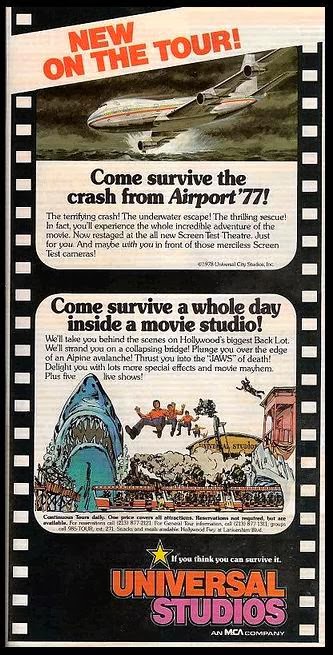
I think I mentioned way back in my
Earthquake tribute how I took part in an attraction at Universal
Studios – Florida in which I got to endure an earthquake while
riding an escalator as debris fell all around me. It was an
unforgettably fun and campy moment of my life. However, I truly
would have gone NUTS if I'd known about or been permitted to take
part in an attraction out in L.A. that I never even heard of until
just recently. They had an
Airport '77 attraction in which visitors
could become part of the story and then wind up in a
three-to-four-minute rendition of the movie, which was for sale to
them!!
This is off the hook....... Take a
really good look at this pictures from the brochure! They had four
sections of set, a hallway where two people played hijackers, the
main lounge, a radio room and the cockpit:
Civilians sat in the recreated lounge
and pretended to be gassed, then crashing at the appropriate moment!
Then there was a big dunk tank in which
people jumped out of the airplane door into the “ocean!”
A person could play Brenda Vaccaro,
including getting wet!!
Are you freaking kidding me?!?!? No
park could get away with this attraction today in our liability and
legality-ridden world. I would have killed, killed, killed to take
part in this. Check out the preposterously hysterical results of
some folks visits to the studio
here and
here!
I hope you didn't mind this reconnaissance back to a previous subject, but I just had to give it a little more love. Ridiculous as it may sound, this is easily a Top 10 favorite film of mine, one of which I never tire from watching.


 As I say, some of the panel weren't given their chance to speak in the final cut of the special. McGavin, who was there no doubt due to the detective angle of Kojak, showed up wearing his hat from Kolchak: The Night Stalker, his spooky, short-lived, but fondly remembered show.