Showing posts with label Zorro. Show all posts

Friday, September 10, 2021

TinselTales: Where Did That Guy Run Off To?

I have written about the subject of today's post before, though eleven years have passed in the meantime! He figured in a lengthy tribute to three different Guys. The man in question is one Guy Williams, famed for his roles on Zorro and Lost in Space. It has always intrigued me the way Williams basically exited his career in 1968 and, in fact, exited the U.S. in 1977, returning only once before his unfortunate death in 1989. He basically severed regular contact with his family in the process. So today we're going to look into that a little bit further. 

Born on January 14th, 1924 to parents of Italian descent, Armando Catalano was schooled at a military academy before growing up into a 6'2" hunk. Working as a print model, he eventually segued into acting, with a Universal Studios contract. He poked around in bit roles before freelancing (appearing in the hooty Sincerely Yours, 1955, and in a variety of TV parts.)

Career salvation came when Walt Disney hand-picked him to portray the title role on Zorro, a hit TV series from 1957 to 1959. Kids couldn't get enough of the Spanish California hero who swashbuckled his way through various adventures.

The tall, handsome Williams inspired a generation of youngsters, but was easy on the eyes of many adults as well. The series enjoyed a healthy budget, making it a popular way for viewers to spend a half hour. The show ran into legal entanglements between Disney and ABC which caused a halt in production. By the time that was settled (after two years!), interest in the concept had cooled.

Regardless of his Italian surname, it was later discovered that his ancestry was likely made up of Spanish people who had migrated to Italy long before, so he was actually more in line with the role than even he knew at the time. The suave, debonair Williams was continuously approached by the ladies, who he may or may not have entertained privately.

Thing was, he was already a husband and father. Married to Janice in 1948, his son Steven was born in 1952 and daughter Toni came along in 1958. The picture perfect family was featured in many publications during his time on Zorro and, later, Lost in Space. Regardless of the smooth manner Williams projected professionally, he was reportedly a fiery, vivacious man in private and a considerable disciplinarian to his children. (Not in an abusive way, more of a constructive, instructive way. The household was a strict one.)

In the wake of Zorro's cancellation, Williams worked on the Disney flick The Prince and the Pauper (1962) and made the European films Damon and Pythias (1962) and, as seen above, Captain Sinbad (1963.)
Devilishly handsome (and sporting some nice legs) in Damon and Pythias.
After these projects, he returned to the U.S. with the promise of a new television venture...

The hit western Bonanza was about to lose one of its key cast members. The saga of a wealthy rancher and his three sons, one son - Pernell Roberts - wanted out of his contract. Williams was brought onto the series as a cousin and plans were made to work him into the mix as a replacement.

Audiences had grown very accustomed to the diverse trio of Cartwright sons and there was a public outcry over the possibility of Pernell's departure. Ultimately, he was retained to finish off his contract, leaving Williams in the lurch and out of a job. Roberts would eventually leave for real (and the show prospered without him for many years after.) DO check out Michael Landon's iconic taupe trousers in this publicity photo, by the way...!

Fortunately for Williams, another break was on the horizon. Irwin Allen hired him to headline a new science-fiction program called Lost in Space, all about a family named Robinson who find themselves, well, lost in outer space! It was a derivation of the famed Daniel Dafoe story Robinson Crusoe. Williams was the husband of June Lockhart and father to three children. Mark Goddard was his faithful assistant.

The initial Lost in Space pilot had only the Robinson Family (along with Goddard) in it. After it was completed, the decision was made to include an antagonist to the mix, which turned out to be Jonathan Harris as the devious and duplicitous Dr. Smith. As the main cast was already set, Smith was granted "Special Guest Star" billing throughout the series' run. The character was a constant fly in the ointment, causing all sorts of mayhem, intentional or otherwise.

During the course of the show, it was basically "stolen" by Harris, young Billy Mumy and the Robot. These three in one combination or another soon became the show's selling point and most of the time the rest of the cast were relegated to supporting roles no matter their billing. The show became campier and, after switching to color, more garish in tone.

Needless to say, this direction did not sit well with Williams who had been hired to headline the series along with Lockhart. He understandably began to lose interest in it, preferring to play the stock market during his plentiful free time. By the time the show was cancelled in 1968, he was through in more ways than one.

The charming Williams is seen here in a 1967 episode of Password in which the answer is "Space." His partner's clue was "Lost..." but it didn't register. Fellow guest Irene Ryan and her partner won. You can clearly see here the way Williams manipulated his hair to provide a false hairline.

Williams had watched "his" series devolve into kiddie-oriented drivel (one of the most humiliating episodes being one in which The Robinsons were held captive by a giant carrot who turned Dr. Smith into a celery stalk!) After its demise, he was able to live comfortably on his investments. But a whole new chapter of life was about to occur.

Argentina was a place that greatly adored Williams' old series Zorro and in 1973 he visited there to be greeted by teeming throngs of fans. He was coaxed at the airport into donning his old hat and there were hordes of autograph seekers and curious spectators at every turn. He returned to Argentina in 1977 with plans to create a new movie featuring his character. A 15-day trip turned into a permanent move...

Williams had plans to reignite the Zorro character, but the project faltered and never got off the ground. (Once George Hamilton's parody Zorro: The Gay Blade, 1981, was green lit, all plans for a legitimate reboot were abandoned by Williams.) He began making public appearances before crowds of thousands. An Argentine Olympian, Fernando Lúpiz, was hired to spar with him during these performances.

Lúpiz, 19 at the time, described his first meeting with Williams thusly: "We looked at each other and we fell in love." !! Needless to say, a revelation like that had my eyes bugging out. But it seems that the relationship was actually more like a father-son association. Williams had separated from his wife and was fairly estranged from his own son over some disagreement (reputedly political.) He and Lúpiz began performing at circuses and Williams lived with the young man's mother for 7 months until he became settled in his new homeland. (You can make out some of Lúpiz in the foreground of the prior photo at an airport as well.)

For 16 years, the two were close friends, traveling and working together as the character of Zorro and "Son of Zorro."

Hideous gossip that I am, I was truly believing that I was on to something here... Notoriously private actor leaves wife and children to move to another country, taking up with a young man and forging an entirely new existence out of U.S. eyes. But it does not seem to be the case - not as I had figured it. His young pal introduced him to a female friend of his, one who caught Williams' eye, and it led to a lengthy, if stormy and tenuous, relationship.

In 1983, Williams made a return to the U.S. in order to appear on a week of celebrity episodes of Family Feud. He also made an appearance on Good Morning America. While here, he finalized his divorce. But he also suffered a heart attack. He headed back to Argentina and was officially retired from performing.
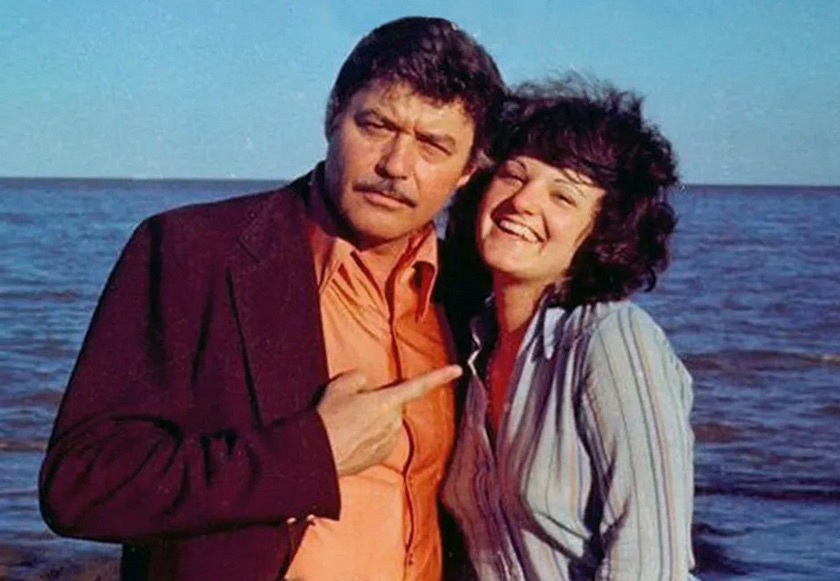
But my instincts that he was in love with his new home for secret reasons were not to be borne out. He actually intended to marry the woman he'd been seeing off and on for several years. But, in a pique of anger over their most recent spat, she'd wed another man! (Not the man shown here! I don't know him.)

The woman, Araceli Lisazo, has described her time with Williams in positively glowing terms. Check out this quote and see if it doesn't melt your butter: "Ours was the love of a novel, from how we met to everything that happened to us, living with him was magical. Never has a man made me feel like this, he made love to me in a wonderful way, I discovered with him that I was multi-orgasmic, although even today no one believes it. He was a unique lover and companion. The first night we spent together we made love all night from eleven at night until eleven in the morning the next day, stopping only to drink champagne and eat nuts. Nobody believes it but he made me have 50 orgasms that time."

Sounds like quite the swordsman, no??! It must be said that when Williams' daughter and ex-wife were preparing a documentary on Williams, they heartily welcomed Lúpiz' involvement, but completely denied the participation of Lisazo. So we may never know exactly what all went down during this mysterious chapter in the actor's life. Living in a variety of furnished apartments, it's been said that he was broke and it's been said that he was rich. There is a lot of disparity in the accounts of his existence during those last years.

What is known is that he sadly died of a brain aneurysm at 65 in 1989. He'd been living a solitary existence for the most part and it wasn't until fellow residents detected a foul scent that his body was discovered by local police. It was an unfortunate end for someone who had given the world a significant slice of entertainment. Initially cremated and laid to rest in Argentina, his son two years later scattered his ashes in the Pacific Ocean, reportedly according to the late actor's wishes. 

Thursday, February 4, 2010

"Hey... You... GUYS!!"

This was initially going to be an idea for New Year’s Eve, a featurette on three different famous Guys with an added shot of Guy Lombardo at the end, but I decided I wasn’t really all that nuts about Guy Lombardo (!), so I put it off. Now, we shall instead take a look at three famous Guys from the heyday of Hollywood and we’ll begin with, perhaps the least famous of the three, Guy Stockwell.

Guy Stockwell was the slightly older brother of Dean Stockwell, a famous child actor who maintained a lengthy TV and film career and is probably best known for his long run on Quantum Leap. Guy and Dean began their career together as teens in a 1943 Broadway play called The Innocent Voyage and a few years they later made the films The Green Years and The Mighty McGurk as well, though Dean was featured while Guy was in uncredited bits.

While Dean’s career as a child star skyrocketed, Guy was out of the picture for more than ten years. However, he grew into a far more virile and handsome adult and eventually was able to win co-starring roles and an occasional lead. One break was as Gardner McKay’s sidekick on the TV show Adventures in Paradise for one season. He also took on many varied roles on the anthology series The Richard Boone Show.

Following this, he won a contract with Universal Studios and began appearing in major releases of theirs during the mid-to-late 60s. First up was a pairing with Charlton Heston in the medieval drama The War Lord, all about the feudal right of a Norman lord to take a local girl on her wedding night to another man and make love to her. In a nod to authenticity, all the men were given atrocious bowl haircuts. Stockwell, it must be said, bore his slightly better than Chuck, in any case.

After supporting Rock Hudson and Claudia Cardinale in Blindfold and working on the movie And Now Miguel, about a boy herding sheep as a rite of passage, Guy acted in a 1966 remake of the Gary Cooper classic, The Plainsman. He portrayed Buffalo Bill Cody to Don Murray’s (of Knots Landing fame) Wild Bill Hickok and Abby Dalton’s (of Falcon Crest fame) Calamity Jane. Rounding out the weird is none other than Leslie Nielsen in a beard, longish hair and cavalry drag as General George Armstrong Custer! With Beau Geste, Stockwell finally got the chance to enact a leading role in a reasonably major remake of another classic story. This time he was paired again with Nielson along with Doug McClure and Telly Savalas, of all people. An exercise in testosterone, there is not one female speaking role in the entire film.
Concerning the departure from England of a disgraced gentleman who then joins his brothers in the French Foreign Legion on duty in North Africa, Stockwell proved his onscreen virility with a whipping scene and a torture sequence in which he was buried up to his neck in the burning sand.

From here, it was back to supporting Rock Hudson, this time in Tobruk, and then playing against Robert Wagner in the golf drama Banning before re-teaming with Doug McClure (and demoted to lower billing) in The King’s Pirate. This was yet another remake (!), this time with the name changed from the original, Against All Flags. Doug does look more than a little goofy in this still from the movie.

Unable to catch a break, none of these films had much of an impact at the box office (in fact, most of them are all but forgotten today!) and Stockwell turned more and more to TV and supporting parts in lesser movies.

He became a frequent guest star on popular late 60s and early 70s series including The Mod Squad, The Streets of San Francisco and Quincy M.E. while occasionally landing a virtual walk-on in a film such as Airport 1975 (that's him behind Chuck Heston in the shades.) One of his last feature films was the 1974 cult flick It’s Alive, about a family whose new baby turns out to be a ravenous monster.

He would work, however, in TV projects through 1990 until his health began to deteriorate. A diabetic, he died from complications of the disease in 2002. Guy Stockwell is not well known, but he deserves to be known at least a little more than he is. His primary body of film work seems buried in a vault somewhere for the most part. My hunch is that those who get to see his films would wind up appreciating him, maybe even more than his more famous brother.

Next on our list of Guys is Guy Williams. Williams only worked on a fairly limited amount of film and TV projects, yet had two major successes, lending him iconic status among both sci-fi and adventure fans. Had things turned out a tad differently for him at one point, he might even have become an important western fixture. More on that later.

Born Armand Catalano in New York City to Italian parents, the lean, 6’3” darkly handsome young man peddled his own photos in order to ignite a modeling career for himself. It worked, too, and he became a success at it. Eventually, he began working in live TV and played small, often uncredited parts in feature films. He toiled away in this manner for several years until a fateful meeting with one of the entertainment business’s leading players.

Walt Disney was personally casting the lead in a television series based on the character Zorro and took a liking to Guy. Guy was, of course, tall, charismatic and good looking, but also had the requisite coloring in order to play the Spanish swordsman. Disney instructed Williams to grow a mustache, “not too long and not too thick,” which, coincidence or not, was very much like his own! Williams also brushed up on his riding, took fencing lessons and even learned to play the guitar.

The show was a roaring success, not only with the kiddie market, but also with adults of both genders. Williams was dandied up in sparkling clothes as Don Diego de la Vega, but then would emerge at the correct time as the dashing and heroic Zorro, carving a Z into various objects to make his mark. His visage appeared on everything conceivable, including a line of comic books.

The demand for the character as portrayed by Williams led the producers to forge several episodes into feature length films and play them in theaters here and overseas. For an entire generation of viewers, Zorro=Guy Williams.

When the series ended in 1961, he went to Italy to take part in the sword and sandal flick Damon and Pythias, in which he played Damon. Williams (who had suffered a violent horse-riding accident in 1953 that left his back scarred) never posed for shirtless beefcake shots, whether due to modesty or some other reason, I don’t know. Family photos in and around the pool demonstrate that he possessed a lean, healthy, hairy chest. Still, he managed to show more than a little leg in this film and very fine legs they were! He then continued to work in another Italian spectacle, this time Captain Sindbad, in which he sported a beard. The elaborate MGM-backed production somehow managed to look garish, lavish and horrendously cheap all at once, but it afforded audiences a chance to see Guy in color (Zorro was a black and white series.)

Returning to the US in 1964, Williams was hired onto the enormously popular western series Bonanza. Principal star Pernell Roberts, who played eldest son Adam, had decided to depart the show and Williams was brought on as a cousin before Roberts’ final episodes were shot as a way of transitioning. Then Roberts, who had bitched from almost the first day of being hired over the quality of Bonanza scripts, decided to stay a while longer (and continued to gripe!) which led producers to write Guy out after only 5 appearances. Thus, he was denied the opportunity to star on the legendary show.

Fortunately for him, Irwin Allen was planning a science-fiction series that was an outer space take-off on The Swiss Family Robinson (in fact, for a brief while, the original working title of the show was Space Family Robinson.) Williams was cast as the father and head of the Robinson family on Lost in Space. June Lockart played his wife Maureen. The pair posed for endless publicity shots in their “oven ready” foil-like spacesuits! (This series also starred the thoroughly edible Mark Goddard as a fellow space pilot on board the ship, the Jupiter II.)
Once the initial pilot was shot, it was determined that the series needed an antagonist and so Jonathan Harris was written into a second pilot as deceitful stowaway Dr. Smith. Thus, Williams, who had always been envisioned as the lead of the show, eventually lost his standing (if not in the credits, then in the episodes themselves) as the series more and more became about the adventures of the endlessly mugging Harris along with Williams on-screen son Billy Mumy and the dryly humorous Robot, which was on board the lost spaceship as an aide.

The series ran for three seasons and very quickly turned from a rather serious adventure show into an increasingly preposterous and garish spectacle. At least it featured, not one, but two differing (and wonderful) theme songs by young John “Johnny” Williams. Guy and June were hardly the first or the last stars to have their series usurped by younger (or more captivating to the public) costars. See also Good Times, Family Ties, Family Matters and, to many people, Will & Grace.

One odd thing I noticed about Guy when watching him on some 1964 color episodes of Password is that he went to great lengths to cover up a small degree of receding hair above his temples. He arranged the sides of his hairline in a convoluted manner in order to create the illusion of a very sharp, straight-across line. If you ever see him in anything from that era, see if you can spot it!

Guy Williams never worked on a scripted TV show or movie after the 1968 cancellation of the show. He was a wealthy man thanks to some very keen business investments and had no need to continue working. In 1973, he visited Argentina and was stunned by the immense popularity he enjoyed there thanks to Zorro. Eventually, he moved there and became a prominent figure in their culture and media, beloved by practically all of its citizens. Sadly, however, in 1989 at age 65, he died of a brain aneurysm and was found dead in his apartment after about a week. He remains, however, a cult figure to many, there, in the US and practically everywhere else.

As Vanessa Williams always warbled, we went and saved the best for last. Our final Guy of the day is Robert Odell Moseley. What do you mean you don’t know him?! Perhaps if I tell you that his name was changed to Guy Madison, it will help. While it’s almost a certainty that you could stop anyone on the street under 45 or 50 and they would not likely know who Guy Madison was, most gay men worth their salt are quite familiar with the man.
A sailor on leave in Hollywood during WWII, Moseley attended the broadcast of a radio program and was spotted sitting in the audience by one of casting director Henry Willson’s assistants. Willson worked for Selznick International Studios and instantly gobbled up the young lad, placing him in a small role in the important film Since You Went Away. It was a bit part, filmed in one day, but Guy Madison (as he was named by Willson, who specialized in giving young actors catchy monikers such as Rock Hudson, Tab Hunter, Race Gentry and the like) elicited massive response from the audience. Letters poured into the studio asking about him, but he was already back in the service fighting in the war!

Having survived his tour of duty, Madison came back to dive into the heady world of (by this time talent agent) Henry Willson’s star-making machinery. He was taught everything from how to dress to how to walk, talk and stand. He was groomed in every conceivable way in order to provide maximum impact. Of course, Willson had an extraordinary original canvas from which to build upon. Madison was already darn close to physical perfection.
Around the same time, Willson was giving the same sort of buff and polish to a former delinquent who was now being primed for screen stardom, Rory Calhoun. Rory and Guy became lifelong friends. (If you believe Willson biographer Robert Hofler, they became much, much more than that! He details an incident that has them going at it like rabbits in the backseat of a parked car.)

Madison was put to work in another major film, this time in a featured role. Till the End of Time was about the readjustment to civilian life of three ex-GIs, the nominal star being Robert Mitchum. Madison was rarely, if ever, praised for his acting ability, but he was blessed with amazing good looks, which captured the public’s attention. His dreamy face and smoothed over manners went a long way in plugging any holes in his thespian talent. This shot of Madison and Mitchum from the film suggests an almost Brokeback Mountain quality that is not present in the actual movie, but it’s fun to dream, isn’t it?

Now ensconced at RKO Studios, one of the lesser places to be by this time in Hollywood, Madison was put to work in various movies, frequently westerns, which were very much in vogue as the 50s dawned and would be so for a long while after. In 1949’s Massacre River, he was cast alongside Calhoun.

Along those same lines, in 1951 he landed the lead role on the TV series Adventures of Wild Bill Hickok and it was a major success, lasting until 1958! He inspired many a small child to learn the difference between right and wrong and amassed a large fan following among kids from this role.

Frequently, in his off time from the show, Madison headlined movies that required little from him, aside from a heroic presence, and he didn’t tend to work with a great many major stars. He did have as his leading lady in 1955’s 5 Against the House, Miss Kim Novak. I can’t say she never had it so good since she also worked with the divine Clint Walker, but she and Guy do make a luscious couple. The heist movie is not considered a classic by any means, but considering Kerwin Matthews is also in it, it’s probably nice to look at.

Before long, Madison was stuck in tripe like The Beast of Hollow Mountain, a Mexican made monster movie flick and so, in time, he felt it necessary to move to Europe and take advantage of the money that was available there to American stars who couldn’t break through to the next level at home. Handsome salaries were being paid there to actors who could headline a movie that would do well in the various foreign markets.

He made the airplane suspense film Jet Over the Atlantic in the US and then spent the better part of the next two decades primarily working in a wide variety of movies produced by Spain, France, Germany and companies of other nationalities.

In the mid-70s, he returned to the US and did infrequent work including bit parts in films or guest roles on television. He appeared in the John Jakes miniseries The Rebels and even popped up on an episode of Fantasy Island in 1979. His final screen role was in the TV remake of Red River, a project that made use of several actors who had once been prominent presences in the western genre. Mr. Madison died in 1996 of emphysema. Married twice between 1949 and 1964, he had four children with his second wife. Whatever his true sexuality entailed, he nevertheless had legions of ladies and gents drooling over him during his peak years and more than a few new fans continue in that vein now!