Showing posts with label Julie Adams. Show all posts

Tuesday, July 7, 2015

Oh, Gawd! Book Two

Here we are again with the second installment of a three-part series. The fifteen-hour, 1978 miniseries Greatest Heroes of the Bible has been partially released to DVD (broken up into hour long segments, four to a disc) and so here we come to disc two.

It kicks off with “The Story of Moses,” though this is actually part two of a two-hour segment devoted to him. We already saw “The Ten Command-ments” on disc one, which came after this (!) and now we get this section, which is missing the first hour of build-up! Messy packaging and presentation. Anyhoo, the stars include Julie Adams as Pharaoh's wife, Robert Alda as his advisor, Lloyd Bochner as his chief henchman and Frank Campanella (!) as Pharaoh. Could there be any less likely people to be found in ancient Egypt??

Even more bizarre is Anne Francis, chiefly because there is not one single (makeup-free!) frame of her in this hour-long story. Moses' wife (the role she was assigned) is absent entirely from this storyline of Moses coercing Pharaoh into freeing the Hebrew slaves. Did she die? (All I know is that in The Ten Commandments, 1956, Yvonne de Carlo was still in the thick of things at this point!) Then there is Frank Gorshin (The Riddler himself!) as a Hebrew still loyal to Egypt and, once again, John Marley as Moses. Just as in “The Ten Commandments,” it is highly jarring to hear Marley's New York accent spout the faux-Biblical dialogue (and this time it's matched by other NYCers like Campanella and Alda!)

Demonstrating significantly more opulence than some of the other stories in the series, this is still feebly papier-mâché when compared to the famous Cecil B. DeMille epic. How could it not be? The very idea of lanky Campanella in what was Yul Brynner's part is amusing enough before you add in the nipple-revealing togas and gaudy headgear. Likewise, the normally covered-up Bochner is handed outfits that are cut up practically to his ball sack. At least Ms. Adams is glammed up and hilariously bewigged, though her role is bereft of the heated romantic elements and delicious campy dialogue than Anne Baxter got to spout. Al Ruscio appears as Moses' brother Aaron, though he was inexplicably replaced by Richard Mulligan in the very next chapter!

Other familiar faces (not worthy of billing in the opening credits) include staggeringly busy character actor Bernard Behrens as an outraged Hebrew slave and Ron Rifkin (later a costar of Alias and Brothers & Sisters) as one of Marley's fellow oppressed cohorts.
The now-familiar story of Marley imploring Campanella to free his people or else feel the wrath of God kicks off with a rendition of Marley temporarily turning his staff into a serpent. Later, he comes to Campanella's outdoor arena and changes the water there (and everywhere) into blood. Not entirely convinced, Campanella saunters over and sticks his finger in it to taste it.
Get a load of some of the outfits that Campanella was forced into. The fifty-four year-old actor was caught with his belly button peering out and was also slipped into what looks like a large diaper... Don't miss, too, Ms. Adams' sizeable wig! It must be a requirement for Pharoah's son to always be played by a highly-annoying child actor. Just as it was in the old DeMille epic, this kid is one you'll be hankering to spank hard.

The plagues continue, be it frogs landing all over the palace floor or – as shown here – a massive swarm of locusts who only bother Egyptians, not Hebrews. As they are represented 100% by tiny animated dots on the screen, the cast is forced to continuously swat away at absolutely nothing while these teensy dots flit about, usually in the center of the picture and nowhere near the actors who are flailing desperately! Irwin Allen must have been drooling over this section as he was preparing his anti-blockbuster The Swarm (1978)!

The back and forth battle between driven Marley and stubborn Campanella continues as the Egyptians are then plagued by boils on their faces. Campanella makes promises, then reneges on them. The biggest mistake he makes, of course, is deciding that all firstborn Hebrews must be slaughtered, since that turns on him and all firstborn Egyptians die instead, including his bratty son.

The camp highlight of Campanella's already crazed wardrobe comes when he darts into his son's room wearing a white habit, a white shawl and a white loincloth, putting us in the mind of something a Mother Abbess might wear in the back yard of her convent if she were desperate to increase her vitamin D intake!

So he finally relents and allows Marley to take his people out of bondage, but still-spiteful Bochner talks Campanella into going after them all and killing them on sight. That's just what he sets out to do, pinning them against The Red Sea, but God has other plans and sets up a walkway for the Hebrews (which comes crashing back down on the Egyptians when they set forth upon it.) This is the point at which the story continues into “The Ten Commandments,” which we've already seen (and recapped) in the prior post.

Next up is “Joshua and the Battle of Jericho,” featuring Robert Culp as the title figure. Also on hand in the male-heavy cast are William Daniels (later of St. Elsewhere) as a shifty city official, omnipresent supporting actor Royal Dano and John Doucette, a veteran movie actor, often as a henchman, who proceeded to appear on almost every conceivable TV western. The latter two portray Culp's fellow Israelites.

Rounding out the credited cast are Sydney Lassick (of One Flew over the Cuckoo's Nest,1975, and Carrie, 1976) as Jericho's decadently evil and flamboyant ruler and Cameron Mitchell as his right-hand military man.
Culp and his sizeable group of followers are camped not far from Jericho, a city full of sin and corruption, which he is bent on wiping out. As a precaution, he has sent all the children of his tribe to a special containment at the rear of his base of operations. He also sends two young gentlemen into the city as spies, telling them to pose as merchants, in order to determine the settlement's strengths and weaknesses. (These actors, Brad David and Rand Bridges, have significant parts, but didn't warrant up-front billing.)

This was the last on-screen role for Bridges, who'd previously landed bit parts in a few movies and on TV. David's career was more substantial, though he was chiefly known for effectively playing strung-out hippies and other troubled young men. As tastes shifted, he found himself only in bit parts before stepping out of the biz in the mid-1980s.

You could search the world and still have difficulty coming up with two bigger hams than Lassic and Mitchell in their scenes together. Lassick parades around in a series of glittery muumuus, flaming out uncontrollably and surrounded by nubile young things. Some token girls are around, but generally there are scantily-clad men, some of them chained up for his (God only knows) bidding! Mitchell, for reasons unknown, has some pasted-on eyebrows that make him look for all the world like one of the Klingons from the original Star Trek!

Like many of the stories told in this series, there is a battle filled to the brim with young men careening around in skimpy togas, often riding up to reveal anything from tiny gym shorts to black briefs. This snap depicts one of the “up the skirt” moments that occur from time to time during the fight choreography.

Another key role, un-billed in the opening credits, is that of a Jericho prostitute who is in the street when all the children from Culp's compound are captured and dragged to a holding cell. Played by Sondra Currie, she helps one of the little girls up who's been knocked to the ground and we see that she's beginning to rethink the vicious behavior of her hometown.

Later, Currie is called upon to dance at a human sacrifice and is unnerved to see that several of the children she's just seen are on the menu! A truly creepy-looking executioner comes out and hacks away at the little ones, including the one (natch!) that Currie helped to pick up off the ground (and who also happens to be the little sister of David and Bridges!)

At the time of this miniseries, Currie had carved out a niche for herself as the star of several sexploitation drive-in movies with titles like Mama's Dirty Girls (1974) and Fugitive Lovers (1975), so it stands to reason that she would be cast as a whore, but fans of The Golden Girls should instantly recognize her as the younger woman who married Blanche's father Big Daddy the time that David Wayne played him! She has also more recently found her way into the series of The Hangover movies as “Linda.” Currie had the same basic hairstyle back then and, apparently, wears it that way still now!

Once Culp finds out that Lassick has been killing off his tribe's children just for the fun of it (it's actually to deliberately goad him into fighting instead of lingering outside the city), he thanks his two spies for the work they've done and then suits up for battle.

In a rather impressive (for this program) display of scenery, the walled city of Jericho is shown up against an impenetrable mountainside. Culp and his men march back and forth in front of the city for several days, finally returning to blow their fabled horns and hop in place until “the walls come a'tumblin' down!” (Actually, they're helped by some fortuitous blasts of lighting, courtesy of the Almighty.) Unintentional hilarity ensues when the towers break apart and send soldiers scrambling upside-down and sideways to the ground below.

Culp and his followers proceed to kill everyone visible in the city with the exception of Currie and her family, who had helped to shield David and Bridges when they were being hunted down by Mitchell's soldiers. Mitchell himself is dispatched by Culp while Lassick is felled by a falling statue (some sort of appropriately fat animal like a bull or a pig!) during all the disastrous goings on.

Our third presentation is a real hoot. “The Story of Esther” gives us one Miss Victoria Principal (!) as the famed queen of Hebrew descent who puts her life on the line with her husband King Xerxes in order to spare her people from slaughter. Noah Beery is her Jewish cousin Mordechai, Michael Ansara is the King's duplicitous second-in-command and, as the King, we have Robert Mandan of Soap!

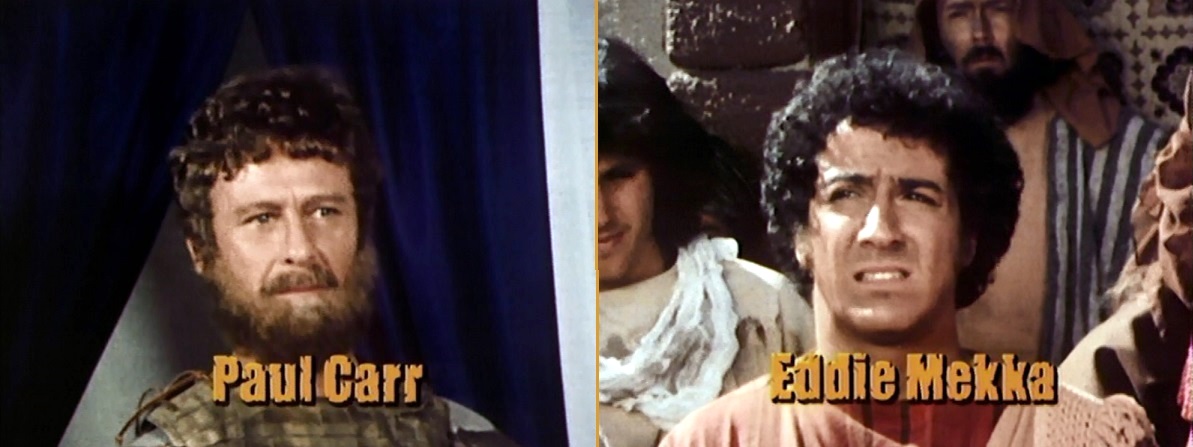
As Ansara's chief henchman, there is ever-busy utilitarian actor Paul Carr and, in a special dollop of camp hilarity, we are presented with Laverne & Shirley's lantern-jawed Eddie Mekka as a rebellious Hebrew whose heroic behavior kicks off a potential bloodbath.
Thanks to the royal aspects of the story, this installment has a certain amount of grandeur to it with regards to the sets. Though nothing about this miniseries can touch the classic Hollywood designs of other countless epics, at least someone out there in the desert was working hard to try to cough up some sort of imposing structure.

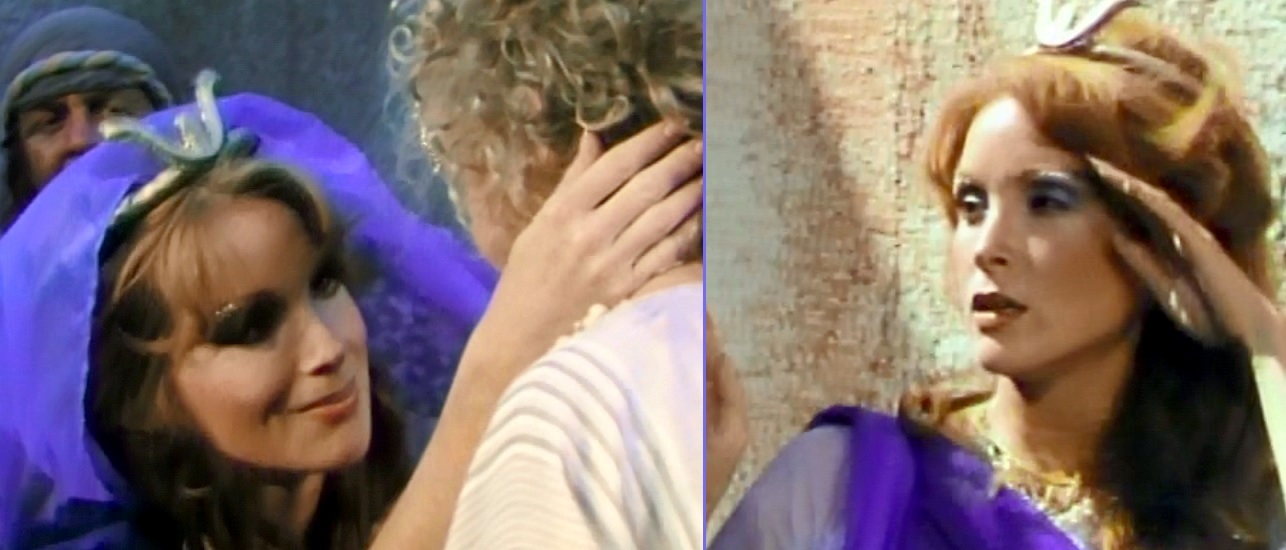
As the story opens, there is heavy unrest between Mandan and the Hebrews living in his kingdom. His soldiers are constantly harassing them and destroying their property. When Mekka resists and antagonizes some of the soldiers, he becomes a hunted fugitive. An old man of the village goes to see the King on his behalf and, for his trouble, is hanged! Principal, decked out in some outre makeup and costuming, wouldn't be out of place on Space: 1999 in this sequence!

It is declared that all Hebrews of the city will be slaughtered on a particular day. Principal, whose Jewish heritage is unknown to her husband Mandan, sneaks out with one of her trusted handmaidens, to warn her cousin Beery of the impending doom. A young boy, Mekka's brother, poses as a trinket dealer and acts as a go-between for Principal and her relatives. Principal has a hilarious come-and-go accent that suggests a Dallas, Texas beauty queen contestant reciting Shakespeare as her “talent.”

Mandan, often guilty of campy overacting in other projects, doesn't disappoint here. Outfitted with a leisure-time piece of headgear that looks like a gold lamé shower cap surrounded by rows of cat ribs, he stews and grimaces and mugs his way through the story. Meanwhile, the imposing Ansara doesn't twirl his mustache, but looks like he may have twirled his curly beard.

It fascinates me that Queen Esther is played by soon-to-be prime-time soap queen Principal (Dallas hit the airwaves this same year), especially since her ratings rival Joan Collins of Dynasty also played the same role in 1960's Esther and the King, opposite Richard Egan. This “Pam Ewing in the Desert” presentation allows Principal to display her usual type of look along with some glamorous get-ups and make-up schemes.

But I digress... After the old man mentioned earlier is killed by the King, his son emerges with revenge on his mind. Previously a loyal member of Mandan's army, he now wants blood because of the way his papa was cruelly offed. He meets uneasily with Mekka to forge a murder plot. (Note the expansive scenery which goes a long way to enhance this sequence.)

The son is played by Michael Anderson Jr., who had once been a burgeoning film actor, but now, despite a sizeable role, didn't even rate an opening credit!
The convoluted murder plot is thwarted by Beery and Mekka, who decide to save the King and expose the fact that Ansara is actually bent on killing him himself, but things backfire and Beery is held captive, soon to be executed. A frantic Principal turns to her faithful handmaiden for solace. The girl is played by Bonnie Ebsen, the not-too-successful-actress daughter of Buddy Ebsen!

Principal begs Mandan to rethink executing Beery, claiming he actually saved the King's life, and tricks Ansara into honoring the man by parading him around town in the royal cloak atop one of his majesty's horses.
Next, Principal has to expose Ansara for the scheming scoundrel he is, so she arranges for him to visit her in her private chambers while Mandan is away. She fans the flames of a seduction, counting on Ebsen to bring Mandan to the room at a key moment, which she does. She also convinces Mandan to allow the Hebrews to arm themselves against the preordained massacre that he isn't able to halt. Thus, it winds up happily ever after (for most of the people!)

The last segment on this disc, “Abraham's Sacrifice,” stars Gene Barry (of Bat Masterson and Burke's Law) as the devout leader. Also on board are his sworn enemy Andrew Duggan, his elderly, barren wife Beverly Garland (positively buried in age makeup) and Ross Martin as a disloyal member of his tribe.

Once more ticking off the camp Richter scale is the presence of Lainie Kazan as one of Barry's servants who has borne him the (illegitimate) son that Garland could not! Rounding out the cast is singer-actor Ed Ames (of Daniel Boone), playing Barry's right-hand man.
The story begins with sheep czar Barry being threatened by a hostile neighbor Duggan, who wants Barry's herd. Duggan's sneering son heads into the fray to take control of the situation and in a bit of a scuffle lands directly onto Barry's ginormous javelin!

With his prized son now dead, Duggan swears revenge on a troubled Barry, who hadn't intended to kill the young man.

Then we meet Kazan, Barry's slave “girl” who resents the second-class treatment that her son receives from his father (not being named heir to the estate because of his illegitimacy, even though he was procreated at Barry's own request!) Kazan is but one of countless New York actors in this project whose jarring accent is completely at odds with the Biblical setting. She plays her part as if she's some back alley call girl from the streets of the Bronx.

She carps and complains like a fishwife while Barry's “real” wife Garland peers out timidly from their tent. Her uncle, Martin, can't wait to plot against Barry and, through the son, take control of everything once the kid has been pronounced legal heir.
Then three angels appear out of nowhere and come into Barry's tent. They tell a shocked Barry (and an even more stunned Garland) that he will soon have a legitimate son via his elderly, long-barren wife Garland.
Sure enough, despite her doubts, Garland soon reverts to the blossom of her youth (complete with glamorous press-on nails and a Loretta Lynn wig) and becomes “with child!” It isn't exactly clear if this was all miraculous or if Barry helped sow the seed himself. Presumably, once she peel back the years, he peeled back the covers on their marriage bed once more!

I'm not really the praying kind, but I must say that I'd be happy to get down on my knees for the angel on the far right! This trio states that they'll return upon the birth of the son, but, sadly, we never see them again in the show.

Martin is aghast that a newborn son and legitimate heir has been born, so he arranges for Kazan and her boy to leave the land for a time, during which he'll dispose of the new kid. Then, when he's sure that Garland can't pop out yet another child, Kazan can return and claim the inheritance for her boy.

About a hot minute after Garland's boy is born, she begins to, as the narrator Victor Jory says, “wither” back into her craggy, wrinkled former self. Martin kidnaps the child and takes him to Duggan to be done in, but winds up being executed himself by the villain for his trouble.

Duggan lures Barry and his men to an ambush, using the boy as bait, but before he can wipe all of them out, The Almighty intervenes and uses lightning and an avalanche to kill Duggan and all his men. But he's not done. As a test of Barry's recently-faltering faith, he orders Barry to kill his own son in sacrifice! Just as he's on the threshold of doing just that, God relents and allows him to proceed with his life, free of any more troubles.

Thus ends this second look at this irresistibly loony miniseries. The third and final part will be unfolding sometime soon!

Friday, February 4, 2011

The Adams Family

Today is a two-fer. Together the subjects fulfill some of my favorite attributes in a performer. On the female side: elegance, glamour and the potential for bitchery. On the male side: cool, manly looks and hunkitude. They were once married and the parents of two sons, though it didn’t wind up lasting in the end (not many marriages do in Hollywood!)

Let’s begin with the lady, Miss Julie Adams. She was born Betty May Adams in Waterloo, Iowa on October 17th, 1926. Soon after, the family moved to Arkansas where she was raised. Even as a tyke in the third grade, the acting bug had bitten and she worked in the school production of Hansel and Gretel. Upon graduation, close to the age of nineteen, she made a movie to Los Angeles where she could live and work as a secretary to an aunt while pursuing a career in the movie business.

It took a couple of years, but finally Betty Adams broke into the movies, first as an uncredited beauty in Red, Hot and Blue and then as feminine decoration in low-budget westerns with titles like The Dalton Gang, Hostile Country, Crooked River, Colorado Ranger and West of the Brazos. Nearly all of these (and more) starred a western dude named Jimmy “Shamrock” Ellison, a cowboy whose legacy is now forgotten except by diehard western buffs.

Somehow, in 1950, she wound up appearing in a screen test opposite Notre Dame football player (and Heisman Trophy winner) Leon Hart, who was under consideration for a movie contract at Universal-International. That's him on the left. He ended up not landing a contract (and wound up playing eight seasons of pro football with the Detroit Lions), but the execs watching the test decided they really liked HER! She was given a contract and her name was changed to Julia Adams.

She began appearing as second leads or (more often) leading ladies in many of the studio’s raft of films. In a lot of cases, she was still making westerns, but these were in color, with larger budgets, and opposite far more important costars. One of the more enduring ones was 1952’s Bend of the River with James Stewart (as well as Arthur Kennedy and Rock Hudson.) She would play a further part in Stewart’s career later on, if a minor one.

In 1951, she had married comedy writer Leonard Stern, who worked on some Abbott and Costello and Ma and Pa Kettle movies and would later work on Get Smart as well as many other TV shows. Unfortunately, their marriage didn’t contain the same degree of laughs as his writing projects did and they were divorced by 1953.
Adams was kept very busy, appearing in movie after movie during the early ‘50s opposite Williams Powell (The Treasure of Lost Canyon), Robert Ryan (that's him above. You know I try never to miss a chance to include shirtless men. Ha!) and Rock Hudson (Horizons West - love Rock's touseled hair in this shot to the right, a break from the usual cremed and combed look.), Tyrone Power (The Mississippi Gambler), Glenn Ford (The Man from the Alamo) and Van Heflin (Wings of the Hawk.)
In Wings of the Hawk, she had a highly unusual role, playing a Mexican lady named Racquel Noriega. Dressed in trousers and with straps of bullets criss-crossing her chest, she was allowed to portray a tough cookie, a departure from her bonnets, corsets and frills, the hallmarks of her parts in most of the western films. The Technicolor film played up her lovely blue eyes.
In 1954, she was assigned to what probably felt like a comedown or a punishment of sorts, though it would wind up, far and away, as her best-known film. A black and white, 3-D monster movie was being planned called Creature from the Black Lagoon. In it, she played a pretty member of a scientific team cruising the Amazon River. Wearing a white swimsuit, she takes a memorable underwater swim (in the Amazon? Really??) where she is accosted by the horrifying gill man. Viewers watching this film with their 3-D glasses would never forget seeing her floating in their midst while the creature lurked behind underwater terrain, waiting to leap out.
Adams had some of Hollywood’s most enviable legs, considered among the most symmetrical and lovely around. The studio had them insured with Lloyd’s of London for $125,000 (one assumes for both, not each!) Her pinup and publicity photos of the time either played up her legs, often depicting her in stylish swimsuits, or accented her glamorous persona with lots of luxurious clothing and plenty of flashy jewelry.

The movie would spawn two sequels, though she was not part of either one.

In 1955, yearning for a new direction in her career and feeling that the name Julia too heavily suggested gentility and other demure qualities, she changed her name to Julie Adams and stuck with that for the rest of her career. Her first film with this moniker was Six Bridges to Cross with Tony Curtis and George Nader. She played the wife of a cop (Nader) who shoots and accidentally sterilizes a young gang member (Curtis) and their lives are intertwined for years after. (What? He shot him in the balls? In 1955??)

Also in 1955, she made a film called The Looters, about a plane crash in which the rescue team not only finds the survivors, but also $250,000 in cash! Costarring were Rory Calhoun and a handsome actor named Ray Danton. Though she had met Danton briefly back in 1953, this time they hit it off and were swiftly married.
In one more of the four films she made in 1955, she was a viciously conniving bitch-goddess in One Desire. Playing a banker’s daughter, she decides that she wants Anne Baxter’s man Rock Hudson and will do just about anything to get him. This deliciously devious sort of part suited her well and was a welcome break from all the good girl roles she’d been playing most often. (One contemporary reviewer at imdb.com refers to her as "Darth Vader" in this role!) This film also featured a teenaged Natalie Wood as a young girl raised by Baxter.

Her final film of that year was the comedy The Private War of Major Benson, which saw her playing second fiddle to boys school taskmaster Charlton Heston and a passel of students. In 1956, she filmed Away All Boats. When I look at the cast, I have to scratch my head as to why I’ve never seen it. Jeff Chandler, George Nader, Lex Barker, Keith Andes and William Reynolds?? What in the hell am I waiting for? She played George’s wife in scenes away from the action.

She also began to appear in television anthology productions for the first time (in shows such as The Colgate Comedy Hour, Lux Video Theatre and Studio One in Hollywood), while maintaining a film career as well. She developed a sophisticated and distinctive voice, one that would serve her well for the rest of her career.

1957 brought Four Girls in Town, the story of four actresses from different countries vying for a role in a big, Biblical epic. Their romantic entanglements took center stage along with the showcasing of the ladies’ lovely looks in gowns and swimsuits (and her costar George Nader showed off his body in a pair of trunks as well. Were his legs insured for anything?!)

Adams continued to balance TV (as in Climax! and Playhouse 90) and movies (including Slaughter on Tenth Avenue, Slim Carter and Tarawa Beachhead, which also starred her real life husband Danton, as her onscreen husband's killer.) As the end of the ‘50s neared, Adams, like many other ladies, found herself appearing in more and more television and in fewer movies.

There was still an occasional feature (like 1959’s The Gunfight at Dodge City opposite Joel McCrea), but she was becoming a very familiar presence on the tube, guest starring on The Loretta Young Show, Cheyenne, Maverick, The Rifleman and other programs. As the early ‘60s dawned, she worked three times on Alfred Hitchcock presents and did several episodes of the cookie-cutter detective series Hawaiian Eye, 77 Sunset Strip and Surfside 6. In 1965, by now almost forty, she played opposite Elvis Presley in Tickle Me as the trim owner of a western spa retreat.

My first real exposure to Julie Adams was unforgettable. The Big Valley was rerun on a local channel at 4:00pm when I was a preteen and I got into the habit of watching it every day. In one of two episodes of the series that she appeared in, she played Janet Masters, the wealthy, attractive wife of a rice distributor and a friend of Barbara “Victoria Barkley” Stanwyck’s. When Stanwyck makes a decision that will benefit most everyone else, but which threatens the financial security of Adams, Adams has her kidnapped and placed in a cellar where she is tormented and tortured into signing a certain document.

She tied Stanwyck up and forced her to look into a rotating colored light, devised to drive a person crazy. She also slashed at her repeatedly with a whip. My innocent little eyes and ears had hardly ever witnessed anyone (especially a beautiful female) being as callous, vicious and determined as Adams was in this episode. She turned out to be just plain evil and after seeing the rerun several times I loved her!
Adams started to become a familiar guest star on practically every popular television show from Ironside to Mannix to The Mod Squad. The late '60s style of false eyelashes, vivid lipstick and creatively swooped hair suited her beautifully and gave her many neat looks while appearing on these programs. Then, in 1971, James Stewart decided to give series television a shot and did The Jimmy Stewart Show, a folksy comedy-drama about the life of a small town professor with a ten year-old son who is younger than his own grandson by first his son. (Confused yet? Ha!) Though Stewart was almost two decades older than her (this is la-La Land, after all), he selected Julie Adams to play his wife. She had enjoyed working with him years before in Bend of the River and was delighted to be cast in the show.

It was not a successful program and only lasted a season, but Adams still considered him her favorite costar and always recalled working on the show with him as complete joy. This series, by the way, marked the only time in his career that James Stewart was billed as “Jimmy.”
In 1974, Adams appeared with John Wayne in McQ and then the following year played Forrest Tucker’s wife in The Wild McCullochs. Her husband Danton had begun directing by then and cast her as a doctor in his horror thriller Psychic Killer. Danton peppered the cast with veteran actors and friends such as Jim Hutton, Aldo Ray, Della Reese and others.

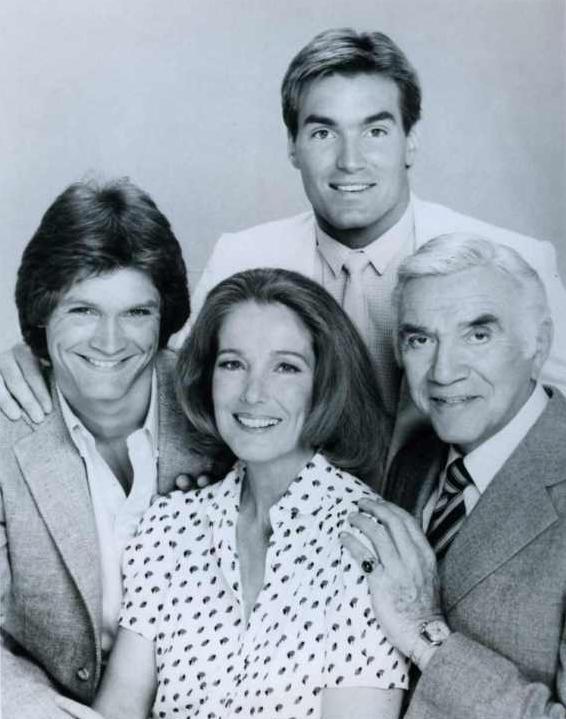
In 1981, Adams played a wife and mother in another series, this time Code Red, about a family of firemen. Her husband was Lorne Greene in this one and somehow they had procreated two very different, but equally adorable sons, Andrew Stevens and Sam J. Jones (both of whom have been profiled here!) That series proved to be short-lived as well, though I would like to know how any show with Jones' beautiful mug in it could not be a ripsnorting success.
It’s not at all clear when the Adams-Danton marriage ended. Different sources list 1967 (which I doubt), 1978 and 1981. I think it’s safe to assume that the marriage was indeed over by 1981. In 1983, she joined the cast of the daytime soap opera Capitol for several years, copping a Soap Opera Digest nomination for Outstanding Actress in a Supporting Role in 1986. (She's third from the left in the front row of this celebratory cast shot.)

In 1987, Adams began making sporadic appearances (ten in all) on Murder, She Wrote as Eve Simpson, an amusingly aggravating resident of Cabot Cove (a place with more than its fair share of homicides over the years!) She was teamed, on a couple of occasions during her time on the show, with other studio-era actresses Ruth Roman, Gloria DeHaven and Kathryn Grayson.

Adams had long been embraced by fans of Creature from the Black Lagoon and eventually began taking part in various screenings, fan events and so forth. Film buffs love it when their leading men and leading ladies last! She was a celebrated guest at many events concerning the film and garners new fans every day. She remains a sharp and captivating interview subject.
And she has indeed lasted. As of this writing she is eighty-four and yet she still appears on episodic television in shows no less popular than Lost, Cold Case and CSI: NY. She even had a small role in the Oliver Stone film World Trade Center. A veteran of close to fifty films and nearly a hundred TV shows, Adams has seemingly played it all.

And now to turn our attention to part two of this post, we will examine the body… er, I mean, the body of work of Adam’s husband, Mr. Ray Danton. I have never been tremendously familiar with Danton, though I have seen him in a few things, but let me tell you, if you don’t know who he was, you will probably want to know after getting a good look at him. One of my devoted divers here in The Underworld, Ima June Pullet, expressed her affection for Danton a while back, so Ima June, this one’s for you!
Danton was born Raymond Kaplan in The Big Apple, September 19th, 1931. While still a preteen, he began acting on radio in a show called Let’s Pretend. Continuing to pursue his love of acting and the theatre, he did many stage roles in school and in college (as a student of University of Pittsburgh and Carnegie Technical School.) In 1950, he had the rare opportunity to perform in London with Tyrone Power in the popular play Mister Roberts.
All dreams of a career on the stage or in the movies were shunted aside when Danton served in the U.S. Army during the Korean War. He was in the service as an infantryman from 1951 to 1954. Upon his discharge, he appeared in a couple of New York based television productions, quickly being snatched up for his tall, dark, chiseled looks by Universal-International Studios in order to portray Little Big Man opposite Victor Mature as Chief Crazy Horse.

His next film, The Looters, is the one during which he fell for Julie Adams and soon married her. His next film was a remake (the fourth remake, actually!) of The Spoilers. He had a supporting role against stars Jeff Chandler and Anne Baxter in the famous western tale involving mining. He then played Susan Hayward’s true, but ill fated, love in I’ll Cry Tomorrow.

He was given the lead in The Night Runner, all about a recently released mental patient with a violent past who tries to start life anew, but has significant trouble in store. Danton’s severe good looks, complete with hooded, dangerously sexy bedroom eyes, made him perfect to play either slick, slimy bad guys or men who look as if they may not be trusted.

In that vein, he played one of Dorothy Malone’s husbands in Too Much, Too Soon, a film (loosely!) based on the life of actress Diana Barrymore, the daughter of the legendary John Barrymore. Here, Danton was basically a nasty tennis bum-cum-gigolo who immediately seduces Malone and convinces her to leave her husband for him.

All along, just like his wife Adams, Danton was being put to work in many TV shows in between movie roles. He appeared in Matinee Theatre, Schlitz Playhouse, Playhouse 90, Studio One in Hollywood and Climax! He and Adams, as stated above, appeared in the film Tarawa Beachhead. In it, he played a marine who kills one of his own men to cover up his own incompetence and then has the audacity to insinuate himself into the life of the man’s widow (Adams.)

1959 brought about one of Danton’s campiest films, The Beat Generation, in which he played a serial rapist called “The Aspirin Kid.” His character, who frequently hung out with beatniks, would go to a house when the husband was absent, claiming to be there to repay a debt, feign a headache and then as the wife was distracted getting the aspirin and water, would force himself on her! Other stars in the film included Steve Cochran, Mamie Van Doren, Fay Spain, Jackie Coogan and Louis Armstrong as himself!

That same year, he was back in Indian drag for a role in Clint Walker’s Yellowstone Kelly. This was followed up by a turn as a part-Eskimo man in the all-star extravaganza Ice Palace, a multi-generational Edna Ferber tale about the settling and industrialization of Alaska. (He's seen here with love interest Diane McBain.)

His most notable role, the one that would stick when film critics and buffs bring his name up, was as the title figure in The Rise and Fall of Legs Diamond. He played the cold, calculating gangster involved in jewel theft, gambling, booze running and prostitution (all handled as carefully as possible under the 1960 guidelines for movie standards.) He would later play the same real life part again in the less popular and lesser-known Portrait of a Mobster in 1961.

He had a regular role in the TV series The Alaskans, broadcast at a time when Alaska was the newest addition to The United States. The stars of the show were Roger Moore, Jeff York and Dorothy Provine and the foursome was given “clever” names like Silky, Rocky, Reno and Nifty… The series lasted one season. He was kept quite busy (now as a Warner Brothers contract player) on Hawaiian Eye, Lawman, Surfside 6, Bronco, The Roraring 20’s and other shows.

He played famous actor George Raft (who he really did not resemble) in The George Raft Story, chronicling the star’s early days as a dancer who becomes entangled with members of organized crime and winds up in Hollywood, where he becomes a major star. Raft had been, in real life, involved with Betty Grable, but her name and likeness were not allowed to be used by the filmmakers, so the character was called Lisa Lang and the role was played by none other than Jayne Mansfield! What an interesting cast and I do love this poster.
He was then utilized in (bespectacled!) support of Alec Guinness and Rosalind Russell in their collaboration A Majority of One. The seriocomic story concerned a Japanese widower (Guinness!) and a Brooklyn widow who fall in love and have to face a variety of cultural and social issues as a result.

He was one of many, many actors to appear in the epic war film The Longest Day. Then he was placed in the revealing role of a playboy carrying on an affair with Shelley Winters in The Chapman Report, a movie I have to see soon or perhaps I will simply expire on the spot. The now-tame film explored the sexual exploits and hurdles of four women (Winters, Claire Bloom, Glynis Johns and Jane Fonda) and their men (Danton, Efrem Zimbalist Jr., Ty Hardin and Corey Allen, among others.)

After his contract with Warner Brothers ended, Danton began to accept work in European films. This was a common practice for a lot of the second and third tier stars of his era. Recognizable faces who had proven their acting ability, but who were perhaps not at the highest level of demand, could earn terrific money headlining adventure films, spaghetti westerns and (later) spy movies.

He made back-to-back films as the fictional hero Sandokan in Sandokan Fights Back and Sandokan Against the Leopard of Sarawak, looking quite fetching in his turban and other ornate regalia. His costar in both of these movies was Guy Madison. (Those who read my tribute to Steve Reeves will remember that he had played this character as well, one year earlier.)
He then appeared in a couple of spy flicks, the ‘60s being a major period for this genre. There was Code Name: Jaguar and Secret Agent Superdragon. The latter film showed off his still impressive figure in poolside scenes that had him clad only in a pair of navy blue swim trunks. All during his time in Europe, he continued to fly back to the U.S. on occasion to accept roles in current television series like Honey West and The Man from U.N.C.L.E. He, like Adams, appeared on The Big Valley as well, as a slick, handsome troublemaker, naturally.
As the ‘60s came to a close, he returned to America fulltime and started working as a guest star on The Name of the Game, Ironside, It Takes a Thief and even Love, American Style. Still good looking (and impossibly tan), he continued in this vein for a few years, making appearances on Police Story, McCloud, Hawaii 5-O, Cannon and many other series. His first appearance on 5-O had him playing a Hawaiian lounge singer and rabid environmentalist and afforded several glimpses of his still impressive physique (he was thirty-nine at the time.)
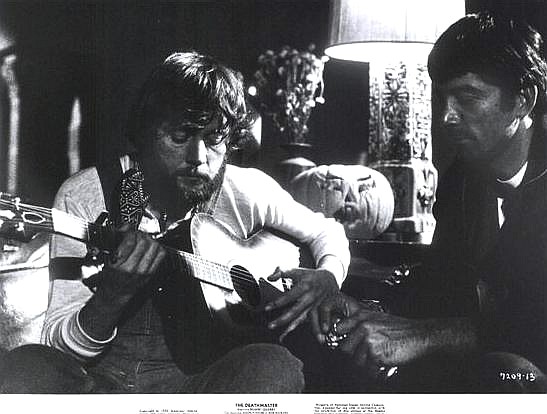
Growing weary of the business and the limits it seemed to offer him, he decided to turn his attention to directing. His first film in 1972 was something called Deathmaster, about a vampire who falls in with a band of hippies, with more than a little of the Charles Manson aura about it (though it is reportedly not a very bloody or violent affair.) The inexpensive production has amassed a cult following and can count among its leading ladies none other than The Young and the Restless star and viral youtube wacko Brenda Dickson. Though he didn't appeat on camera, he is shown here instructing a cast member for a scene.
Then, after making the aforementioned Psychic Killer, he started working as a director in episodic television. He worked frequently on Quincy, M.E. and Cagney and Lacey, but also directed single episodes of Dallas and Dynasty. Cagney star Sharon Gless had met Danton when she was on Switch and fell for his infectious personality. Later, when he became seriously ill, she saw that he had some sort of job on set to keep his health insurance going. Danton was known all through his career for possessing an infectiously fun-loving spirit and he often made dull TV and film sets more enjoyable.

Things came full circle for him in 1975 when he played an Indian named Yellow Shirt in the low-budget revenge flick Apache Blood. It had been thirty years since his film debut as an Indian in Chief Crazy Horse. His last appearance as an actor was in 1977 in an episode of Barnaby Jones, but his directing career lasted until 1989. Long divorced from Julie Adams, he was the father of their two sons Steve and Mitchell. Both Danton men are successful in the television business with Steve a busy assistant director and Mitchell an Emmy-winning editor.

Passing away in 1992 from a severe kidney ailment at the far too early age of sixty-two, Danton left behind a wealth of TV and film acting endeavors as well as a substantial amount of directorial work. A couple of years ago, readers of Robert Wagner’s “autobiography” had their eyebrows raised when Wagner relayed that while filming The Longest Day in 1962, Ray Danton had a room at a local hotel in which he kept, and simultaneously serviced, two ladies while the proprietor charged people to watch him in action through a two-way mirror without his knowledge! While we in The Underworld may be a little disappointed to learn that his tastes ran to such heterosexual extremes, we heartily applaud his confidence, agility and endurance. As my mama often said, “If you’ve got it, use it!”