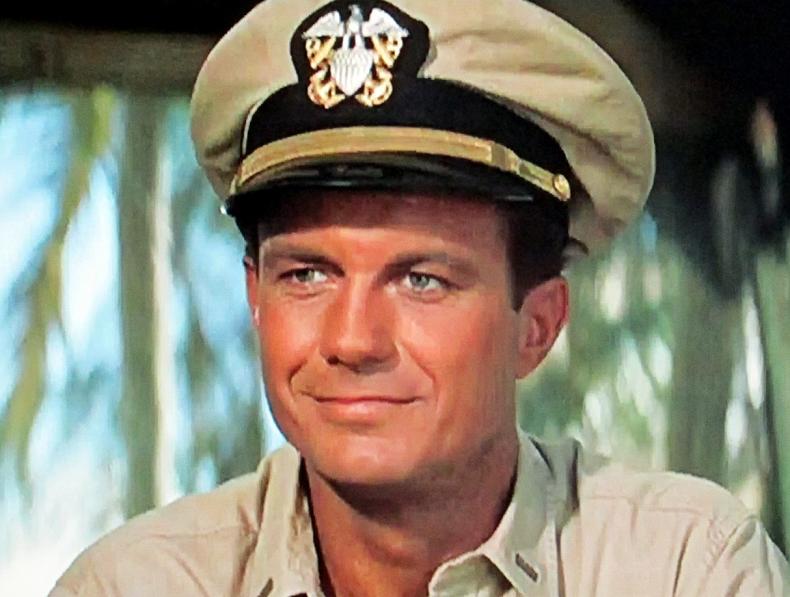
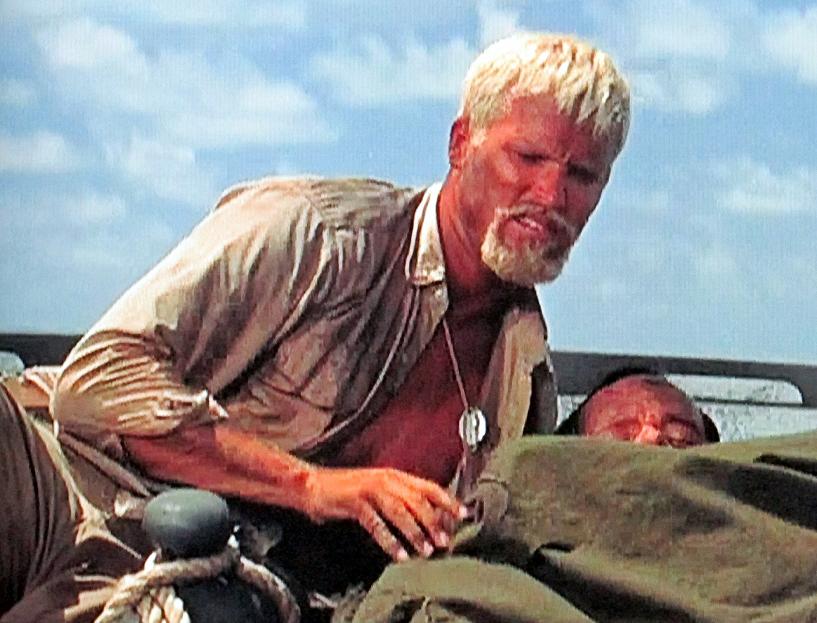
Today we celebrate another gentleman looonng overdue for a tribute here in The Underworld, the husky, handsome, Australian leading man and sometimes adventure hero Rod Taylor. Though primarily famous for two early-'60s films in particular, Mr. Taylor actually worked for half a century as a film and television actor and provided many diverse and entertaining performances. (Along with the usual movie stills and so forth, I'll be peppering this post along the way with delicious shirtless shots of Mr. T. whenever possible!)


Rodney Sturt Taylor came into the world on January 11th, 1930. His unusual middle name sprung from the last name of a great-great uncle (Charles Sturt), who was a noted explorer of the mysterious, sometimes punishing, rivers of untamed Australia. Taylor, always a fit and athletic young man, had some adventure in his blood through Sturt, but his parents also provided a dichotomy of focus in their own professions. His father was both a steel construction contractor and a commercial artist while his mother was a prolific short story writer and author of children's books. So a blend of the rugged and the fanciful came to him naturally.

Taylor attended a technical and fine arts college and intended to become a commercial artist like his father until fate stepped in. He attended a touring performance of Shakespeare with legendary leading man Laurence Olivier starring in it and it ignited an interest in acting in the young man. He began to find work in radio programs and auditioned for (and won) roles on the local stage. In between these gigs, he supported himself as a department store artist and display designer. He married for the first time in 1950 to a model named Peggy Williams.
Again, fate lent a hand to Taylor's career when producers were making a short film re-enacting Charles Sturt's river expeditions as part of a national celebration of 50 years as a Federation. Grant Taylor played Sturt while Charles “Bud” Tingwell was cast as his associate George Macleay. When Tingwell dropped out suddenly to take a role in the feature film
Kangaroo (1952), Taylor was fortunate enough to win the part, though the other Taylor was playing his ancestor instead of him.
Scores of Australians saw this short film, though it didn't lead right away to further screen work. It took him until 1954 to debut in a feature film, that being
King of the Coral Sea, ironically costarring Bud Tingwell! He portrayed an American in the Australian film, something he would do again and again later with ease. He won another role, Israel Hands in
Long John Silver (1954) because the original actor Guy Doleman declined to grow a beard and wear special contact lenses. Grant Taylor, his costar from the Sturt short film, was in this, too, a testament to the tightly-knit circle of film actors in Australia at the time.
His talented, prolific work in radio won him an award whose prizes included a trip to London, but with a stopover in Los Angeles. Taylor made the stopover, but never proceeded to London! Instead he went to work on TV (on
Studio 57 and
Cheyenne) and landed small parts in movies such as
The Virgin Queen,
Hell on Frisco Bay (a very rare example of his playing a villain) and
Top Gun (all 1955.) The writer of
Frisco Bay had worked with Taylor on
Long John Silver and created a role specifically for him in this movie. Also, he and Peggy had divorced in 1954.
In 1956, he had a supporting role in the sci-fi thriller
World Without End as one of a team of astronauts who wind up in Earth's future in the wake of a nuclear war. He was then signed to a contract at MGM based upon his recent work in Hollywood. First up was the fondly remembered family drama
The Catered Affair (1956) which starred Bette Davis (who'd been the star of
The Virgin Queen), Ernest Borgnine, Barry Fitzgerald and, as Taylor's fiancee, Debbie Reynolds. While considered a minor classic now, the low-budget film actually lost money on initial release.
Now ensconced at MGM, Taylor found himself working in big-budget epic films with major stars. He had a small role as Elizabeth Taylor's brother-in-law in
Giant (1956), a positively mammoth film that also featured Rock Hudson and James Dean among many others. Then, after pleading with studio bosses, he won a role in
Raintree County (1957), which starred Montgomery Clift, Elizabeth Taylor,
Eva Marie Saint and Lee Marvin. The expensive production was dealt a creative and financial blow when Clift nearly died in a severe car accident and lost money despite its popularity at the box office.
In 1958, he appeared in
Separate Tables, but with Rita Hayworth, Deborah Kerr, David Niven, Burt Lancaster and Wendy Hiller leading the way, there wasn't much room for him to have a lot of impact. (His role wasn't even in the original stage play, but he was eager to be part of a prestige production such as this and so he took the inconsequential part.) he also kept busy working on several installments of
Playhouse 90 and even an episode of
The Twilight Zone.
Also in 1958, Taylor worked on
Step Down to Terror, a rehashing of Hitchcock's
Shadow of a Doubt (1943) that featured Charles Drake uncharacteristically playing a psychotic serial killer. Taylor and Drake would later be reunited in one of Taylor's most memorable movies,
The Birds. 1959 brought
Ask Any Girl, which starred Shirley MacLaine. Taylor was fourth-billed, but made enough of an impression to warrant (at last!) a starring role of his own. The movie would become his signature piece, one treasured by sci-fi and fantasy fans all over the world, even if parts of it come off as extraordinarily campy now.
Director George Pal, who specialized in fantasy films with eye-popping art direction and special effects, was putting together a cinematic adaptation of an H. G. Wells novel concerning an inventor who manages to create a device that takes him back and forth in time.
The Time Machine (1960) was initially to feature a mature British star like Paul Scofield, Michael Rennie, David Niven or James Mason in the leading role, but ultimately (thanks to budgetary concerns along with a desire to have a more youthful, athletic lead) the relatively unknown Taylor won the part.
His character, a young Victorian gentleman of 1899 London, devises a contraption that transports him to the future (the far-flung future of 1966!) where man has only barely survived a nuclear holocaust. A lazy, noncommittal, blonde race of humans frolics amid lush greenery and rushing water while another strain of green mutants periodically attack and capture them. (This sort of scenario is not dissimilar to 1968's
Planet of the Apes, a movie that Taylor was considered for prior to the casting of Charlton Heston – whose character was named “Taylor!”)
As one of the blonde females in particular who captures Taylor's attention, a newcomer named Yvette Mimieux was cast. Taylor had hoped to get
Shirley Knight for the part, but grew to enjoy working with Mimieux who improved with each passing shot until the director Pal ultimately went back and redid some of her earliest scenes in order to improve the film and her performance in it.
Funny how, in this black and white shot, the “green” Morlocks look like just burly men who have a different head attached! Though, as I mentioned above, certain aspects of the movie are campy and unintentionally funny, the concept was a novel one at the time and the movie was a delight to audiences then and now. With it, Taylor proved he could handle the starring role in a complicated motion picture.
Still, true screen stardom eluded him for now. He journeyed to Italy to make the sword and sandal flick
Colossus and the Amazon Queen (1960), in which he looked tremendously out of place (though no more than many other big stars who took on similar roles such as Rory Calhoun and Alan Ladd.)
He was given a TV series of his own,
Hong Kong (1960-1961), which probably impeded what might have become a more important film career at this stage. He costarred with Lloyd Bochner, playing an investigative journalist to Bochner's chief of police. Next, he put his radio training to use by providing the voice of Pongo in Walt Disney's
101 Dalmatians (1961.)
His next starring role was in
Seven Seas to Calais (1962), another Italian-made film distributed by MGM. In it, he played Sir Francis Drake (sporting a jaunty goatee) opposite Keith Michell and with Irene Worth as Queen Elizabeth I. While in Italy, he fell in with Swedish bombshell Anita Ekberg and the two were engaged, but the marriage never took place.
Instead, he married another model, Mary Hilem, in 1963 and they had a daughter, Felicia, the following year. (Felicia Taylor would later grow up to become a CNN business anchor and correspondent.) But 1963 was a big year for Taylor for other reasons as well. It marked the time of his other highly memorable role, Mitch Brenner in Alfred Hitchcock's
The Birds.
For his follow-up to
Psycho (1960), Hitchcock turned to a Daphne Du Maurier short story about seemingly unprovoked attacks on a coastal community by hordes of birds. He jettisoned most of the original story, opting instead to fashion a sophisticated romance that would be threatened by the birds. He envisioned Cary Grant and Grace Kelly in the lead roles. As Kelly was now Princess of Monaco and unable to take the role, newcomer Tippi Hedren was groomed for it instead and Taylor was cast as her love interest.
Taylor's character was a San Francisco attorney who ventures home on weekends to Bodega Bay where his widowed mother, little sister and ex-girlfriend all reside. When Hedren arrives unexpectedly to pull a prank on him, it coincidentally seems to signal the beginning of horrible unrest amongst the avian population of the town.
With increasing ferocity, the seagulls, crows and other bird species begin pecking away at the townspeople while Taylor has his hands full with the women surrounding him. There is more to be found
here about The Birds and
here about Miss Hedren for those interested in reading more about them.
Incidentally, I've always thought that Rod's outfit in the latter part of the movie, a white oxford with army green cargo pants and brown boots, was strikingly classic and contemporary, fitting for every era from then to now! I don't know if Edith Head worked on that look or if it was something he and
Hitch decided upon.
The Birds was only one of four releases that featured Taylor in 1963, however. He also costarred with Rock Hudson in
A Gathering of Eagles, playing an old war buddy of his who eventually comes into conflict with him (and comes close to having an affair with his wife, Mary Peach, though the affair was cut from the final print.)
There was also the glossy, multi-star drama
The V.I.Ps, which featured Richard Burton, Elizabeth Taylor, Louis Jourdan, Maggie Smith, Orson Welles, Margaret Rutherford and Linda Christian. The bulk of his scenes were with Smith and Christian and, remarkably, this was the very first time in his movie career that Taylor was permitted to play an Australian character! He augmented his dialogue slightly in order to depict the character's home accent.
His final film of this year was the cutesy sex comedy
Sunday in New York, which costarred Cliff Robertson and Jane Fonda. Fonda was playing a twenty-two year-old virgin with Taylor one of her potential lovers (Robert Culp being another.) Based on a stage play, Taylor's role had been played by Robert Redford during the original Broadway run. Jane doesn't seem to be admiring the correct scenery here!
In 1964, he played an airline pilot suspected of causing a fatal plane crash through his drinking habit in
Fate is the Hunter. Glenn Ford starred as one of Taylor's old friends who endeavors to see his reputation cleared up. Many other stars dotted the cast list including Suzanne Pleshette (of
The Birds), Nancy Kwan,
Dorothy Malone, Wally Cox and Jane Russell.
Another very busy year came in 1965 when Taylor figured into a wide variety of movies. There was
36 Hours, which placed him with James Garner and his old
Raintree County costar Eva Marie Saint. In it, he played a German intelligence officer posing as a U.S. psychiatrist in order to extract top secret information from U.S. army major Garner, who is being put through a complicated and elaborate hoax. The film's concept would be cribbed and used in many later TV shows.
A considerable opportunity came with
Young Cassidy, the story of Irish playwright Sean O'Casey, but the trouble-plagued production wound up being only marginally successful. Richard Harris had been set to star, but departed, allowing
Sean Connery to inherit the lead. However, he had to leave to honor his contract for
Thunderball, so – as had happened so many times in the past – Taylor won the role.
Then the director, the legendary John Ford, fell ill and production shut down for a couple of weeks. Cinematographer Jack Cardiff took over, but Siobhan McKenna was lost in the interim, to be replaced by Sian Phillips. Then O'Casey himself (who did approve of Taylor's casting) died before the film was finished! Taylor was reunited with Maggie Smith for this as well as paired with a young Julie Christie, who would break out that same year with both
Darling and
Doctor Zhivago.
Two more 1965 films were still to come,
Do Not Disturb was one in a considerable line of
Doris Day confections, this one featuring Taylor and Day as an American couple relocating to England who encounter cultural hurdles and a variety of screwball marital misunderstandings and complications.
His fourth film of the year was actually held for release until 1966 because of legal wranglings. It was first in what was conceived to be a series of films, ala James Bond, but ended up being a one shot.
The Liquidator had him playing a British intelligence agent named Boysie Oakes (a part that was offered first to Richard Harris.) Oddly, Taylor had by now become so familiar with acting using an American accent that he opted to do so here as well, even when playing an Englishman! This was helmed by his
Young Cassidy director Jack Cardiff. Jill St. John costarred.
1966 brought another, better and more successful, re-teaming with Doris Day in
The Glass Bottom Boat. Filmed partly on and around Catalina Island, he played a research scientist who becomes involved with Day just as she is being investigated by an overzealous security chief (played memorably by
Paul Lynde) as a potential Soviet spy! This second pairing of the stars revealed a more relaxed and comfortable chemistry between them and the movie took in double its budget.
He played the lead in an all-star adaptation of a popular Arthur Hailey novel in 1967's
Hotel. As Peter McDermott, manager of the (fictional) St. Gregory Hotel in New Orleans, Louisiana, he was acting alongside most of the other performers including Melvyn Douglas, Karl Malden, Kevin McCarthy, Catherine Spaak, Michael Rennie,
Merle Oberon and Merle Oberon's hair. Years later, James Brolin would play the same part in the successful TV series
Hotel (1983-1988.)
Taylor, now thirty-seven sought to augment his image to that of a more rugged, adventuresome type and to that end began to produce his own film projects. First up was
Chuka (1967), a western about troubled souls at a remote army fort that is in danger of attack from Arapahoe Indians. With a cast that included Sir John Mills, Ernest Borgnine, James Whitmore and Luciana Paluzzi, it promised a bit more than it delivered, was perhaps more trouble than it was worth and, in the end, Taylor chose not to produce again. Certainly, that awful title didn't help (which was pronounced “Chuck-a.”)
A truly great adventure film was next in line for him, though, with
Dark of the Sun (1968.) He played a mercenary hired to head into the Belgian Congo in order to rescue the mostly European residents of a remote town. He's been hired to do that, but actually has his eye on $50 million worth of diamonds that are located in a mining company's vault. Along on the mission are his old buddy, the towering
Jim Brown, an alcoholic doctor Kenneth More and a vicious former Nazi (Peter Carsten) who provides expert skill in performing the tasks at hand.
Things hit a snag when the train the rescuers are on (which has already picked up recent widow Yvette Mimieux, by now a star in her own right) is delayed in order for the time-locked safe to be relieved of its diamonds. This allows Simbanese rebels the chance to descend upon them in a grisly attack. Later, an infamous fight involving a chainsaw raised eyebrows among critics and audiences.


Once again and for the final time, Taylor was directed by Jack Cardiff, whose terrific career as a cinematographer ensured that the movie had strong visual appeal along with its exciting story. Though the movie was compelling and impressively vivid, it was lambasted at the time for its depiction of violence and torment (some of it sexual in nature.) This makes viewing the film now a somewhat startling occasion since it was much ahead of its time on such counts. Martin Scorsese and Quentin Tarantino are but two of the current directors who have cited the movie as a favorite (and Cardiff proclaimed that the violence and savagery he depicted was but a sixteenth of what was actually occurring in that area at the time.)
In 1968's
Nobody Runs Forever he played an Australian policeman in London to bring Christopher Plummer (the Australian High Commissioner,
The High Commissioner later serving as a re-title of the movie) back to face a recently-discovered twenty-five year-old murder charge. Plummer brooks no resistance, but requests a delay of a few days because of some sensitive peace negotiations set to take place. The glamorous cast also included Lilli Palmer, Camilla Sparv,
Daliah Lavi and Daliah Lavi's hair. (Make no mistake, I LOVE the 1960s'
hair that Lavi and, earlier in this post, Oberon were sporting!)
His last film of the year was
The Hell with Heroes, an African-set WWII drama that paired him with curvaceous beauty Claudia Cardinale and also starred Harry Guardino, Kevin McCarthy (of
Hotel) and Peter Duel. The inexpensively mounted film took advantage of a contract with Universal he'd signed in 1962, promising one more picture and is rarely screened in the U.S. today.
He managed to get involved with director Michelangelo Antonioni (then white-hot from
Blowup, 1966) in his next enterprise, the one and only film Antonioni made in America,
Zabriskie Point, but the protracted project, riddled with issues, didn't see release until 1970 and was a massive failure. It cost $7 million and brought in $1 million. Only many years later did some folks begin to appreciate the cinematography and use of music, but no one has really ever expressed any appreciation for the storyline or the acting, involving sexy teens and a stolen airplane in the Arizona desert.
In the meantime of filming
Heroes and seeing the release of
Zabriskie, Taylor's marriage to Mary disintegrated. He would remain single until 1980 when he married for a third and final time. Another 1970 film was
Darker Than Amber, an adaptation of a novel concerning an investigator for hire who becomes unintentionally embroiled in a murder attempt and a prostitution ring. Also on board were Suzy Kendall, Theodore Bikel, Janet MacLachlan and, in her final movie role, Jane Russell. Taylor was still showing off some chest (and look at the amusing shot below with his gymmies and a flash of undies!)
A climactic fight scene between Taylor and handsome William Smith turned real when one of them accidentally struck the other and the one on the receiving end retaliated. The two men (who've never revealed which one started the “true” fight) began pummelling each other with fists (and teeth!) flying and real blood flowing! This violent scene has made the movie a cult favorite in some circles though there is no full, original, American print to be found.
A lighter project, but decidedly not a better one, was the British comedy
The Man Who Had Power Over Women, which cast Taylor as an Australian talent agent who must not only grapple with a troublesome rock group, but an unhappy marriage and an affair with his best friend's wife (played by Carol White.)
Taylor had been solely a movie star and had not acted on American TV since 1962's
The DuPont Show of the Week, but in the wake of these lackluster movies he must have felt it was time to try another series. The show was an adventure series called
Bearcats! in which he and towheaded Dennis Cole played 1914 soldiers of fortune in the American southwest, taking on various jobs in a Stutz Bearcat. The fondly-recalled 1971 series only lasted 14 episodes before being cancelled.
He filmed a movie of the week called
Family Flight in which he, alcoholic wife Dina Merrill and troubled son Kristopher Tabori crash their private plane in the desert and have to work together to survive the ordeal. Next, he teamed up with John Wayne in
The Train Robbers, though most of the attention in that one went to a young and curvy Ann-Margret.
A cheapjack version of
Trader Horn (1973) was compared quite unfavorably to the 1931 original and costarred Anne Heywood, Jean Sorel and Don Knight (who had also been in Taylor's
The Hell with Heroes.) That same year, he costarred with a man who had so often been first choice for the roles he played, Richard Harris, in the rugged outdoor drama
The Deadly Trackers. It was practically the first villainous role he'd played since first entering films in the 1950s! The two played antagonists with former-pacifist Harris out to get Taylor for killing his family.
A variety of lesser-known international productions followed until he made another stab at a television series. This time, in
The Oregon Trail, he played a pioneer widower who is taking his three children (one of them played by cute
Andrew Stevens) to a new life out west via a wagon train.
In one ep, Andrews Stevens' mother
Stella guest-starred, sporting uncharacteristically dark hair! Like
Bearcats!, it only lasted 14 episodes before being cancelled.
In 1979, he joined a handful of other stars whose “best if sold by” date had either been met or was fast approaching in
Jamaican Gold. He, Stuart Whitman, Elke Sommer, Jeremy Kemp and Keenan Wynn figured into the low-budget diving for treasure drama. He then married for the third and final time in 1980 to Carol Kikumura (shown here), who he remains wed to today.
Several TV-movies followed including
Cry of the Innocent (1980), with a weathered looking Taylor and Joanna Pettet in dual roles (and looking quite annoying in this photo!),
Hellinger's Law (1981), an unsold Telly Savalas pilot, and
Jacqueline Bouvier Kennedy (1981) in which he played the father of Jaclyn Smith who was starring as Mrs. Kennedy.
A couple more movies came about in the early-'80s.
A Time to Die (1982) had him playing with Rex Harrison, Edward Albert and Raf Vallone in a story about a WWII veteran avenging the death of his wife at the hands of the Nazis.
On the Run (1983) cast him as a shady businessman whose young nephew is forced to flee some hit men with Paul Winfield. He was also one of the stars cast in support of the leads in
Charles & Diana: A Royal Love Story (1982.)
1983 brought still another attempt at a regular series,
Masquerade, about a spy organization that recruited civilians who were deemed helpful for a particular mission, with Taylor as the head of it. (Think
Mission: Impossible, but with everyday people in place of most of the agents.) His young costars were Kirstie Alley and Greg Evigan and, similar to his previous efforts, this one was toast after thirteen episodes.
After a Canadian-made thriller called
Mask of Murder (1985) with Christopher Lee and Valerie Perrine, Taylor made yet another TV series.
Outlaws starred him as an 1886 sheriff who, along with four bad guys he'd been pursuing, is catapulted through time to 1986! His casting recalled the fact that he'd made his first big mark in
The Time Machine, but the show just couldn't find a large enough audience and was canned after eleven episodes.
Perhaps feeling it would be better to simply join an existing successful show than try to mount his own, he became part of
Falcon Crest's sizable cast in 1988 and indeed spent thirty episodes there, longer than any of his own shows had ever individually lasted. He stayed there until almost the end of the series' run in 1990.
Occasional projects came along from TV-movies like
Palomino (1991) which reunited him with Eva Marie Saint once more, a few appearances on
Murder, She Wrote and a recurring role on
Walker, Texas Ranger. In 1997, he costarred with Jonathan Schaech in the Outback-set film
Welcome to Woop-Woop. He then retired around 2000 after a two-part episode of
Walker.
He was lured out of retirement in 2007 to take a role in the tacky horror movie
Caw, about flesh-eating ravens, no doubt thanks to his association with
The Birds. That might have been his final movie, but thank Jesus it was not. Quentin Tarantino, who'd been a fan of his ever since
Dark of the Sun, contacted him about appearing as Winston Churchill in his movie
Inglourious Basterds (2009.) Taylor resisted, citing Albert Finney as a more apt choice, but Tarantino persisted until he got his man. Thus, Taylor took the part and avoided something like
Caw representing his movie swan song.
Presumably happily retired to, first, Los Angeles, then, New York City with his wife of over thirty years, Carol, Mr. Taylor can look back on a considerable career in which his charming, charismatic personality, often-rugged, forthright persona and delicious barrel chest has pleased countless fans over the years. He is now eighty-three and, unless some other terrific opportunity comes along, is most likely content to enjoy his well-deserved retirement.