Wednesday, November 11, 2020

Disastrous Demise: Our Sean is Gone...

You may be surprised to see the passing of Sir Sean Connery marked with my label for those beloved stars who helped contribute to the 1970-1980 cycle of disaster movies which changed my life. It's not something he is readily identified with. However, he did headline one of the entries in the genre, giving him a special place in my heart apart from his many other remarkable achievements. We did a pretty expansive photo essay on the physical charms of Connery quite some time ago (which bears revisiting!) if you wish to look him over carefully here. Today, we're going to touch on some of the (other) photos and projects that happen to be favorites of mine, though they may not be his most notable roles. Despite being known far and wide as the first James Bond, he had a remarkable range of movies under his belt when he passed away on Halloween, 2020 at the age of 90.

Born August 25th, 1930 in Edinburgh, Scotland, Thomas Sean Connery was 6'2" tall at age twelve. He joined the navy at age 16 and thereafter performed practically every job imaginable from lifeguard to milk deliveryman to artists model to coffin polisher! An interest in bodybuilding inadvertently led to a gig on stage in South Pacific and, from there, he worked on British TV and the occasional movie, honing his craft.

Connery had long since proven his virility whether it be taking on several members of a violent gang at once or tossing Johnny Stompanato onto his keister following some threatening behavior during Another Time, Another Place (1958) opposite Lana Turner. He had supporting roles in a few moderately successful films before landing the lead in the color Disney musical Darby O'Gill and the Little People (1959.)

It was 1962's Dr. No, his debut as super spy James Bond, that really put him on the map, though. Seen here with sultry Ursula Andress, he amassed thousands of fan letters a week and could hardly walk along the street without being called out as the character (a fact that perturbed him.) Despite the risk of typecasting, even he couldn't deny the staggering success of the part and he proceeded to more films in the series.


To the delight of virtually everyone with their vision intact, he was often shirtless in the franchise and frequently taking a roll in the hay in-between thwarting bad guys.

In the midst of his time as Bond, he worked for Alfred Hitchcock in the psychological drama Marnie (1964), shocking the director by asking to see a script first. (He wanted to be sure he would be doing nothing "Bond-like" in the story.) Some less empathetic or more shallow viewers (such as myself!) had trouble understanding how Tippi Hedren could remain frigid while wed to the palpably sexy Connery.

Regardless of the international success of the James Bond movies, Connery was itching to move on and explore other types of roles. This, even though his latest, Thunderball (1965), was the highest-grossing one to that time and the number one money earner in the U.S. for that year.

Gracing the cover of Life magazine, Connery was now a household name. He walked away from the franchise following 1967's You Only Live Twice, replaced by George Lazenby. (I wonder if Burt Reynolds was in any way inspired by this photo when he opted to wear a torn up scuba top in Deliverance (1972.)

Many of his films from this stage were not barn-burners, but he was exploring different genres and settings, such as in the western Shalako (1968.) Many people dislike it and find there to be no chemistry between him and Brigitte Bardot, but I've always been fascinated by the movie. Perhaps it is because of the way the characters, in their European finery, are eventually deconstructed by some (very!) hostile Apaches. This is a trope that I always enjoyed in the disaster movies.

With The Anderson Tapes (1971), Connery finally scored a decent box office hit and established success outside the Bond franchise. He had, however, by then committed to make one more - Diamonds Are Forever (1971) - whereupon he flatly stated, "Never again!" I always enjoyed The Anderson Tapes, directed by Sidney Lumet, who was a favorite of Connery's.

Surely one of his most unusual roles (not to mention scantily-clad ones!) came with 1974's Zardoz. This part had initially been intended for Burt Reynolds, which one can sort of imagine (though I don't know that Burt could have properly pulled this look off either.)

Definitely pursuing new horizons on the opposite end of the "shaken, not stirred" spectrum.

Also in 1974, he worked for Sidney Lumet again as one of a train-full of suspects in Murder on the Orient Express, a much-beloved movie of mine. He proceeded on to sweeping historical films such as The Wind and the Lion (1975), The Man Who Would Be King (1975) and Robin and Marian (1976.)

On the heels of A Bridge Too Far (1977) and The Great Train Robbery (1978), Connery filmed his entry into the then-hot genre of the all-star natural disaster movie, in this case Meteor (1979.) Co-starring was a somewhat drab Natalie Wood, who accepted her part because it permitted her to speak Russian.

Although the movie wasn't cheap (and was directed by Ronald Neame of The Poseidon Adventure, 1972, fame!), it nonetheless had a cheap look, in particular where the title object was concerned. At least he was surrounded by a variety of esteemed performers from Karl Malden to Martin Landau to Brian Keith and even Henry Fonda, though most of them were far from their highest peak, career-wise.

Connery reportedly lost his shit once when a deluge of disgusting mud was unleashed onto him before he was expecting it, which is rather understandable.

Nonetheless, most of the on-set shots from the movie seem to depict a happy experience. The day this climax was filmed, an impish Connery pretended that he was going to drag a visiting Dinah Shore into the muck with him! The movie is not terrific, but I love every one of these films, which sparked my childhood imagination incredibly.

After filming Cuba (1979), Connery was off-screen for two years when he returned with a new look in Outland (1981.) A reworking of High Noon (1952) in outer space, he sported a scruffy beard and a close-cropped hairpiece.

The still-handsome, still-virile remained in demand as an actor (though shooting overruns on Outland cost him a featured role in Chariots of Fire, 1981, a Best Picture Oscar-winner.) In 1983, he would do something he swore he'd never do...

In 1983, Connery was coaxed back to the role which made him famous, James Bond, in the aptly-titled (and suggested by his wife) Never Say Never Again. Made by a rival company of the one who produced the franchise, it was a remake of Thunderball, a property partly owned by said rival. While reasonably successful, it was a highly-troubled production and that truly was the end of Connery in the role.

Mr. C was aging handsomely and lent his authoritative and commanding presence to various films including, as seen here, Highlander (1986.) He could still star in a picture (such as The Name of the Rose, 1986), but more often than not he was a prominent costar for much of the time now.

In this portrait from Highlander, he somewhat resembles Stanley Baker, a Welsh actor on whose film he worked way back in 1957.

The Untouchables (1987), in which he lent some heart to the Brian De Palma redux of the famed television series, copped him a Best Supporting Actor Oscar and he parlayed that into a wave of new high-profile roles. Here, he's seen as Harrison Ford's father in Indiana Jones and the Last Crusade (1989.)

Among many other hit movies of this period was The Hunt for Red October (1990), in which he helped bolster Alec Baldwin's debut as Jack Ryan in what would become a series (though Harrison Ford took over the next two entries, none of which contained Connery again.) He remained a sought-after performer up into the millennium until The League of Extraordinary Gentlemen (2003) soured him on the process and he retired. A decision to decline the role of Gandolf in The Lord of the Rings trilogy (claiming not to understand the script) cost him an estimated $450 million! But Connery virtually always did things his way.

Easily one of the most notable movie actors to come out of Scotland, Connery had come from delivering milk on a truck route to enjoying international superstardom. Sadly, his final years were affected by the onset of dementia, one of life's more cruel diseases.

He's now at rest, but left behind one impressive resume of stirring movies. (I guess I could have cropped out these bottles! But, hey, like many actors and others he liked a drink or two after work...)

The End!

Tuesday, November 3, 2020

Guest Who: Hammer Time!

There have been countless TV series devoted to police work, from the procedural (Dragnet) to the family friendly (Adam-12) to the hip (The Mod Squad) and beyond. However, 1972 brought about the exemplary anthology series Police Story, peppered with top writers, directors and performers who brought an edgy, adult, sometimes bleak, angle to the proceedings. With a (nearly always) different cast each week, there was freedom to present practically any type of story. There were some topics covered that episodic TV had heretofore barely allowed, especially with the gritty handling afforded them here. I can't forget to mention the arresting music for the series as well. The gallery of actors and actresses who pop up on the show make it a joy to behold, but this time we're going to zero in on one who certainly caught our eye. It was the very first episode of the series, following the pilot, and was directed by John Badham (who six years later would helm a little something called Saturday Night Fever!)

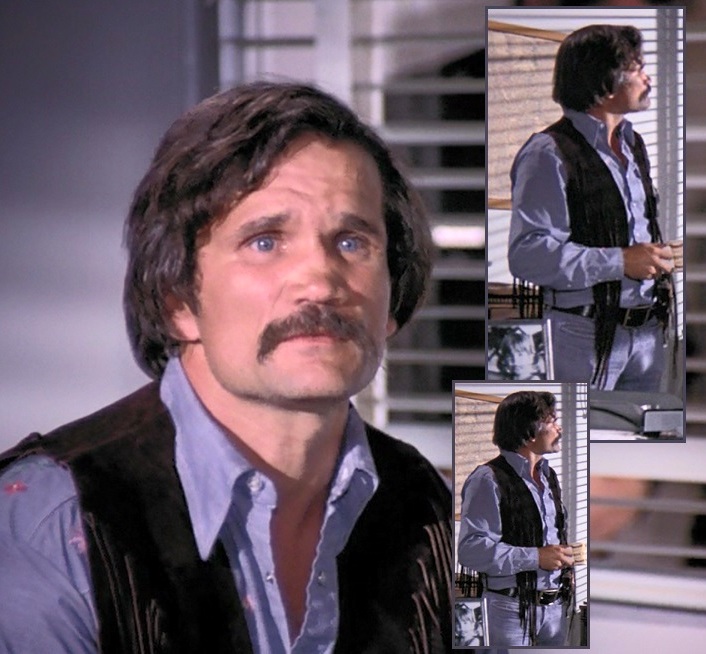
The ostensible star of this installment is James Farentino, a busy actor of the 1960s and '70s who also later popped up in the second season of Dynasty. Playing an undercover cop who is trying to infiltrate a prostitution ring, he goes ALL-IN with the deliciously crazed clothing options of the early-'70s. One could look far and wide and come up empty-handed when trying to out-do some of the get-ups he has on here. Interestingly, he also plays opposite one of his ex-wives, Elizabeth Ashley, and they even have a love scene, despite having divorced seven years prior!

It's 1972, baby, and no one has ever been able to truly duplicate that overall look and vibe of the people, places and things. Today's cameras always make it all look too glossy and nice (and sharp.)

The photo with the little boy in his arms is of the character's ordinary street clothes. I included that because of the fit of his jeans. You might recognize buxom Francine York in the happenin' yellow ensemble.

Take note of The Underworld's favorite extra, Leoda Richards, in the thick of things above-left as always! While the lower-left outfit was one of the more eye-popping, I really dug this blue see-through shirt, open to the navel...! One of my very earliest posts at Poseidon's Underworld zeroed in on this 1970s look.
This being the '70s, it seems like every third character is sporting a bulge (another one of my earliest observations, which spawned a whole series of posts on the same theme.) The actor above, Eric Server, was playing a character called "Royster," who would later figure prominently in a Police Story spin-off.

Here we have Charles Dierkop who, interestingly, would take over the character of "Royster" in a later episode of Police Story and then carry it on to the spin-off show Police Woman, which starred Angie Dickinson. Dierkop is also sporting some revealing jeans, as he nearly always did on the show. But these are really just appetizers prior to the main course, which is about to be served...

Special guest star in this episode, and playing the villain of the piece, is Fred "The Hammer" Williamson. Williamson was a pro football player (known for hammering his opponents on the field with a swift arm chop!) who retired in 1968 and followed the lead of Jim Brown by turning to acting for a second career. He had a recurring role on Julia as Diahann Carroll's handsome boyfriend and later became a key figure in the Blaxploitation genre of tough-ass action flicks.

Here, he's a highly-charming, yet highly-dangerous, pimp with a penchant for roughing up the women around him. Here, he's even wielding the knife end of a corkscrew to show Farentino what can happen to those who cross him.

This moment, the first real scene with Williamson, was the one that was eye-popping. Greeted by the undercover Farentino (who is accompanied by Ed Bernard, who would also become a regular on Police Woman), Williamson is working one jaw-dropping white-on-white combo.

Hammer time, indeed!

It takes a lot to draw attention away from Bernard's funkalicious outfit, but Williamson manages to do so. Did I mention his character's name is "Snake McKay?!"

During a side-view, we can make out his tighty-whitey briefs.

Only in the '70s, folks...

Even when he's dressed in traditional men's wear, he got a fair amount of torque going on the crotch. He's seen here with Elizabeth Ashley. The clothes sprinkled throughout this episode are about a captivating as the story line.

Here we find Mr. Slick in one incredible jacuzzi...

The one concession to television standards and practices is that his woman is wearing a bikini. You know in their own backyard she'd at least be topless in the real world.

Williamson had, at this time, gone from supporting parts in movies such as MASH (1970) and starred in a couple of his own, notably Hammer (1972), but would very soon explode as a go-to guy in a whole series of rough and ready, lowdown action flicks. Many of these, albeit not for every taste, are among the mostly highly-regarded of the genre. 

He also, soon after this, would become one of the earliest male celebs to pose semi-nude for Playgirl. (In its earliest days, the famous men often showed almost everything instead of everything, though that would soon change - as when Williamson's peer Jim Brown posed a year later in 1974.)

You didn't really think I was going to wrap this up without presenting a couple of examples from that shoot did you?

I wouldn't dare caption this any further... Ha ha!

The End!

Tuesday, October 20, 2020

Deja View - Travel Trauma

COVID19 shelter-in-place viewing has led to a reliance on satellite TV to bring obscure, potentially interesting things to my attention. (Yeah, I also have Netflix, but I watch precious little new material.) One of my high-def movie channels recently dredged up the 1973 western movie Showdown, which I swear I never even knew existed! It's stars, Rock Hudson and Dean Martin, are perhaps not my very favorite, but they are interesting enough to me that I wanted to see the pairing (and, they are, after all, members of the imaginary Disaster Movie Club.) While watching the opening sequence of the film, I was immediately struck with a sense of deja vu. What makes that all the more intriguing I will get to in just a moment...

As a train choo-choos its way across the western terrain, Martin is seen wearing a sheriff's badge and transporting a prisoner who's shackled to the overhead luggage rack. When the train is stopped by a pile of logs on the track, it's clear that a robbery is about to happen and Martin stands up to plead with the passengers to hand over their valuables to him for safe keeping. Something about this moment set off a bell in my head (oh, there are plenty up there... Ha ha!) Can you guess where I'm going?

Yes, I have to say that the way Martin stood in the aisle with the passengers on the train turned and looking reminded me of a similar moment in Airport (1970) when Martin, as the pilot of a passenger aircraft, was forced into pleading with a despondent man to resist setting off a bomb he's carrying which would blow the plane and everyone in it to smithereens! Both moments were featured in publicity stills for the respective films. Still not convinced? See below:


But what's more intriguing is that Showdown was directed by George Seaton. It was the final film of the seasoned director (who won an Oscar for writing Miracle on 34th Street, 1947, which he also directed.) He's seen here coaching Martin for the scene in question.

And guess what? Airport was also directed by Seaton! He's seen here on the set of that film giving direction to Martin, who he obviously enjoyed working with enough to bring him back for his next project. How nice for Martin that his blocking didn't wind up being demonstrably different for the first scene in Showdown! He'd already gone through the motions on Airport. Airport was, of course, a gargantuan hit that spawned three follow-ups while Showdown virtually descended into the nether regions. I hope you found this little moment in the cinema firmament amusing. I'll be back soon with something else that grabs me.

Double the Deano. Makes for interesting bookends.