Hello, my devoted followers. Did you think I had forsaken you lately? This month is an all-time low when it comes to the frequency of posting! I assure you I am still in the blogging game, I've just been caught up in a tidal wave of activity, some good and some bad.
Not only did the Thanksgiving holiday bring a busy four-day weekend of family commitments, but I've been attending many theatrical productions (one of which required me to write a nine-page critique!), several parties and have begun my seasonal part-time job at night. Then at work I was flooded with all kinds of extra duties because of some unscheduled absences. If all this wasn't enough, I've also had a next-door neighbor die, the husband of a co-worker die, the child of my best friend in the hospital near death and the wife of another good friend leave him for one of his "frenemies." So there's been plenty of hand-holding and so on. Peyton Place was never this full of tragedy and angst!
But I will be back ASAP with more Underworld merriment, I promise!
Monday, November 26, 2012
Wednesday, November 14, 2012
Right on the Mark!
When we profile an actor in The Underworld, it's often due to his handsome looks rather than for any Herculean acting talent and today is no exception. However, what today's featured performer had in addition to boyishly adorable features was a well-placed heart with a desire to be a constructive role model to others. And he certainly wasn't a bad actor. He just never made significant enough inroads in that field to sustain a lasting career (and there was more than a little stigma left over from his most famous part!) We refer to 1960s dreamboat Mark Goddard.
Born Charles Goddard on July 24th, 1936 in Lowell, Massachusetts, he was the last of five children born to his parents. Always an athletic young man (and six feet tall), he helped bring state-level glory to both his high school baseball and basketball teams. He even toyed with the idea of pursuing a basketball career, but turned to the idea of acting instead, no doubt thanks to his lean, good looks.
Two years in to his studies at The American Academy of Dramatic Arts in New York City, he opted to head for Los Angeles, California where the promise of television and film work seemed more likely. This was 1959, when westerns ruled the television airwaves and though young Goddard had practically no experience with horses, his healthy physique could support the cowboy drag with ease. After being in town only three weeks, having brazenly called contacts he didn't know and headed to movie lots without an appointment, he got lucky.

One of his first gigs was a guest spot on Chuck Connors' The Rifleman. He then caught the eye of producer Aaron Spelling who was producing his very first series (of many, many to come), a western called Johnny Ringo. Spelling wanted a young deputy to play opposite the series' star, singer/actor Don Durant, and settled on the novice actor.
Upon the advice of Chuck Connors (perhaps due to his TV son's character name of Mark McCain, played by Johnny Crawford), Charles Goddard had adopted the new name of Mark Goddard. Thus, Durant, Goddard and Karen Sharpe began starring in what was a reasonably successful show. (Sharpe was fired about halfway through the season in a dispute with Spelling over playing the character her way, as a gutsy tomboy, or his way, as a delicate lady.)
In between the pilot and the series production, Goddard was drafted into the army! He was discharged in time to do the show, but his curly locks had been chopped shorter in the process. Even though ratings for the series were decent, the glut of westerns on television (thirty on the air at this time!) caused the program's sponsor to pull the plug on it and support a sitcom in its place. All was well, though, because he now had experience and contacts. He did several guest appearances on shows including an installment of The DuPont Show which costarred Myrna Loy, The Chevy Mystery Show with Walter Slezak, Nick Adams' The Rebel and an episode of Zane Grey Theater opposite Tuesday Weld (as shown here.)
Even better, he was signed on for the second season of an existing series called The Detectives Starring Robert Taylor. The series starred former movie superstar Taylor and was undergoing a cast shake-up, which left room for an additional character. Goddard joined Taylor and fellow costar Tige Andrews (later to costar on The Mod Squad) and, for one season, Russell Thorson, who departed in 1961.
Do you know who he's posing with in this publicity shot from The Detectives? It's Donna Douglas, prior to her embodying (for all time, apparently!) Ellie Mae Clampett on The Beverly Hillbillies!
Goddard was with the show from 1960 to 1962, the third and final season being an hour-long program instead of thirty minutes. Adam West joined the show during that season as well. Goddard next filmed a semi-musical, Desilu-produced TV pilot with Ethel Merman called Maggie Brown, about a single mother who operates a South Pacific-set nightclub frequented by sailors (sign me up!), but it didn't come to fruition.
In 1961, Goddard married Marcia Rogers and the two proceeded to have two children together. They generally seemed a happy couple and were socially active amongst their peer group in Tinseltown. They were particularly close to a starlet named Karyn Kupcinet who was a busy TV actress in the late-'50s and early-'60s and who was dating fellow actor Andrew Prine.
Unfortunately, Kupcinet (seen here with a young James Caan) was a very troubled young lady with a propensity for diet pill abuse and a roller-coaster relationship with Prine, who was not as on-board with monogamy in their relationship as she was. She struggled with depression and anxiety over her obsession with her weight and with Prine until one day Goddard and his wife found her dead in her apartment! She was nude and seemed to have been strangled.
Countless theories popped up about it; everything from an accident occurring during a nude dance to a mob hit in relation to the Kennedy assassination. Her autopsy was reportedly mishandled by a coroner with a drinking problem. Prine was also questioned. The case, however, was never solved and remains that way to this day.
Goddard was a frequent guest star on many of the hit TV shows of the time, in a variety of genres. He did Burke's Law, The Beverly Hillbillies, The Bill Dana Show, The Virginian, Gunsmoke, Perry Mason and The Fugitive. He also landed yet another regular series role, this time on the sitcom Many Happy Returns, as the son-in-law of a fussbudgety return department store clerk played by John McGiver. As shown here, Elinor Donahue played his wife. The show only made it one season from 1964-1965.
A first for Goddard came in 1965 when he made his debut on the big screen. The bad news is that it was in the trifling Disney comedy The Monkey's Uncle, starring Tommy Kirk and Annette Funicello (and a chimpanzee!) The film was a hit with kids, but added little, if any, luster his career.
A more provocative part came his way that same year in A Rage to Live, all about the struggles of a nymphomaniac (played by Suzanne Pleshette) who is deflowered as a teen by one of her brother's friends (played by Goddard) and decides she likes it! She proceeds to attract a variety of men from Bradford Dillman to Peter Graves to Ben Gazarra.
Goddard's appalled mother in the film was played by Brett Somers, who would later go on to fame as a regular panelist on Match Game. His horny, sometimes rude character gave him a chance to play something different than the idealistic good guys he'd come to portray most often. You can read more about this deliciously faux-dirty movie here in a profile I did on it a while back.
Any further immediate forays into the movie business would have to wait, however. He had agreed to costar in a pilot for still another TV series and this one would not only be picked up, but would run three seasons and, more importantly, become a cult culture touchstone that survives vigorously to this day. The pilot was called “Space Family Robison,” a riff on the Robert Louis Stevenson classic novel Swiss Family Robinson, and concerned a father and mother with three children who depart the Earth in a spaceship along with one fellow astronaut (Goddard) only to be stranded in outer space, unable to return home.
After the pilot was shot, it was determined that there should be an antagonist on board who could be part of the series to provide conflict. So the pilot was re-shot with the addition of Jonathan Harris as a crafty saboteur named Dr. Smith. It was also renamed Lost in Space. Because all of the billing for the show had been contracted previously, Harris suggested and obtained “Special Guest Star” billing for the run of the show, the chief stars being Guy Williams and June Lockhart.
From the start, Goddard regretted signing on to the show since he was on the threshold of finally obtaining a movie career, but it turned out to be a success. Ironically, even though his own role and that of the other adult stars wound up being shunted to one side in order to showcase Harris, child actor Billy Mumy and the famous Robot, he found himself becoming extremely fond of the literate, articulate and flamboyant Harris. They would become lifelong friends. (Harris' character, a highly effeminate variation of Clifton Webb with a dollop of Martita Hunt tossed in, could not have come off as more gay, though the actor himself was reportedly not so.)
Goddard was paired often with the eldest child of the Robinson family, played by Marta Kristin. As a youngster watching the series in reruns, I couldn't quite decide if I wanted to strangle Kristin out of jealously or simply be her so I could cling to the delectable Goddard every time something threatening happened. They certainly made an attractive couple (and their romantic relationship was downplayed more and more as the series progressed, resulting in practically nothing by the end.)
Now we know that this below is absolutely nothing more than a suggestive fold in the trouser leg of Mr. Goddard's and not a representation of Mark Jr., but isn't it fun to momentarily presume otherwise? (Click to, er, enlarge! LOL)
Lost in Space began in black and white, with a comparatively serious and sinister tone, but in its second season switched to color. The clothing of the actors thus became almost comically garish, with plenty of bright orange, pink, yellow, green and rust velour in various combinations. It took quite a man to pull off some of these looks and Goddard succeeded on that count.
Still, with Harris, Mumy and the Robot (who was regularly insulted by Harris in a never-ending series of alliterative ad-libs such as “Nickel-plated Nincompoop” or “Miserable Mass of Metal”) stealing 90% of the focus, Goddard's contributions, like the others, became more and more negligible.
During one of the hiatuses of Space, Goddard accepted a film role which afforded him something different to do rather than yell at the scheming Harris or fend off “killer vegetables” (Lost in Space had begun to devolve to that level.) The Love-Ins was a thinly-veiled (yet enhanced) rendition of the LSD-espousing Dr. Timothy Leary.
Richard Todd played the lead, James MacArthur (Danno of Hawaii 5-O fame) and Susan Oliver were a couple of his followers and Goddard was one of the chief drug dealers who is enmeshed in the “far-out” and “groovy” storyline (which is filtered through the staid sensibilities of Columbia Pictures versus any other gritty independent company.) Needless to say, this movie did not signal a new era in Goddard's cinematic career.
In the wake of Lost in Space's cancellation (in 1968), Goddard and Marcia were divorced after eight years of marriage. He also returned to the occasional TV guest role such as on The Mod Squad (shown at right) and on Adam-12 (a special episode in which he played, in flashback, Martin Milner's best friend, an officer who is killed in the line of duty.) That was in 1970 and his career momentum slowed considerably after that. He remarried in 1970 as well, to actress Susan Anspach, then on a roll from Five Easy Pieces.
He took a minor, unbilled role in the 1972 Woody Allen film Play it Again, Sam (in which Anspach had a bigger part), but didn't work on screen again until the 1974 TV-movie The Death Squad. Here, he joined Robert Forster, Claude Akins and Melvyn Douglas in a story about vigilante policemen who have been killing criminals who in their estimation weren't dealt the proper hand of justice by the court system. The project was a swiftly-made cash-in on Clint Eastwood's Magnum Force, which was on the verge of release (and, in fact, came out two weeks before this telefilm aired.)
Again, he made ends meet with plenty of guest work on shows like Barnaby Jones, Petrocelli, Switch, The Streets of San Francisco and Quincy, M.E. Then he took part in what is surely one of the most unusual blips on his resume. Still tan, lean and handsome, he took a featured (but non-singing) role in the 1977 Broadway musical The Act, all about a fading film star staging a comeback on stage in Las Vegas. The star was portrayed by none other than Liza Minnelli, who won a Tony for her work (despite plenty of absences and uneven behavior during those heady, Studio 54 days.) The overpriced show ran for 233 performances, but was incapable of making back its money. (He almost has a Billy Crystal thing going on here!)
By 1978, his marriage to Anspach was over. (The split may or may not have had to do with Anspach having a child that she later claimed to belong to her Easy Pieces costar Jack Nicholson!) Goddard did take a supporting part in an oddball 1978 thriller called Blue Sunshine, which starred Zalman King (later to enjoy a measure of success directing a series of Red Shoe Diaries softcore movies.)
It concerned the aftermath when some 1960s hippies had taken some LSD in their youth only to wind up a decade later losing their hair and morphing into zombie-like killers! Goddard played a politician who was in danger of flipping out any moment thanks to his prior drug use. The generally obscure, low-budget movie retains a cult following these days.
During this catch as catch can phase of his life, he popped up on Benson, B.J. and the Bear and also played the bad guy (albeit a rather tame one) in the craptacular mess Roller Boogie (1979.) He portrayed a shifty land developer who wants to buy up a Venice beach roller rink, much to the dismay of Linda Blair (yes, that Linda Blair) and her spandex and satin-clad cronies. After taking nearly an hour to show up in the 103-minute film, he is ultimately fended off with (I'm not making this up) projectile fruit...
Understandably, considering the caliber of work available to him, Goddard welcomed the opportunity to begin appearing on daytime television. First came a stint on One Life to Live in 1982, followed by another on The Doctors in 1983. In 1984, a longer assignment came with a role on General Hospital, then the #1 soap opera on TV, in which he played a character named Derek Barrington (no doubt inspired by the #1 prime-time show Dynasty's Blake Carrington.)
After departing General Hospital, he played a guest role on Jake and the Fatman and then did something rather unexpected. At age fifty, he went back to school in his home state of Massachusetts, earned a Masters Degree in Education and proceeded to become a teacher at a school for students with behavioral problems. At this stage in his life, he saw no use in waiting around for the scarce decent acting gigs that might come his way and was determined to do something positive and fulfilling.
Having costarred in one of science-fiction television's most enduring favorites, there was no chance he was going to be completely forgotten, but he was anonymous enough to the younger generation of students for his fame not to be too much of a distraction. He also began to make the rounds at various conventions and fan events in his off time, frequently appearing with Marta Kristin once again. In 1990, he married for a third time to a lady he met in Massachusetts and remains with to this day.
In 1998, renewed interest in Lost in Space came about thanks to a big screen remake (you know, how every conceivable TV show under the sun was being re-envisioned as a feature film? Usually a shitty one...) He was approached to make a cameo appearance along with all of his surviving costars and he did, as a General. Mumy, however, was bumped out of his cameo when it was declared that having him play his old character as a grown-up would be too distracting and then-eighty-four year-old Harris flatly refused the entire enterprise, proclaiming, “I will have you know I have never done a walk-on or bit part in my life! And I do not intend to start.” Goddard's role was taken on in this new version by... Matt LeBlanc...
Also in 1998, a retrospective special called Lost in Space Forever was done in which Harris and Mumy reprised their roles (along with the Robot, naturally) and the rest of the cast, including Goddard, reminisced about their time on Lost in Space.
Having gotten his toes wet in the public conscience again, he took on a supporting role in an independent film called Overnight Sensation (2000.) In it, he played a washed-up agent who helps a novice writer drum up interest in his screenplay while attending the Sundance Film Festival. Sean Dugan (later to work on the TV series Smash) and Maxwell Caulfield were among the other performers in the little-seen film.
A final (to date anyway!) role came in 2010 with the obscure, low-budget movie Soupernatural. The story concerned the appearance of Jesus Christ serving soup at a church festival and the hubbub that occurs thereafter. Goddard was stunt cast along with a plethora of other “past their sell by date” stars such as Lou Ferrigno, Pamela Sue Martin, Dee Wallace, Butch Patrick, Paul Peterson and Kathy Garver (the last three former TV child stars.)
Today, Mark Goddard is seventy-six years old, but remains a slender, healthy man with a bright smile and a willingness to help others. Aside from the students who benefitted from his instruction over the years, he has a reputation among sci-fi fans for being a warm, friendly presence at various events.
He wrote about some of his life and career in a slim, 120-page volume called “To Space and Back,” which delighted as many people as it left wanting still more from him. Considering some of the huge names he rubbed elbows with, many of them not mentioned in this post, he probably could have penned a book twice as long! In any case, we adore Goddard for his kind nature, his sense of humor and needless to say his adorable, boy next door, good looks.
Born Charles Goddard on July 24th, 1936 in Lowell, Massachusetts, he was the last of five children born to his parents. Always an athletic young man (and six feet tall), he helped bring state-level glory to both his high school baseball and basketball teams. He even toyed with the idea of pursuing a basketball career, but turned to the idea of acting instead, no doubt thanks to his lean, good looks.

One of his first gigs was a guest spot on Chuck Connors' The Rifleman. He then caught the eye of producer Aaron Spelling who was producing his very first series (of many, many to come), a western called Johnny Ringo. Spelling wanted a young deputy to play opposite the series' star, singer/actor Don Durant, and settled on the novice actor.
Upon the advice of Chuck Connors (perhaps due to his TV son's character name of Mark McCain, played by Johnny Crawford), Charles Goddard had adopted the new name of Mark Goddard. Thus, Durant, Goddard and Karen Sharpe began starring in what was a reasonably successful show. (Sharpe was fired about halfway through the season in a dispute with Spelling over playing the character her way, as a gutsy tomboy, or his way, as a delicate lady.)
In between the pilot and the series production, Goddard was drafted into the army! He was discharged in time to do the show, but his curly locks had been chopped shorter in the process. Even though ratings for the series were decent, the glut of westerns on television (thirty on the air at this time!) caused the program's sponsor to pull the plug on it and support a sitcom in its place. All was well, though, because he now had experience and contacts. He did several guest appearances on shows including an installment of The DuPont Show which costarred Myrna Loy, The Chevy Mystery Show with Walter Slezak, Nick Adams' The Rebel and an episode of Zane Grey Theater opposite Tuesday Weld (as shown here.)
Even better, he was signed on for the second season of an existing series called The Detectives Starring Robert Taylor. The series starred former movie superstar Taylor and was undergoing a cast shake-up, which left room for an additional character. Goddard joined Taylor and fellow costar Tige Andrews (later to costar on The Mod Squad) and, for one season, Russell Thorson, who departed in 1961.
Do you know who he's posing with in this publicity shot from The Detectives? It's Donna Douglas, prior to her embodying (for all time, apparently!) Ellie Mae Clampett on The Beverly Hillbillies!
Goddard was with the show from 1960 to 1962, the third and final season being an hour-long program instead of thirty minutes. Adam West joined the show during that season as well. Goddard next filmed a semi-musical, Desilu-produced TV pilot with Ethel Merman called Maggie Brown, about a single mother who operates a South Pacific-set nightclub frequented by sailors (sign me up!), but it didn't come to fruition.
In 1961, Goddard married Marcia Rogers and the two proceeded to have two children together. They generally seemed a happy couple and were socially active amongst their peer group in Tinseltown. They were particularly close to a starlet named Karyn Kupcinet who was a busy TV actress in the late-'50s and early-'60s and who was dating fellow actor Andrew Prine.
Unfortunately, Kupcinet (seen here with a young James Caan) was a very troubled young lady with a propensity for diet pill abuse and a roller-coaster relationship with Prine, who was not as on-board with monogamy in their relationship as she was. She struggled with depression and anxiety over her obsession with her weight and with Prine until one day Goddard and his wife found her dead in her apartment! She was nude and seemed to have been strangled.
Countless theories popped up about it; everything from an accident occurring during a nude dance to a mob hit in relation to the Kennedy assassination. Her autopsy was reportedly mishandled by a coroner with a drinking problem. Prine was also questioned. The case, however, was never solved and remains that way to this day.
Goddard was a frequent guest star on many of the hit TV shows of the time, in a variety of genres. He did Burke's Law, The Beverly Hillbillies, The Bill Dana Show, The Virginian, Gunsmoke, Perry Mason and The Fugitive. He also landed yet another regular series role, this time on the sitcom Many Happy Returns, as the son-in-law of a fussbudgety return department store clerk played by John McGiver. As shown here, Elinor Donahue played his wife. The show only made it one season from 1964-1965.
A first for Goddard came in 1965 when he made his debut on the big screen. The bad news is that it was in the trifling Disney comedy The Monkey's Uncle, starring Tommy Kirk and Annette Funicello (and a chimpanzee!) The film was a hit with kids, but added little, if any, luster his career.
A more provocative part came his way that same year in A Rage to Live, all about the struggles of a nymphomaniac (played by Suzanne Pleshette) who is deflowered as a teen by one of her brother's friends (played by Goddard) and decides she likes it! She proceeds to attract a variety of men from Bradford Dillman to Peter Graves to Ben Gazarra.
Goddard's appalled mother in the film was played by Brett Somers, who would later go on to fame as a regular panelist on Match Game. His horny, sometimes rude character gave him a chance to play something different than the idealistic good guys he'd come to portray most often. You can read more about this deliciously faux-dirty movie here in a profile I did on it a while back.
Any further immediate forays into the movie business would have to wait, however. He had agreed to costar in a pilot for still another TV series and this one would not only be picked up, but would run three seasons and, more importantly, become a cult culture touchstone that survives vigorously to this day. The pilot was called “Space Family Robison,” a riff on the Robert Louis Stevenson classic novel Swiss Family Robinson, and concerned a father and mother with three children who depart the Earth in a spaceship along with one fellow astronaut (Goddard) only to be stranded in outer space, unable to return home.
After the pilot was shot, it was determined that there should be an antagonist on board who could be part of the series to provide conflict. So the pilot was re-shot with the addition of Jonathan Harris as a crafty saboteur named Dr. Smith. It was also renamed Lost in Space. Because all of the billing for the show had been contracted previously, Harris suggested and obtained “Special Guest Star” billing for the run of the show, the chief stars being Guy Williams and June Lockhart.
From the start, Goddard regretted signing on to the show since he was on the threshold of finally obtaining a movie career, but it turned out to be a success. Ironically, even though his own role and that of the other adult stars wound up being shunted to one side in order to showcase Harris, child actor Billy Mumy and the famous Robot, he found himself becoming extremely fond of the literate, articulate and flamboyant Harris. They would become lifelong friends. (Harris' character, a highly effeminate variation of Clifton Webb with a dollop of Martita Hunt tossed in, could not have come off as more gay, though the actor himself was reportedly not so.)
Goddard was paired often with the eldest child of the Robinson family, played by Marta Kristin. As a youngster watching the series in reruns, I couldn't quite decide if I wanted to strangle Kristin out of jealously or simply be her so I could cling to the delectable Goddard every time something threatening happened. They certainly made an attractive couple (and their romantic relationship was downplayed more and more as the series progressed, resulting in practically nothing by the end.)
Now we know that this below is absolutely nothing more than a suggestive fold in the trouser leg of Mr. Goddard's and not a representation of Mark Jr., but isn't it fun to momentarily presume otherwise? (Click to, er, enlarge! LOL)
Lost in Space began in black and white, with a comparatively serious and sinister tone, but in its second season switched to color. The clothing of the actors thus became almost comically garish, with plenty of bright orange, pink, yellow, green and rust velour in various combinations. It took quite a man to pull off some of these looks and Goddard succeeded on that count.
Still, with Harris, Mumy and the Robot (who was regularly insulted by Harris in a never-ending series of alliterative ad-libs such as “Nickel-plated Nincompoop” or “Miserable Mass of Metal”) stealing 90% of the focus, Goddard's contributions, like the others, became more and more negligible.
During one of the hiatuses of Space, Goddard accepted a film role which afforded him something different to do rather than yell at the scheming Harris or fend off “killer vegetables” (Lost in Space had begun to devolve to that level.) The Love-Ins was a thinly-veiled (yet enhanced) rendition of the LSD-espousing Dr. Timothy Leary.
Richard Todd played the lead, James MacArthur (Danno of Hawaii 5-O fame) and Susan Oliver were a couple of his followers and Goddard was one of the chief drug dealers who is enmeshed in the “far-out” and “groovy” storyline (which is filtered through the staid sensibilities of Columbia Pictures versus any other gritty independent company.) Needless to say, this movie did not signal a new era in Goddard's cinematic career.
In the wake of Lost in Space's cancellation (in 1968), Goddard and Marcia were divorced after eight years of marriage. He also returned to the occasional TV guest role such as on The Mod Squad (shown at right) and on Adam-12 (a special episode in which he played, in flashback, Martin Milner's best friend, an officer who is killed in the line of duty.) That was in 1970 and his career momentum slowed considerably after that. He remarried in 1970 as well, to actress Susan Anspach, then on a roll from Five Easy Pieces.
He took a minor, unbilled role in the 1972 Woody Allen film Play it Again, Sam (in which Anspach had a bigger part), but didn't work on screen again until the 1974 TV-movie The Death Squad. Here, he joined Robert Forster, Claude Akins and Melvyn Douglas in a story about vigilante policemen who have been killing criminals who in their estimation weren't dealt the proper hand of justice by the court system. The project was a swiftly-made cash-in on Clint Eastwood's Magnum Force, which was on the verge of release (and, in fact, came out two weeks before this telefilm aired.)
Again, he made ends meet with plenty of guest work on shows like Barnaby Jones, Petrocelli, Switch, The Streets of San Francisco and Quincy, M.E. Then he took part in what is surely one of the most unusual blips on his resume. Still tan, lean and handsome, he took a featured (but non-singing) role in the 1977 Broadway musical The Act, all about a fading film star staging a comeback on stage in Las Vegas. The star was portrayed by none other than Liza Minnelli, who won a Tony for her work (despite plenty of absences and uneven behavior during those heady, Studio 54 days.) The overpriced show ran for 233 performances, but was incapable of making back its money. (He almost has a Billy Crystal thing going on here!)
By 1978, his marriage to Anspach was over. (The split may or may not have had to do with Anspach having a child that she later claimed to belong to her Easy Pieces costar Jack Nicholson!) Goddard did take a supporting part in an oddball 1978 thriller called Blue Sunshine, which starred Zalman King (later to enjoy a measure of success directing a series of Red Shoe Diaries softcore movies.)
It concerned the aftermath when some 1960s hippies had taken some LSD in their youth only to wind up a decade later losing their hair and morphing into zombie-like killers! Goddard played a politician who was in danger of flipping out any moment thanks to his prior drug use. The generally obscure, low-budget movie retains a cult following these days.
During this catch as catch can phase of his life, he popped up on Benson, B.J. and the Bear and also played the bad guy (albeit a rather tame one) in the craptacular mess Roller Boogie (1979.) He portrayed a shifty land developer who wants to buy up a Venice beach roller rink, much to the dismay of Linda Blair (yes, that Linda Blair) and her spandex and satin-clad cronies. After taking nearly an hour to show up in the 103-minute film, he is ultimately fended off with (I'm not making this up) projectile fruit...
Understandably, considering the caliber of work available to him, Goddard welcomed the opportunity to begin appearing on daytime television. First came a stint on One Life to Live in 1982, followed by another on The Doctors in 1983. In 1984, a longer assignment came with a role on General Hospital, then the #1 soap opera on TV, in which he played a character named Derek Barrington (no doubt inspired by the #1 prime-time show Dynasty's Blake Carrington.)
After departing General Hospital, he played a guest role on Jake and the Fatman and then did something rather unexpected. At age fifty, he went back to school in his home state of Massachusetts, earned a Masters Degree in Education and proceeded to become a teacher at a school for students with behavioral problems. At this stage in his life, he saw no use in waiting around for the scarce decent acting gigs that might come his way and was determined to do something positive and fulfilling.
Having costarred in one of science-fiction television's most enduring favorites, there was no chance he was going to be completely forgotten, but he was anonymous enough to the younger generation of students for his fame not to be too much of a distraction. He also began to make the rounds at various conventions and fan events in his off time, frequently appearing with Marta Kristin once again. In 1990, he married for a third time to a lady he met in Massachusetts and remains with to this day.
In 1998, renewed interest in Lost in Space came about thanks to a big screen remake (you know, how every conceivable TV show under the sun was being re-envisioned as a feature film? Usually a shitty one...) He was approached to make a cameo appearance along with all of his surviving costars and he did, as a General. Mumy, however, was bumped out of his cameo when it was declared that having him play his old character as a grown-up would be too distracting and then-eighty-four year-old Harris flatly refused the entire enterprise, proclaiming, “I will have you know I have never done a walk-on or bit part in my life! And I do not intend to start.” Goddard's role was taken on in this new version by... Matt LeBlanc...
Having gotten his toes wet in the public conscience again, he took on a supporting role in an independent film called Overnight Sensation (2000.) In it, he played a washed-up agent who helps a novice writer drum up interest in his screenplay while attending the Sundance Film Festival. Sean Dugan (later to work on the TV series Smash) and Maxwell Caulfield were among the other performers in the little-seen film.
A final (to date anyway!) role came in 2010 with the obscure, low-budget movie Soupernatural. The story concerned the appearance of Jesus Christ serving soup at a church festival and the hubbub that occurs thereafter. Goddard was stunt cast along with a plethora of other “past their sell by date” stars such as Lou Ferrigno, Pamela Sue Martin, Dee Wallace, Butch Patrick, Paul Peterson and Kathy Garver (the last three former TV child stars.)
Today, Mark Goddard is seventy-six years old, but remains a slender, healthy man with a bright smile and a willingness to help others. Aside from the students who benefitted from his instruction over the years, he has a reputation among sci-fi fans for being a warm, friendly presence at various events.
He wrote about some of his life and career in a slim, 120-page volume called “To Space and Back,” which delighted as many people as it left wanting still more from him. Considering some of the huge names he rubbed elbows with, many of them not mentioned in this post, he probably could have penned a book twice as long! In any case, we adore Goddard for his kind nature, his sense of humor and needless to say his adorable, boy next door, good looks.
Friday, November 9, 2012
It's Time to "Take" "Care"
We've had a very, very busy period here in The Underworld; an extra-heavy workload at our job (which pays the bills and must come first!) and a lot of social engagements, so it's been hard to get a post ready. One could almost say it's been crazy, so what better subject to tackle during this belated return to posting than mental illness?! We're going to examine the 1963 screamer The Caretakers.
The Caretakers was based on a 1959 novel by a middle-aged lady named Dariel Telfer who'd worked for several years as a clerk in a mental institution. She parlayed her inside glimpse of that world into a novel that, after a rather intense period of editing, was a reasonable success. Producer-director Hall Bartlett optioned the book for a movie version, but left behind quite a bit of the spicy story in the process. The book had focused on the tumultuous lives of the doctors and nurses, with a love triangle, the rape of a patient by a hospital employee and even a murder, but the movie eliminated all of these plot points and more, even shifting the focus more to one of the patients.
The story takes place at a sprawling mental hospital called Canterbury (even the name suggests the old and archaic) where the status quo is in the process of being interrupted by a newcomer with fresh ideas and strategies for dealing with the psychologically impaired.
Run by the rather impotent Herbert Marshall and his domineering chief of nurses, Joan Crawford, the establishment is soon in a minor state of chaos when dynamic doctor Robert Stack tries to implement a program called Borderline, in which patients enter into group therapy with the ultimate goal being the ability for them to sleep at home and merely attend a day hospital to help them work through their issues with a foothold in the outside world.
This simply will not do as far as Crawford is concerned. She and her stern henchwoman and fellow nurse Constance Ford believe in the old ways; the “intelligent use of force,” control, self-defense and restraint. Needless to say, despite the progressive, compassionate attitude of Stack and his followers, it's a bit more fun to witness the determined, almost Gothic approach that Team Crawford applies.
The catalyst for the battle of wills comes primarily in the form of a new patient, Polly Bergen, who kicks the film off with a hysteria-laden breakdown inside a movie theater. As she frantically rubs her temples and agonizes over every detail of everything, she somehow decides that going to see West Side Story will cure what ails her.
She's feverishly led to a seat (in the packed, and I mean PACKED, theater) and as some news reels begin to play (every one of them involving some sort of loud vehicle or device), she starts sweating and panicking. Suddenly, she darts out of her seat and, in a surreal moment, stands in front of the movie screen screaming as race cars zoom towards her!
The first time I saw this scene, many years ago, I broke into fits of laughter, it's so overheated and over-the-top dramatic. However, I must say that after a bout with significant depression in 2000, I can actually identify with the part about certain sounds amplifying in the brain and causing severe annoyance. Ever since that time, I have a sensitivity to noise pollution like barking dogs or loud trucks and positively cannot bear any type of radio advertising, nor most TV ads as well.
Anyway, Bergen has suffered a major breakdown and is eventually transported to Canterbury, where she is shackled tightly with restraints around her wrists and ankles. She lashes out violently to anyone near her. Stack sees something in her that tells him she would nevertheless be a good candidate for the Borderline program. One of his first acts of trust is giving Bergen a cigarette (and from the sound of that Winston-Salem voice of hers, it ain't the first!)
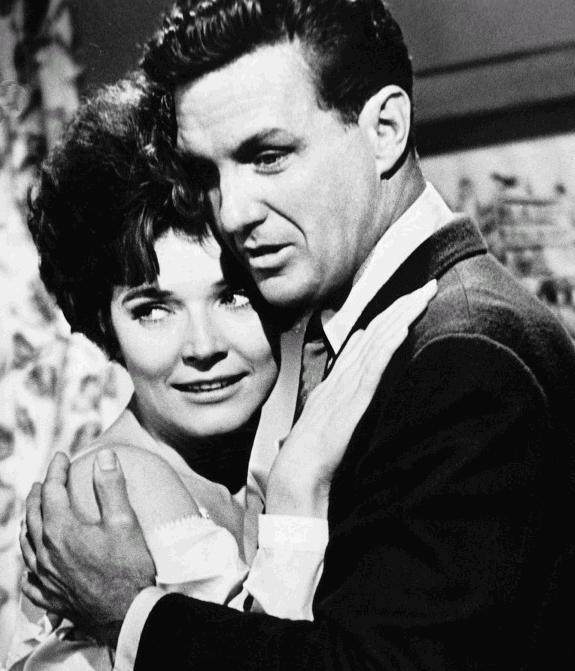
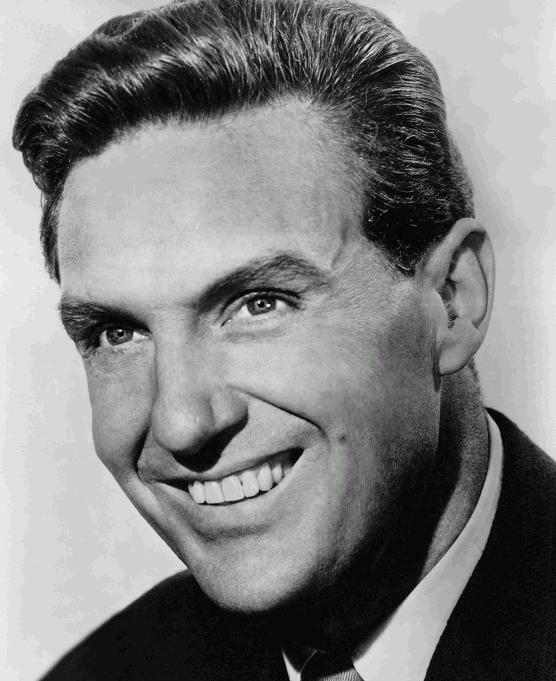
Bergen's distressed husband Robert Vaughn reveals some of her issues to Stack and Stack's fellow physician, the edible Van Williams. Fans of TV action shows may delight in seeing Stack (of The Untouchables), Williams (of Surfside 6 and The Green Hornet) and Vaughn (of The Man from U.N.C.L.E.) sharing the screen together, though a couple of those shows came after this.
It seems that Bergen and Vaughn lost their only child and their marriage has never been the same since. She blames herself for the death of her little boy and has progressively slid into serious mental despair. Vaughn isn't particularly well-equipped to deal with his disturbed wife, though he tries his best.
Stack places the anxious and upset Bergen in group therapy and this is when things get quite loopy. The Borderline group is, as you might expect, loaded down with problem cases, some worse than others. Kindly, old Ellen Corby (later to be the grandma on The Waltons) seems primarily just a bit senile and not worse than most people you run into at any small town smorgasbord restaurant.
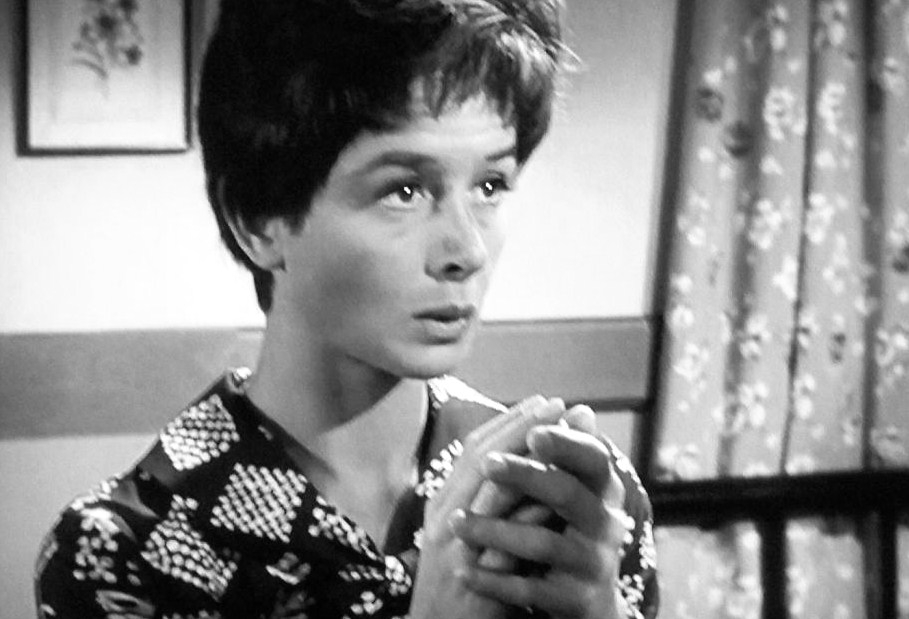
Sharon Hugueny is an emotionally fragile girl who stares catatonically at times and hears voices, that is when she isn't daydreaming and creating an emotional reality for herself that is quite far from actuality. Locking the film into the era in which it was made, she also partakes in finger-snapping, Beatnik activity from time to time.
Then there's Barbara Barrie, who hasn't spoken a word in ages and tends to act out various physical playlets that confound everyone else (such as wetting her comb and sprinkling water on the others!)
Janis Paige is a manic nymphomaniac who can't stop running her mouth antagonistically. She parades around in slinky and/or skin-tight clothes, hair all done up in a swoop that would make even Jack Lord take pause, and berates pretty much anyone in earshot. It's a full-on, roof-top level performance that isn't always easy to endure, though, again, I once knew a tramp waitress at Red Lobster who demonstrated characteristics very much like this, so I don't know that I can say it isn't realistic!
Weirdest of all is Ana St. Clair as a dreamy, gauzy, bird-lover who almost never seems to interact with the others and frequently has her back turned. I'll elaborate more on her later, but this is one of the most oddball aspects of an already strange movie.
Stack sits mostly benign as these ladies take turns speaking their mind, though its primarily Paige who sucks up all the oxygen out of the room and antagonizes the others. They mostly get to sit there and either take it or offer up some weak response. Meanwhile, Ford writes everything down in detail so that she can show her boss lady Crawford what's been happening in the newfangled program.
In one of the sillier moments of the film, a scene is taking place in Borderline, with all sorts of camera angles, close-ups, et al and then suddenly we're informed that what we've been watching has all been piped through closed-circuit television to the nurses in training! Sure... the feed from the therapy room to the classroom was photographed by Lucien Ballard, the stunning cinematographer who invented the Obie light (which could make even an actress with skin like the surface of the moon look good on screen!)
They might have preferred to wait another year or so and watch Crawford play the nut-job herself in Strait-Jacket! But that's another story...
Anyway, in this training scene we get to meet novice nurse Susan Oliver who is tentative, but intrigued by the program and willing to help any way she can. In a tried and true “go to the head of the class” move, she swiftly begins dating her teacher Williams to no one's dismay or reaction.
Then again, Stack isn't wasting his down time either. He is dating his own blonde nurse Diane McBain, who is at his side for many or most of his adventures in the hospital. Cinemagoers who accidentally left their glasses at home may have been a little confused watching dark-haired doctors Stack and Williams simultaneously date the platinum blonde nurses McBain and Oliver, especially in those moments where they seem to switch off and stand or sit with the wrong partner!
Bergen, in what truly is a rather harrowing moment in the picture, is given electro-shock therapy. She's strapped down, a bit put between her teeth, and given some heavy voltage as the various students look on (for as long as they can stand it.) This smothering, intense scene is vivid now, but must have been fairly alarming in 1963.
Bergen finally has had enough of Paige's commandeering, negative attitude in the group sessions and lets her have it, though any significant trouble is broken up by the staff. Once Crawford (who doesn't even appear until a half-hour into the movie!) gets wind of the potentially violent Bergen, she digs in her heels with Stack, with hapless Marshall caught in the middle.
In perhaps the movie's most famous scene, Crawford dons a black leotard and tights and instructs her nurses in the art of judo. She instructs the ones assigned to Borderline to take double the lessons in case they have to do physical battle with a deranged patient.
Crawford (close to sixty by this time) looks remarkably fit and even gives the more hardy Ford a little flip to the mat in demonstration! It's a short scene, but a memorably visual one with the ladies all in black against a pale, cavernous gymnasium. Crawford's line delivery here is authoritative and confident and as far as I'm concerned could be played on an endless loop in my house, I enjoy it so.
As you can see, Miss Crawford's hair is really strange in this movie, a shiny, silvery, shellacked look that is quite immobile. Many people hate it, but let me assure you that I love, love, LOVE it and consider almost every frame of her screen time in this movie a portrait worth framing!
The put-upon Vaughn makes an attempt to visit with Bergen and give her some hope of a normal life, but things don't go well and she winds up turning on him and tearing her dress apart. Bergen tears at her clothes at least one other time and Barrie also takes this same short-cut to disrobing, so the wardrobe people on the set probably had a time of it! Also, in a typically ridiculous moment, Vaughn remarks on Bergen's new hairstyle, even though it is EXACTLY the same (a towering bouffant helmet) that she's had all along.
Things seem better at a bright and fun picnic on the grounds with Stack manning a grill full of steaming hot dogs and slipping his weiners one at a time into the buns of a nearby female assistant (usually Oliver, though Mr. Williams pitches in at one point, too!) Paging Sigmund Freud! There's a band and a hilarious little “dance floor” (basically two plywood-looking strips lying in the grass for the folks to twirl around on.) Paige, naturally, wants to cut-in on Oliver's choreographed cuddle with Williams.
Bergen wanders up on a hill to sit under a tree and sketch charcoals of her deceased son until a little boy comes up (who in the hell is he and why is he there??) to ask if she wants to play baseball. His father comes to get him, makes a derogatory remark and Bergen is back off the deep end again, running frantically away as Stack chases after her with no success.
Bergen had one of the most distinctively strange methods of running (seen to great effect in the prior year's Cape Fear as well.) Her arms would be straight out, wafting from side to side, as she trotted off. Kudos to her for doing a lot of this in spike heels!
She scurries around the grounds, into a building, right past nurses and staff, shimmies here and there until finally she hides in a stairwell where she passes out. When she wakes up again, she attempts to slip back into her dorm with the other Borderline ladies, but she is in the wrong wing of the hospital... the VERY wrong wing, where all the males are kept and, of course, all the male patients are sex-starved, hirsute, wrong-side-of-the-tracks types. There's no male equivalent of Ellen Corby around there! (And apparently they can forget any picnic of their own!)
So, once again, the progress made with Bergen is jeopardized. We know that Stack and his crew have the best interests of the patients at heart, but in truth their approach is more than a little lax and so you wind up with folks being verbally abused by Paige, there is confusion for the bewildered Barrie, who winds up taking out her frustrations on one of the institution's pets, and now this rape (or as a coda after the men's ward scene with Stack urges us to believe, near-rape.)
There's also an impromptu shindig with medicinal liquor and juice (and even a little rubbing alcohol!) and, eventually, a sudden fire in the Borderline women's ward! Thus, some of Crawford and Ford's hard line tactics don't seem as senseless as the scriptwriters would like us to believe. Still, Bergen and Stack are the stars, so we know that they are going to emerge on the high end of things one way or another.
Producer-writer-director Bartlett was the man behind the camp scream Zero Hour! as well, but he was a filmmaker with a social conscience, too. His prior movie to this one was 1960's All the Young Men, which dealt with racism in the military and starred Sidney Poitier. Then again, after The Caretakers landed with a thud in theaters, his resultant picture was Bob Hope's A Global Affair in 1964. His career was spotty indeed until the surprise hit Jonathan Livingston Seagull (1973) captured the imagination of much of the public. (Look closely at his lapel in the shot below from 1973 at a charity premiere event and you will see a seagull pin. Love the ladies' hair here, too.)
Not too long after this movie, Bartlett married Rhonda Fleming, but the union only lasted from 1966 to 1972. In 1978, he very briefly married the ingenue (Lupita Ferrer) of a Mexican-set movie he was working on, The Children of Sanchez, which starred Anthony Quinn, Dolores Del Rio and Katy Jurado. Then, after having retired in 1983 after the Michael Landon TV-movie Love is Forever, he died in 1993 at the age of seventy of surgery complications.
At this time, Stack was fully ensconced in his Emmy-winning role of Eliot Ness on The Untouchables (1959-1963), though that would soon be ending. He'd previously enjoyed considerable success in the movies, with an Oscar nomination for 1956's Written on the Wind (the award went to Anthony Quinn in Lust for Life.) His prior film to this one was the 1960 nail-biter The Last Voyage, about a sinking cruise ship.
The comparative failure of this movie meant that he'd be balancing his subsequent film career with more television, which he did with The Name of the Game (1968-1971) and, most famously, as host of Unsolved Mysteries (1987-2002.) Of course, his comedic turn in the smash hit Airplane! can't be forgotten. Stack passed away in 2003 at the age of eighty-four of a heart attack, though he'd been suffering from prostate cancer as well.
Bergen was in the midst of a career upswing from the aforementioned Cape Fear (1962) and would also costar in the far lighter (as well as colorful) James Garner-Doris Day comedy Move Over, Darling this same year. After 1964's Kisses for My President, however, she receded from the big screen and did mostly television (and also enjoyed some success on stage, notably in Follies where she was Tony-nominated in 2001, losing to Cady Huffman of The Producers.) She and Stack would be reunited in the craptastical 1975 TV-movie Murder on Flight 502.
Here between takes, Ford and Bergen play a game of chess. An Emmy-winner in 1958 for her performance as Helen Morgan in an episode of Playhouse 90, she was nominated three other times for The Winds of War (1983), War and Remembrance (1988) and a guest role on Desperate Housewives (2008.) The latter three awards went to Jean Simmons for The Thorn Birds, Colleen Dewhurst in Those She Left Behind and Kathryn Joosten, also of Desperate Housewives (which really wasn't fair as Joosten, with 89 appearances on the show, was hardly a “guest!”)
Bergen, who gave 110% to her part in The Caretakers; screaming, sweating, flailing and emoting all over the place, even becoming deeply emotionally affected personally by the part, was nominated for a Golden Globe award, but lost to Leslie Caron in The L-Shaped Room. Having hosted The Pepsi-Cola Playhouse in 1954 and appeared in ads for the soft drink, one would have thought that she and Crawford would be more chummy than they turned out to be. Miss Bergen is still with us today and still acting at age eighty-two.
Many of the stars of The Caretakers have been profiled here in The Underworld previously, so I won't dwell on them too much additionally, but will link to their own tributes when applicable. This film happens to contain quite a few stars who I personally favor, so this will happen several times.
McBain, who is profiled briefly here, somehow scored third-billing in The Caretakers in what is the epitome of a decorative part! She's lovely, amiable and welcome, but has practically nothing to do in the finished cut of the movie. It's almost laughable how insignificant her part is, especially compared to some of the more meaty roles her costars get to play.
I've written about Joan Crawford several times, but this post is one that focuses on this particular stage of her career and is the period of hers I am most fascinated with personally. I simply cannot get enough of the tightly-controlled, severe presence she provides here.
That's not to say that she isn't also quite nuanced, despite all the glossy shots of her in this post. She clearly intended to demonstrate her character's inner passion for her work and the pride she took in it. In a couple of scenes, she is nearly on the verge of tears with frustration.
Her initial scene has her sporting a pair of hysterical eyeglasses that almost look like a joke! It's hard to believe that she was willing to put these on and, thankfully, only does so once. Most of the time she is dressed in a crisp, white uniform, but Moss Mabry also designed a couple of smart dresses that look terrific on her. They are trim and sleeveless and, thus, lack the shoulder pads she tended to favor.
By now, Crawford was on the board of directors of Pepsi-Cola, so when Bergen enters the lobby of the movie theater at the start of the film, it is Pepsi that the concession stand offers!
Likewise, at the hospital picnic, there's a big ol' Pepsi wagon overseen by big ol' Constance Ford. (Okay, I know she wasn't “big” or “old,” but she's a big ol' something for sure and it's funny to see her surrounded by a wealth of phallic, 16 oz bottles jutting in every direction!)
Paige was principally a musical/comedy actress who'd scored a big hit on Broadway with The Pajama Game (but who lost the role in the movie adaptation to Doris Day.) She later appeared with Day in 1960's Please Don't Eat the Daisies after having made a mark in 1957's Silk Stockings. After The Caretakers, big screen movies were few and far between, but she was a very busy TV presence until the millennium. Now ninety (!), she was performing an autobiographical cabaret act as recently as 2010 or so!
Williams has been offered up multiple times in The Underworld, both here and here , in particular. I just love his clean-cut looks and genial manner.
Hugueny was on the cusp of movie stardom, having played a significant part in 1961's Parrish and set to play the female lead in 1964's The Young Lovers opposite Peter Fonda. However, a disastrous marriage to hot shot producer Robert Evans (from 1961 – 1964) jeopardized everything. She did some TV, married a second time and had a child, but that union also ended in divorce. She married a third time and was about to begin a new phase in her acting career when fate dealt her a stunning blow. She was hit by a zooming police car and took a long time to recuperate, never acting again. In 1996, she died of cancer at only age fifty-two.
Veteran actor Marshall was near the end of his career (and, in fact, life) by this stage. He'd been playing cameos in movies like 1962's Five Weeks in a Balloon and 1963's The List of Adrian Messenger and would only make one more movie, The Third Day (1965), before dying of a heart attack in 1966 at age seventy-five.
Though he was a more frequent costar of Bette Davis', he and Crawford had worked together back in 1941 on When Ladies Meet and she made it a point to treat him with kindness during the filming of The Caretakers. Always one to shoot her close-ups early in the day, she acquiesced during her scenes with Marshall so that he could complete his own and finish his days as early as possible.
Barrie, who very often sported a “pixie” hairdo as she had here, has been working on stage and in movies and TV for well over half a century. One of her most memorable roles came in 1979's Breaking Away, for which she scored an Oscar nod (but lost to Meryl Streep for Kramer vs Kramer, a controversial win considering Streep was billed above the title!) Barrie proceeded to play that role again in the 1980 TV series Breaking Away and was Emmy-nominated (but lost in that race to Nancy Marchand in Lou Grant.) Other Emmy noms came her way for Law & Order (1991, losing to Valerie Mahaffey - WHO? - in Northern Exposure) and as a guest on Law & Order: Special Victims Unit (2002, losing to Alfre Woodard in The Practice.)
She gives her near wordless role in The Caretakers a stunning level of feeling and commitment and provides some of the movie's rare moments of palpable emotion. Now eighty-one, she still performs in the occasional movie or TV show.
Miss Corby toiled away in movies since the early-1930s, playing countless maids and aunts, though she did win a Golden Globe and got an Oscar nomination for playing an aunt in 1948's I Remember Mama. Claire Trevor won for Key Largo. (She had also played one of Crawford's beleaguered servants in 1950's Harriet Craig and worked with her the year after in Goodbye, My Fancy.)
In 1971, she took on the role of Grandma Walton on The Waltons and became a household name, winning three Emmys and two Golden Globes in the process. (I will break from tradition and not go through her six losses and those winners!) Despite growing health issues, she played Grandma Walton in TV-movies up til 1997, but died in 1999 at the age of eighty-seven. She was moving a heavy safe down from the third story-attic of a condo and... LOL! No, it was from natural causes.
Next is the peculiarity of Ana St. Clair. The Argentine actress, then known as Ana Maria Lynch, had been considered a real beauty in her home country and made several films there. It is reported that she emigrated from Argentina during the reign of Juan and Eva Peron and then married director Hall Bartlett, who cast her (as Ana St. Clair) in All the Young Men and The Caretakers, yet, even though it makes sense, I could find no U.S. Source to support this! Another sign that she might have been Bartlett's wife, though, is her prestige billing and the fact that she gets the same movie goddess lighting as Crawford.
Even more weird is the strange way she is presented in The Caretakers. She's often shot through the wires of a birdcage or else off to herself, which not so much as a background extra to tie her in. It's like she exists in her own world within the film! There are a few sequences when she is spotted with the others, but most often she is completely alone within her frame! And I am positive that this is not her, but a stand-in, during this moment with Barrie. Weirdest thing ever... She never worked on screen again after this and died in 1976 at only age fifty-seven.
Vaughn had been busily acting on TV and in movies since the mid-1950s. In 1960, he'd scored an Oscar nomination for 1959's The Young Philadelphians (losing to Hugh Griffith of Ben-Hur.) He lost a Golden Globe that year to Stephen Boyd of Ben-Hur (who wasn't even nominated for an Oscar in a bizarre oversight.) His work on The Man from U.N.C.L.E. gathered two more Globe nominations in 1965 and 1966, but the awards went to Gene Barry of Burke's Law and David Janssen of The Fugitive. Now eighty, he is still actively working in movies and television.
Oliver made a fair share of movies (including the hooty BUtterfield 8 with Elizabeth Taylor in 1960), but was far more often a television presence, appearing on countless series over the span of her career (including The Untouchables and The Man from U.N.C.L.E.) Perhaps her most enduring contribution to pop culture was her guest role in the first Star Trek pilot, which had her playing multiple variations including a sexy, scantily-clad, green slave girl. An aviatrix in real life, she had been nominated for an Emmy with 1976's Amelia Earhart as a flight instructor, but lost to Diana Hyland in The Boy in the Plastic Bubble. She was taken far too early from cancer in 1990 at only age fifty-seven.
This movie marks the debut and the swan song of actress Virginia Munshin, who played one of the Borderline patients who, despite having precious little to say or do, won billing in the opening and the end credits. The thirty year-old actress, whose first film or TV role this was, died of a cerebral hemorrhage in 1962 before the film was even released! The end credits, by the way, are my favorite style, which is the kind that show each actor's face and name, in increasing level of importance from the supporting stars to the leads. I love it when movies do this!
The opening credits (and the rest of the film, naturally) are heavily punctuated by the music of Elmer Bernstein, a prolific and highly-gifted composer, though his score here is remarkably unusual. The pounding, driving theme played over the opening as well as during Bergen's run through the hospital grounds and corridors, seems far more suited to an action movie set aboard a fast-moving train. Though there are no locomotives in The Caretakers, there is still plenty of “loco” to be found! Bernstein was not recognized for this score or even for The Great Escape, one of his other movies that year, but was nominated many other times, winning only once for Thoroughly Modern Millie (1967) of all things.
The film's sole Oscar nomination was for Black and White Cinematography, courtesy of the aforementioned Lucien Ballard. It's often extremely effective and gorgeous to look at, even containing several visual effects, but he lost to the excellent James Wong Howe for Hud. (One effect, I must say, that is jarringly bad involves a shot of the Borderline dormitory that pulls back to reveal a humongous cavern of beds, but the whole thing is just an obvious matte painting!)
Apart from Bergen's acting nod at the Golden Globes, the movie also scored Globe nominations for Best Director (with Elia Kazan winning for America, America) and even Best Picture-Drama (which Otto Preminger's The Cardinal won.) A couple of U.S. Senators were taken enough by the film to have it screened for the U.S. Senate in order to enlighten them on the subject of treatment for mental illness, with Stack and Crawford on hand afterwards for a reception. Just because it might come off as tame now doesn't change the fact that some of it was quite daring in its day.
The Caretakers is now a period piece and at times hilariously so, but there's also something wistfully nostalgic about the respect that the participants show one another, even when they don't agree. Stack and Crawford do NOT see eye to eye, but they are nearly always tensely polite and it's fun to watch them square off, sometimes teasingly. The cast, filled with stars (most of them from the Warner Brothers stable even though this is a United Artists picture!), is captivating to behold, if you're into that sort of thing like I am.
Not to mention (as I only have multiple times), if one is a fan of latter-day Crawford, she simply has to be seen in this, limited screen time or not. Just look at that FACE...
The Caretakers was based on a 1959 novel by a middle-aged lady named Dariel Telfer who'd worked for several years as a clerk in a mental institution. She parlayed her inside glimpse of that world into a novel that, after a rather intense period of editing, was a reasonable success. Producer-director Hall Bartlett optioned the book for a movie version, but left behind quite a bit of the spicy story in the process. The book had focused on the tumultuous lives of the doctors and nurses, with a love triangle, the rape of a patient by a hospital employee and even a murder, but the movie eliminated all of these plot points and more, even shifting the focus more to one of the patients.
The story takes place at a sprawling mental hospital called Canterbury (even the name suggests the old and archaic) where the status quo is in the process of being interrupted by a newcomer with fresh ideas and strategies for dealing with the psychologically impaired.
Run by the rather impotent Herbert Marshall and his domineering chief of nurses, Joan Crawford, the establishment is soon in a minor state of chaos when dynamic doctor Robert Stack tries to implement a program called Borderline, in which patients enter into group therapy with the ultimate goal being the ability for them to sleep at home and merely attend a day hospital to help them work through their issues with a foothold in the outside world.
This simply will not do as far as Crawford is concerned. She and her stern henchwoman and fellow nurse Constance Ford believe in the old ways; the “intelligent use of force,” control, self-defense and restraint. Needless to say, despite the progressive, compassionate attitude of Stack and his followers, it's a bit more fun to witness the determined, almost Gothic approach that Team Crawford applies.
The catalyst for the battle of wills comes primarily in the form of a new patient, Polly Bergen, who kicks the film off with a hysteria-laden breakdown inside a movie theater. As she frantically rubs her temples and agonizes over every detail of everything, she somehow decides that going to see West Side Story will cure what ails her.
She's feverishly led to a seat (in the packed, and I mean PACKED, theater) and as some news reels begin to play (every one of them involving some sort of loud vehicle or device), she starts sweating and panicking. Suddenly, she darts out of her seat and, in a surreal moment, stands in front of the movie screen screaming as race cars zoom towards her!
The first time I saw this scene, many years ago, I broke into fits of laughter, it's so overheated and over-the-top dramatic. However, I must say that after a bout with significant depression in 2000, I can actually identify with the part about certain sounds amplifying in the brain and causing severe annoyance. Ever since that time, I have a sensitivity to noise pollution like barking dogs or loud trucks and positively cannot bear any type of radio advertising, nor most TV ads as well.
Bergen's distressed husband Robert Vaughn reveals some of her issues to Stack and Stack's fellow physician, the edible Van Williams. Fans of TV action shows may delight in seeing Stack (of The Untouchables), Williams (of Surfside 6 and The Green Hornet) and Vaughn (of The Man from U.N.C.L.E.) sharing the screen together, though a couple of those shows came after this.
It seems that Bergen and Vaughn lost their only child and their marriage has never been the same since. She blames herself for the death of her little boy and has progressively slid into serious mental despair. Vaughn isn't particularly well-equipped to deal with his disturbed wife, though he tries his best.
Stack places the anxious and upset Bergen in group therapy and this is when things get quite loopy. The Borderline group is, as you might expect, loaded down with problem cases, some worse than others. Kindly, old Ellen Corby (later to be the grandma on The Waltons) seems primarily just a bit senile and not worse than most people you run into at any small town smorgasbord restaurant.
Sharon Hugueny is an emotionally fragile girl who stares catatonically at times and hears voices, that is when she isn't daydreaming and creating an emotional reality for herself that is quite far from actuality. Locking the film into the era in which it was made, she also partakes in finger-snapping, Beatnik activity from time to time.
Then there's Barbara Barrie, who hasn't spoken a word in ages and tends to act out various physical playlets that confound everyone else (such as wetting her comb and sprinkling water on the others!)
Janis Paige is a manic nymphomaniac who can't stop running her mouth antagonistically. She parades around in slinky and/or skin-tight clothes, hair all done up in a swoop that would make even Jack Lord take pause, and berates pretty much anyone in earshot. It's a full-on, roof-top level performance that isn't always easy to endure, though, again, I once knew a tramp waitress at Red Lobster who demonstrated characteristics very much like this, so I don't know that I can say it isn't realistic!
Weirdest of all is Ana St. Clair as a dreamy, gauzy, bird-lover who almost never seems to interact with the others and frequently has her back turned. I'll elaborate more on her later, but this is one of the most oddball aspects of an already strange movie.
Stack sits mostly benign as these ladies take turns speaking their mind, though its primarily Paige who sucks up all the oxygen out of the room and antagonizes the others. They mostly get to sit there and either take it or offer up some weak response. Meanwhile, Ford writes everything down in detail so that she can show her boss lady Crawford what's been happening in the newfangled program.
In one of the sillier moments of the film, a scene is taking place in Borderline, with all sorts of camera angles, close-ups, et al and then suddenly we're informed that what we've been watching has all been piped through closed-circuit television to the nurses in training! Sure... the feed from the therapy room to the classroom was photographed by Lucien Ballard, the stunning cinematographer who invented the Obie light (which could make even an actress with skin like the surface of the moon look good on screen!)
They might have preferred to wait another year or so and watch Crawford play the nut-job herself in Strait-Jacket! But that's another story...
Then again, Stack isn't wasting his down time either. He is dating his own blonde nurse Diane McBain, who is at his side for many or most of his adventures in the hospital. Cinemagoers who accidentally left their glasses at home may have been a little confused watching dark-haired doctors Stack and Williams simultaneously date the platinum blonde nurses McBain and Oliver, especially in those moments where they seem to switch off and stand or sit with the wrong partner!
Bergen, in what truly is a rather harrowing moment in the picture, is given electro-shock therapy. She's strapped down, a bit put between her teeth, and given some heavy voltage as the various students look on (for as long as they can stand it.) This smothering, intense scene is vivid now, but must have been fairly alarming in 1963.
In perhaps the movie's most famous scene, Crawford dons a black leotard and tights and instructs her nurses in the art of judo. She instructs the ones assigned to Borderline to take double the lessons in case they have to do physical battle with a deranged patient.
Crawford (close to sixty by this time) looks remarkably fit and even gives the more hardy Ford a little flip to the mat in demonstration! It's a short scene, but a memorably visual one with the ladies all in black against a pale, cavernous gymnasium. Crawford's line delivery here is authoritative and confident and as far as I'm concerned could be played on an endless loop in my house, I enjoy it so.
The put-upon Vaughn makes an attempt to visit with Bergen and give her some hope of a normal life, but things don't go well and she winds up turning on him and tearing her dress apart. Bergen tears at her clothes at least one other time and Barrie also takes this same short-cut to disrobing, so the wardrobe people on the set probably had a time of it! Also, in a typically ridiculous moment, Vaughn remarks on Bergen's new hairstyle, even though it is EXACTLY the same (a towering bouffant helmet) that she's had all along.
Things seem better at a bright and fun picnic on the grounds with Stack manning a grill full of steaming hot dogs and slipping his weiners one at a time into the buns of a nearby female assistant (usually Oliver, though Mr. Williams pitches in at one point, too!) Paging Sigmund Freud! There's a band and a hilarious little “dance floor” (basically two plywood-looking strips lying in the grass for the folks to twirl around on.) Paige, naturally, wants to cut-in on Oliver's choreographed cuddle with Williams.
Bergen wanders up on a hill to sit under a tree and sketch charcoals of her deceased son until a little boy comes up (who in the hell is he and why is he there??) to ask if she wants to play baseball. His father comes to get him, makes a derogatory remark and Bergen is back off the deep end again, running frantically away as Stack chases after her with no success.
Bergen had one of the most distinctively strange methods of running (seen to great effect in the prior year's Cape Fear as well.) Her arms would be straight out, wafting from side to side, as she trotted off. Kudos to her for doing a lot of this in spike heels!
She scurries around the grounds, into a building, right past nurses and staff, shimmies here and there until finally she hides in a stairwell where she passes out. When she wakes up again, she attempts to slip back into her dorm with the other Borderline ladies, but she is in the wrong wing of the hospital... the VERY wrong wing, where all the males are kept and, of course, all the male patients are sex-starved, hirsute, wrong-side-of-the-tracks types. There's no male equivalent of Ellen Corby around there! (And apparently they can forget any picnic of their own!)
So, once again, the progress made with Bergen is jeopardized. We know that Stack and his crew have the best interests of the patients at heart, but in truth their approach is more than a little lax and so you wind up with folks being verbally abused by Paige, there is confusion for the bewildered Barrie, who winds up taking out her frustrations on one of the institution's pets, and now this rape (or as a coda after the men's ward scene with Stack urges us to believe, near-rape.)
There's also an impromptu shindig with medicinal liquor and juice (and even a little rubbing alcohol!) and, eventually, a sudden fire in the Borderline women's ward! Thus, some of Crawford and Ford's hard line tactics don't seem as senseless as the scriptwriters would like us to believe. Still, Bergen and Stack are the stars, so we know that they are going to emerge on the high end of things one way or another.
Producer-writer-director Bartlett was the man behind the camp scream Zero Hour! as well, but he was a filmmaker with a social conscience, too. His prior movie to this one was 1960's All the Young Men, which dealt with racism in the military and starred Sidney Poitier. Then again, after The Caretakers landed with a thud in theaters, his resultant picture was Bob Hope's A Global Affair in 1964. His career was spotty indeed until the surprise hit Jonathan Livingston Seagull (1973) captured the imagination of much of the public. (Look closely at his lapel in the shot below from 1973 at a charity premiere event and you will see a seagull pin. Love the ladies' hair here, too.)
Not too long after this movie, Bartlett married Rhonda Fleming, but the union only lasted from 1966 to 1972. In 1978, he very briefly married the ingenue (Lupita Ferrer) of a Mexican-set movie he was working on, The Children of Sanchez, which starred Anthony Quinn, Dolores Del Rio and Katy Jurado. Then, after having retired in 1983 after the Michael Landon TV-movie Love is Forever, he died in 1993 at the age of seventy of surgery complications.
At this time, Stack was fully ensconced in his Emmy-winning role of Eliot Ness on The Untouchables (1959-1963), though that would soon be ending. He'd previously enjoyed considerable success in the movies, with an Oscar nomination for 1956's Written on the Wind (the award went to Anthony Quinn in Lust for Life.) His prior film to this one was the 1960 nail-biter The Last Voyage, about a sinking cruise ship.
The comparative failure of this movie meant that he'd be balancing his subsequent film career with more television, which he did with The Name of the Game (1968-1971) and, most famously, as host of Unsolved Mysteries (1987-2002.) Of course, his comedic turn in the smash hit Airplane! can't be forgotten. Stack passed away in 2003 at the age of eighty-four of a heart attack, though he'd been suffering from prostate cancer as well.
Bergen was in the midst of a career upswing from the aforementioned Cape Fear (1962) and would also costar in the far lighter (as well as colorful) James Garner-Doris Day comedy Move Over, Darling this same year. After 1964's Kisses for My President, however, she receded from the big screen and did mostly television (and also enjoyed some success on stage, notably in Follies where she was Tony-nominated in 2001, losing to Cady Huffman of The Producers.) She and Stack would be reunited in the craptastical 1975 TV-movie Murder on Flight 502.
Here between takes, Ford and Bergen play a game of chess. An Emmy-winner in 1958 for her performance as Helen Morgan in an episode of Playhouse 90, she was nominated three other times for The Winds of War (1983), War and Remembrance (1988) and a guest role on Desperate Housewives (2008.) The latter three awards went to Jean Simmons for The Thorn Birds, Colleen Dewhurst in Those She Left Behind and Kathryn Joosten, also of Desperate Housewives (which really wasn't fair as Joosten, with 89 appearances on the show, was hardly a “guest!”)
Bergen, who gave 110% to her part in The Caretakers; screaming, sweating, flailing and emoting all over the place, even becoming deeply emotionally affected personally by the part, was nominated for a Golden Globe award, but lost to Leslie Caron in The L-Shaped Room. Having hosted The Pepsi-Cola Playhouse in 1954 and appeared in ads for the soft drink, one would have thought that she and Crawford would be more chummy than they turned out to be. Miss Bergen is still with us today and still acting at age eighty-two.
Many of the stars of The Caretakers have been profiled here in The Underworld previously, so I won't dwell on them too much additionally, but will link to their own tributes when applicable. This film happens to contain quite a few stars who I personally favor, so this will happen several times.
McBain, who is profiled briefly here, somehow scored third-billing in The Caretakers in what is the epitome of a decorative part! She's lovely, amiable and welcome, but has practically nothing to do in the finished cut of the movie. It's almost laughable how insignificant her part is, especially compared to some of the more meaty roles her costars get to play.
I've written about Joan Crawford several times, but this post is one that focuses on this particular stage of her career and is the period of hers I am most fascinated with personally. I simply cannot get enough of the tightly-controlled, severe presence she provides here.
That's not to say that she isn't also quite nuanced, despite all the glossy shots of her in this post. She clearly intended to demonstrate her character's inner passion for her work and the pride she took in it. In a couple of scenes, she is nearly on the verge of tears with frustration.
Her initial scene has her sporting a pair of hysterical eyeglasses that almost look like a joke! It's hard to believe that she was willing to put these on and, thankfully, only does so once. Most of the time she is dressed in a crisp, white uniform, but Moss Mabry also designed a couple of smart dresses that look terrific on her. They are trim and sleeveless and, thus, lack the shoulder pads she tended to favor.
By now, Crawford was on the board of directors of Pepsi-Cola, so when Bergen enters the lobby of the movie theater at the start of the film, it is Pepsi that the concession stand offers!
Likewise, at the hospital picnic, there's a big ol' Pepsi wagon overseen by big ol' Constance Ford. (Okay, I know she wasn't “big” or “old,” but she's a big ol' something for sure and it's funny to see her surrounded by a wealth of phallic, 16 oz bottles jutting in every direction!)
Paige was principally a musical/comedy actress who'd scored a big hit on Broadway with The Pajama Game (but who lost the role in the movie adaptation to Doris Day.) She later appeared with Day in 1960's Please Don't Eat the Daisies after having made a mark in 1957's Silk Stockings. After The Caretakers, big screen movies were few and far between, but she was a very busy TV presence until the millennium. Now ninety (!), she was performing an autobiographical cabaret act as recently as 2010 or so!
Williams has been offered up multiple times in The Underworld, both here and here , in particular. I just love his clean-cut looks and genial manner.
But you know I can never resist the opportunity to throw in a little beefcake whenever possible, so I give you this shot below of Williams going over his lines in-between takes. The memory works better when you're half-naked... What was I saying?? Oh...Well, anyway.
Ford, an indispensable and surprisingly versatile character actress, was one of my earliest recipients of a tribute. This role certainly played to her strengths. Interestingly, her character is called Nurse Bracken, which is not dissimilar in sound (nor far off in type) to Nurse Ratched of the novel One Flew Over the Cuckoo's Nest, which was published three years after this movie's source novel. Hugueny was on the cusp of movie stardom, having played a significant part in 1961's Parrish and set to play the female lead in 1964's The Young Lovers opposite Peter Fonda. However, a disastrous marriage to hot shot producer Robert Evans (from 1961 – 1964) jeopardized everything. She did some TV, married a second time and had a child, but that union also ended in divorce. She married a third time and was about to begin a new phase in her acting career when fate dealt her a stunning blow. She was hit by a zooming police car and took a long time to recuperate, never acting again. In 1996, she died of cancer at only age fifty-two.
Though he was a more frequent costar of Bette Davis', he and Crawford had worked together back in 1941 on When Ladies Meet and she made it a point to treat him with kindness during the filming of The Caretakers. Always one to shoot her close-ups early in the day, she acquiesced during her scenes with Marshall so that he could complete his own and finish his days as early as possible.
Barrie, who very often sported a “pixie” hairdo as she had here, has been working on stage and in movies and TV for well over half a century. One of her most memorable roles came in 1979's Breaking Away, for which she scored an Oscar nod (but lost to Meryl Streep for Kramer vs Kramer, a controversial win considering Streep was billed above the title!) Barrie proceeded to play that role again in the 1980 TV series Breaking Away and was Emmy-nominated (but lost in that race to Nancy Marchand in Lou Grant.) Other Emmy noms came her way for Law & Order (1991, losing to Valerie Mahaffey - WHO? - in Northern Exposure) and as a guest on Law & Order: Special Victims Unit (2002, losing to Alfre Woodard in The Practice.)
She gives her near wordless role in The Caretakers a stunning level of feeling and commitment and provides some of the movie's rare moments of palpable emotion. Now eighty-one, she still performs in the occasional movie or TV show.
Miss Corby toiled away in movies since the early-1930s, playing countless maids and aunts, though she did win a Golden Globe and got an Oscar nomination for playing an aunt in 1948's I Remember Mama. Claire Trevor won for Key Largo. (She had also played one of Crawford's beleaguered servants in 1950's Harriet Craig and worked with her the year after in Goodbye, My Fancy.)
In 1971, she took on the role of Grandma Walton on The Waltons and became a household name, winning three Emmys and two Golden Globes in the process. (I will break from tradition and not go through her six losses and those winners!) Despite growing health issues, she played Grandma Walton in TV-movies up til 1997, but died in 1999 at the age of eighty-seven. She was moving a heavy safe down from the third story-attic of a condo and... LOL! No, it was from natural causes.
Next is the peculiarity of Ana St. Clair. The Argentine actress, then known as Ana Maria Lynch, had been considered a real beauty in her home country and made several films there. It is reported that she emigrated from Argentina during the reign of Juan and Eva Peron and then married director Hall Bartlett, who cast her (as Ana St. Clair) in All the Young Men and The Caretakers, yet, even though it makes sense, I could find no U.S. Source to support this! Another sign that she might have been Bartlett's wife, though, is her prestige billing and the fact that she gets the same movie goddess lighting as Crawford.
Even more weird is the strange way she is presented in The Caretakers. She's often shot through the wires of a birdcage or else off to herself, which not so much as a background extra to tie her in. It's like she exists in her own world within the film! There are a few sequences when she is spotted with the others, but most often she is completely alone within her frame! And I am positive that this is not her, but a stand-in, during this moment with Barrie. Weirdest thing ever... She never worked on screen again after this and died in 1976 at only age fifty-seven.
Vaughn had been busily acting on TV and in movies since the mid-1950s. In 1960, he'd scored an Oscar nomination for 1959's The Young Philadelphians (losing to Hugh Griffith of Ben-Hur.) He lost a Golden Globe that year to Stephen Boyd of Ben-Hur (who wasn't even nominated for an Oscar in a bizarre oversight.) His work on The Man from U.N.C.L.E. gathered two more Globe nominations in 1965 and 1966, but the awards went to Gene Barry of Burke's Law and David Janssen of The Fugitive. Now eighty, he is still actively working in movies and television.
Oliver made a fair share of movies (including the hooty BUtterfield 8 with Elizabeth Taylor in 1960), but was far more often a television presence, appearing on countless series over the span of her career (including The Untouchables and The Man from U.N.C.L.E.) Perhaps her most enduring contribution to pop culture was her guest role in the first Star Trek pilot, which had her playing multiple variations including a sexy, scantily-clad, green slave girl. An aviatrix in real life, she had been nominated for an Emmy with 1976's Amelia Earhart as a flight instructor, but lost to Diana Hyland in The Boy in the Plastic Bubble. She was taken far too early from cancer in 1990 at only age fifty-seven.
This movie marks the debut and the swan song of actress Virginia Munshin, who played one of the Borderline patients who, despite having precious little to say or do, won billing in the opening and the end credits. The thirty year-old actress, whose first film or TV role this was, died of a cerebral hemorrhage in 1962 before the film was even released! The end credits, by the way, are my favorite style, which is the kind that show each actor's face and name, in increasing level of importance from the supporting stars to the leads. I love it when movies do this!
The opening credits (and the rest of the film, naturally) are heavily punctuated by the music of Elmer Bernstein, a prolific and highly-gifted composer, though his score here is remarkably unusual. The pounding, driving theme played over the opening as well as during Bergen's run through the hospital grounds and corridors, seems far more suited to an action movie set aboard a fast-moving train. Though there are no locomotives in The Caretakers, there is still plenty of “loco” to be found! Bernstein was not recognized for this score or even for The Great Escape, one of his other movies that year, but was nominated many other times, winning only once for Thoroughly Modern Millie (1967) of all things.
The film's sole Oscar nomination was for Black and White Cinematography, courtesy of the aforementioned Lucien Ballard. It's often extremely effective and gorgeous to look at, even containing several visual effects, but he lost to the excellent James Wong Howe for Hud. (One effect, I must say, that is jarringly bad involves a shot of the Borderline dormitory that pulls back to reveal a humongous cavern of beds, but the whole thing is just an obvious matte painting!)
Apart from Bergen's acting nod at the Golden Globes, the movie also scored Globe nominations for Best Director (with Elia Kazan winning for America, America) and even Best Picture-Drama (which Otto Preminger's The Cardinal won.) A couple of U.S. Senators were taken enough by the film to have it screened for the U.S. Senate in order to enlighten them on the subject of treatment for mental illness, with Stack and Crawford on hand afterwards for a reception. Just because it might come off as tame now doesn't change the fact that some of it was quite daring in its day.
The Caretakers is now a period piece and at times hilariously so, but there's also something wistfully nostalgic about the respect that the participants show one another, even when they don't agree. Stack and Crawford do NOT see eye to eye, but they are nearly always tensely polite and it's fun to watch them square off, sometimes teasingly. The cast, filled with stars (most of them from the Warner Brothers stable even though this is a United Artists picture!), is captivating to behold, if you're into that sort of thing like I am.
Subscribe to:
Posts (Atom)