Last fall, one of my most popular posts among those who come here for the older stars was put forth. It was a collection of rare, regional theatre programs from the early-’70s that contained it-could-only-happen-at-The-Burt-Reynolds-Dinner-Theatre-style  pairings such as Don Ameche, Karen Valentine and John Saxon in The Moon is Blue, John Gavin and Karen Lynn Gorney in Dracula or Joe Namath in Picnic! I had purchased a box full of the programs at a local estate auction and couldn’t wait to share their campy qualities with my devoted divers at The Underworld. (As an example of what I'm talking about, can you determine from this cover who it is that is enacting the role of Dolly Levi in Hello Dolly!? Answer in a moment...)
Imagine my surprise when, recently, one of my longtime friends, a theatre enthusiast who had helmed a local company for close to a decade, who has conceived and/or adapted a couple of locally-produced plays and even authored a book on musicals, came to me to announce that the mother of one of his other friends had been at a sale of some sort and had purchased a box of programs for him (again for a dollar!) Joe and I met for lunch and howled together as we perused the stack of programs, most of which,  astonishingly, were from the very same theatre company as my own were (Kenley Players), but with not one duplication! There were other items in his stack that went beyond what I had bought, but which were equally fun. I instantly asked if he would be kind enough to lend me the stack of programs so that I might scan in some highlights to share with my readers at The Underworld and he graciously complied. So, here we go!
One aspect of Joe’s programs, by the way, which is as annoying as it is fascinating, is that the original owner for some reason felt the need to write not only the date of the day she saw the production in question, but also the name(s) of whoever she attended with! Thus, you will see this scribbling occasionally on some of the covers. The upside is that it usually pinpoints the exact year of a production, something that isn’t always completely obvious. (Theatre programs very often list the days of the month of a production, but hardly ever bother to denote the year!) As I will demonstrate below, though, even this isn’t always reliable. Unfortunately, thanks to the new blog photo viewer, in order to properly see and read the scans on this page you will likely have to right-click the images and choose “Open Link in a New Window.”
 Kenley Players was founded by John Kenley, a peculiar, but very successful, producer of a Midwestern summer stock theatre circuit that began in 1950 and proceeded for three decades or so after. Kenley made it a point early on to bring name brand (if, perhaps, a trifle dusty) stars to his company, knowing that audiences who were typically deprived the chance to see such people would patronize the performances. Here is the billing info for the Hello Dolly! cover portrait from the top of this post. Yes, it was Miss Betty White!
Kenley was a most androgynous person, reportedly spending summers in Ohio as John Kenley and winters in Florida as Joan Kenley! (This in spite of his WWII stint as a Merchant Marine!) Merv Griffin stated outright in his biography that Kenley was a hermaphrodite! A longstanding tradition of his productions was that at the opening night party, the leading man of the show was required to dance the first number of the night with Kenley. Presumably, the gentlemen good-naturedly complied. In any case, he lived until the ripe age of one hundred three, passing away in 2009.
For his first show in 1950, he ingeniously used dynamic actress Susan Peters (tragically paralyzed in a hunting accident) in The Barretts of Wimpole Street,  shifting the position of her sofa occasionally to suggest variety of movement. (She's seen here after her accident with close friend Cesar Romero and prior to her accident in a lovely portrait.) Peters remained under contract to MGM for a short time after her paralysis, but ran into understandable limitations when it came to parts. Though she put forth a valiant effort, even attempting a TV series called Miss Susan, she was dead by age thirty-one of illness and the effects of anorexia nervosa.
Some of the later Kenley combinations (which, sadly, I do not have programs for) included Joey Heatherton in Can Can, Florence Henderson in Annie Get Your Gun, Barbara Eden in Finian's Rainbow, Dirk Benedict in Oklahoma!  and Robbie Benson in Evita (again in this post, I must employ the abused exclamation point!) I mean, you can't make this shit up! From here on, though, I’ll concentrate more on what I do have evidence of. The 1961 Broadway flop Everybody Loves Opal had starred Eileen Heckart, Stubby Kaye, James Coco and Brenda Vaccaro, but two key unfavorable reviews led to its premature closure. It later became a vehicle and potential comedic showcase for actresses of a certain age and is done in community theatre still today. In ‘72, Kenley’s production starred Phyllis Diller, depicted on the front and back cover (and inside) in ways that had nothing whatsoever to do with her eccentric, raggedy sort of character (a shabby hermit who is suspected of hoarding money and who is infiltrated by a gaggle of would-be murderers.)

 The 1964 Broadway hit Luv had starred Alan Arkin, Eli Wallach and (his real life wife) Anne Jackson. It focused on two old college pals who discover that they are both miserable with one trying to offload his wife on the other in order to improve both of their lives. Ten years later at Kenley, the stars were Dom DeLuise, Joyce Van Patten and Bill McCutcheon. (Fans of Steel Magnolias will recall McCutcheon as Ouiser’s love interest Owen Jenkins.)
In 1934, Cole Porter’s Anything Goes had been a hit vehicle for Ethel Merman (who made an augmented film version two years later) and costarred William Gaxton and Victor Moore. It was revived Off-Broadway in 1962 with Hal Linden, Kenneth Mars and Eileen Rogers.  Later, The Kenley Players production featured Frankie Avalon, Karen Morrow and Joe Flynn. Morrow was a veteran of quite a few Broadway flops who later worked on a lot of ‘70s television including the Bewitched spin-off Tabitha. In a strange interlude within his lengthy career, Avalon had determined to be billed as Frank Avalon versus the more familiar Frankie. The owner of this program had scrawled 1979 on the cover as the date she saw this, but that isn’t possible. For one thing, Avalon’s bio makes no mention of the gargantuan hit Grease in 1978, in which he played Teen Angel. It is unlikely that such a thing would be left out. More importantly, though, is the fact that costar Flynn could not possibly have performed in a 1979 production of Anything Goes (Weekend at Bernie’s, maybe…) Flynn, the star of McHale’s Navy from 1962-1966
  and of several Disney movies, was found dead (and nude) in the family swimming pool on July 19th, 1974! He had apparently either drowned or had a heart attack that lead to drowning. He was forty-nine years old. This production was most likely done in the very early ‘70s as one of the costars, Leland Palmer, was nominated for a Tony for Pippin in 1973 and at the time of this show, such a thing had not yet occurred (though her earlier nomination for 1967’s A Joyful Noise is listed.)
 High Button Shoes had been a George Abbott-directed/Jerome Robbins-choreographed musical, running for over 700 performances on Broadway in 1947. It concerned a con-man trying to fleece a New Jersey couple in a land deal, cheating people of the town in other ways all along, eventually being chased through Atlantic City in an elaborate number. The star then was Phil Silvers. In this 1983 production, Gavin McLeod was the headliner.
  For whatever reason, McLeod’s head shot in the program was merely one from his hit series The Love Boat, complete with captains hat! Perhaps they wanted there to be no doubt about the fact that a popular TV star was being put before the audiences.
Some of the programs that were in this bunch that I didn’t scan, but  which I will mention for the curious, include: operatic tenor Jan Peerce in a July, 1971 performance of Fiddler on the Roof, a dry-run for his eventual stint as a Broadway replacement in December of that year, John Raitt in Camelot, The Smothers Brothers in I Love My Wife, Sally Ann Howes in The Great Waltz, Gary Sandy in Barnum (there were no revealing photos!) and McLean Stevenson in Under the Yum Yum Tree. We're also sorry that we don't have one for the hystercial productions advertised here to the left of a highly '80s-ized Morgan Fairchild and James Farentino starring in Goodbye Charlie!

 A bit more interesting, to me anyway, is the 1983 production of Pal Joey starring Joel Grey and Alexis Smith, two people I do not associate together at all ordinarily. The Rodgers and Hart musical was done on Broadway in 1940 with Gene Kelly and Vivienne Segal (and June Havoc.) At the time of this production, Grey had already appeared in Kenley shows Cabaret (for which he’d won a Tony and, later, an Oscar), George M!, and 1776. Smith had performed with Kenley Players way back in the 1950s and had, by now, enjoyed her triumphant,
  Tony-winning stage success in Follies. She followed that up with The Women (as Sylvia), Summer Brave and Platinum, eventually touring as Miss Mona (!) in The Best Little Whorehouse in Texas. She also did Kenley versions of Mary, Mary and Applause. One of the cast members of this production would soon go on to greater fame. With Quest for Fire under his belt and The Ice Pirates about to be released, young, unusual-looking Ron Perlman would just a few years later become a cult favorite in the romantic fantasy TV series Beauty and the Beast, which ran from 1987 - 1990. He is still a busy actor today, a recent success being the biker-themed FX series Sons of Anarchy. Check out that ‘80s hair and stache!
Speaking of The Best Little Whorehouse in Texas, there was a program mixed in with the rest from a 1982 tour of the show that didn’t really star anyone of note.  It did have a photo of some shirtless cowboys, which I am including not because they are particularly good-looking, but more as a way of pointing out how much the standards have changed since then with regards to the age and physical condition of shirtless chorus men! Lord, I could have done this next to these chaps without too much undue embarrassment…
Another one-shot oddity in the stack was a program from the concert group called The New 4 Girls.  Initially called 4 Girls 4 with its inception in 1977, it was a quartet consisting of Rosemary Clooney, Margaret Whiting, Barbara McNair and Rose Marie. McNair, who truly was not of the same era as the rest, quickly departed, replaced by Helen O’Connell. The old gals enjoyed staggering success in this venture among those folks longing for the nostalgic music they’d helped make famous. The ladies had occasional squabbles amongst themselves, most often involving Helen O’Connell, who somehow managed to aggravate virtually everyone despite the success were enjoying together. She was a woman apart, including, at first, her clothing. In a coincidence with regards to this post, it was reportedly John Kenley who said to her, “You look like you’re wearing pajamas next to the other girls.” O’Connell allegedly replied that she was wearing a designer dress herself, but he stated, “I don’t care… They’re all sequined and beaded and theatrical and you look like you just came out of the bathroom.”
  Eventually, Rose Marie grew tired of the stress and left, replaced by Martha Raye (who also couldn‘t bear O‘Connell.) Then, Whiting departed as well. When Kay Starr took her spot is when The New Girls 4 re-christening came about. In time, Raye was forced to reduce her time with the group and Kaye Ballard would fill in. Before it was over, Rose Marie was back briefly, as was Whiting, but without Clooney, and the whole thing eventually consisted of O’Connell, Whiting and Starr and was called 3 Girls 3! It petered out for good in the late ‘80s after considerable success. Today, Ballard is eighty-six, Rose Marie is eighty-eight and Kay Starr is eighty-nine. O’Connell died back in ‘93 at seventy-three, Raye died in ‘94 at seventy-eight, Clooney passed away in 2002 at seventy-four and Whiting died in 2011 at eighty-six.

 While we're on Martha Raye, we have here a program from one of her own Kenley Players productions in 1983. In a rather interesting stroke of casting, she was given the role of Miss Hannigan in hit musical Annie. The original production had run for six years on Broadway starting in 1977. Dorothy Loudon was the first Mrs. H., followed by Alice Ghostly, Betty Hutton, Marcia Lewis and June Havoc. For some reason, the young lady playing Grace Farrell made no attempt to alter her name (Norma Jean Baker) even though (or maybe because) it was the real name of the legendary movie star Marilyn Monroe.
 Next, we have a 1983 presentation of No, No Nanette, another old chestnut that was being revived. The 1925 three-act musical concerned marital confusion amongst three couples. After being adapted into a few movies, sometimes with significant alteration to its plot
  (such as with 1950’s Tea for Two starring Doris Day), the property was dormant for a while. Then, in 1971, a nostalgic revival starred Ruby Keeler along with Patsy Kelly, Jack Gilford and Bobby Van. The version at Kenley starred Van Johnson and Gloria DeHaven.
  Considering the allegation that Johnson’s already-controversial marriage came to an end when he fell for a chorus boy performing with him in a production of The Music Man in the late ‘60s, one parlor game might be to print off this shot of the chorus of No, No Nanette and guess which fellows either kissed up to or caught the eye of or had to fend off the advances of (or all three!) the leading man.
 There was a collection of programs from another local company that I had never heard of, but which also had its share of stars come forth to perform in their shows. The James Alex Summer Theatre was founded in the early 1960s (and, sadly, I don’t know how long it lasted) by a former dancer and choreographer named James Alex. One thing is certain. For at least one summer, he managed to align a jaw-dropping selection of shows and stars.
  See the photo here for more evidence. It’s from inside the program of Damn Yankees, starring Rita Moreno as Lola (this right on the heels of her Oscar-winning 1961 turn as Anita in West Side Story!) and lists eight more shows in the series, each one with someone famous in the lead. Most mind-boggling of all is the order form at the bottom of the page for tickets. The price range for seats, from best to worst, was $2.85 to $1.50 (with $2.25 resting in the middle!!) Unbelievable.
 The cover for Damn Yankees has Miss Rita in a scenario I’ll have to remember the next time I feel too fat to be featured in publicity photos. Her disembodied noggin, cut out of an old head shot, has been adhered to artwork showing a reed thin body in a one-piece costume and heels, brandishing a decidedly unrealistic looking baseball cap in one hand! She’s poised atop her “victim,” a ball player lying on his belly on the playing field.
 A closer look at another James Alex Production reveals the musical Flower Drum Song, an Asian-populated Rodgers and Hammerstein musical that had run on Broadway from 1958 to 1960. (Do note that on this and the other James Alex programs, there is mention of the fact that Dayton, Ohio’s Memorial Hall is air conditioned, not an entirely commonplace thing at that time still!) Admirably, considering the date of this production and the geographic location of it, the vast majority of Asian characters were portrayed by true Asian performers.
 There’s a more than exotic looking leading lady named Yin Sun. That’s quite a head shot!
  More interestingly, though, was my spotting of the name of one Chao Li. Playing the character Master Wong, I wondered, could this possibly be the same Chao Li I was thinking about?? I’m referring to Chao-Li Chi, faithful servant to Jane Wyman’s Angela Channing during nearly decade of Falcon Crest. Sure enough, thanks to a photo inside I was able to easily recognize the actor’s familiar gaze. It’s a lesser known fact that Chao-Li Chi (whose character on Crest was also named Chao-Li!) continued to work on TV in guest roles for close to two more decades after the soap’s 1990 cancellation. He died in 2010 at the age of eighty-three.
 Dorothy Collins, a Canadian-born singer, had been popular in the 1950s on a series called Your Hit Parade, which highlighted through lavish production numbers the top seven songs in the U.S. each week. She appeared in the 1962 James Alex Production of Brigadoon (alongside someone with the highly unfortunate name of Jean Betty Weiner…) Collins would later take part in 1971’s Broadway smash Follies (as Sally, who sings Losing My Mind), scoring a Tony nomination, but losing to costar Alexis Smith. She died in 1994 of asthma-related illness at the age of sixty-seven.
 These programs often feature hysterical advertising and this one is no exception. This page has an ad for an Academy of Dramatic Art run by a Norma Sharkey. Their big claim to fame is that someone called Sandra Sturdivant is now working in summer theatre. Wow… You, too, can be fifth shrub on the right in a splashy chorus. Sign me up!
 This one cracked me up, too. Mam’selle Model Agency, owned and operated by Bette Jeane Shively, a Donna Reed-ish lady who is only too happy to straighten out and finish off career girls, teenagers and homemakers who are currently lacking in the proper social and physical graces. Don’t miss the ad at the bottom for Mike Longo’s in which $5.00 will get you a choice seat at the show plus dinner!
Looking at the next page,  I thought poor Jack Carson (in town at the time to headline Bye Bye Birdie) had been arrested!! Luckily, he was just checking out the latest in a new fleet of local taxis, the officious-looking driver standing near. Look at some of the phone numbers in these ads. They are still using the old two-letter, five-number ones that are immortalized for many of us by the film BUtterfield 8.
 There’s a program from a tour of Andrew Lloyd Webber’s Cats that doesn’t really contain anything of interest, but which does have a couple of very “80s” ads. I chose to share this one with you for Dodge cars because it features a good-looking man in a revealing Speedo! (I’m always looking out for you folks. Truly!)
 This next program is from a tour that came to Dayton (with my best guess of the date being 1977) and starred a very notable leading lady. Lillian Roth was a singer and actress whose career on stage began way back in 1917 when she was but seven years old. What followed was an up and down career, filled with alcohol and tumultuous relationships, that were ultimately recounted in a vivid autobiography called I’ll Cry Tomorrow. That tome was eventually made into a movie starring Susan Hayward, the part earning her a nomination for a Best Actress Oscar (losing to Anna Magnani in The Rose Tattoo.)
 The costar here was Gretchen Wyler. Wyler was a Broadway veteran who I had never heard of prior to about 2006 when I saw her in the terrific documentary Broadway: The Golden Age, by the Legends Who Were There. To be honest, I found her to be self-aggrandizing and more than a little devious, though she must be congratulated for her candor in any case. Breast cancer claimed her in 2007 when she was seventy-five years old.
I’m hopping back to Kenly now, trying to space some of the more interesting programs out a bit. This next one is 1983’s Artists and Models and Madness (which I believe is different from the other works that are simply titled Artists and Models, though I can’t be sure. The creators, Michael Sartor and David Sinkler, are unknown to me at any rate.) 
 This one featured several known folks, not the least of which was its leading lady Mamie Van Doren (!), once a 1950s sexpot in the vein of Jayne Mansfield and Marilyn Monroe, she had trouble sustaining a legitimate acting career, especially after the 1960s. By the ‘70s, she was doing stage shows that the other blondes, Jayne and Marilyn, had enjoyed success with in their movie renditions (such as Will Success Spoil Rock Hunter? and Gentlemen Prefer Blondes.) Does she not resemble a platinum blonde Marie Osmond in the shot at the far left?? A sizzling 1987 autobiography shed an all-new light on the blonder and less-covered-up than ever actress and she has continued to capitalize on this new level of notoriety, at varying levels of success, ever since. She is currently eighty.
Also in the show was ventriloquist Jay Johnson, who’d been a cast member of the TV sitcom Soap.  Then there were Phil Ford and Mimi Hines, a comedy pairing who’d been together for many years (since at least 1958) and enjoyed considerable success. One of Hines’ most notable achievements was ably doing what was considered the impossible, replacing Barbra Streisand in the original Broadway production of Funny Girl in 1964. (She performed it for 18 more months.) Ford passed away in 2005 at age eighty-five while Hines is still with us at age seventy-eight.
Now, when the show The Unsinkable Molly Brown comes up, such a name as Tammy Grimes (who originated the role on Broadway from 1960 - 1962) or Debbie Reynolds (who portrayed her in the 1964 film adaptation) might come to mind. (Debbie had to practically ask Shirley MacLaine to turn the part down in order to land it, however.) What other names might come to mind as Molly when you look at this Kenley Players program cover from 1982?

 How about Miss Connie Stevens?! We’ve remarked here before about her dead-serious desire to play Eliza Doolittle in the film version of My Fair Lady and the frustration she felt towards Jack Warner for not considering her. I guess she was still working out some of her thwarted musical theatre yearnings even by this time. There are several very UN-Molly Brown-ish photos of Miss Stevens in the program,
  but none more so than the one of her draped in fur with one long, pantyhosed limb jutting out from her pelvic bone onward. (This shot is from her 1976 undercover policewoman opus Scorchy, a film I’ve yet to see, but will celebrate with a display of fireworks when I finally get to do so!) Miss Connie is seventy-three today and is still lookin’ good (thanks, likely, to her Forever Spring line of beauty products.)

 The final Kenley Players program is from Promises, Promises. That musicalization of The Apartment was a substantial hit on Broadway from 1968 - 1972, starring Jerry Orbach. Until recently, the show had never enjoyed a revival there, but in 2010, Kristin Chenowith and Will and Grace’s Sean Hayes headlined one that played for about three-quarters of a year. For this 1973 production, the big name was Rich Little, who I must say I never thought of as a singer. He is still alive today at age seventy-three. David Doyle also had a role in this one.
The fascinating thing about this production for me was the actress playing the role of Vivien Della Hoya (originated on Broadway by Donna McKechnie.) Vivien is one of the three ladies who perform the vivacious song “Turkey Lurkey Time.” In this production, nineteen year-old Pia Zadora had the part!! Zadora had one crazy, up-and-down career.  Chosen by Burgess Meredith at the tender age of six to play against Tallulah Bankhead in Broadway’s Midgie Purvis, she soon thereafter was featured in the notoriously ghastly film Santa Claus Conquers the Martians. She worked a couple more times on Broadway in short stints or small roles before taking to the road in various theatrical tours (meeting her first husband while working on Applause! with Alexis Smith.) In 1982, she reignited her film career with a string of splashy, sexy, trashy films like Butterfly and The Lonely Lady. She won a Golden Globe as Most Promising Newcomer, but also landed three Razzies! Steve Allen made a wisecrack about her one year at the Night of 100 Stars benefit, resulting in her getting the chance to wow the crowd the year after with a startlingly good vocal performance. Having retired in 1999 and now with her third husband, she is fifty-seven today.
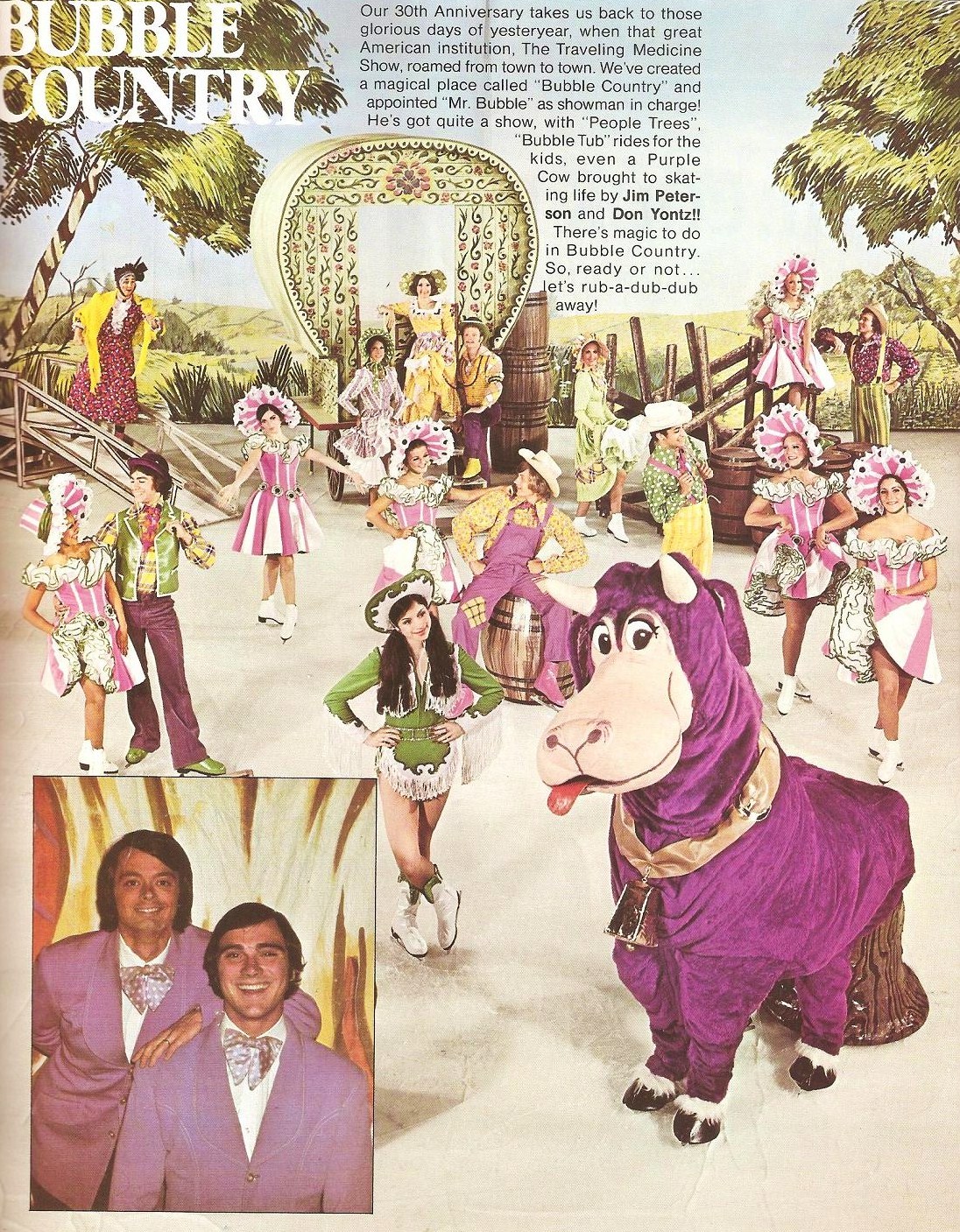
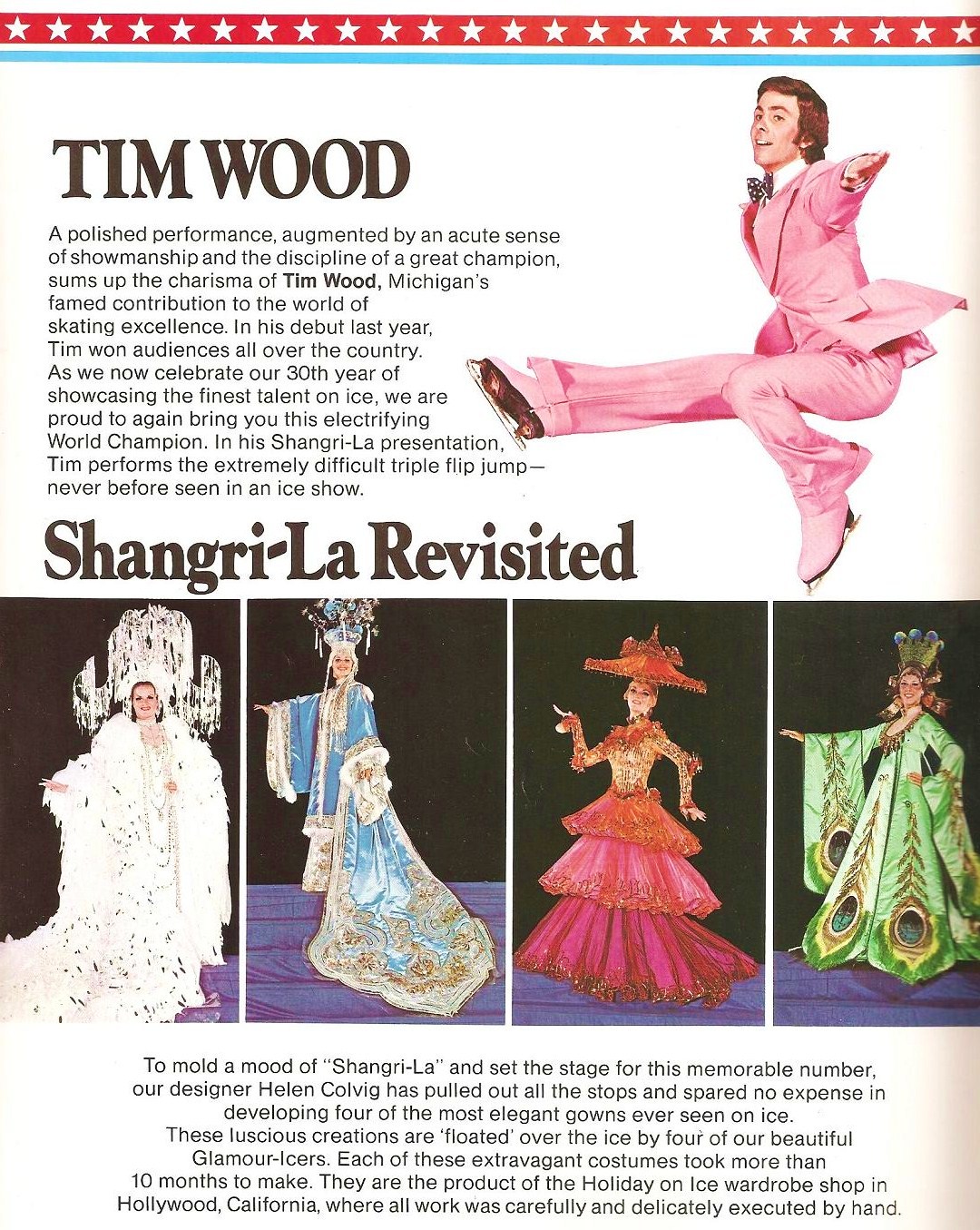
I don’t know for certain that I have “saved the best for last” this time out, but I have to put this next batch of photos last because it was really the only way I could work out the formatting. They are hilarious, though.  These are pages from a 1975, 30th anniversary tour of Holiday on Ice. Do enjoy the funky costumes, the goofy poses and just the overall campiness of it all. See who is inside the giant, purple, skating cow. See what costume designer Helen Colvig was up to after having worked three times with Clint Eastwood. Find out why I think Jimmy Crockett was always a hit at closing night parties… I hope you had fun with these. It took quite a while to sort through them, gather info and scan them in, which is why it’s been a few days since my last post! I’ll be back soon with more Hollywood fun and frolic.



Lord, how I waited... No one understands what it has been like to know about the existence of a movie that features Chad Everett, Ty Hardin, Corey Allen and Ray Danton, whose focus happens to be on sex (!), and not get to see it!  The movie is from 1962 and is called The Chapman Report. I first discovered its existence more than two decades ago and have never once, in all that time, come upon it in any way, be it broadcast or home video. FINALLY, thanks to Jane Fonda's birthday (she is one of the female stars), it was run on TCM late one night recently. The jigsaw puzzle of my bad movie life has one more piece in place and it feels terrific!
Author Irving Wallace released the original novel in 1961, all about a team of sex researchers, led by a Dr. Chapman, who descend on a ritzy Los Angeles suburb in order to interview a large contingent of ladies. Their identities kept secret as they are only known by their case number, answering questions from behind a screen, the women are encouraged to answer detailed, potentially embarrassing  questions for the purpose of collecting data. The novel (allegedly not inspired by the famous Kinsey Report, but rather by a collage of various researchers who'd been in business for many decades and the author's own imagination) was considered explosive and scandalous at the time. Early versions of the paperback had a very clinical, official look to them, often citing prestigious reviews on the cover while other, later copies were more to the point, as shown here!
Darryl F. Zanuck, of 20th Century Fox fame, acquired the rights to the book with his son Richard as producer. The studio had been able to turn the scorching page-turner Peyton Place into a lustrous, highly-acclaimed film just a few years prior. They sought that film's director, Mark Robson, to direct The Chapman Report. Unfortunately,  production issues with The Longest Day and Cleopatra meant that Zanuck (now independent and no longer the head of 20th) was forced to offer the property to his rival Jack Warner of Warner Brothers. Richard Zanuck and his quartet of leading ladies headed there where all of the primary leading male roles were soon filled with actors from Warner's stable of popular television stars. Veteran “women's picture” director George Cukor was enlisted to helm the film, which was officially a “DFZ Production,” despite being made at Warner Brothers. By the way, I don't think there is another female “look” I adore more than the snug pencil skirt paired with spike heels, as depicted on this lobby card!
 Many writers (too many!) worked on the story and screenplay, which pared the focus down to four primary study participants. One of the screenplay writers was Don Mankiewicz, of the famous writing family, and another was Wyatt Cooper, the part-time actor whose son Anderson grew up to be a famous tele-journalist. Costumes for the movie came courtesy of legendary designer Orry-Kelly, who by then had spent three decades clothing the stars on film. Someone (uncredited) supplied a raft of fun and funky jewelry pieces. Music was provided by Leonard Rosenman (best known at the time for having scored both East of Eden and Rebel Without a Cause, but who would later win Oscars for Barry Lyndon in 1975 and Bound for Glory in 1976)
 As the movie opens, credits are shown on top of multitudes of computer punch cards, designed to tabulate all the answers from the sexually-oriented questions into usable data. Amusingly, the punch cards shown have the names of the cast, not their characters, on them! Rosenman's opening music sounds like something more akin to a Peter Gunn-style detective series than a film devoted to the dissection of physical love!
We soon meet the ladies of the suburb The Briars, a well-to-do neighborhood of sleek and glamorous homes containing no small amount of problems beneath their facades. Shelley Winters is a wife and mother, shuttling her child off to school and her devoted, but dull, husband off to work so that she can call her lover and arrange a tryst.  As revealed in flashback, her secret man is the hunky Ray Danton, director of the local community theatre, a place that has always been a fertile breeding ground for adultery (at least I've seen a fair share of it in my own experience!) He's trapped in a loveless marriage and is only too happy to bring some spice to the otherwise humdrum existence of Winters. Their most frequent meetings take place on his boat or at an ocean-side cafe nearby.

 There is also Jane Fonda, in one of her very earliest screen roles. She plays the young widow of a popular test pilot who crashed to his death, leaving a legacy of honor which she feels compelled to perpetuate. A daddy's girl (with whom she lives) at heart, she is revealed in flashback to have had enormous difficulties with intimacy between her and her husband. The word used is frigid and we see that her now-dead husband was none too patient about it either. (Interestingly, her dead husband's nickname was “Boy!”) Because she is the resident ice queen, sexually, she is dressed at all times in white and her hair is pulled back tautly, frequently twirled up on top like the tip of a soft-serve ice cream cone!
 Glynis Johns portrays the flighty wife of John Dehner, an art gallery owner who encourages her own creative endeavors.
  The latest one involves her recording an album of poetry reading. They share a most unique relationship which, though devoted, could almost be read as pansexual, particularly on his part. He sends her to the beach to practice into a tape recorder, the loud surf demanding that she enunciate loudly and clearly. Alas, her studies are interrupted by a foursome of rowdy football players who happen to be in that exact spot of beach every single time she goes there! One of them, the gloriously beautiful Ty Hardin, winds up diving right in front of her and they strike up an acquaintance. As he is diametrically opposite of Dehner in every way, she soon becomes fascinated with him and decides to pursue him.
 Finally, there is Claire Bloom, a fashion designer and divorcee who is overly reliant on booze and pills and who tends to wallow around in her bedroom with the curtains drawn. It doesn't take long at all to realize that Bloom is what we might call today a sex addict, but what was then referred to as a nymphomaniac. In a classic porn set-up (which nonetheless came straight out of the novel), she has a fresh bottle
  of drinking water brought to her by a new delivery man (the edible Chad Everett) who she decides to pay with nature's credit card in addition to petty cash. Slinking to the kitchen to greet him in her loose, virtually transparent negligee, she invites him further and further into her house where he, in a blessedly snug khaki uniform, follows tentatively. With passion palpable, she coerces him into making out with her, the promise of ecstasy more than evident. However, she suddenly shifts into the reality of what she's doing and calls the whole deal off (WHAT??), sending young Everett out of her house and, sadly, out of the movie. Bloom's clothes throughout the film are all brown (because she's “dirty?”)

 Andrew Duggan plays Dr. Chapman and he's assisted by colleague Efrem Zimbalist Jr. The local women convene at their club for a lecture and an explanation of what Duggan's visit and resultant interviews will entail. Incidentally, this photo of the leading ladies all in a row at the lecture never occurs in the actual film. In actuality, the women are scattered somewhat throughout the audience and Bloom, in fact, arrives in time only to hear the last few bits of the presentation (delayed as she was by water boy Everett!)
 There is an opponent to the work of Duggan in the form of curmudgeonly old doctor Henry Daniell (a terrific character actor who is profiled here elsewhere.) In an extended cameo, an exchange with Duggan's helpmate Zimbalist, he puts forth a warning about the after-effects of a study such as this which is actually rather prescient.
As the ladies brace themselves for the upcoming investigative research into their sex lives,  they continue to practice (or, in Fonda's case, not!) Winters hooks up with Danton, even having a close call with his wife who is on the way from his boat as Winters is on her way to it! This chance encounter leads to a bit of a speed bump for the illicit lovers as Winters starts to demonstrate her ever-deepening feelings for him and feels a misplaced sense of jealously regarding Danton's own wife. Their affair is never depicted graphically, though scenes of a more undressed nature were shot as seen in this still photo of a moment that (excruciatingly) doesn't appear in the finished product.
 Fonda wrestles anxiously with the idea of confessing her frigid feelings to Zimbalist. On the big day, she wears a hysterically oversized hat (one whose shadow she can hide beneath?) - that I nonetheless adore - to the appointment and is fraught with nervousness, avoidance and, ultimately, frantic despair, causing her to spill the contents of her purse onto the floor. Unable to verbalize her conflicted feelings, she darts from the room, causing Zimbalist to worry if he's pushed too far. She has left her billfold on the floor under her chair which is discovered by his prim assistant (played by Cloris Leachman of all people!), but eventually he, in a controversial move, decides to return it to Fonda in person.
 Bloom answers her door (which is not unlike that old game Mystery Date, in that there's almost certainly a man behind it each time, but which type?) and finds neighbor Corey Allen, a seedy, but ruggedly sexy, cad who makes his attitude towards her known.
  His name is, no kidding, Wash Dillon! He pushes his way in and declares that he's seen the parade of men who've been to her house and wouldn't mind joining their ranks. He is interrupted before getting to score, but mentions to her that he plays in a band at a downtown joint. It isn't long before Bloom is there, in sunglasses despite the already darkened surroundings in the establishment!
Allen has already placed a bet with his jazz band cronies as to whether or not he'll land the sultry Bloom. As she sits percolating in the seat of her booth, he gives her the eye and then demonstrates, via his instrument, just what it is she's doing to him by being there, ready, willing and able! It's a hysterical bit of suggestive symbolism, but effective nonetheless.
 Johns is elated to get to explore her personal life with researcher Duggan. Dehner is all for it, too, and is happy when she decides to take along her portable tape recorder and put everything down for Dehner to listen to afterwards. (By the way, I love her over-the-top bracelet in this scene on the lower left!) Despite the relative bliss of her personal life compared to the others, she wonders how the other half lives and soon sets her mind to conquering Hardin. She tracks him down at his amusement park job (where he's in charge of wiping down the windows of a bubble car/ski lift contraption) and convinces him that he would make an excellent subject for one of her figure paintings. He's not very interested until she declares that he'll be paid for his poses.
 The day she arrives at his pad, with an unmistakably phallic oil well next to it dipping up and down and in and out with regular rhythm,
  she finds him prone on a chaise grappling the handle of his guitar. As they make preparations for his first sitting, she places him in the position of an Olympic discus thrower, then explains that such an athlete would, in order to preserve authenticity, be nude during the act! With this, Hardin removes his shirt and then steps behind a wicker chair to shuck off his pants. Unfortunately, he's wearing his ever-present swim trunks under them, but what trunks they are. The abbreviated shorts, of a very thin, green material, hug every contour of his manhood, leaving precious little to the imagination.
  His chiseled, perfect profile isn't bad, either. He's breathtaking to behold and, in fact, Johns soon becomes a bit breathless herself. This being a deliberately comic segment in contrast to the other three more angst-ridden stories, Johns is soon in over her head as the strong lunk starts making out with her and clinging to her until she's in danger of suffocation. During all the thrashing melee, with Johns writhing on top of Hardin, she manages to get out this howler of a double entendre: “...as much as I appreciate your strength and erectness...” We think she means the kind relating to a person's character, or perhaps not!
 While something of a romantic relationship (inappropriate as it is!) begins to develop between Zimbalist and Fonda, Winters and Bloom begin to approach some hurdles. Winters is totally under Danton's spell and resolves to leave her clueless husband (played sturdily by Harold J. Stone), but Danton remains more than a little dicey on the subject. Far worse off is Bloom who finally winds up with Allen, but when he's done with her, he introduces her to his band mates/poker buddies who waste no time in trying to find out what Allen sees in her.
  (By the way, the man on the right is Alex Cord in his film debut, but people-even at imdb.com-keep thinking it's Richard Mulligan!) The result is a fairly harrowing encounter that is capped off by a ragged and bruised Bloom being tossed into the street at the foot of her driveway where she is discovered by alarmed neighbor Fonda. The two have a scene together that brings to light something that's not particularly common in this movie: the lead actresses tend mostly to act their vignettes apart and enjoy precious little interaction together. It's really at the initial lecture and at a later party that any of them really share the screen and these connections are exceedingly brief! Seeing these ladies interact and reflect more on each other's lives might have made the stories more poignant and meaningful while also capitalizing on the chance to put such notable actresses together. Those looking for a lot of byplay between the lead actresses of The Chapman Report are in for a disappointment.
 As Fonda's stringent resistance to love lessens (in one of the film's more blatantly symbolic aspects),
 her hair begins to unwind as well. Soon she's wearing it completely down with merely a headband holding it back (that one last impediment standing in the way of full-on release.) Later, when she's finally relented and accepted love into her heart, when her blood is really pumping, her all-white wardrobe gets a shot of red in it. Her white evening gown has vein-like red threads coursing through it, concentrations of them surrounding her breasts! The hair is back up again, but this time it's just for looks.
 By the time the film has reached it 125th minute, one lady is on the threshold of happiness, two have learned to embrace what they already had and one has been destroyed
 by the events in her life. A studio-imposed ending, hastily written and then shot by someone other than George Cukor, has Duggan and Zimbalist expressing how most women are happily normal, something at odds with what the viewer has just witnessed over the prior two hours. It turns out that the Legion of Decency (any spicy film's mortal enemy until about the 1970s) was up in arms over the film's content and Jack Warner, in an effort to appease them, trimmed some of the scenes and tacked on the faux feel-good ending, severely hamstringing its effectiveness.
 I sometimes like to take a look at the advertising campaigns of U.S. films aiming for a foreign market.
  Almost invariably, the artwork is more dramatic and/or passionate. Certainly the Spanish (or is it Mexican) poster above leaves little doubt about the content of the film, or at least the content that the exhibitors wanted to stress anyway. Even more interesting, though, is this French poster on the left which takes Ty Hardin's legs (from a still photo done with Johns situated between them), paints pants on them and makes it seem as if it's Bloom who's doing the ogling! Both of these posters demonstrate changes in the title that have less to do with Chapman and his report, but are more vividly about the confessions and/or the relationships of the women, a more obviously sexy angle than the U.S. posters projected.
 Director Cukor, who'd been so successful in working with famous actresses including Katharine Hepburn, Greta Garbo, Joan Crawford and others, had been floundering a bit with stalled projects from The Lady L to Goodbye, Charlie (which were later made by other directors) when he was called upon to direct Chapman. He still owed 20th Century Fox one picture (even though this wound up released by Warners, as I described above.) A discreet, but nevertheless active, homosexual, he allegedly infuriated Jack Warner with dailies that were overloaded with shots of Ty Hardin and his pals playing football on the beach. Warner remarked that there was more film coverage of this incidental material than that of several real college teams! Aside from things like that, though, he was distraught to find that between 20 and 25 minutes of material that he felt was superior had been snipped down or cut out by Warner.
  As far as I can tell, Jack Cassidy's entire role (as one of Fonda's dates early in the movie) is missing entirely. Cukor considered removing his name from the film but didn't, always considering it a wounded movie. (This had happened with 1954's A Star is Born, too, also a Warner Brothers film.) He had better luck with his next picture, 1964's Oscar-winning musical My Fair Lady, which Warner allowed to run longer and which was a big success and finally won him an Oscar his fifth time out. His fifty-one year career as a director ended with Rich and Famous (a contemporary “women's picture”) in 1981 and he died in 1983 at the age of eighty-three of heart failure.
 As mentioned earlier, all of the men in The Chapman Report were Warner contract players who received no extra payment beyond their existing contracts in order to film their roles. It was presumed that they would be happy to act in something other than their usual parts and in the milieu of a feature film versus the small screen. Zimbalist was working on 77 Sunset Strip at the time, but had also starred in 1960's The Crowded Sky and 1961's By Love Possessed. He would continue to work steadily in both mediums, with Wait Until Dark and Airport 1975 among his later movies. Today, Mr. Z. is ninety-three years old and he worked up through the mid-2000s before retiring.
 Danton (shown above) had been acting on the big and small screen since the mid-'50s.
  He'd just finished a series called The Alaskans and had done the all-star Ice Palace in 1960 and A Majority of One (with Alec Guinness and Rosalind Russell) in 1961. Like Everett and Hardin, he has an individual tribute all his own here (well, okay, his is shared with one-time wife Julie Adams, but nevertheless...) Everett (at left) had just gotten started acting in 1961, but already had amassed a slew of TV credits. He'd also had roles in 1961's Claudelle Inglish and 1962's Rome Adventure. He would go from Chapman into his own series The Dakotas, but, of course, is best known for Medical Center, which ran from 1969 – 1976. he is seventy-six now, but still works on TV.
Hardin was also a relative newcomer at this point, having debuted  in a trio of low-budget 1958 films under his real last name of Hungerford. He shot to fame in 1960 when he was cast as Bronco in order to fill the space left on Cheyenne when Clint Walker had had enough grief from the studio and walked out for a while. After Chapman, he was featured in quite a few movies, though few of them were of a particularly high quality (Berserk with Joan Crawford anyone?!) Now eighty-one, he occasionally makes an acting appearance when not concentrating on his more-than-a-little-extreme political viewpoints.
 Duggan (shown above) was a mighty prolific actor, having begun on TV as early as 1949. Prior to Chapman, he'd been in The Bravados and Splendor in the Grass as well as starring on Bourbon Street Beat.
  His incredibly familiar face dotted many, many projects, primarily on television, until the mid-'80s. He died in 1988 of throat cancer at only the age of sixty-four. Harold J. Stone (at left) was one of those men you saw in films and TV countless times, yet likely didn't know his name. A TV actor from the late '40s on, he segued to movies in the mid-'50s. By 1960, he was part of the large cast of Spartacus with Kirk Douglas and Tony Curtis. He also was a favorite of Jerry Lewis who cast him in three movies of his. Though he only appeared as a regular on one series (1973's Bridget Loves Bernie), he guest-starred more than 150 times on plenty of others! He continued to act until 1986 when he retired, ultimately passing away from natural causes in 2005 at the age of ninety-two.
 Dehner (shown above) was an extremely familiar and prolific character actor from the early 1940s through the late '80s.
  Capable of playing virtually anything from a steely, heartless villain to a shifty con man, this part of an erudite, somewhat effeminate artist was something of a switch for him, but he's entertaining in it. At the time of filming, he was a regular on the Warner Brothers TV series The Roaring 20's (sic.) He died in 1992 at the age of seventy-six from emphysema and diabetes. Allen (at the left) is likely best known for his role as Buzz Gunderson in Rebel Without a Cause, the tall, dark antagonist to James Dean in the classic film. As the 1960s began to give way to the next decade, he left acting behind, for the most part, and became a very successful TV director (with an occasional movie tossed in.) He retired in 1994 and passed away from the effects of Parkinson's Disease in 2010 at the age of seventy-five.
 Enjoying a small, but colorful, role in the movie is Jennifer Howard. She plays Fonda's friend and neighbor who is in strong support of the Chapman research. Howard was the daughter of screenwriter Sidney Howard (who was a key writer on Gone with the Wind) and married Samuel Goldwyn Jr, resulting in a son – Tony Goldwyn – who is a working actor today! Fans of Return to Peyton Place might recall her as Jeff Chandler's wife in that film. She died in 1993 of lung cancer at the age of sixty-eight.
Leachman had, by this time, been steadily acting on TV since 1948, but this was only her fourth movie appearance.  In about a decade, she would win an Oscar for The Last Picture Show, thrusting her into a far more high-profile type of career. Not only would she establish a successful collaboration with Mel Brooks in films like Young Frankenstein and High Anxiety, but she would also steal scenes on The Mary Tyler Moore Show, which lead to Phyllis, her own sitcom. Now eighty-five, she remains busily working on TV and in movies, continuing with her staggering sixty-five year career!
By this time, Winters had one Oscar under her belt for 1959's The Diary of Anne Frank and would earn another on in 1965 for A Patch of Blue. Having begun working in movies in 1943, she would continue to do so up until 1999, making her career a fifty-three year one.  Her other film of 1962 was also notorious. Lolita concerned a seductive teen (with Winters starring as her mother) who carries on with an older man. She continued to appear in many, many movies, quite a few of which were beneath her, though 1972's The Poseidon Adventure was a highlight. Just prior to Chapman, Winters had been working on an Arthur Laurents play with Jane Fonda and Eileen Heckart and walked out before it opened after having several concerns go unheeded. This was her only film with Fonda and she never did one with Heckart, though Heckart won an Oscar for Butterflies Are Free the year Winters was nominated for Poseidon. Chapman marked a joyous reunion for director Cukor and Winters as he had given her her first important role back in 1947's A Double Life, thus kick-starting her fledgling career. She died of heart failure in 2006 at the age of eighty-five.
Fonda was right near the start of a big career. She'd debuted in Tall Story opposite Anthony Perkins in 1960, then had three films released in 1962.  Apart from this one, she also starred in Walk on the Wild Side, a camp screamer destined to be profiled here, and Period of Adjustment, a marital comedy with Tony Franciosa (who had recently been divorced from Shelley Winters.) Films of varying types continued, some good, some deliciously bad, until Barbarella in 1968 made her a household name and They Shoot Horses, Don't They? in '69 increased her credibility. She was Academy Award nominated for Horses, but lost to Maggie Smith for The Prime of Miss Jean Brodie. Her Oscar-winning role in Klute (1971) made her an actress to be reckoned with and she was nominated five additional times, winning once more in 1979 for Coming Home. Frequently a lady who sublimated herself to her high-profile husbands, she went sexy for Roger Vadim, got serious with Tom Hayden and retired completely as Mrs. Ted Turner, but sixteen year hiatus in 2005 when she did Monster-in-Law (having divorced Turner in 2001.) Now seventy-four, she continues to act in movies that draw her fancy.
Bloom (who is palpably sensual and sensitive here) began working in films with a supporting role in the 1948 British drama The Blind Goddess, but really gleaned the most amount of early fame for 1952's Charlie Chaplin film Limelight.  From there, she mostly became a go-to girl for historical epics and other serious fare, though she did do The Wonderful World of the Brothers Grimm the same year as Chapman. Enamored of Cukor and respectful of his abilities, she stated that not only was she willing to go braless for him in Chapman, but that if he'd asked to to, she'd have also removed her “knickers!” In 1963, she was cast in The Haunting, a chiller that remains famous as a great example of the haunted house genre. In a very ironic twist, both she and Jane Fonda played the exact same character of Nora in Ibsen's A Doll's House, in competing films released the very same year (1973)! Bloom starred with Anthony Hopkins while Fonda's version placed her opposite Edward Fox. Though Fonda's was screened at that year's Cannes Film Festival, it went directly to television in the U.S. while Bloom's played theaters. Despite a considerable body of work in many well-known films, Miss Bloom was never nominated for an Oscar. Now eighty, she continues to work, one recent example being her portrayal of Queen Mary in 2010's The King's Speech.
 South African born Johns acted in British films from the late-'30s until the early-'50s when she transferred to Hollywood, notably working opposite Danny Kaye in 1956's The Court Jester. Her work here is refreshingly bright and amusing. Just her body language alone is award-worthy. The same year she did Chapman, she starred in the oddball, low-budget chiller The Cabinet of Doctor Caligari. Two years later, she was portraying the mother of the house in Mary Poppins. Johns continued to work, becoming quite adept at playing feisty little old ladies (see The Ref, for a great example!), her last credit to date being cast as Grandma in Superstar in 1999 (about that crazy klutz Mary Katherine Gallagher.) Miss Johns has retired since that, but is still with us at eighty-eight!
The Chapman Report didn't get any love from The Academy of Motion Picture Arts and Sciences, but the less-discriminating Hollywood Foreign Press Association  gave it four nominations! It was listed as a contender for Best Picture-Drama, Best Director, Best Actress (Glynis Johns) and Best Supporting Actor (Harold J. Stone.) It lost in all of its categories with Golden Globes going instead to Lawrence of Arabia, David Lean for Lawrence of Arabia, Geraldine Page in Sweet Bird of Youth and Omar Shariff in Lawrence of Arabia. I'm ashamed to say, but it's completely true, that I'd rather watch The Chapman Report again before attempting Lawrence once more!

 pairings such as Don Ameche, Karen Valentine and John Saxon in The Moon is Blue, John Gavin and Karen Lynn Gorney in Dracula or Joe Namath in Picnic! I had purchased a box full of the programs at a local estate auction and couldn’t wait to share their campy qualities with my devoted divers at The Underworld. (As an example of what I'm talking about, can you determine from this cover who it is that is enacting the role of Dolly Levi in Hello Dolly!? Answer in a moment...)
 astonishingly, were from the very same theatre company as my own were (Kenley Players), but with not one duplication! There were other items in his stack that went beyond what I had bought, but which were equally fun. I instantly asked if he would be kind enough to lend me the stack of programs so that I might scan in some highlights to share with my readers at The Underworld and he graciously complied. So, here we go!
 Kenley Players was founded by John Kenley, a peculiar, but very successful, producer of a Midwestern summer stock theatre circuit that began in 1950 and proceeded for three decades or so after. Kenley made it a point early on to bring name brand (if, perhaps, a trifle dusty) stars to his company, knowing that audiences who were typically deprived the chance to see such people would patronize the performances. Here is the billing info for the Hello Dolly! cover portrait from the top of this post. Yes, it was Miss Betty White!
 reportedly spending summers in Ohio as John Kenley and winters in Florida as Joan Kenley! (This in spite of his WWII stint as a Merchant Marine!) Merv Griffin stated outright in his biography that Kenley was a hermaphrodite! A longstanding tradition of his productions was that at the opening night party, the leading man of the show was required to dance the first number of the night with Kenley. Presumably, the gentlemen good-naturedly complied. In any case, he lived until the ripe age of one hundred three, passing away in 2009.
 shifting the position of her sofa occasionally to suggest variety of movement. (She's seen here after her accident with close friend Cesar Romero and prior to her accident in a lovely portrait.) Peters remained under contract to MGM for a short time after her paralysis, but ran into understandable limitations when it came to parts. Though she put forth a valiant effort, even attempting a TV series called Miss Susan, she was dead by age thirty-one of illness and the effects of anorexia nervosa.
 and Robbie Benson in Evita (again in this post, I must employ the abused exclamation point!) I mean, you can't make this shit up! From here on, though, I’ll concentrate more on what I do have evidence of. The 1961 Broadway flop Everybody Loves Opal had starred Eileen Heckart, Stubby Kaye, James Coco and Brenda Vaccaro, but two key unfavorable reviews led to its premature closure. It later became a vehicle and potential comedic showcase for actresses of a certain age and is done in community theatre still today. In ‘72, Kenley’s production starred Phyllis Diller, depicted on the front and back cover (and inside) in ways that had nothing whatsoever to do with her eccentric, raggedy sort of character (a shabby hermit who is suspected of hoarding money and who is infiltrated by a gaggle of would-be murderers.)
  The 1964 Broadway hit Luv had starred Alan Arkin, Eli Wallach and (his real life wife) Anne Jackson. It focused on two old college pals who discover that they are both miserable with one trying to offload his wife on the other in order to improve both of their lives. Ten years later at Kenley, the stars were Dom DeLuise, Joyce Van Patten and Bill McCutcheon. (Fans of Steel Magnolias will recall McCutcheon as Ouiser’s love interest Owen Jenkins.)
 Later, The Kenley Players production featured Frankie Avalon, Karen Morrow and Joe Flynn. Morrow was a veteran of quite a few Broadway flops who later worked on a lot of ‘70s television including the Bewitched spin-off Tabitha. In a strange interlude within his lengthy career, Avalon had determined to be billed as Frank Avalon versus the more familiar Frankie. The owner of this program had scrawled 1979 on the cover as the date she saw this, but that isn’t possible. For one thing, Avalon’s bio makes no mention of the gargantuan hit Grease in 1978, in which he played Teen Angel. It is unlikely that such a thing would be left out. More importantly, though, is the fact that costar Flynn could not possibly have performed in a 1979 production of Anything Goes (Weekend at Bernie’s, maybe…) Flynn, the star of McHale’s Navy from 1962-1966
  and of several Disney movies, was found dead (and nude) in the family swimming pool on July 19th, 1974! He had apparently either drowned or had a heart attack that lead to drowning. He was forty-nine years old. This production was most likely done in the very early ‘70s as one of the costars, Leland Palmer, was nominated for a Tony for Pippin in 1973 and at the time of this show, such a thing had not yet occurred (though her earlier nomination for 1967’s A Joyful Noise is listed.)
 High Button Shoes had been a George Abbott-directed/Jerome Robbins-choreographed musical, running for over 700 performances on Broadway in 1947. It concerned a con-man trying to fleece a New Jersey couple in a land deal, cheating people of the town in other ways all along, eventually being chased through Atlantic City in an elaborate number. The star then was Phil Silvers. In this 1983 production, Gavin McLeod was the headliner.
  For whatever reason, McLeod’s head shot in the program was merely one from his hit series The Love Boat, complete with captains hat! Perhaps they wanted there to be no doubt about the fact that a popular TV star was being put before the audiences.
 which I will mention for the curious, include: operatic tenor Jan Peerce in a July, 1971 performance of Fiddler on the Roof, a dry-run for his eventual stint as a Broadway replacement in December of that year, John Raitt in Camelot, The Smothers Brothers in I Love My Wife, Sally Ann Howes in The Great Waltz, Gary Sandy in Barnum (there were no revealing photos!) and McLean Stevenson in Under the Yum Yum Tree. We're also sorry that we don't have one for the hystercial productions advertised here to the left of a highly '80s-ized Morgan Fairchild and James Farentino starring in Goodbye Charlie!
 A bit more interesting, to me anyway, is the 1983 production of Pal Joey starring Joel Grey and Alexis Smith, two people I do not associate together at all ordinarily. The Rodgers and Hart musical was done on Broadway in 1940 with Gene Kelly and Vivienne Segal (and June Havoc.) At the time of this production, Grey had already appeared in Kenley shows Cabaret (for which he’d won a Tony and, later, an Oscar), George M!, and 1776. Smith had performed with Kenley Players way back in the 1950s and had, by now, enjoyed her triumphant,
 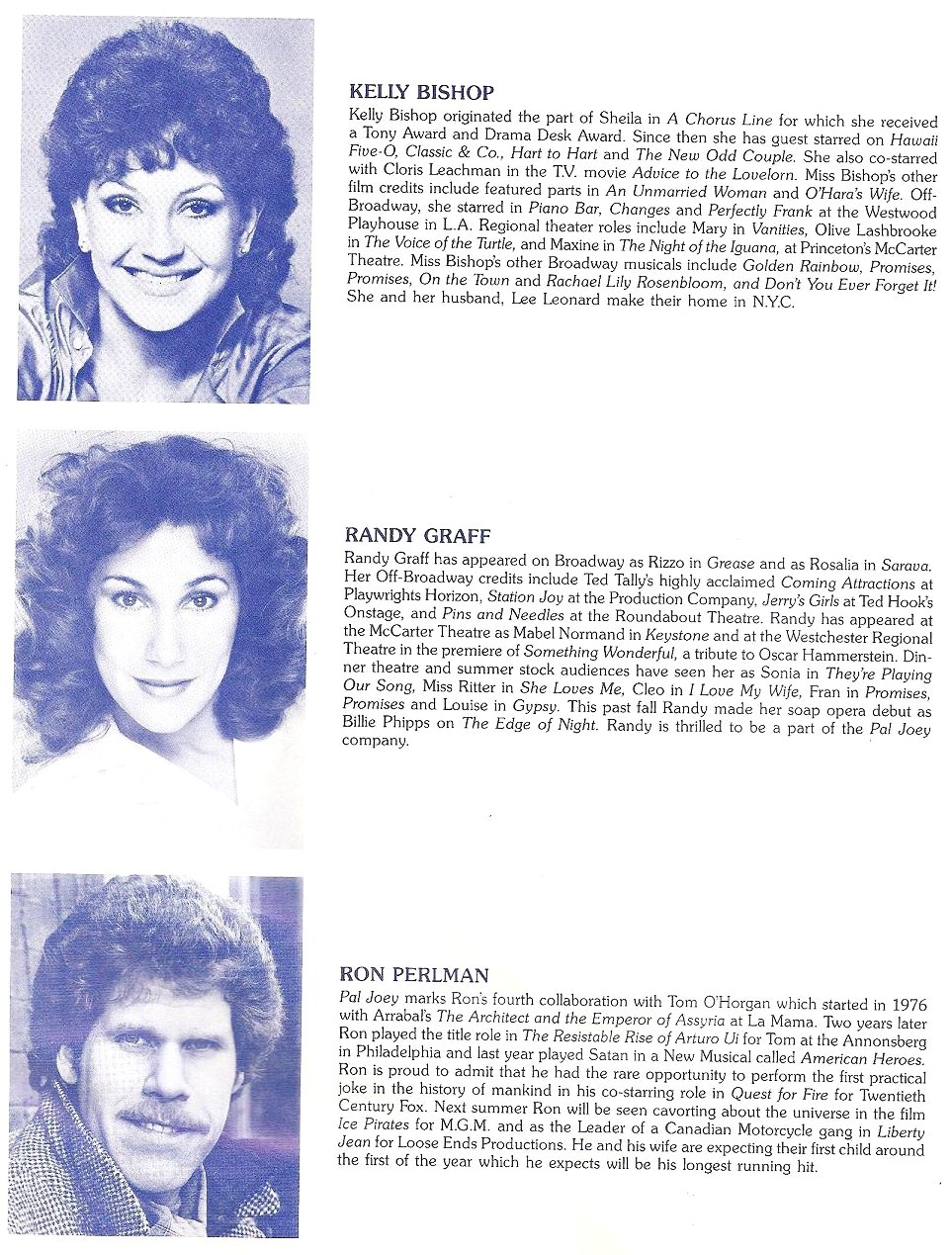 Tony-winning stage success in Follies. She followed that up with The Women (as Sylvia), Summer Brave and Platinum, eventually touring as Miss Mona (!) in The Best Little Whorehouse in Texas. She also did Kenley versions of Mary, Mary and Applause. One of the cast members of this production would soon go on to greater fame. With Quest for Fire under his belt and The Ice Pirates about to be released, young, unusual-looking Ron Perlman would just a few years later become a cult favorite in the romantic fantasy TV series Beauty and the Beast, which ran from 1987 - 1990. He is still a busy actor today, a recent success being the biker-themed FX series Sons of Anarchy. Check out that ‘80s hair and stache!
 It did have a photo of some shirtless cowboys, which I am including not because they are particularly good-looking, but more as a way of pointing out how much the standards have changed since then with regards to the age and physical condition of shirtless chorus men! Lord, I could have done this next to these chaps without too much undue embarrassment…
 Initially called 4 Girls 4 with its inception in 1977, it was a quartet consisting of Rosemary Clooney, Margaret Whiting, Barbara McNair and Rose Marie. McNair, who truly was not of the same era as the rest, quickly departed, replaced by Helen O’Connell. The old gals enjoyed staggering success in this venture among those folks longing for the nostalgic music they’d helped make famous. The ladies had occasional squabbles amongst themselves, most often involving Helen O’Connell, who somehow managed to aggravate virtually everyone despite the success were enjoying together. She was a woman apart, including, at first, her clothing. In a coincidence with regards to this post, it was reportedly John Kenley who said to her, “You look like you’re wearing pajamas next to the other girls.” O’Connell allegedly replied that she was wearing a designer dress herself, but he stated, “I don’t care… They’re all sequined and beaded and theatrical and you look like you just came out of the bathroom.”
  Eventually, Rose Marie grew tired of the stress and left, replaced by Martha Raye (who also couldn‘t bear O‘Connell.) Then, Whiting departed as well. When Kay Starr took her spot is when The New Girls 4 re-christening came about. In time, Raye was forced to reduce her time with the group and Kaye Ballard would fill in. Before it was over, Rose Marie was back briefly, as was Whiting, but without Clooney, and the whole thing eventually consisted of O’Connell, Whiting and Starr and was called 3 Girls 3! It petered out for good in the late ‘80s after considerable success. Today, Ballard is eighty-six, Rose Marie is eighty-eight and Kay Starr is eighty-nine. O’Connell died back in ‘93 at seventy-three, Raye died in ‘94 at seventy-eight, Clooney passed away in 2002 at seventy-four and Whiting died in 2011 at eighty-six.
 While we're on Martha Raye, we have here a program from one of her own Kenley Players productions in 1983. In a rather interesting stroke of casting, she was given the role of Miss Hannigan in hit musical Annie. The original production had run for six years on Broadway starting in 1977. Dorothy Loudon was the first Mrs. H., followed by Alice Ghostly, Betty Hutton, Marcia Lewis and June Havoc. For some reason, the young lady playing Grace Farrell made no attempt to alter her name (Norma Jean Baker) even though (or maybe because) it was the real name of the legendary movie star Marilyn Monroe.
 Next, we have a 1983 presentation of No, No Nanette, another old chestnut that was being revived. The 1925 three-act musical concerned marital confusion amongst three couples. After being adapted into a few movies, sometimes with significant alteration to its plot
  (such as with 1950’s Tea for Two starring Doris Day), the property was dormant for a while. Then, in 1971, a nostalgic revival starred Ruby Keeler along with Patsy Kelly, Jack Gilford and Bobby Van. The version at Kenley starred Van Johnson and Gloria DeHaven.
  Considering the allegation that Johnson’s already-controversial marriage came to an end when he fell for a chorus boy performing with him in a production of The Music Man in the late ‘60s, one parlor game might be to print off this shot of the chorus of No, No Nanette and guess which fellows either kissed up to or caught the eye of or had to fend off the advances of (or all three!) the leading man.
 There was a collection of programs from another local company that I had never heard of, but which also had its share of stars come forth to perform in their shows. The James Alex Summer Theatre was founded in the early 1960s (and, sadly, I don’t know how long it lasted) by a former dancer and choreographer named James Alex. One thing is certain. For at least one summer, he managed to align a jaw-dropping selection of shows and stars.
  See the photo here for more evidence. It’s from inside the program of Damn Yankees, starring Rita Moreno as Lola (this right on the heels of her Oscar-winning 1961 turn as Anita in West Side Story!) and lists eight more shows in the series, each one with someone famous in the lead. Most mind-boggling of all is the order form at the bottom of the page for tickets. The price range for seats, from best to worst, was $2.85 to $1.50 (with $2.25 resting in the middle!!) Unbelievable.
  The cover for Damn Yankees has Miss Rita in a scenario I’ll have to remember the next time I feel too fat to be featured in publicity photos. Her disembodied noggin, cut out of an old head shot, has been adhered to artwork showing a reed thin body in a one-piece costume and heels, brandishing a decidedly unrealistic looking baseball cap in one hand! She’s poised atop her “victim,” a ball player lying on his belly on the playing field.
 A closer look at another James Alex Production reveals the musical Flower Drum Song, an Asian-populated Rodgers and Hammerstein musical that had run on Broadway from 1958 to 1960. (Do note that on this and the other James Alex programs, there is mention of the fact that Dayton, Ohio’s Memorial Hall is air conditioned, not an entirely commonplace thing at that time still!) Admirably, considering the date of this production and the geographic location of it, the vast majority of Asian characters were portrayed by true Asian performers.
 More interestingly, though, was my spotting of the name of one Chao Li. Playing the character Master Wong, I wondered, could this possibly be the same Chao Li I was thinking about?? I’m referring to Chao-Li Chi, faithful servant to Jane Wyman’s Angela Channing during nearly decade of Falcon Crest. Sure enough, thanks to a photo inside I was able to easily recognize the actor’s familiar gaze. It’s a lesser known fact that Chao-Li Chi (whose character on Crest was also named Chao-Li!) continued to work on TV in guest roles for close to two more decades after the soap’s 1990 cancellation. He died in 2010 at the age of eighty-three.
 Dorothy Collins, a Canadian-born singer, had been popular in the 1950s on a series called Your Hit Parade, which highlighted through lavish production numbers the top seven songs in the U.S. each week. She appeared in the 1962 James Alex Production of Brigadoon (alongside someone with the highly unfortunate name of Jean Betty Weiner…) Collins would later take part in 1971’s Broadway smash Follies (as Sally, who sings Losing My Mind), scoring a Tony nomination, but losing to costar Alexis Smith. She died in 1994 of asthma-related illness at the age of sixty-seven.
 These programs often feature hysterical advertising and this one is no exception. This page has an ad for an Academy of Dramatic Art run by a Norma Sharkey. Their big claim to fame is that someone called Sandra Sturdivant is now working in summer theatre. Wow… You, too, can be fifth shrub on the right in a splashy chorus. Sign me up!
 This one cracked me up, too. Mam’selle Model Agency, owned and operated by Bette Jeane Shively, a Donna Reed-ish lady who is only too happy to straighten out and finish off career girls, teenagers and homemakers who are currently lacking in the proper social and physical graces. Don’t miss the ad at the bottom for Mike Longo’s in which $5.00 will get you a choice seat at the show plus dinner!
  I thought poor Jack Carson (in town at the time to headline Bye Bye Birdie) had been arrested!! Luckily, he was just checking out the latest in a new fleet of local taxis, the officious-looking driver standing near. Look at some of the phone numbers in these ads. They are still using the old two-letter, five-number ones that are immortalized for many of us by the film BUtterfield 8.
  There’s a program from a tour of Andrew Lloyd Webber’s Cats that doesn’t really contain anything of interest, but which does have a couple of very “80s” ads. I chose to share this one with you for Dodge cars because it features a good-looking man in a revealing Speedo! (I’m always looking out for you folks. Truly!)
 This next program is from a tour that came to Dayton (with my best guess of the date being 1977) and starred a very notable leading lady. Lillian Roth was a singer and actress whose career on stage began way back in 1917 when she was but seven years old. What followed was an up and down career, filled with alcohol and tumultuous relationships, that were ultimately recounted in a vivid autobiography called I’ll Cry Tomorrow. That tome was eventually made into a movie starring Susan Hayward, the part earning her a nomination for a Best Actress Oscar (losing to Anna Magnani in The Rose Tattoo.)
 The costar here was Gretchen Wyler. Wyler was a Broadway veteran who I had never heard of prior to about 2006 when I saw her in the terrific documentary Broadway: The Golden Age, by the Legends Who Were There. To be honest, I found her to be self-aggrandizing and more than a little devious, though she must be congratulated for her candor in any case. Breast cancer claimed her in 2007 when she was seventy-five years old.
 This one featured several known folks, not the least of which was its leading lady Mamie Van Doren (!), once a 1950s sexpot in the vein of Jayne Mansfield and Marilyn Monroe, she had trouble sustaining a legitimate acting career, especially after the 1960s. By the ‘70s, she was doing stage shows that the other blondes, Jayne and Marilyn, had enjoyed success with in their movie renditions (such as Will Success Spoil Rock Hunter? and Gentlemen Prefer Blondes.) Does she not resemble a platinum blonde Marie Osmond in the shot at the far left?? A sizzling 1987 autobiography shed an all-new light on the blonder and less-covered-up than ever actress and she has continued to capitalize on this new level of notoriety, at varying levels of success, ever since. She is currently eighty.
 Then there were Phil Ford and Mimi Hines, a comedy pairing who’d been together for many years (since at least 1958) and enjoyed considerable success. One of Hines’ most notable achievements was ably doing what was considered the impossible, replacing Barbra Streisand in the original Broadway production of Funny Girl in 1964. (She performed it for 18 more months.) Ford passed away in 2005 at age eighty-five while Hines is still with us at age seventy-eight.
 How about Miss Connie Stevens?! We’ve remarked here before about her dead-serious desire to play Eliza Doolittle in the film version of My Fair Lady and the frustration she felt towards Jack Warner for not considering her. I guess she was still working out some of her thwarted musical theatre yearnings even by this time. There are several very UN-Molly Brown-ish photos of Miss Stevens in the program,
  but none more so than the one of her draped in fur with one long, pantyhosed limb jutting out from her pelvic bone onward. (This shot is from her 1976 undercover policewoman opus Scorchy, a film I’ve yet to see, but will celebrate with a display of fireworks when I finally get to do so!) Miss Connie is seventy-three today and is still lookin’ good (thanks, likely, to her Forever Spring line of beauty products.)
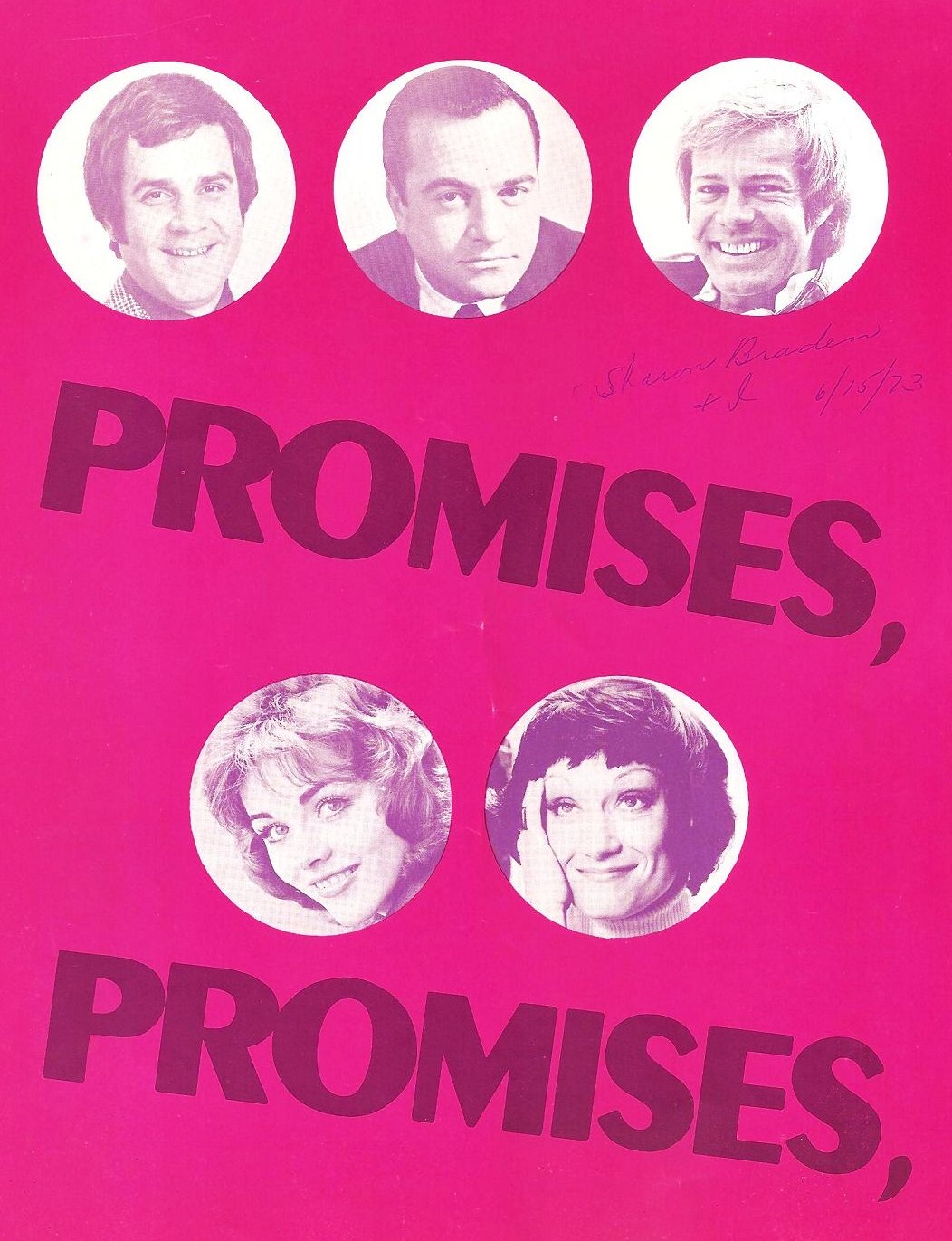 The final Kenley Players program is from Promises, Promises. That musicalization of The Apartment was a substantial hit on Broadway from 1968 - 1972, starring Jerry Orbach. Until recently, the show had never enjoyed a revival there, but in 2010, Kristin Chenowith and Will and Grace’s Sean Hayes headlined one that played for about three-quarters of a year. For this 1973 production, the big name was Rich Little, who I must say I never thought of as a singer. He is still alive today at age seventy-three. David Doyle also had a role in this one.
 Chosen by Burgess Meredith at the tender age of six to play against Tallulah Bankhead in Broadway’s Midgie Purvis, she soon thereafter was featured in the notoriously ghastly film Santa Claus Conquers the Martians. She worked a couple more times on Broadway in short stints or small roles before taking to the road in various theatrical tours (meeting her first husband while working on Applause! with Alexis Smith.) In 1982, she reignited her film career with a string of splashy, sexy, trashy films like Butterfly and The Lonely Lady. She won a Golden Globe as Most Promising Newcomer, but also landed three Razzies! Steve Allen made a wisecrack about her one year at the Night of 100 Stars benefit, resulting in her getting the chance to wow the crowd the year after with a startlingly good vocal performance. Having retired in 1999 and now with her third husband, she is fifty-seven today.
 These are pages from a 1975, 30th anniversary tour of Holiday on Ice. Do enjoy the funky costumes, the goofy poses and just the overall campiness of it all. See who is inside the giant, purple, skating cow. See what costume designer Helen Colvig was up to after having worked three times with Clint Eastwood. Find out why I think Jimmy Crockett was always a hit at closing night parties… I hope you had fun with these. It took quite a while to sort through them, gather info and scan them in, which is why it’s been a few days since my last post! I’ll be back soon with more Hollywood fun and frolic.