
 there’s no way I could fully examine the entire career of today’s featured actress. I’ll just have to make due with some highlights and my own personal reflections of her and her films.
Known to the world for her role of Melanie Wilkes in the bona fide classic Gone With the Wind, Miss Olivia de Havilland had a career that stretched far beyond that (admittedly meteoric) film and, through her recollections of life during the studio era, continues to delight us today at the tender age of 94!
Truly born Olivia de Havilland (could anyone ever have been clever enough to create a name like that simply for star machine purposes?) with the middle name of Mary, to English parents living in Tokyo, Japan, she entered this world on July 1st, 1916. The following year, little sister Joan de Havilland was born, but, sadly, their parents were divorced by 1919.

 Joan was of frail health and Olivia’s mother took her two daughters to live in sunny California (in the city of Saratoga) in order to help her improve. (In hindsight, Olivia might have preferred to leave her baby sister lying on a damp rice patty in Japan, but, at this stage anyway, there was no reason for concern!) Both girls thrived in the temperate new environment, though the younger sister would retain a more slight build for many years after.
Olivia attended two different
 local high schools, taking an interest in acting as she grew up. As a pretty teen, she took part school productions of Alice in Wonderland and A Midsummer Night’s Dream (as Puck.) In the audience one night was famed director Max Reinhart who then put her in a spectacularly staged version of the play at The Hollywood Bowl (this time as Hermia.) Not long after in 1935, when the decision was made to film the production, Olivia found herself cast amidst a wealth of well-known movie actors of that time from James Cagney to Joe E. Brown to Mickey Rooney to Dick Powell (shown with her here) to even Billy Barty! From the very start of her film career, she was decorated in elaborate costumes and photographed lovingly.
 Her debut film resulted in a contract with Warner Brothers, the studio that made the picture, and she was soon being put to use in a variety
 of movies including Alibi Ike and The Irish in Us. She was selected to appear with Robert Donat, one of the more revered actors of the time, in the swashbuckling adventure Captain Blood, but he failed to report to the set and so a virtual unknown who had been essaying small roles was rushed in to replace him. The replacement, Errol Flynn, became an instant sensation and he would become a significant figure in de Havilland’s life, particularly during her tenure at Warners.
Something about the chemistry between Olivia and Errol (not to mention the combination of their stunning looks!) clicked and they went on to make
 eight films (plus one all-star extravaganza as themselves) together. Everyone has his or her taste as to what is attractive, but I must join in the legion of fans who felt that Errol and Olivia made the perfect onscreen couple. His sly, winking, adventuresome persona contrasted and yet blended beautifully with her aristocratic, wholesome, ladylike manner. Each one gave a bit, resulting in striking cinematic companionship, egged on by their own real life affection for each other, which was allegedly never consummated.
Their films together were usually of the period sort, with either swords, guns or arrows frequently in use. The historical aspects of some of them have been derided since their release (Hollywood rarely let the facts interfere with their desire to put on a show!), but for those who can relax on that point, there is grand entertainment to be enjoyed.
 1938 brought one of the all-time beloved examples of movie swordplay and dashing, The Adventures of Robin Hood. Flynn was, of course, the title character while de Havilland played the role of Marian. As was often the case in their movies together, she was of a higher station in life, eventually defrosted into falling for the raucous adventurer. In a symbolic move, de Havilland’s hair was covered up with headdresses in every scene of the film except one that takes place in her chambers, where Flynn secretly visits her.
 As successful (and enduring) as Robin Hood was, there was another, far greater triumph on the horizon for Miss D. David O. Selznick was putting together the film adaptation of a novel that had completely captured the nation’s fancy. The mercurial, obsessive, demanding, flamboyant producer would stop at nothing to get the film he wanted and the cast he wanted to be in it. Gone With the Wind
 would become one of the most lauded and well-remembered pieces of cinema ever assembled and de Havilland was granted one of the primary roles, that of Melanie Wilkes.
Melanie was the impossibly good-natured and genteel flip-side to the main character Scarlett, a selfish, domineering and driven woman who spent the better part of her life longing for someone she shouldn’t have, namely Melanie’s husband Ashley. Detractors have expressed their dismay at the overly gooey and caring de Havilland who puts up with so much and who seems to have no backbone. However, in my opinion, they are missing the fact that while she chooses to be optimistic, she is certainly no dummy and has surprising reservoirs of strength. Beyond that, de Havilland’s portrayal is precisely what is described in the source novel (as is practically every cast member in the mammoth production, a testament to the tenacity of Selznick in getting only the right people!)
One scene which many people point out as notable f
 or de Havilland is the one in which she interacts (against all social convention of the era) with the town madam, Belle Watling (played by Ona Munson.) She accepts money from the scarlet woman that no one else will take because it may provide comfort or safety for her husband who is away at war. She also states that she would not shy away from acknowledging Watling, should they ever meet on the street, indicating a bit of rebelliousness in her straight-laced character.
Those who think of Olivia as the most ladylike of actresses will be surprised to know that it was she who provided the wretching noises Scarlett makes after eating the dired-up, dirt-covered turnip. Vivien was unable to come up with such sounds and, upon hearing this, Liv offered
 up her own services in order to get the effect recorded. She was also, however, responsible for getting the great screen he-man Clark Gable to the point where he would cry onscreen, something he was greatly against doing and felt unable to do until she spoke with and coached him on it.
My favorite moment of de Havilland’s (one of two favorite scenes I have in the long film, the other being Scarlett’s “I’ll never go hungry again” moment) takes place after the war. No one has anything and everyone is tired, hungry and defeated. Melanie is feeding displaced and injured soldiers, wearily trying to get through another agonizing day of drudgery when she sees a hobbling figure making his way down the dirty pathway to the once-great estate. Within seconds, even from far away, she can tell that it is her beloved husband and with a sudden burst of energy she hurls herself over a hill and down the drive to him, arms extended. Call it corn, call it whatever you wish, but that moment never fails to send me to the Kleenex and I, along with multitudes of others, could only wish for a love like that!
GWTW was a supreme hit from the moment it opened and came close to sweeping the Academy Awards that year.
 For Olivia, it was a bittersweet time. There was no chance of her being nominated in the leading category in competition with Vivien Leigh as Scarlett, but she was placed in the Supporting Actress category along with Hattie McDaniel, unforgettable and iconic as Scarlett’s servent Mammy. When both Leigh and McDaniel won, de Havilland was crushed at being left out. She later allowed her affection for McDaniel (along with the historical significance of her win) to put a patch on her wounds. I certainly wouldn’t take away McDaniel’s achievement (and she is nothing short of wonderful in the movie), but the truth is that de Havilland’s role was surely more difficult to convey and a more complex part despite its seeming simplicity.
Olivia was dismayed to come back to Warner Brothers and find herself cast in a secondary role in The Private Lives of Elizabeth and Essex with Bette Davis and Errol Flynn. Flynn had been under heavy consideration
 for the role of Rhett Butler until Davis (a front-runner for Scarlett for a time) quashed it, refusing to play Scarlett opposite him. Davis thought he was a sub-par actor and blamed him for the loss of the role, taking pleasure in whacking him mightily across the face in one scene. The color film had Flynn looking handsomer than at any other time, practically, and many, many years later, Davis viewed the film again and called de Havilland to express that she had been wrong about him and his talent (a fact Olivia surely knew all along.) Davis and de Havilland would have a long association with each other over the years, even if their initial contact was such that Bette scared the hell out of Olivia with her dominant, aggressive personality.
 She was, especially with Flynn, still quite a box office draw. They Died With Their Boots On, the pair’s final teaming (though they had no way of knowing it at the time) was the number two film of 1941. (The photo above is not from that film.) Nevertheless, de Havilland was increasingly unhappy with the studio’s persistence in casting her again and again in “damsel in distress” roles or in parts that otherwise gave her nothing challenging to play.
This situation finally showed
 some chance of subsiding when she got to play (albeit on loan to Paramount) Emmy Brown in Hold Back the Dawn, also in 1941. As a single schoolteacher exploited by a gigolo (Charles Boyer) wanting to marry her in order to gain American citizenship, she received her first Best Actress Oscar nomination. The bad news was that little sister Joan (by now Joan Fontaine and a burgeoning star in her own right) was also nominated (for the second time in a row, following Rebecca!) for her work in Alfred Hitchcock’s Suspicion. This time, Fontaine was victorious and her victory helped to further ignite a rivalry and sense of resentment that had been simmering ever since their teen years.
 In 1942, Olivia re-teamed with Bette Davis in In This Our Life with the two playing sisters. Davis’s vixen runs off with de Havilland’s husband and that’s just the beginning of the trouble. The film was problem-plagued throughout its filming schedule with everything from Davis’s husband falling ill to her own health concerns to the bombing of Pearl Harbor, which resulted in director John Huston’s departure before filming was completed. All along, Davis (perhaps rightly) felt herself not young enough to take away Olivia’s man and somehow she wound up collaborating on unbecoming makeup,
  hairstyles and clothing, all of which were panned by the critics. Though they played rivals, Bette and Olivia didn’t share the real life enmity that Olivia and Joan did.
Earlier, Davis had fought back against the oppressive, almost indentured servitude-like Studio System and was defeated in her efforts. De Havilland, finding the roles offered her almost unbearable, couldn’t wait until her seven years at Warner Brothers were up. When the day arrived, she found that the time she’d spent on suspension had been added to the length of her contract! Furious, she took up the reins of the actors’ cause against this practice and fought back again. This time, the studios were on the losing end and were forced to release actors after seven years, regardless of time spent on suspension, unless the actor wished to continue. A law was even named after her for this pioneering act, which endeared her to many a performer (if not too many studio chiefs!)
 Nonetheless, Paramount Pictures, who had enjoyed success with Olivia on loan-outs, formed a three-picture deal with her. In one, The Dark Mirror, she played a dual role of twin sisters, one kind and one evil. This offered her the chance to really dominate the proceedings in a film instead of prettily support someone else. While its certainly no great shakes now, it was a diverting thriller for 1946 audiences. A hooty TV remake was made in 1984 with Jane Seymour doing double-duty.
More importantly, her new deal brought
 her the property To Each His Own, a melodrama about a woman who becomes pregnant by a WWI Army Flyer who is killed in action. She then secretly gives birth and allows the baby boy to be adopted only to continue to be a part of his life, though at arm’s length. The Madame X-ish tale of a mother’s sacrifice gleaned Miss de Havilland her first Oscar for Bess Actress. Yet another chilly moment occurred at the ceremony between Liv and Joan, their situation still unresolved and apparently getting worse with time.
Olivia married for the first time in 1946 (at age 27) to novelist and former sailor Marcus Goodrich. They would have one son (in 1949), but divorce by 1953. Incidentally, the 1949 pregnancy and resultant birth precluded her from accepting the role of Blanche DuBois in the film version of A Streetcar Named Desire, which, of course, eventually went to her old GWTW costar Vivien Leigh (who won the Oscar that year.)
 1948 brought Olivia another of her great roles, this one in The Snake Pit, all about the horrors of life in a mental institution. She had Gene Tierney’s pregnancy to thank for the part, since the actress departed the 20th Century Fox production for that reason. De Havilland researched the role thoroughly in a manner that would become far more common in later years, but was still fairly unusual then. It resulted in another nomination for Best Actress, but this time the statuette went to Jane Wyman for Johnny Belinda.
If de Havilland has another iconic role apart from Melanie Wilkes, it is very likely that of Catherine
 Sloper in The Heiress. Once again in period dress, but this time made up to look dowdy and deliberately photographed to be as plain as possible, she played a socially awkward young lady, heir to a fortune, who becomes involved with a handsome and attentive suitor played by Montgomery Clift. The distinguished cast also included Ralph Richardson and Miriam Hopkins, two scene-stealers from way back who knew every trick in the book. Olivia was primarily appalled by Richardson’s tactics and disliked working with him intensely. This probably only aided the performance since the character ultimately has to despise her father and she took home her second Best Actress Oscar for the part.
 Off the screen for a few years (having become a mother to her new son Benjamin), she returned in 1952 for My Cousin Rachel. The period film, based on a Daphne Du Maurier novel, concerned the death of a young man who was married to Olivia and his cousin’s investigation into whether she had anything to do with it. The cousin was portrayed by none other than Richard Burton in an early role. Shortly after, she would remarry to Pierre Galante, the editor of Paris Match magazine. This union would cause her to make Paris her home base, with occasional trips to the U.S. for filmmaking. She also gave birth to their daughter Giselle in 1956 at the age of 40.
 When she returned to the screen in 1955, the vehicle was called That Lady, another costume picture with the distinction that she wore an eye patch throughout, the result of a duel the character had been involved in as a young girl. This (along with the film’s title) makes her seem as if she’s villainous, though she’s actually more scandalous, due to an affair of hers taking place within the court of Spanish royalty.
 If I have a least favorite Olivia de Havilland performance, it is probably her turn as Kristina Hedvigson in the medical drama Not as a Stranger. In retrospect,
  it’s really rather surprising to see her costarring with both Frank Sinatra and Robert Mitchum, not names you would typically associate with her, but they aren’t particularly well cast as medical students and doctors. She, with very blonde hair in order to drive home her character’s Scandinavian heritage, has a Swedish accent that may very well cause you to rip your ears off and plug them up with Silly Putty. I have never seen Loretta Young in The Farmer’s Daughter (an Academy Award-winning performance) no matter what I may be missing because I just can’t go there with the patently phony accents. This one just didn’t do it for me, I’m afraid.
 No longer needing to work, but accepting jobs when they seemed interesting or accommodating, she averaged about a movie a year for a while. The Ambassador’s Daughter in 1956 was followed by The Proud Rebel (a western with Alan Ladd) in 1958 and then Libel (with Dirk Bogarde) in 1959. She also worked on Broadway with two shows in the 50s and a 1962 production of The Gift of Time opposite Henry Fonda.
Also in 1962, she was elegantly dressed
 and had a decent starring role in the Rome-set romance Light in the Piazza. As the concerned mother of a brain-damaged, but very pretty, daughter (Yvette Mimieux), she must weigh the consequences when the girl falls in love with an eager young Italian (George Hamilton!) Meanwhile, the boy’s suave, captivating father (Rosanno Brazzi) begins to show interest in de Havilland even though she’s married to craggy Barry Sullivan. The picturesque story was later developed into a Broadway musical.
1964 brought quite a change of pace in terms of de Havilland’s screen roles. Two black and white thrillers (part of the string of such films that came in the wake of What Ever Happened to Baby Jane? in 1962) gave audiences a look at a very different side of the actress. There’s a whole post here at The Underworld devoted to Lady in a Cage, so I won’t dwell on that one. The other film was Hush… Hush, Sweet Charlotte.
 Conceived as reunion of the stars from Baby Jane, Charlotte was to star Bette Davis and Joan Crawford as feuding females once again.
  Unfortunately, in the two years since Jane, the real life animosity between the two ladies had reached such a fever pitch that all sorts of shenanigans led to Crawford no longer being in the picture after just some brief location filming. Director Robert Aldrich contacted Vivien Leigh to replace Crawford to which she famously replied, “I could just look at Joan Crawford’s face at sevon o’clock in the morning, but I couldn’t possibly look at Bette Davis’s.” (Bette, no shrinking violet, reportedly responded that she couldn’t work with Leigh anyway because of her well-documented emotional problems, perhaps a bit of resentment over losing the role of Scarlett still remaining these twenty-five years or so hence!)
Aldrich flew to Paris to convince de Havilland to accept the part and he had some real convincing to do, but she accepted.
 The result was one of Olivia’s more dynamic parts from the latter stage of her career and she not only got to work with Davis again, but was paired with amiable Hollywood veteran Joseph Cotten, with whom she would work again at least twice more. Generally, filming went on smoothly after this and the picture was quite a hit. It seems almost certain that there will be a tribute to it on this site sometime in the future as it has quite a grip on me and contains many campy elements. The year after this, Olivia made history as the first female president of the jury at The Cannes Film Festival.
Now, de Havilland worked in films even more infrequently,
 not returning to the screen until 1970’s The Adventurers (also a recent subject covered here.) She then worked with Liv Ullmann in Pope Joan, playing a Mother Superior. A rare foray into television followed with The Screaming Woman, a fondly remembered telefilm in which she worked with Joseph Cotton and played a woman tormented by by the title figure whose voice seems to be coming from the ground!
Irwin Allen came calling in 1974 to enlist Olivia in joining his all-star extravaganza The Towering Inferno,
 wishing her to play Lisolette Mueller, an artist who falls in love with a conman only to face death in a burning skyscraper. He wasn’t able to convince her to do the part and Jennifer Jones took it, to considerable acclaim. Liv decided eventually to get her feet (and a lot more) wet in the disaster genre when she took a role in Airport ’77 (a part that had been, in the incestually cannibalistic world of Hollywood, first offered to Joan Crawford!)
She played arts patroness Emily Livingston, a caring, but canny, woman who takes some fellow passengers
 to the cleaners at the poker table of a luxury airliner. On board, she meets a long lost love (Joseph Cotten) and the two pick up where they left off in 1937. Unfortunately, a hijacking takes the plane off course where it crashes beneath the sea in The Bermuda Triangle! This was far from the type of work she had done in her glory days, being pummeled with water and appearing damp and unkempt, but she lent an air of class to the proceedings.
By now, her feud with sister Joan
 Fontaine was legend and the two took pains to avoid one another. The death of their mother (and the resultant funeral arrangements) seemed to hammer the final nail into the coffin of their relationship. Allegedly, the two have had no contact with one another since 1975 with Olivia referring to Joan as her “sibling” and considering her a “destructive” person while Joan wrote a tell-all autobiography called No Bed of Roses (which ex-husband William Dozier called “No Shred of Truth.”) It’s a sad situation, but one that has fed the public’s imagination for decades (and they are, of course, both still alive and looking quite well for their ages, the separation seeming to agree with them both!)
When Irwin Allen came calling again, this time to place Olivia in his (spectacularly
 unsuccessful) killer bee epic The Swarm, she accepted the offer. She was one of many, many stars to run screaming from the little stingers and was placed in a love triangle with Ben Johnson and Fred MacMurray. This was a far cry from the days when she might be fought over between, say, Ronald Reagan and Errol Flynn!
She played small town school principal Maureen Schuster
 and enjoys one of the great howlers of a film filled to the brim with them. She makes a hysterically funny P.A. announcement that the “killah bees” are coming only to race into a classroom and see a bunch of children being stung outside, the bees pressed up against the window in an effort to gain entry to more victims. Her slo-mo cry of angst is a MUST SEE.
Later, on the train that’s evacuating the town, she is tossed around and ignominiously done away with
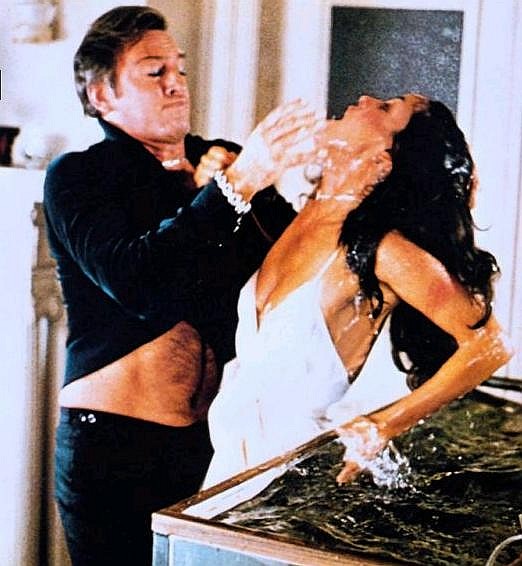
 when the bees cause the train to derail. What’s worst is that the scene depicted here, of Miss Schuster covered in bees, does not appear in the final cut of the film even though Miss D. really did have to endure having herself covered in the little buggers, lying in deathlike stillness as they mass around her face and body!
In 1979, she took a role in the TV miniseries Roots: The Next Generations and appeared in her final feature film as an actress, The Fifth Musketeer, a retelling of The Man in the Iron Mask with the musketeers of Alexandre Dumas classic story now older and with Olivia playing Queen Mary.
A few TV projects followed such as Murder is Easy, a middling Agatha Christie mystery starring Bill Bixby,
 The Royal Romance of Charles and Diana, in which she played The Queen Mother, and North and South II, another cameo role to fill out the all-star roster of the project. Next came Anastasia: The Mystery of Anna, an attempt to bring a tad more realism to the candy box story told in the 1956 film that starred Ingrid Bergman (in an Oscar-winning role) and Helen Hayes. Here, de Havilland had the Hayes role opposite Amy Irving in the title part. The magic of the original take on the story (that one based on a Maxwell Anderson play) wasn’t duplicated this time out, but Miss D. did earn an Emmy nomination for her work.
 1988 brought the last onscreen acting credit to date for Miss de Havilland, a TV film based on the story of the abdication of Edward VIII in order to marry divorcee Wallis Simpson called The Woman He Loved. Jane Seymour (who did the TV remake of Olivia’s Dark Mirror) was Simpson while Anthony Andrews was Edward. De Havilland played the regal, but unspectacular role of Aunt Bessie Merryman.
 Since this, Miss de Havilland has felt no need to act (not that she ever ruled out coming back if the part was satisfying enough. She has fielded countless offers, but didn’t bite because none of the roles tempted her enough to go through the process of filming them.) She nursed her son, a victim of Hodgkin’s lymphoma, through his premature death in 1991 and, even though they had divorced in 1979, she did the same for her ex-husband Galante when he battled lung cancer, dying in 1998.
 It hasn’t been all doom and gloom, though. She has enjoyed life in Paris and is an occasional guest at various ceremonies from The Academy Awards to other celebrations honoring either herself or her films or other similar occasions. For a time, she eschewed interviews, but has lately begun to enjoy them again, always making sure to demonstrate elegant good taste, both in the surroundings and in her appearance. Her contribution to the two-hour TCM documentary on Errol Flynn cannot be underestimated. An impish, but razor sharp, commentator, she also was part of a special feature on the most recent Gone with the Wind DVD release. She also provided narration for a feature length documentary about Alzheimer’s Disease called I Remember Better When I Paint in 2009.
 Earlier this year, she was awarded the French award The Knight Legion of Honor (as was the much younger Jacqueline Bisset, shown with her here.) Though a U.S. citizen for many decades, her chief residence has been in France since 1953 and she is much beloved there. (She wrote a fun book in 1962 called Every Frenchman Has One about her attempts at adapting to life in the foreign country.)
 Truly one of THE stars from the classic age of motion pictures, she is one of the Hall of Famers in The Underworld and only grows more beloved here with each passing day.


 In 1958, he began making motion pictures, a reluctant way of padding out his bank account in between theatrical pursuits and the TV gigs. Appropriately enough, his first film was called Stage Struck, a reworking of the play (which had been a 1933 movie starring Katharine Hepburn) Morning Glory. Already adopting the sort of debonair quality he would be known for later, he took on the role which had been played by Douglas Fairbanks Jr. in the original.




 Though he could usually still command top-billing in the Canadian


 the demand for his services as a character actor increased. He was reunited with his old Canadian pal William Shatner in Star Trek VI: The Undiscovered Country as a grizzled, but very erudite Klingon general, adding a sort of faux-Shakespearean air to the role. He was placed under heavy makeup and decked out in heavy costuming for the showy role.


