I watched the hooty disaster classic
Airport 1975 (released in 1974, natch!) the other day for what is probably the twentieth time in my life, if not more. I have to see my all-star '70s disaster flicks with some degree of regularity or else I suffer pangs of withdrawal. It amazes me that, after all these years (and this one I distinctly recall seeing in the theater as a pup of seven!) that I can still find new details with each viewing. I covered this
movie (all about a jumbo jet that is struck by another plane during flight, leaving a sizable hole and a mostly empty cockpit behind) briefly once before, but I always like to keep my site dotted with posts from this genre and I thought it would be fun to share some of my most recent observations (or at least ones that I haven't droned on about yet!)
1. How in God's name I could have seen this movie as much as I have and never once realized this first one is beyond me. Karen Black, as first stewardess Nancy Pryor, is wearing a wiglet (a fall) on her head! I always thought her hair was kind of fugly in the movie, even in 1974 (I never went in for those curled-under, bowl-style haircuts), but since you can see her hairline and part very clearly and her hair isn't particularly big or full, I never suspected that it was anything but her own tresses.

Now that I've seen the movie in 55” high-def, I can clearly spot the fall positioned just above her own hair, an inch or so back. It's a slightly lighter color than her own hair and you can no longer spot the part since the wig has been sewn together snugly at the center line. My big question is WHY?? Black's hair has no need at all to look coiffed after the first thirty minutes of the movie. She could have done a hundred things from a short 'do to a bun to a slicked-back look with a ponytail. Why was this straight, unspectacular mop attached to the crown of her head? I'd love for someone to tell me.
2. I'm more than familiar with Charlton Heston's flab- revealing, lemon yellow turtleneck (often covered up for the most part by a more flattering, taupe cargo jacket), but in his initial scene in the movie, which takes place during the opening credits, he's dressed differently. He's wearing what was then “on trend,” a semi-loud, plaid dress suit made of rather drab, pukey colors.
Just when he turns his back to the camera to walk away and you wonder to yourself, “Who is responsible for this awful piece of clothing??”, the credit comes up “Costumes by Edith Head”!! Now, even though she and her work are not very popular in certain circles today, you won't find any Head bashing here. I typically love her smartly-tailored, clean-lined clothing in the movies, but even giants (and after half a century in the biz and eight Oscars, she does qualify as one!) occasionally trip up a bit.
3. On the subject of costumes, surely Ms. Head had nothing to do with the air traffic controller at the Salt Lake City airfield choosing to wear a lavender dress shirt that is almost precisely the same color as the tinted sunshades that protect the employees from sun glare? Right?? I can't imagine that she bothered to have anything to do with that, but it's distractingly coincidental.
4. Anyway, as the stewardesses and flight crew head towards the plane, you can spot various passengers behind them who will also be departing on Columbia 409. I appreciate the fact that someone thought to have the background extras in these scenes played in many cases by folks who will later be seen on the doomed aircraft. Among them are a young couple in love (presumably newlyweds) and a gaggle of middle-aged ladies (one of whom is played by the extraordinarily busy movie and TV actress Virginia Gregg.) Note, though, that the male half of the couple is in a different outfit!
5. As the passengers embark, several Hare Krishna followers present their tickets without any sort of fanfare, humor or irony. It's likely that they were inserted into the mix in order to add some variety amongst the passengers and perhaps make it look as if the movie were relevant to a movement that was burgeoning at the time. Six years later in
Airplane! (1980), a far more satiric approach would be taken as that movie presented members of a similar sect annoying patrons at the airport. (Within that span of time, the leader of the movement had died and a case of brainwashing had been filed which went all the way to The U.S. Supreme Court!) For whatever reason, the Krishnas are dead last to be evacuated from the plane, by the way!
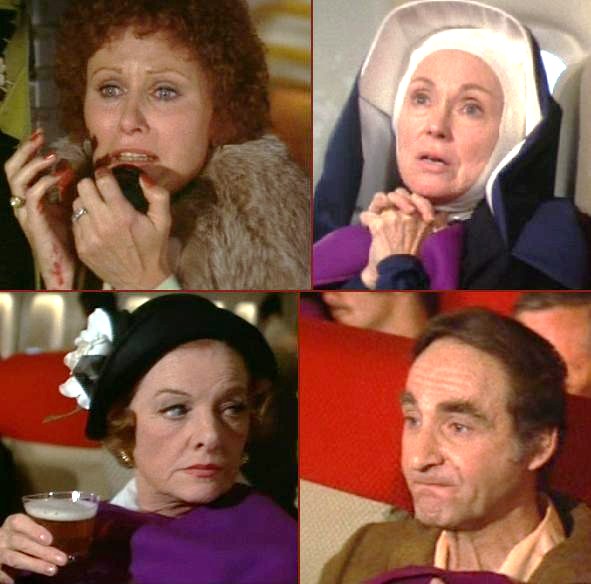
6. In the earlier post I did on this movie, I noted the presence of a lady seated near sickly Linda Blair who managed to carry on her own personal through-line during the course of the flight. She's clearly bothered by something, all stressed out and requesting drink after drink from the stewardess. She's completely a background character, but this chick is selling it for everything that it's worth!
It's interesting to see that she later turns up with a more substantial role in
Airplane! (1980) as the passenger who becomes sick from food poisoning and exclaims, “I haven't felt this awful since we saw that Ronald Reagan film.” Then Leslie Nielsen, with sleight of hand, begins extracting whole eggs from her mouth! This isn't a new observation here, but this time I at least have some photos to share regarding it.
7. Also on board Columbia 409 is character actress Alice Nunn as a lady who's sneaked her little Yorkshire terrier onto the flight in a basket. He's on his way to breed with another dog named Fifi! She's shown animatedly chatting away to it as she files her nails. Once calamity strikes, she doesn't even pretend to hide the pooch anymore and clings to it in fear.
Nunn, a Broadway bit player who'd only been working in television since 1965, holds a special place in my heart because apart from this role, she also portrayed Joan Crawford's maid Helga in
Mommie Dearest (1981) - “Helga... when you polish the floor you have to MOVE the tree.” - and more importantly gave the world the utterly unforgettable figure Large Marge in 1985's
Pee Wee's Big Adventure! "On this very night... ten years ago... on this same stretch of road..." She also popped up in other hooty “classics” such as Lucille Ball's
Mame (1974) and the Madonna debacle
Who's That Girl? (1987) before passing away of a heart attack at only age sixty in 1988.
8. Another passenger is played by character actor Ray Ballard. He's the one who gets all nervous and agitated when George Kennedy's young son proclaims that his dad practically runs the airline. Kennedy's wife Susan Clark clarifies that he is vice-president of operations and Ballard exclaims, “Some operations!” Ballard's character might have very good reason to be upset since, according to imdb.com, the actor also played a passenger in 1970's
Airport! (It's rare for anyone not named George Kennedy to have been in more than one of the four films in the franchise.) That time, a mad bomber blew a hole in the back of the airplane, so by now he'd seen the worst of both worlds.
9. Some stunt casting of a sort comes in the form of two pro football players seen on board the airplane. New England Patriots quarterback Jim Plunkett and San Francisco 49ers wide receiver Gene Washington are briefly chatted up by the male steward. Why these two men from different teams are flying together from Washington D.C. to Los Angeles is a mystery. And while they seem to be in first class, they are in the back of first class, smushed into a corner.

At first glance, it would seem that they filmed this insert over the course of a couple of hours or so, but Plunkett does show up again, peering around the corner as Helen Reddy sings and when Black makes a bullhorn announcement, and is even seen sliding down the inflatable emergency flumes near the end of the picture with Blair in his arms. Washington proceeded to do a little bit more acting while Plunkett mostly steered clear of that arena (in his primary scene, he looks directly into the camera. A no-no), but enjoyed greater success as a player (notably leading the Oakland Raiders into two Super Bowl wins.)
10. While we're on the subject of football, Sid Caesar is seated near a slim, casual woman who is working intently on a needlepoint project. His overly demonstrative, faux-ingratiating character can't help himself from commenting on it. He tells her he hears that “Rosey Grier does that.” Grier was a mammoth, 6' 5” former tackle for the New York Giants and the Los Angeles Rams who turned to an acting career (he was in 1972's
Skyjacked with Heston) and might seem an unlikely candidate for the art of needlepoint. However, he really was into both needlepoint and macrame and released a book called “Needlepoint for Men.” Groovy, baby!
Incidentally, the needlepoint woman Caesar accosts is an actress billed as Joyce Cunning who slept with the director in order to win her part. You see, she was actually Joyce Smight, director Jack Smight's wife, who acted on TV in the 1950s, then retired, only to come back in the '70s with this new moniker and take bit parts in her husband's films and TV-movies. Their son Alec Smight went on to a successful career as a TV editor, working on shows such as
L.A. Law,
Chicago Hope and
CSI: Crime Scene Investigation.
11. Most devotees of
Airport 1975 recall the snippet that shows two elderly women snickering over one of the passages in a (fake?) book called “Epicurean Sexual Delights.” One of them is Susan French, a supporting player who remarkably went from this movie to an uncredited role in the 1975 disaster drama
The Hindenburg. She's also known to many folks as the elderly version of Jane Seymour in
Somewhere in Time (1980), who beckons Christopher Reeve to “Come back to me...”
12. One of my favorite background passengers is the lady shown here who, immediately upon realizing that there has been a collision, proceeds to stand up, grip the seat in front of her and scream her head off non-stop, in a single, sustained bleat! (For years I was convinced this was gossip columnist Marilyn Beck, but it's not.) What's really funny is that action moves away from her to the cockpit, but then later she's shown again, still standing there in place screaming!
As the immediate terror subsides, she hunkers down into her seat and, hilariously, keeps her ears covered with the sides of a purple blanket until practically the end of the movie. Many others barely register any demonstration of being cold after the initial collision as the plane careens across the Rocky Mountains (though Gloria Swanson does break out a fur coat), but this lady acts like she's sitting in Doctor Zhivago's ice-encrusted holiday bungalow.
It gets better, though. Now I want every single one of you people who is familiar with Hollywood movie-making, billing, star-power and the like to really think about this...
Airport 1975 featured a downright plethora of stars. Some big, some small, but nevertheless a name actor in practically every part. But for the belated release of this movie in Turkey (Dubbed "Airport 2" or "Airport 80," depending on your language and released there in 1980), this dress extra, an unbilled bit actress won a showcasing spot directly in the center of the poster, her head generally the same size as the six stars shown below!!! Talk about a score! Take my advice folks, if you are ever an extra in a movie, do NOT phone it in. Stardom awaits you in a foreign country!
13. Back to Swanson, who pontificates on the benefits of health food while being referred to repeatedly by everyone, to her face and elsewhere, as looking amazing; she is seated in first class, but brings her own tea to the airplane, apparently not even trusting that Columbia airlines would have the type of leaves that could meet her stringent approval. Her assistant Linda Harrison (billed here as Augusta Summerland in an unsuccessful attempt to steer her career in a new direction) orders “a martini.” Is it really so that there was a time when one could order “a martini” and not have there be any other description? I assume she got a gin martini, served up with an olive? Now, there are vodka martinis, martinis on the rocks, martinis with flavored liquor and hundreds of ingredients and variations.
14. Like Harrison, most of the stars on board (and there are plenty!) get only a few lines here and there in order to try to establish some sort of pat, cliched charac- terization. Some, like Susan Clark, Myrna Loy and Sid Caesar, are afforded a smidge more screen time, but most often, the actors are given scant dialogue to be certain. Linda Blair, then a major name thanks to
The Exorcist just a year prior, has only a handful of lines. Martha Scott, an Oscar nominee for 1941's
Our Town and a costar in
The Ten Commandments (1956) and
Ben-Hur (1959), both of which had her playing Heston's mother by the way, is left to rot in a seat by herself once fellow nun Helen Reddy (who somehow landed sixth billing in her film debut over a host of other stars) goes to play the guitar and sing for ailing Blair.
15. Nancy Malone, as Blair's fretful mother, is another one who gets short shrift in the dialogue department. She also has one of the movies very strangest moments. During the flight, the camera closes in on the hole of Blair's acoustic guitar and weirdly ominous music strums. Then Malone, who's seen reading quietly, removes her glasses and stares at Blair with grave concern and alarm even though nothing untoward, or even remarkable, is happening (except bizarre, disembodied guitar strumming on the soundtrack.)

It looks like something almost supernatural or extrasensory is about to happen, but, in fact, it's absolutely nothing. In one of many lunatic circumstances in the film, Blair is headed for Los Angeles for a kidney transplant, but when the accident diverts Columbia 409 to Salt Lake City, Utah, they miraculously "have a kidney waiting at the hospital" there, too, because, you know, organs, especially in 1974, were always just lying around ready to be transplanted regardless of tissue typing or any other such concerns! No line, no waiting!
16. The big point of impact between Dana Andrews' private plane and Efrem Zimbalist Jr's jet has long been considered a miss thanks to some quest- ionable rear-projection work. We never really see anything much beyond footage of a plane through the jet's windshield, followed by smoke, sparks and a big hole in the side with the co-pilot (who'd been standing up to investigate a noise) being yanked out.

Co-pilot Roy Thinnes probably wasn't even on the set the day they shot his stunt dummy being sucked out of the cockpit. This is also very poorly handled with a straight up and down figure suddenly soaring horizontally out. At a speed of almost 200 miles per hour, wouldn't he go more to the side of the plane? I'm no physicist, but even gum goes sideways out a car window going 45 (do not ask me how I know this.) Also, I could swear that an alternate take of this shot is featured in the trailer for the film (shown above left) and that it's a better one because the legs of the body look more realistic! (They seem to have more bend to them.) NOTE: Upon repeat viewing, I've discovered that the shot in the trailer is framed wider and goes on a tad longer (and may be different altogether.)
17. During a rescue attempt, U.S. Naval major Ed Nelson tried to deposit himself into the cockpit of the partially disabled jetliner via an umbilical cord dangling from a helicopter. He clanks up against the plane as stewardess Black flounders around trying to guide him in. Once inside, he is supposed to release the tether line he is connected to by pulling on a silver handle, but as fate would have it, the handle gets caught on a gnarled piece of metal skin before he's inside.

Of course, what's really ridiculous about it is that the entire right side of the co-pilot's area has been ripped away by the collision with a small craft, but the remaining shard of aluminum skin happens to be not only in just the right location and just the right size to activate his toggle pull, but even juts up and back to create a perfect grabber that it would almost take precision in order to hit! (And, hysterically, he keeps bobbing up and down and around it. One can almost envision the riggers off to the side of the set desperately trying to ensure that Nelson somehow manages to make this connection which is akin to having a man with swollen, calloused hands undo the clasp on a woman's delicate necklace!)
18. Much has been made over the years regarding the hilarity of (then seventy- five) Gloria Swanson's stunt double whizzing down the escape slide while trying to obscure her face. Her concentration on the cowl of her hood was so great that she neglected to shield the audience from a shot of her white panties. Unknowing viewers may have been duped into thinking that they saw up Miss Swanson's skirt, but I assure you it wasn't her.
However, seventy-one year-old Myrna Loy really did fly down the inflatable chute and, believe it or not, there is a brief flash of her drawers, too! She flashes her undies and a garter belt, revealing the fact that her hose are not "panty-hose." One would probably have to go all the way back to 1933's
The Barbarian to see this much of Miss Loy! Kudos to her, though, for having the guts to jettison herself down this slide for the cameras.
19. This is a Universal film and that studio had its hand in quite a few of the disaster epics of the day, so it's common to see the same actors here and there in the various movies. For their own part, Heston and Kennedy ran long on the filming of
Airport 1975 and had to sometimes hop from set to set as they were beginning
Earthquake! (Shown at right.) They played close comrades in that one as well.
Kip Niven (the ex-Mr. Linda Lavin), who plays a rather snooty naval secretary here also popped up in
Earth- quake as the fledgling seismologist who can't seem to make anyone believe his theory that “the big one” is about to hit Los Angeles. Likewise, Dana Andrews' friends at the airport (both seen below) turn up in other disaster flicks as well. Bob Hastings had portrayed the New Years Eve emcee in 1972's
The Poseidon Adventure (a 20th Century Fox movie) while Gene Dynarski would, like several aforementioned folks, proceed to
Earthquake. He played a dam worker who gets caught in an elevator and drowns.
There we have 19 tidbits about
Airport 1975. I probably could have even coughed up more, but does anyone besides me even give a care?! It didn't take long at all for this flick to be parodied (long before
Airplane!) Take this
installment of
The Carol Burnett Show. This is part one. If you enjoy it, part two is available to the side at the link!
As a P.S., I give you this hilarious publicity photo featuring Miss Gloria Swanson, who was returning to the screen after a twenty-two year absence and convinced the producers to allow her to play, not just a fictional actress of a certain age, but HERSELF! Always ready for her close-up, she posed inside the cockpit of a 747 as part of the hype. Can you imagine this movie if something had felled Karen Black and Glo had to take the wheel?? That would really have been something.