Recently on Facebook, a clatch of friends began to discuss the 1956 epic The Ten Commandments and the banter about it led me to watch it again just before Easter for the first time in a while. I've long wanted to write about it here, but it's such an incredibly gargantuan undertaking that I never got around to it. (I have featured some of its actors here, though, such as Anne Baxter and John Derek.) Needless to say, I still don't have the time to do my usual microscopic tribute to a film of this magnitude, but I am going to try to make due with this unusual approach. I have come up with ten of my own commandments in relation to the movie so that it will allow me to expound on some of my favorite aspects of it. No, I'm not actually commanding anyone to do anything. It's a gimmick. The Ten Commandments isn't everyone's cup of tea, though I will say that it's just reverent enough to inspire devotion from believers and more than spectacular enough to hold the attention of other viewers who are in the right frame of mind for such an offering. I find it practically spellbinding myself.
Thou Shalt Admire the Music:
Neophyte composer Elmer Bernstein, who'd scored several films including Sudden Fear (1952) and The Man with the Golden Arm (1955, for which he was Oscar-nominated), was commissioned to provide music for the various dances in the film. Ultimately, he was selected by commanding director Cecil B. De Mille to score the entire movie and he crafted some unforgettable themes. Bernstein emerged as a busy, highly-regarded composer (The Magnificent Seven, 1960, anyone?) who shockingly only won one Academy Award over the course of his 50+ year career. It was for 1967's Thoroughly Modern Millie.
Thou Shalt Be Amazed at the Cast:
If you watched the above-linked video, you not only heard the music, but caught a glimpse of the amazing collection of performers who were put together for the film. De Mille not only selected his leads very carefully, but he was practically obsessive when choosing other people down to the smallest of roles. He saw dozens, sometimes even hundreds of performers for certain key parts.
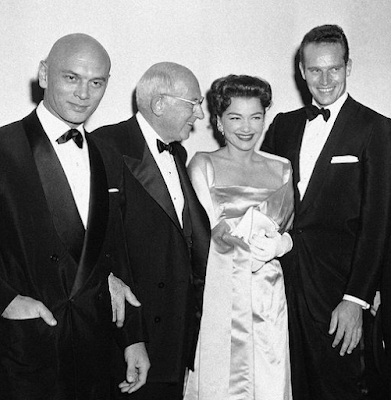
Director C. B. De Mille is surrounded by his star triad of Yul Brynner, Anne Baxter and Charlton Heston.
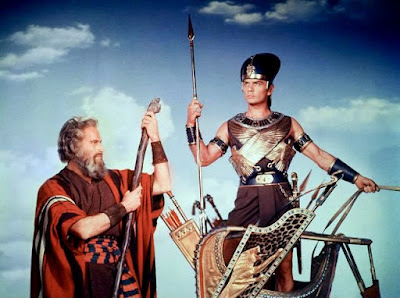
Heston as Moses and Brynner as Rameses go from adoptive brothers to mortal enemies over the course of the film. Heston's five-inch height differential was creatively disguised throughout the filming. Heston, who'd worked for De Mille on The Greatest Show on Earth (1952) resembled Michelangelo's statue of Moses, giving him a leg up on the part.
Baxter was in the enviable position of being desired by both characters. De Mille, fearful of anyone cracking bosom jokes (!), had her character's name adjusted from Nefretiti to Nefretiri...! The role was first earmarked for Audrey Hepburn (!), but De Mille didn't find her buxom enough.
Rameses wound up with Baxter on screen, though it was hardly a match made in heaven for the characters. Her heart always belonged to Moses (Moses, Moses.)
Heston and Baxter were paired up again directly following Commandments in the western Three Violent People (1956), with Tom Tryon playing the third member of that triangle.
Pretty Yvonne De Carlo had lineage portraying exotic seductresses, but wound up being successfully cast against type as Moses' appealing, but ultimately neglected, wife. Initially called Zipporah, again De Mille worried about untoward titters from people associating "zippers" with the name and opted for the Greek spelling Sephora. Other cast mates were forced to wear brown contact lenses over their light eyes, but De Mille chose to allow De Carlo's luminous ones to remain as is.
Edward G. Robinson, known for his urban roles, seemed a surprising choice for the craftily villainous Dathan. Initially, De Mille was confused and dissatisfied with Robinson's acting style, but once it was assembled, he recognized the sly, fox-like humor he'd been imbuing the slimy part with and he greatly appreciated it.
In 1993, Rob Schneider did a send up of Robinson and his New York-ish persona in The Ten Commandments on Saturday Night Live. No less than Moses himself showed up to seal the deal! Heston and Robinson later worked closely together in Soylent Green (1973), Robinson's final film.
Here we see the put-upon lovers Lilia and Joshua. De Mille was keen on Pier Angeli for Lilia, but MGM wouldn't release her. She had little luck with movies like this, having done the awful The Silver Chalice (1954) and later appearing in the not-great Sodom and Gomorrah (1962.) Beauteous Debra Paget was then chosen, but the only way De Mille could get her from 20th Century Fox was to also take John Derek. They make a stunning pair, but the casting of Derek meant that Cornel Wilde (who'd been in Greatest Show and was set to play Joshua) was shown the door.
I thought they were both just gloriously beautiful. They were both compelled to wear brown contact lenses for their roles, though it seemed to make the biggest difference in Paget, whose regular eye color was a luminous blue.
The talented Nina Foch, who'd been a 1940s ingenue in a variety of thrillers, was cast as Pharaoah's sister Bithiah, who rescues Moses from the river and raises him as her own. Foch had just enjoyed success in Executive Suite (1954), but lost an Oscar for it to Eva Marie Saint in On the Waterfront. De Mille's right-hand man Henry Wilcoxon recommended Foch for the part, having worked with her in Scaramouche (1952.) Practically all the roles in the movie were coveted by various known actors. One close call in this case was...
...our patron saint Miss Joan Crawford was in contention for this part! Strangely enough, I can sort of see it, but in 1956, before she had done any "prestige billing" supporting roles, it likely would have upset the focus and balance of the picture. But, God... they talk about Commandments being campy as is. The mind reels. This was in her Johnny Guitar/Torch Song era!
The reigning Pharaoh as the film begins was played by the prolific and highly-acclaimed British stage actor Sir Cedric Hardwicke. He'd been knighted for his services to drama back in 1934! Apart from his remarkable career on the stage, he wound up making many, many movies, too, and was in-demand as a character actor once he moved to the U.S. in 1948.
Another performer who was to be honored by the Queen of England is Judith Anderson, made Dame Judith Anderson in 1960. This role, believe it or not, had first been assigned to longtime De Mille collaborator Gloria Swanson, but she departed the project while caught up in the demands of trying to get a musical version of Sunset Boulevard (1950) off the ground. Bette Davis (!) was considered for it, too. Can you imagine Bette & Joan on the Nile!??!?! As it was, Anderson was deliciously craggy and bitter in the part and was the recipient of some amusing insults from Baxter's desperate character.
Portraying Moses' birth mother, who must give him up in order to save him from the mass killing of all Hebrew newborn boys, is Martha Scott. Scott figures into one of my most favorite moments in the film, when her character is about to be crushed by the gargantuan stones of a pyramid but is saved by Heston, who has no idea who she is to him. She played his mother again in 1959's Ben-Hur, though she was only 11 years older than Heston in real life. Most people know, but in case you don't, that's Heston's real-life baby son Fraser playing Moses as a baby in the basket.
The cast goes on and on and on, but I'll finish this section with Vincent Price, as the sneering slave master Baka. When the snarlingly evil Price is given his due by Heston, we are treated to the sight of one Cardinal Richelieu (Heston in The Three Musketeers, 1973) strangling another Cardinal Richelieu (Price in The Three Musketeers, 1948!)
Thou Shalt Marvel at the Use of Color:
Sure color movies had been around since the late-1930s, but still in 1956 there were many, many releases in black & white. Color was most often reserved for important or highly scenic releases. The Ten Commandments made damned darned sure to exploit the eye-popping hues of Technicolor in VistaVision. The backdrop may have been the burning sand of Egypt or the dreary quarters of the slaves, but upon that were vividly arresting shades of saturated color.
The color of this helmet against the dimly-lit set is just perfection.
Thou Shalt Appreciate the Special Effects:
Does every effect in Commandments hold up today? Perhaps not. The parting of the Red Sea, a legendary and once awe-inspiring moment, is one of the less-convincing sequences now. We've become more able to discern its trickery than we could in 1956. (Nonetheless, it was still done with extraordinary creativity and I'll always prefer it over anything CGI, which is today's norm.) There are still many moments in this spectacle whose effects work still dazzles.
Hordes of slaves work to raise an obelisk in Pharaoh's honor.
Multiple pieces of film coming together to capture the moment from afar.
Bluescreen and artwork combine to set the background.
The glow of The Burning Bush.
Moses transforms his staff into a cobra.
Burning hail (actually painted popcorn) falls from the sky.
Moses' right-hand man Aaron turns the Nile River into blood.
Rameses thinks his sacred water will be exempt, but is stunned to learn otherwise.
Backed up against the Red Sea?
No sweat. Just part it and race across the ground.
(The remarkably dry ground!)
The enemy is hot on their tail...
So you let them catch up, some, then allow the water to careen back in on them!
Looks like it's time for the title tablets to be made.
One of several instances in which animation is used.
The lighting and cinematography create a painterly effect on Heston as he watches the tablets being zapped into existence.
Real pyrotechnics at this stage.
Derek's horn-blowing signifies that they're all ready!
Thou Shalt Honor the Work of the Costumes:
Five (!) costumers, along with a fleet of assistants, provided the eye-popping clothing in The Ten Commandments. Many have already been depicted above, but to show off a little bit more of them...
The intricate detailing of the collars, gloves, closures, etc... can be glimpsed in this close-up of Heston during his princely-period.
Aspects of birds and snakes show up often in the designs for the Eqyptian costumes.
Freed of his Siamese makeup from The King and I, Brynner probably never looked better on screen.
Baxter was given some rare finery to parade around in.
The neck-wear anticipates the "chandelier necklaces" which would become
popular over the next decade.
Check this one out!
Baxter and Brynner in palatial splendor and each with their asps out!
Hardwicke had his share of gilding, too, naturally.
The task of outfitting the many extras must have been monumental.
There's always so much going on and so much to look at that it can be easy to miss details such as the priest on the left who is wearing not only leopard print, but the HEAD of the beast on his torso as well!
Thou Shalt Gape at the Scope of the Production:
The production took two years to make. (Heston even lensed another movie, The Private War of Major Benson, 1955, during the summer in-between location shooting in Egypt and the return to the studio!) While process shots did combine bits of film to make the spectacle more sensational, it doesn't change the fact that teeming hordes of extras were employed to bring the story to life. Now, someone at a computer would create the bulk of the crowd scenes in order to fill out the screen. But in 1956, each of the people shown was a fully costumed and made-up extra! Many of the set pieces were practical, not imaginary.
14,000 people and 15,000 animals were employed on this movie.
The cost of this today would be utterly insurmountable.
This was, at $13 million, the most expensive movie ever made to that time, and it was a complete sensation, thankfully, earning all of its money back and then some. Adjusted for inflation (yeah, I've heard of that...) only six other films have ever taken in more at the box office.
Imagine being hired as an extra for this movie and then straining to ever find yourself on screen (in the days long before video, freeze-framing, etc...!)
Seriously...?!?!
Thou Shalt Revel in the Dialogue:
Biblical epics have a tough row to hoe in that they need to sound ancient enough to have not happened a couple of years ago, yet not so authentic that we have no clue what in the hell's being said. Then there's the tendency to want to be profound. And add in the passage of time since the film itself was contemporary (and in the meantime acting styles have changed.) It's easy to slide into camp. But so what?! Almost everything Baxter says is a hoot whether it's the dialogue itself or the silky, intense way she delivers it. Some delicious soul composed a video which is nothing but her reciting lines with the word Moses in them. It might save you from watching the full movie again! Stunning as this sounds, it is merely 1 minute, 38 seconds long!
Just a few more lines of note:
Nefretiri: Did you think my kiss was a promise of what you'll have. No, my pompous
one. It was to let you know what you will not have. I could never love
you.
Rameses: Does that matter? You will be my wife. You will come to me whenever I
call you, and I will enjoy that very much. Whether you enjoy it or not
is your own affair... but I think you will.
Sephora: She was very beautiful, wasn't she? This woman of Egypt, who left her
scar upon your heart. Her skin was white as curd, her eyes green as the
cedars of Lebanon, her lips, tamarisk honey. Like the breast of a dove,
her arms were soft... and the wine of desire was in her veins.
Moses: Yes. She was beautiful... as a jewel.
Sephora: A jewel has brilliant fire, but it gives no warmth. Our hands are not so
soft, but they can serve. Our bodies not so white, but they are strong.
Our lips are not perfumed, but they speak the truth. Love is not an art
to us. It's life to us. We are not dressed in gold and fine linen.
Strength and honor are our clothing. Our tents are not the columned
halls of Egypt, but our children play happily before them. We can offer
you little... but we offer all we have.
Nefretiri: [nodding to her servants]
Go then, while I hear what this puckered old persimmon has to say.
. . .
Memnet: Bithiah drew a slave child, from the Nile, called him son and Prince of
Egypt, blinding herself to the truth and the pain of an empty womb.
Nefretiri: Were you alone, with, Bithiah?
Memnet: A little girl led me to the Hebrew woman, Yochabel, that the child might be suckled by his true mother.
Nefretiri: Take care, old frog. You croaked too much, against Moses!
Rameses: You have rats' ears and a ferret's nose.
Dathan: To use in your service, son of Pharaoh.
Rameses: Add to them the eyes of a weasel and find me this deliverer.
Rameses: So it shall be written. So it shall be done.
Thou Shalt Delight in the Magnificent Squalor:
The production was gargantuan. The sets immense and impressively appointed, the clothing opulent, the accessories and props eye-catching. But even beyond that there is more to behold. Parades of colorful excess, dance numbers, an "orgy" before a golden calf... No wonder there were repeat viewings. No one's eye could take everything in the first time!
After months of having to wear the same distressed costume, which became more and more rank as her character's condition worsened, Miss Paget began to feel frustrated by the goats chewing on it and camel dung here and there, but she felt privileged (like virtually everyone) to be working for De Mille.
Hardwicke overlooks the splendor that Heston has brought back to him after conquering Ethiopia. SO MUCH to see in the frame.
This dance was rather fascinating, with Busby Berkeley-ish configurations and pelvises grinding, all the while the red pom-poms at the end of each ponytail bobbing everywhere; just like The Bible says...! LOL
Thou Shalt Spot the Future Stars:
There were many people in The Ten Commandments who were yet to be known commodities or who were at the dawn of their careers. Actress-turned-prolific soap opera producer Gail Kobe was a slave girl, stuntman-turned-Oscar-winning actor Richard Farnsworth drives a chariot and people as diverse as Robert Fuller, Patricia Hitchcock, Irene Tedrow, Carl 'Alfalfa' Switzer (!), Kathy Garver, Robert Vaughn and future hairdresser Jon Peters are in there as well! Here are a couple more of my own favorites.
In the back, beating a kettle drum above the orgy is none other than famed musician Herb Albert (of The Tijuana Brass!) De Mille found someone who could keep time and still doff his shirt...
When Heston kicks as at De Carlo's well, taking on three selfish Amalekite herders at once, one of them (closest to the well) would later become a TV star who was usually beat up once a week.
That's Mike Connors of Mannix! He was one of Henry Willson's clients at the time and was thus dubbed (and credited as) "Touch" Connors.
Making the trek back with Heston from Ethiopia is this impressive couple. This brief moment is rather saucy because the princess on the left (played by Esther Brown) is very sensual and gets Baxter a little riled. The character Tharbis was written about as Moses' first WIFE, who he wed in order to secure the city of Meru. This being 1956, there could be no depiction of that, but the implication is subtly present that something might have happened. Heston, an active civil rights advocate, did later have an on-screen interracial romance in The Omega Man (1971.)
As the King of Ethiopia, Woody Strode is a sight to behold. De Mille thought so as well and put him in another role later in the film as one of Foch's charioteers.
Seen here standing among the slaves is prolific actor Michael Ansara, who portrayed many a menacing or commanding sort over his long career. He was married to Barbara Eden for some years and popped up on her show I Dream of Jeannie, too.
Of course my favorite is the sight of our beloved Clint Walker, who is present in most of the palace scenes. He's just under Wilcoxon's elbow in the horned helmet.
He has no lines, but pops up in the tableau quite a bit along the way. We get to see a section of his incredible physique as he stands next to Brynner, but never too closely.
This is about as close to a good look at him as we ever get. He has a couple of instances in which he is dispatched and makes some moves with his sword, but generally he's in place as decoration. And this brings us (at last!) to our tenth commandment regarding this movie!
Thou Shalt Bask in the Glow of the Beefcake:
Now we come to one of the best features of all! There's already been plenty of muscle on display in this (ungodly lengthy!) post, but naturally I wanted to end with more of the same. There would seem to be something for everyone here, be it the tall, lean, hairy build of Heston or the smooth ripples of the sturdy Brynner. Then there is Derek, a hybrid of slimness, muscles, smoothness and hair. Plenty of sweaty extras along the way, too!
Is that a scabbard in your hand or are you happy to see me?
"Pump it up, go ahead go ahead!"
For me, this was Derek's finest hour.
It wasn't just The Bible that put butts in seats. Paramount knew to sell beefcake as part of the package, too.
I really don't think Heston ever looked any better than he does in the early part of this movie either. Even in Ben-Hur, a scant 3 years later, he'd somehow lost a bit of his already limited softness.
Calling all armpit fetishists!
You just know that Price adored shooting this scene...
Heston wore loincloths in several movies, from this to Ben-Hur (1959) to Planet of the Apes (1968) and its sequel.
Heston and Derek are frequently touching throughout the movie. Derek's adoration of "the deliverer" inadvertently comes across as homoerotic at times when only looking at the visuals. But intentional or not, there are indeed a couple of times when that certain symbolism pokes through.
Here an agitated Brynner has a snake bobbing at crotch level as his trusty manservant Wilcoxon is grasping nearby. That one might be accidental, but...
...there isn't the slightest doubt in my mind about the sadomasochistic sexuality implied here when Price is about to whip his bound-up prisoner and takes a good look at the dangling, phallus-like handle of his weapon!
For those into mud-wrestling.
Hey, I'd give my home A/C a break if I could get someone like this to fan me with ostrich feathers...!
The movie is saturated with brawn and beefcake, be it guards, priests or the leads. (Even Edward G. Robinson was showing nip in his early scenes. LOL)
Note the spelling of Brynner's name on this foreign postcard. He was not then the commodity he'd soon become. Apart from one 1949 flick, he'd never made a movie and was known for his work on Broadway. In 1956 alone, he saw the release of The King and I, The Ten Commandments and Anastasia. He was poised for movie success thereafter.
The instant he found out he would be next to naked throughout most of Commandments, he began conditioning his physique like mad, giving him a far more muscular appearance than he'd shown on stage. His body language in this movie is spellbinding.
So it has been written, so this post is finally DONE!
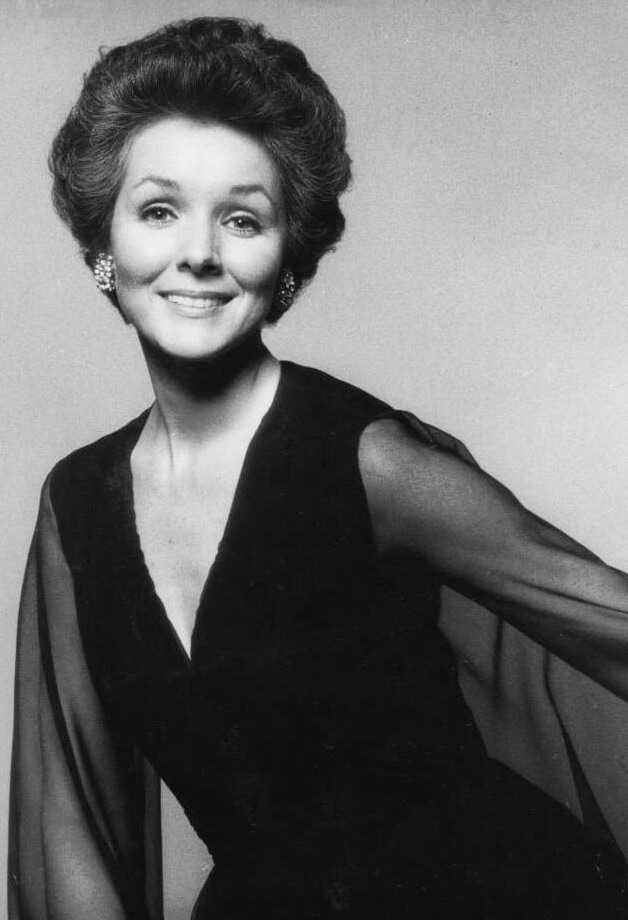
On March 25th, 2022, the world stopped turning for the iconic matriarch of As the World Turns, Kathryn Hays, who portrayed Kim Hughes from 1972 until the program's demise in 2010. We've written about ATWT before and how important a show it was for a certain stretch of time and Hays was a considerable part of its appeal. She did have at least one other career touchstone which ensures her place in the entertainment stratosphere, but we'll get to that in a moment. Now let's have a photo essay of the appealing Miss Hays.
Hays was born Kay Piper (which sounds more like a stage name than the one she later chose!) in Princeton, Illinois on July 26th, 1933. The family soon moved to Joliet. She attended Northwestern University and became involved in modeling, followed by acting and singing. Marrying at 24, she became a mother to daughter Shari.
Hays continued to pursue a career modeling and appearing on stage. By 1962, she was winning parts on Broadway, as a replacement in the hit Mary, Mary and in the unfortunate flop The Moon Besieged. She appeared opposite no less than Miss Claudette Colbert in the play The Irregular Verb to Love, which ran for 115 performances in 1963.
Having also begun making appearances on TV by 1962, she guest starred on Hawaiian Eye, Surfside 6, Naked City and, as seen above, Dr. Kildare, playing a blind sculptress. (Take that Lionel Richie!) Other shows like Route 66 and The Lieutenant soon followed.
Her movie debut came in 1963 with the now-obscure paranoia drama Ladybug Ladybug, in which the students and staff of a rural school are alerted that nuclear attacks are imminent. Hays deftly portrayed a secretary who is pregnant at this cataclysmic moment. Among the other skilled players were Estelle Parsons, Nancy Marchand and Jane Connell.
Now an increasingly in-demand television actress, Hays appeared on show after show, from Mr. Novak and Bonanza to The Alfred Hitchcock Hour and The Virginian. She also appeared on The Man from U.N.C.L.E. In those three-network days, a performer could make quite a comfortable living by guesting on various shows here and there through a season.
Hays attempted another trip to Broadway in 1965 with the musicalization of Picnic called "Hot September," (seen with Sean Garrison), but the production was troubled and she left the show, which closed after it's Boston tryout.
1966 brought a second film role, this time as the leading lady in Ride Beyond Vengeance, a flashback western with a cast of familiar faces.
Hays had more than likely been selected to play her pivotal part opposite Chuck Connors after having guest-starred on two of his prior TV series, Arrest and Trial and Branded. The year 1966 was to be a banner one in other ways, too, though not everything would go as hoped or planned.
Having aptly demonstrated her acting talent in a wide variety of ways, she was granted a leading role in a series of her own, alongside Barry Sullivan. The Road West was yet one more in a string of countless western programs that dominated the airwaves in the 1950s & '60s.
Not the most aerodynamic hairstyle for traveling across the American wilderness. The Wagon Train-ish series, with a bit more female presence, lasted 29 episodes before facing cancellation.
More momentous for 1966 was her marriage to actor Glenn Ford. (I couldn't ascertain when her first marriage was dissolved.) Having seen only the black & white photo of their wedding, I never would have guessed the actual color of her dress, so I had to include it in the inset!)
Marriage in Tinseltown is challenging enough without the bride being heavily enmeshed in an hour-long series. To me, the smiles are already a tad forced in these publicity pics of the "happy" couple. In any event, the marriage was dissolved in 1969.
Career-wise, things took an uptick when she was selected to be the leading lady caught between a taciturn Charlton Heston and the suavely villainous Maximilian Schell in Counterpoint (1967) - and married to Leslie Nielsen if you can believe it! The film was not a blockbuster, but it did finally become available on DVD a while back.
Returning to TV on The High Chaparral and Mannix, she then took part in what would become a lasting and famous endeavor among sci-fi fans. She worked on a 1968 episode of Star Trek as Gem, an empath who helps the primary officers of the Starship Enterprise survive captivity by an alien species. She spoke no lines, using only her expressive features to convey every feeling she was experiencing as she took on the pain and injuries of the men, particularly Dr. McCoy.
Many more TV appearances continued, from Here Come the Brides to Marcus Welby, M.D. She also did the TV-movie Breakout, with James Drury (of The Virginian) and Sean Garrison (her one-time leading man of the ill-fated Hot September.) In 1971, she costarred with Clint Walker in the western telefilm Yuma. Appearances like these would continue until 1973. By that time, she'd tried out the world of daytime with a stint on The Guiding Light. But in 1972, she opened up an entirely new world for herself...
As the World Turns was the first 30-minute daytime soap and had begun in 1956. By 1958, it had climbed to the top of the ratings and held firm there for two decades. In 1972, the creator and head writer Irna Phillips brought Hays on in the role of Kim to serve as a trouble-maker, seducing her sister Jennifer's husband Bob. Both sisters wound up pregnant and when the network wouldn't allow Bob to leave Jennifer for Kim, Phillips left! (She returned not too long after when the show began to falter without her firm guidance.) In despair, Kim married Dr. John Dixon in order to give her baby a father, though the infant died.
Eventually, Kim became a sympathetic character and ultimately moved on to Dan, and those two were a major couple for a while, though always under various strains. Her in-name-only husband John had raped her and generated another pregnancy while Dan's alcoholic ex-wife strove to break them up. (Note the mid-'70s matching hair and clothing!)
Once the couple FINALLY got together, Dan died of a brain tumor. (Even in her early years, mostly thanks to the styles of the times, but also due to Hays' own style and demeanor, Kim had a somewhat matronly look, foreshadowing the years in which she would become a comfort and voice of reason to most of - fictional - Oakdale.)
There was also the whirlwind romance with Nick Andropolous (played by Michael Forest himself a former Star Trekguest star), which included a then-staggering and expensive location shoot amid the Greek isles. Sadly, he died as well.
In the mid-'80s, Kim and Bob, who'd remained close friends through the years, let go of their guilt, rekindled their love and were married at last. They became, along with Bob's parents, the cornerstones of the show and the program's most happy and contented couple. It was evendiscovered, in true soap opera fashion, that their old stillborn baby had actually lived and been sold away! They were able to reunite with her.
Under the expert writing of Douglas Marland, the character of Kim still received gripping story lines, such as when her daughter's boyfriend was secretly obsessed with her! If the daughter looks familiar here (and in the group shot above) that's because she later gained fame in the movies - it's Julianne Moore!
Kim and Bob were the moral center of the series and doled out advice and support to all the troubled friends and family around them. But, again thanks to writer Marland, they became the center of a front-burner story when the saintly Dr. Bob had a one-night affair with one of Kim's most dreaded enemies, the ex-wife of her one-time husband Dan, who'd tried to split that marriage up way back when.
Marland had immense respect for his characters and for the history of the show. He kept all the veteran actors involved in the more youth-oriented story lines while also giving the old guard their due. His untimely passing in 1993 marked the beginning of the end of ATWT's glory years.
As the series continued, Hays became one of the mainstays of the show, along with the other folks shown here. Most of these New York-based actors and actresses had excellent stage backgrounds. The young'ns might come and go, but these core personalities remained. Some of those young actors included the likes of Meg Ryan and Marisa Tomei.
When the show was cancelled in 2010, Hays had not only lived her own life (including a brief third marriage from 1984-86), but had practically lived out the better part of Kim's life as well! She'd been aunt, mother, friend, lover, wife, confidante, even occasional victim, but always exuding grace, elegance and charm.
In the wake of ATWT, Hays continued to partake in fan events, webcasts, interviews, etc... sometimes with her pal Don Hastings, who'd portrayed Bob since 1960! She was 88 when she passed away of undisclosed causes.
No one involved in the world of soaps, particularly As the World Turns, could fail to remember Kathryn Hays, but thanks to her guest turn on Star Trek, there is another cult of fans who know her and reacted warmly to her as a performer.
"To Jon-I really enjoyed your blog! Love Joan" -- Dame Joan Collins (via autographed menu supplied by a mutual friend!) Photos of Menu & Joan
"Thank you for your nice message, and for the link to your blog. I had actually seen your blog before - a friend showed it to me a year or two ago. You clearly have an intense and wonderful passion for cult and genre cinema... Thank you for joining my page, and for sharing your passion for EARTHQUAKE and other films of that remarkable era in our industry. My husband would have gotten a huge kick out of it! With love, Monica"-- Monica Lewis Tribute to Monica
"Oh, and for those who are looking for fascinating, funny, often outré online reading about vintage, sometimes obscure, movies, TV shows and stars, try the blog, “Poseidon’s Underworld.” You’ll find everything from detailed and witty biographies to posts on how stars wore their clothes — or didn’t — as each show biz decade constricted or loosened up. Heavily illustrated and highly informative". - Liz Smith - Liz Smith - newyorksocialdiary.com
"I just discovered your profile about me and my career. I was flattered and very happy with the photos (some I had never seen) and your talented style of writing. As a gesture of thanks, I would like to send you a signed copy of my book. I think you would enjoy it. So if you would like one or a signed photo, let me know with an address I can send it to. - Sincerely, Mark Goddard" (via e-mail) Tribute to Mark