Today we're going to take a little gander at a lesser-known film from an era which we don't tend to focus on all that much around here. Because said movie had some points of interest to us, however, I'm sharing these with you in the hopes that you might also find them entertaining. The movie
Devil's Playground (1937) is a remake (yes, they were remaking all sorts of things even back then...!) of Frank Capra's 1928 action-thriller
Submarine, a silent film with some recorded sound effects.
Submarine had been Columbia Pictures' top-grossing film of all time to that date, so a sound remake surely seemed like a winner. Lightning didn't exactly strike twice, but the result is a movie with some compelling attributes.
 |
The top-billed star is Richard Dix as a U.S. Navy officer. A stage actor, he transitioned to films in the 1920s and led a successful career for a time. He was Oscar-nominated for Cimarron (losing to Lionel Barrymore in A Free Soul), a picture that won top prize for 1931 and was the only western so honored until Unforgiven (1992), many decades later.
|
 |
Costarring as fellow naval officer was Chester Morris. Morris had also come from the Broadway stage to movie screens in the 1920s and starred in a memorable hit, The Big House (1930), about life in prison. That same year, he won his only Oscar nomination for Alibi (a fact that was discovered years after, not officially announced at the time!) After proceeding to play detective Boston Blackie in a popular series of films, he struggled to maintain a career in "A" pictures.
|
 |
The gents play carousing buddies, who - while devoted to their navy duties - enjoy chasing women and swilling booze in their off hours.
|
 |
Their fleet of good times (and their close relationship together) comes to a screeching halt when Morris is assigned to command a submarine and Dix is selected to train deep-sea divers for the navy.
|
 |
Things perk up a little when Dix is shown surveying his latest class of potential divers.
|
 |
This being 1937, they are all shaved to the skin.
|
 |
This young man (who commits the cardinal sin of a movie performer by looking right into the camera) was perhaps my favorite, not that any of these guys are seen for very long.
|
 |
Now, apart from training in the water, Dix is basically a landlubber and soon buys himself a small house. Yet before long he is both lonesome and bored. He heads out to a nightclub where he meets up with an attractive taxi dancer.
|
 |
Practically from the start, the two hit it off and are enjoying a lovely dinner in a secluded restaurant booth. (If you don't know, a taxi dancer was someone who worked in a dance club and could be hired as a dance partner in exchange for tickets purchased from the club. Ever heard of the song "Ten Cents a Dance?" Often in Hayes Code era films, these sort of people were euphemisms for prostitutes and gigolos!)
|
 |
The lady winning Dix's heart is played by Mexican-born actress Dolores Del Rio. Del Rio had begun film work in the mid-1920s and proceeded to star in hit films including Bird of Paradise (1932) and Flying Down to Rio (1933) among others. Although enjoying her newfound fame, she became tired of playing natives or exotic foreigners and was eager to play more conventional roles, albeit ones in which her considerable beauty was going to be present in any case.
|
 |
Take note of this beach-side picnic grill-out in which Dix has just slipped Del Rio a wiener.
|
 |
Caught in the rain, burly Dix takes his gal to his home where we see that his own chest hair is still in place, though covered up. Next thing we know, the two are married.
|
 |
It's not long, though, before he is sent away on an assignment and she is left to her own devices. In her (then) contemporary clothing, she seems to be borrowing attributes of fellow stars Greta Garbo and Luise Rainer. The trademark mole on the left side of her nose was her own.
|
 |
Eventually, used to a colorful nightlife, she can't bear the solitude any more and heads back to the nightclub where she used to work.
|
 |
Here she meets up with Morris, in town for a visit, never knowing he is her husband's close friend. They embark on a very similar trajectory as she did with Dix.
|
 |
See? The same booth in the same restaurants, though this time shrouded with drapes.
|
 |
And this time she's the one serving up the meat while Morris relaxes nearby.
|
 |
I had to laugh when he took one bite of her hot dog and then tossed the remainder in the sand!
|
 |
Nevertheless, he immediately falls heels over head for her. She makes a vain attempt at resisting his charms, but...
|
 |
...he dives into the (apparently quite deep!) ocean and manages to reel her in for an underwater kiss.
|
 |
Later on, post-tryst, Morris drops in to visit his old pal Dix, still unaware that he's just taxi-danced his wife into a state of ecstasy!
|
 |
As Dix introduces her, he becomes unaccountably surly.
|
 |
And this is Del Rio's fever-ridden "poker face." In barely a moment, Dix discovers what has happened and beats Morris up.
|
 |
Later, Morris is aboard his sub when (in a now-rickety sequence - though I'll still take it over CGI any day!) it plows into an old shipwreck and becomes disabled on the ocean floor!
|
 |
Classic movie buffs will note Ward Bond at left as a key member of Morris' crew.
|
 |
As a lifelong disaster movie fanatic, I never fail to be captivated by cataclysmic events in old movies. The sailors scramble for their lives as water begins to pour into their sub.
|
 |
The water effects from 1937 remain exciting today.
|
 |
6'5" Bond (who likely wouldn't have been at all comfortable on a real submarine!) appears to be a tough, secure seaman, but turns out to be among the weakest-willed on board.
|
 |
As happens so often in period movies, the more messed up the leading man's hair gets, the more easily his looks transcend time. I love Chester's brooding expression here.
|
 |
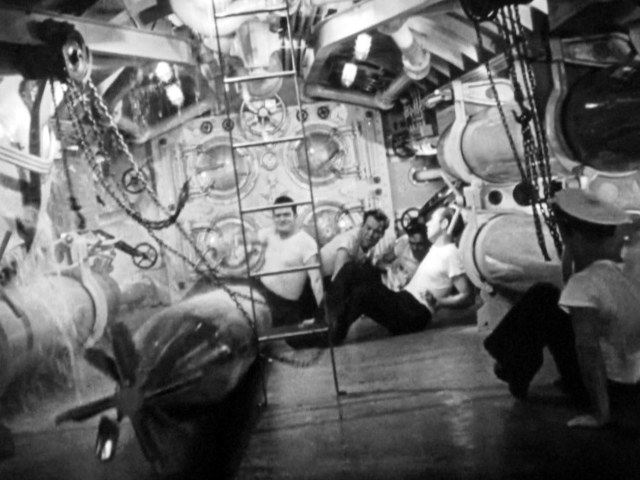
Trapped in a small section of the sub with highly limited air (which is meted out at certain intervals to make it last), the crewmen begin to submit to everything from fatigue to delirium to outright fear and despair.
|
 |
Bond finds that he can hardly take the increasingly thin air any longer...
|
 |
In a move that might have helped the movie Gray Lady Down (1978) become a bigger hit, he starts to tear off his t-shirt!
|
 |
He intends to MAKE the man operating the air controls allow more oxygen to enter the room.
|
 |
At this point, Morris steps in and begins wrestling Ward to keep him from wasting the air (and somehow wins!) This is sort of a hairier, oilier rendition of what later went on between Lee Grant and Brenda Vaccaro in Airport '77, a movie whose plot line owes a little bit to Devil's Playground!
|
 |
Bond finally returns to his senses as the half-naked, nearly-unconscious fellow crewmen watch from the floor.
|
 |
This movie already has unintentional moments of homoeroticism throughout, but it hit a cheeky new level when Bond placed his hand on Morris' sweaty arm...
|
 |
...then rested it on his behind as he went to turn away from the conflagration.
|
 |
Bond still isn't done freaking out, though. While awaiting a miracle rescue, he continues to tear at his throat and chest in agony.
|
 |
Morris gives him a few seconds of fresh air, still trying to control how much is stored up as they await their fate. This dark, sweaty den of half-clothed men reminds me of a couple of seedy bars I ventured into back in the 1990s and early 2000s...!
|
 |
Meanwhile, topside, the only person who can come to Morris & Co.'s rescue is Dix, looking anything but heroic in his deep-sea diver's get-up...
|
 |
In an earlier shot, bent over, Morris' chest looked a little droopy by today's standards, but he was in quite good shape for an actor of the time. These photos don't truly capture the sheen of his luminous skin in the film.
|
 |
These last two shots bring to mind the final moments of another big favorite of mine, The Poseidon Adventure (1972.)
|
 |
It's never a goal of mine to run anybody down (well, maybe a little bit here and there! Ha ha!), but Dix was never a leading man who I appreciated much. Even in his hey-day he was only so-so and he grew to become sort of, well, clammy looking, as he matured. He also had a bad habit of focusing on costars' foreheads, sometimes with his eyes slightly crossed! He continued in films for another decade after this, notably in ones concerning The Whistler, but died prematurely of a heart attack in 1949 at only age 56.
|
 |
On the other hand, lantern-jawed Morris, with his crooked mouth has become something of a favorite for things he appeared in during his early career.
|
 |
His haircut, all swept straight across his scalp and trimmed straight across the back, became known as the "Boston Haircut," presumably because of his role as Boston Blackie.
|
 |
Clearly a man interested in playing all sorts of roles, he managed to remain a working actor for more than half a century. Just look at the bottom left photo of him with goatee, close-cropped hair and those big soulful eyes! Morris had finished The Great White Hope (1970) and was appearing in a play when he took a barbiturate overdose, presumably to end the suffering he was in from stomach cancer. He was 69.
|
 |
Del Rio was hailed for her beauty and style, which never left her. A few years after this movie, she returned to Mexico where she emerged as a highly successful and beloved leading lady, winning awards there for her work. Occasionally, she returned to English-speaking films like Journey Into Fear (1943) for her lover Orson Welles or Flaming Star (1960) as Elvis Presley's mother.
|
 |
Del Rio (I couldn't love this portrait any more!) believed in physical discipline (diet, meditation, mental health) in order to remain attractive. Though she swore by a daily 20-minute relaxation exercise and a good 8 or 9 hour sleep each night, it is a myth that she owed her looks to 14 or 16 hours of slumber per night. She was far too active and enthusiastic a person to have taken part in that!
|
 |
Del Rio basically retired by 1970, with one further movie, and lived until 1983 when liver failure claimed her at age 78. One of her later films was Cheyenne Autumn (1964) for John Ford, the third movie she made for him. Which brings us to...
|
 |
Ward Bond. Bond basically owed his career to Ford, working with him more than 30 times over the course of his very busy career. After many years of featured roles in countless movies, Bond segued into TV as the star of the popular western series Wagon Train, with Robert Horton. A polarizing figure thanks to his emphatic political views, he died in 1960 of a heart attack while still starring on Wagon Train. he was 57.
|
 |
While Del Rio is the object of desire in Devil's Playground and threatens to tear apart the close bond between Morris and Dix, the movie at its heart is more about the camaraderie of the two gentlemen.
|
 |
It even concludes with them snugly situated in a rickshaw, riding off into the sunset together, singing as if there had never been an issue between them!
|
 |
They were clearly smitten with the divine Miss Del Rio...
|
 |
...but one can also wonder how they got along in China without her in the way!
|