Tuesday, November 3, 2020

Guest Who: Hammer Time!

There have been countless TV series devoted to police work, from the procedural (Dragnet) to the family friendly (Adam-12) to the hip (The Mod Squad) and beyond. However, 1972 brought about the exemplary anthology series Police Story, peppered with top writers, directors and performers who brought an edgy, adult, sometimes bleak, angle to the proceedings. With a (nearly always) different cast each week, there was freedom to present practically any type of story. There were some topics covered that episodic TV had heretofore barely allowed, especially with the gritty handling afforded them here. I can't forget to mention the arresting music for the series as well. The gallery of actors and actresses who pop up on the show make it a joy to behold, but this time we're going to zero in on one who certainly caught our eye. It was the very first episode of the series, following the pilot, and was directed by John Badham (who six years later would helm a little something called Saturday Night Fever!)

The ostensible star of this installment is James Farentino, a busy actor of the 1960s and '70s who also later popped up in the second season of Dynasty. Playing an undercover cop who is trying to infiltrate a prostitution ring, he goes ALL-IN with the deliciously crazed clothing options of the early-'70s. One could look far and wide and come up empty-handed when trying to out-do some of the get-ups he has on here. Interestingly, he also plays opposite one of his ex-wives, Elizabeth Ashley, and they even have a love scene, despite having divorced seven years prior!

It's 1972, baby, and no one has ever been able to truly duplicate that overall look and vibe of the people, places and things. Today's cameras always make it all look too glossy and nice (and sharp.)

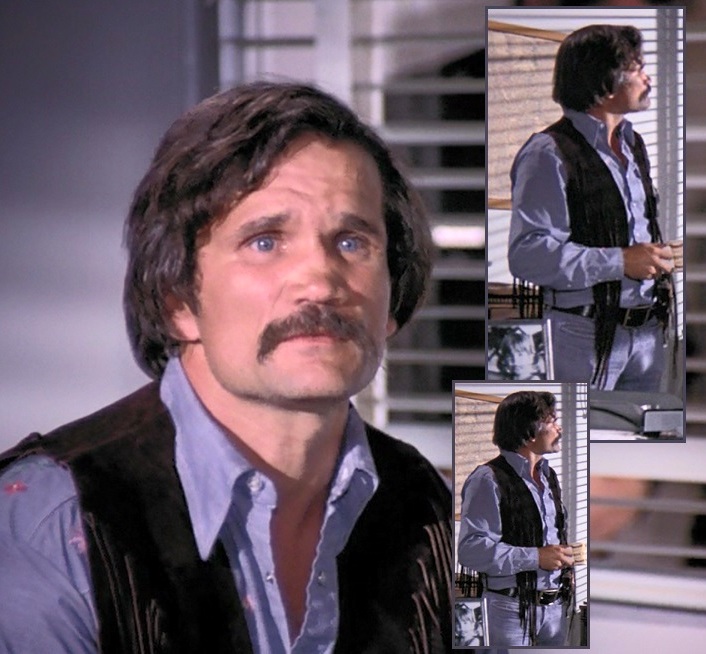
The photo with the little boy in his arms is of the character's ordinary street clothes. I included that because of the fit of his jeans. You might recognize buxom Francine York in the happenin' yellow ensemble.

Take note of The Underworld's favorite extra, Leoda Richards, in the thick of things above-left as always! While the lower-left outfit was one of the more eye-popping, I really dug this blue see-through shirt, open to the navel...! One of my very earliest posts at Poseidon's Underworld zeroed in on this 1970s look.
This being the '70s, it seems like every third character is sporting a bulge (another one of my earliest observations, which spawned a whole series of posts on the same theme.) The actor above, Eric Server, was playing a character called "Royster," who would later figure prominently in a Police Story spin-off.

Here we have Charles Dierkop who, interestingly, would take over the character of "Royster" in a later episode of Police Story and then carry it on to the spin-off show Police Woman, which starred Angie Dickinson. Dierkop is also sporting some revealing jeans, as he nearly always did on the show. But these are really just appetizers prior to the main course, which is about to be served...

Special guest star in this episode, and playing the villain of the piece, is Fred "The Hammer" Williamson. Williamson was a pro football player (known for hammering his opponents on the field with a swift arm chop!) who retired in 1968 and followed the lead of Jim Brown by turning to acting for a second career. He had a recurring role on Julia as Diahann Carroll's handsome boyfriend and later became a key figure in the Blaxploitation genre of tough-ass action flicks.

Here, he's a highly-charming, yet highly-dangerous, pimp with a penchant for roughing up the women around him. Here, he's even wielding the knife end of a corkscrew to show Farentino what can happen to those who cross him.

This moment, the first real scene with Williamson, was the one that was eye-popping. Greeted by the undercover Farentino (who is accompanied by Ed Bernard, who would also become a regular on Police Woman), Williamson is working one jaw-dropping white-on-white combo.

Hammer time, indeed!

It takes a lot to draw attention away from Bernard's funkalicious outfit, but Williamson manages to do so. Did I mention his character's name is "Snake McKay?!"

During a side-view, we can make out his tighty-whitey briefs.

Only in the '70s, folks...

Even when he's dressed in traditional men's wear, he got a fair amount of torque going on the crotch. He's seen here with Elizabeth Ashley. The clothes sprinkled throughout this episode are about a captivating as the story line.

Here we find Mr. Slick in one incredible jacuzzi...

The one concession to television standards and practices is that his woman is wearing a bikini. You know in their own backyard she'd at least be topless in the real world.

Williamson had, at this time, gone from supporting parts in movies such as MASH (1970) and starred in a couple of his own, notably Hammer (1972), but would very soon explode as a go-to guy in a whole series of rough and ready, lowdown action flicks. Many of these, albeit not for every taste, are among the mostly highly-regarded of the genre. 

He also, soon after this, would become one of the earliest male celebs to pose semi-nude for Playgirl. (In its earliest days, the famous men often showed almost everything instead of everything, though that would soon change - as when Williamson's peer Jim Brown posed a year later in 1974.)

You didn't really think I was going to wrap this up without presenting a couple of examples from that shoot did you?

I wouldn't dare caption this any further... Ha ha!

The End!

Tuesday, October 20, 2020

Deja View - Travel Trauma

COVID19 shelter-in-place viewing has led to a reliance on satellite TV to bring obscure, potentially interesting things to my attention. (Yeah, I also have Netflix, but I watch precious little new material.) One of my high-def movie channels recently dredged up the 1973 western movie Showdown, which I swear I never even knew existed! It's stars, Rock Hudson and Dean Martin, are perhaps not my very favorite, but they are interesting enough to me that I wanted to see the pairing (and, they are, after all, members of the imaginary Disaster Movie Club.) While watching the opening sequence of the film, I was immediately struck with a sense of deja vu. What makes that all the more intriguing I will get to in just a moment...

As a train choo-choos its way across the western terrain, Martin is seen wearing a sheriff's badge and transporting a prisoner who's shackled to the overhead luggage rack. When the train is stopped by a pile of logs on the track, it's clear that a robbery is about to happen and Martin stands up to plead with the passengers to hand over their valuables to him for safe keeping. Something about this moment set off a bell in my head (oh, there are plenty up there... Ha ha!) Can you guess where I'm going?

Yes, I have to say that the way Martin stood in the aisle with the passengers on the train turned and looking reminded me of a similar moment in Airport (1970) when Martin, as the pilot of a passenger aircraft, was forced into pleading with a despondent man to resist setting off a bomb he's carrying which would blow the plane and everyone in it to smithereens! Both moments were featured in publicity stills for the respective films. Still not convinced? See below:


But what's more intriguing is that Showdown was directed by George Seaton. It was the final film of the seasoned director (who won an Oscar for writing Miracle on 34th Street, 1947, which he also directed.) He's seen here coaching Martin for the scene in question.

And guess what? Airport was also directed by Seaton! He's seen here on the set of that film giving direction to Martin, who he obviously enjoyed working with enough to bring him back for his next project. How nice for Martin that his blocking didn't wind up being demonstrably different for the first scene in Showdown! He'd already gone through the motions on Airport. Airport was, of course, a gargantuan hit that spawned three follow-ups while Showdown virtually descended into the nether regions. I hope you found this little moment in the cinema firmament amusing. I'll be back soon with something else that grabs me.

Double the Deano. Makes for interesting bookends.

Friday, October 16, 2020

TinselTales: Murder "in the Family"

Archie and Edith Bunker. Television icons thanks to the unbel- ievable success of the Norman Lear sitcom All in the Family, which ran from 1971-1979 (thereupon followed by an augmented continuation, Archie Bunker's Place, until 1983, which was mostly without Edith.) Having segued through the loss of key characters such as daughter Gloria and son-in-law Mike, the show now had a new adolescent character called Stephanie in order to help generate new story lines. The episode, "The Return of Stephanie's Father" had the Bunkers grappling with the notion that their new little moppet was about to be reclaimed by her ne'er do well papa and taken to live in a derelict hotel.

Arriving at said hotel, Carroll O'Connor (as Archie) and Jean Stapleton (as Edith) are appalled. O'Connor doesn't even want to look at, much less smell, the place.

There's a careworn desk clerk checking people in by the hour rather than the night.

In the lobby are a couple of men of ill repute.

Finally, Stapleton and O'Connor are greeted by the tenant and soon try to find a place to sit and hash out the details of this sudden attempt at Stephanie's custody after having been in their care.

The desk clerk in this episode was portrayed by one Victor Kilian. Having begun acting on Broadway in the mid-1920s, he had proceeded to a film career (followed by much television) in an assortment of useful parts. At the time of this filming, he was just shy of 88 years of age.

The bum shown getting an earful from O'Connor was played by Charles Wagenheim. Wagenheim also acted on Broadway from the early-1920s to the late-1930s and then moved on to countless film roles. He then acted plentifully on television. He was nearly 84 at the time of this episode's filming.

The House of Frankenstein (1945)
Sadly, Wagenheim would not be among the viewers watching the March 25th, 1979 airing of this episode, "The Return of Stephanie's Father." On March 6th, he returned home to the Hollywood apartment he shared with his invalid wife to discover the young female nurse they'd hired to look after her going through their drawers attempting to steal! Caught in the act, she responded by bludgeoning the poor man to death (then calling to report that she'd "found him" that way.) Wagenheim's 50-year career included movies such as The Song of Bernadette (1943), The Spiral Staircase (1946), Executive Suite (1954), The Diary of Anne Frank (1959, as the thief who breaks into the factory below), Hello Dolly! (1969) and many, many others.

Blondie for Victory (1942)

I Escaped the Gestapo (1943)

Canyon Crossroads (1955)


Perhaps his most notable role of all, as the assassin in the famous umbrella sequence of Alfred Hitchcock's Foreign Correspondent (1940.)

But the horror doesn't stop there. Wagenheim was murdered on March 6th, which happened to be the 88th birthday of his recent costar Victor Kilian. Kilian had to have been distressed to hear of the murder of a recent coworker. But he didn't have time to fret... On March 11th, he too was found beaten to death in his luxury apartment! Like Wagenheim, he found himself at the mercy of a burglar or burglars who had intruded while he was watching TV. Five days apart, one mile away from one another, these longtime performers and recent coworkers were gone.

The woman who killed Wagenheim, ironically named Stephanie, was sentenced to only 8 years in prison for the senseless killing of the veteran actor. God only knows what she actually served after her voluntary manslaughter plea deal... There wound up being no direct correlation between the two killings.

With Patricia Hitchcock in Broadway's Solitaire.
Killian had worked on many, many movies including Ramona (1936), The Adventures of Tom Sawyer (1938), Only Angels Have Wings (1939), Reap the Wild Wind (1942), Gentleman's Agreement (1947) and many others. It all came screeching to a halt when he was blacklisted during the McCarthy witch hunt in the early-1950s. However, he was able to resume a Broadway career (including a turn in Look Homeward, Angel with Miriam Hopkins and Andrew Prine) until TV came along with its employment opportunities.


In his day, Kilian could boast featured billing in movies like Bad Boy (1935.)


King of the Lumberjacks (1940)

Kilian got a late-career boost as the father of Mary Hartman, Mary Hartman, a Norman Lear sitcom with a cult following.

As a lascivious old coot (and "The Fernwood Flasher!"), he made quite an impression on viewers.

This is indeed a more gruesome post than we might typically put up, but it is mere weeks from Halloween, after all, so the time is sort of right in a way.  What are the chances of these still-active, octogenarian actors meeting their fates in these awful ways after enjoying such long careers on screen? It just isn't fair. My mind was blown when I found out about this, though, and wanted to share.