Today's featured flick,
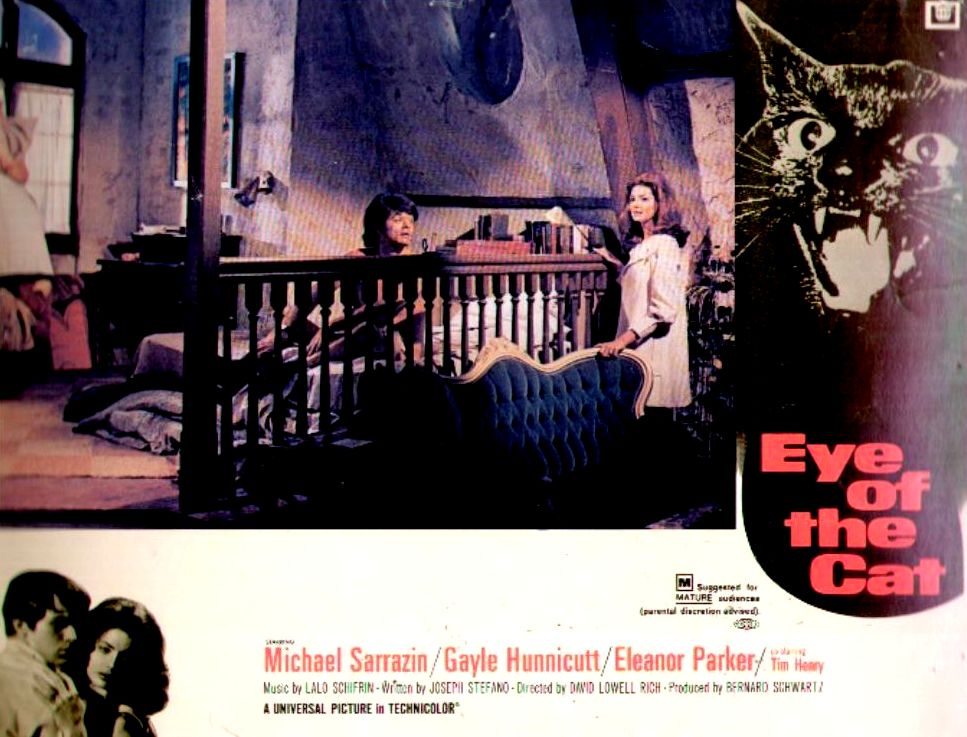
Eye of the Cat (1969) was a bucket list movie of mine for three
decades. Ever since I purchased the coffee table book “The
Illustrated Who's Who of the Cinema” back in 1986 (which instantly
became an irreplaceable resource for me after every movie viewing
thereafter until I knew practically every person in it!), I have
wanted to watch it. As an obsessed fan of Baroness Schraeder in The
Sound of Music (1965), I saw that Eleanor Parker made this movie four
years later and played another glamorous character, which made it a
must-see. However, even though Cat had apparently been shown on TV ad
nauseam in the '70s, I never, ever saw it broadcast anywhere again.
Ever!
A few years ago, one of
my favorite movie blogs did a tribute to the film and it was clear
even from that post that this movie has yet to be given any sort of
proper video release (as its webmaster always features pristine
vidcaps.) It is screaming out for DVD! I had told myself that I would
not view it in a blurry, sub-par print with all the hiccups, muffled
sound and unclear visuals, but in the end I simply could not resist
watching it. While it is far from a perfect film, it did not
disappoint!
Directed by (primarily TV)
veteran David Lowell Rich, Cat often takes hits from some critics and
viewers for its staid, uncreative direction, but to me the movie
contained atmosphere, suspense, intriguing set-ups and angles and a
fluid, moving camera, so I couldn't understand what the fuss was
about. While no one is Hitchcock (and this movie contains MANY
Hitchcockian elements thanks to a script by 1960's Psycho author Joseph
Stefano), I found this to generally be a well-handled, yet elegant,
popcorn thriller for 1969 (though it must be said that I am averse to
all the hepped-up, over-the-top action that dominates today's
cinema.)
 Things certainly get off
to a terrific start thanks to a pre-credits sequence that manages to
crib from both Walk on the Wild Side (1962), with the meandering cat,
and The Thomas Crown Affair (1968), with then-revolutionary
split-screen work. We are introduced to Parker, an obviously wealthy,
yet sickly, San Francisco socialite who visits a pampering salon for
a facial, pedicure, hairstyling... the works! The salon's iron gate
even includes a brass placard in the shape of a cat's eye!
Things certainly get off
to a terrific start thanks to a pre-credits sequence that manages to
crib from both Walk on the Wild Side (1962), with the meandering cat,
and The Thomas Crown Affair (1968), with then-revolutionary
split-screen work. We are introduced to Parker, an obviously wealthy,
yet sickly, San Francisco socialite who visits a pampering salon for
a facial, pedicure, hairstyling... the works! The salon's iron gate
even includes a brass placard in the shape of a cat's eye!
Reviews of Eye of the Cat
often cite Parker's character as “wheelchair-bound.” She's not.
It just turns out that she has severe emphysema (“two-thirds of her
lung tissue is gone!”) and cannot over-exert herself. She uses a
wheelchair for most of her getting around and sleeps in an oxygen
tent.
As fur-covered Parker
enters the salon, we meet Gayle Hunnicutt, one of the beauty
operators who works there, grooming herself, cat-like, in the mirror.
Next we see the salon's
flamboyant owner Mark Herron regaling Parker with some sort of tale
as he welcomes her into the establishment. In an amusing bit, he
takes time while walking to cover the exposed knees of a client, lest
her dignity be at risk. In real life, the gay Herron was not too long
divorced from his short-term wife Judy Garland! And look at the
gray-haired patron in the lower right corner of the shot below, it's
Poseidon's Underworld's favorite extra, Leoda Richards, almost always
a sign that we're in for a fun time.
With the salon buzzing and
Parker under the dryer, she takes an attack and begins wheezing and
flailing in agony, dropping a prized locket of hers in the process
and sending all the folks in the parlor into a tizzy. Hunnicutt,
kneading a hand towel in a feline manner, had already had her eye on
the pendant and happily pockets it.
After the credits roll, we
see Hunnicutt on something of a mission. She drives her convertible
to an out of the way, rather seedy motel with rooms rented by
everything but the hour. After bribing the manager, she proceeds to
one of the rooms, enters with a key and discovers a young couple in
bed together, post coitus.
The girl is horrified and
uses a pillow to partially cover herself, but the guy (mop- haired
Michael Sarrazin) takes it in stride. As Hunnicutt practically orders
him to get up and come with her, we find that he is (implied) naked
except for a pair of black boots and doesn't really mind at all if
the interloper sees it for herself.
Hunnicutt is one tough
cookie, however, and isn't at all phased by Sarrazin's brazen manner.
Soon, he's slipped on some clothes and is along for the ride with her
to places unknown. The place turns out to be the salon, her place of
employment, where she puts him through his paces, with a haircut, a
shave, body massage and so on.
Sarrazin, who'd already
expressed a phobia about back alleys, becomes unsettled even despite
his blasé attitude, but can't quite pinpoint what's wrong. We get a
foreshadowing when, in a moment that pays tribute to Psycho, the
shadow of a cat appears on his shower door while he's scrubbing off.
Later, a towel-clad
Sarrazin reveals to Hunnicut that he is deathly afraid of cats. As a
child, he'd nearly been smothered to death by one when it climbed up
into his crib and covered his face. Now the mere sight of one causes
an adverse reaction. (One assumes he made a habit of leaving the room during any of the prolific Morris
the cat TV commercials for Nine Lives cat food?)
Just then, the same orange
cat that had been skulking around Parker and the salon leaps into his
lap, causing him to violently toss the feline aside (and causing it
to suffer a simultaneously horrifying and perhaps unintentionally
hilarious fate.) I will add here that I have been known to boycott
movies in which the deaths of dogs or cats is presented as “funny.”
I just found the execution – no pun intended – of this to be a
bit loony!
Sarrazin thinks he's been
collected and cleaned up by this self- assured, gorgeous young woman
for the purposes of sex, but he's in for quite a surprise. What she
really wants is for him to head back home to his aunt's mansion in
order to get her will changed to himself as the beneficiary. Then she
wants to kill the woman and split the inheritance. The aunt? Parker,
of course!
Sarrazin is dropped off
outside Parker's looming San Francisco home (Hitchcock's dreamy
masterpiece Vertigo, 1958, was memorably filmed in this city as well)
and begins to have little flashes from his childhood. He and his
little brother were raised by Parker after their mother, her sister,
passed away, followed later by their father.
We soon meet the little
brother, who's not as little any more and is now played by Tim Henry.
He's never left Parker the way Sarrazin did and we find that he is
the same handsome driver who'd earlier taken her to the salon. The
brothers' reunion is affectionate, yet slightly antagonistic, with
Sarrazin not understanding why Henry has proceeded to stay with his
aunt rather than experience the world at large.
Soon Sarrazin heads to see
his aunt for the first time in years. Due to her declining health,
she's established a bedroom in the first floor study rather than
climb any stairs. He enters the room and finds her asleep under the
oxygen tent and is at first pleased to see her, but soon realizes to
his utter horror that the room is positively crawling with cats!
He bolts from the study
and immediately races to Hunnicutt's apartment where he hurls her
around for not warning him about all the kitties in residence at
Parker's abode. She claims ignorance about them and before long has
seduced him to clam his nerves. After their romp in bed, we get a
look at the claws this gal is sporting as she traces his arm with one
of them.
Meanwhile, Parker, who had
opened her eyes long enough to glimpse Sarrazin before he ran off, is
wistfully recalling him in her run-down conservatory. Thankfully,
Henry has opted to do some shirtless repair work while she's waxing
nostalgic, but sadly it's our only glimpse of his yummy physique.
Henry, for whom Parker holds a general disdain despite his devotion
to her every need, convinces her to take her daily dose of fresh air
at the park across the street.
Here, Sarrazin officially
meets up with his aunt again and they instantly strike up a fondness
for each other that had been part of their lives when he was a youth.
Part of their fun and games is his penchant for doing anything and
everything he can think of you get a rise out of her, be it rapidly
thrusting her wheelchair down a path or pretending to be dead in her
presence!
Parker is desperate for
him to return home, but he won't set foot in the place until all of
those cats are gone. Parker orders Henry to lure the bevy of beasts
into the car with a large bowl of meat so that he can transport them
out of Sarrazin's hair.
Next, she calls her
attorney that very day and announces that she wishes to change her
will! The bene- ficiaries had been the cats(!), but now she wants it
changed so that Sarrazin will inherit her estate. (Bizarrely, at no
time does Henry ever seem to be included in the plans for her will,
though he is the one who's been at her side all along!)
Just when she thinks that
the cats are all gone and that Sarrazin will be back in her roost,
Parker hears mewing and searches her room to locate the source! She
discovers that one of her wardrobes is housing a newborn litter of
tiny kittens!
She surreptitiously
gathers them up and tiptoes outside with them (to do God knows what!
It's never shown.) One her way back inside, she realizes that she
may as well dispose of the article of clothing they were nestled in
as well so she heads to the basement, but gets something of a shock.
(Her garish reaction is the expression shown on the movie's poster.)
Meanwhile, Sarrazin has
brought Hunnicutt into the house! After stowing her in a storage area
(where they again make love), he installs her upstairs – out of
Parker's reach – in a place they call the play room. There, she
oversees how well her grand plans are taking place.
The lawyer (Linden Chiles)
– to Parker's dismay, an associate, not the senior partner –
arrives to redo her will. He listens to her requests, but informs her
that the document cannot be official until it is drawn up and signed
in the presence of two witnesses not listed as beneficiaries of the
estate. Chiles can't even get out the door before Sarrazin begins
quizzing him on how soon he would be able to spend the money and if
the cats are well out of the inheritance! Chiles assures him that so
long as Parker survives until the next day's signing, he will get
everything that's coming to him.
Sarrazin spends more time
zipping Parker around in her wheelchair, but at one point slips and
sends her careening into the side of the conservatory's fountain!
This brings on another one of her attacks and she's sent to bed.
Realizing that he's got to keep the woman alive through the next
afternoon, Sarrazin is worried that he brought on another violent
breathing episode.
Later, Henry goes looking
for Sarrazin and finds him soaking under- water in the bathtub. The
rotten picture of this version of the movie doesn't allow us to see
things completely clearly, but something or other is bobbing around in the water
near his foot (in the inset) and it's not his hand or thumb. Both
hands are up near his face.
 This mini-tribute to
Diabolique (1955) is interrupted by Henry who enters and tries to get
his brother's attention. Unable to rouse him by name, he takes a back
brush and pokes him in the belly with the handle of it!
This mini-tribute to
Diabolique (1955) is interrupted by Henry who enters and tries to get
his brother's attention. Unable to rouse him by name, he takes a back
brush and pokes him in the belly with the handle of it!
In yet another instance of
Sarrazin being openly naked in front of another person, he is coerced
out of the tub.
He proceeds to enlist
Henry to dry off his back! Needless to say, we welcome this little
bit of homoerotic kink with open arms.
Sarrazin obtains the key
to Parker's strongbox in order to pilfer a bit of cash to spend on
Hunnicutt and to get her away from the house for a stretch. While
he's rooting around in the iron cookie jar, Parker awakens and calls
him over to her bedside. As they continue to bond over memories and
the subject of Henry's love life, Parker rests her hand in quite a
pronounced manner on Sarrazin's inner-thigh!
This bit of sensual
tension includes a close-up of Sarrazin's commando crotch (accented
by Parker's hand, which sports a dazzling ring on it!)
It's also punctuated by a
moment of desperate sensual longing in which Parker pulls off one of
the most startling lip/cheek quivers that I have ever seen! The
still-lovely actress is giving this movie her all (as virtually all
of the old-Hollywood pros who found themselves in similar
predicaments did), regardless of the fact that this is nothing more
than a glitzy, ditzy thriller with plot holes wider than some of the
fault lines found in California.
Sarrazin does show
Hunnicutt the town in a montage that is typical of the era before
escorting her to a funky 1960s party complete with gyrating dancers,
plenty of big hair & short skirts and this guy, who unleashes an
amusing bon mot regarding his sexual preference. Half the inhabitants
of the party are getting high, but Hunnicutt decides she's too
singleminded for that. She heads off to the ladies room to freshen
up.
In her absence, Sarrazin
is again confronted by the first girl we saw him with, Jennifer Leak.
She expresses her still-brewing affection for him, but when he
reveals that he's still with Hunnicutt and, in fact, has brought her
there to her place with him, she becomes unglued.
Now we are treated to an
Eye of the Cat catfight, in which Leak and Hunnicutt trash the
already filthy and disgusting restroom. Like alleycats in the gutter,
they tear at each other repeatedly until the other folks,
alternately amused and concerned, manage to break them apart.
Following her wallow with
Leak, Hunnicutt has clearly decided to partake in something because
she's deliriously relaxed, yet, starry-eyed and opts to seduce the
easily-seducible Sarrazin in the conservatory. Unknown to them,
however, Parker has heard them come in and slinks out to watch them
together and hear about their plot to murder her for her money!
Next comes the movie's
chief set piece, in which a now- paranoid Parker is taken for her
daily airing by a grinning Sarrazin. She's told him that she knows
about his plans, but has signed the will anyway. She doesn't even
make it to the park when she thinks she sees someone in her bedroom
window. She points it out to her nephew who, after seeing something
himself, heads off to investigate.
He finds Hunnicutt in
Parker's room trying to jimmy open the strongbox to be certain for
herself that the new will is all signed.
Parker, resplendent in her
Edith head finery, isn't content to merely wait for him and begins to
roll down a steep incline slightly to see for herself what is
happening in her room. Deciding to climb back up the hill, she turns
the chair around.
Only, surprise! Her
electric attach- ment suddenly blows up and konks out, causing her to
stall and begin to roll backwards. With agonizing determination, she
fights to keep from zooming backwards down the hill into heavy
traffic! It should be noted that Parker previously – and very
dramatically - portrayed women in wheelchairs in both The Man with
the Golden Arm and Interrupted Melody, both 1955 (Melody garnered one
of her three Best Actress nominations), and she's still providing
A-List Face throughout this tense – yet undeniably giddy –
sequence!
Sarrazin opts to try to
save Parker, signed will or not, and darts out to the street, but now
a cat, who seems bent on watching over Parker, is in the way,
distrustful of the would-be killer. With Parker's ankle caught under
the chair and her grip on the wall slipping, Sarrazin's decision to
swat away the cat has perilous consequences when it lands right in
her lap!
This is not the end of the
movie, and there is still a fair amount of story to come, but I don't
like to reveal too many key plot specifics on my site, especially
regarding mysteries or thrillers. Even in my detailed tributes, I
always try to leave certain things out. I will tell you, however,
that the bevy of cats who resided in the house to begin with, do make
a rather bloodthirsty return. In this respect, Hitchcock's The Birds
(1963) is evoked to a certain degree.
Rail-thin Sarrazin was
just making his mark in motion pictures. Having appeared on TV in the
mid-'60s, he started to earn film roles by 1967 and soon graduated to
youthful leads. 1969 also brought him the far more prestigious They
Shoot Horses, Don't They? Other notable movies in which he starred
include Harry in Your Pocket (1973) and The Gumball Rally (1976.) He
was still a viable leading man until the late-'70s before seguing
into lower-budget thrillers like The Seduction (1982) and Mascara
(1987.) Only seventy when he died of cancer in 2011, he had by then
amassed a substantial list of acting credits.
Texas born Hunnicutt was a
tall, attractive fashion model before segueing into acting. Not
unlike Linda Gray, though in my opinion even more beautiful, she
married British star David Hemmings in 1968, the year her movie
career began to gather steam. They costarred in 1970's Fragment of
Fear, another thriller, and worked in both the U.S. and the U.K. She
acted after their divorce in 1975 with regularity, but in less
high-profile projects (1985's Target being one exception.) Now
seventy-two, she began to slow down in the 1990s and her last TV
guest role came in 1999.
Parker is one of my very
favorite actresses and she received an early tribute here and a
later, far more thorough one, here. Following her role in The
Sound of Music, a staggering world-wide success, she nevertheless
struggled to land decent big-screen roles. The Oscar (1966) was a
royal hoot, but she was good in it. 1966's An American Dream gave her
a brief, lacerating role as a sensual, drunken bitch. Warning Shot
(1967) had initially been intended as a TV-movie.
Indeed, she began to work
more in television and Eye of the Cat became her final feature film
until 1979 when she had a blink-and-you'll-miss-it role in Sunburn.
After departing the biz in 1991, she led a quiet life of retirement
until death from pneumonia in 2013 at age ninety-one. Seeing Cat and
the way her hair was sometimes styled amused me because at times it
looked like she could be Baroness Schraeder's evil twin the way
Serena was on Bewitched or Jeannie II on I Dream of Jeannie!
Canadian actor Henry was
making his movie debut here, having only recently begun on TV in his
homeland. Though he never became famous in the U.S., he worked
steadily for many years and often turned up in bit roles (guards,
doctors, detectives) in a multitude of projects until 2013. A
handsome, effective performer, it's surprising that he wasn't able to
achieve more prominent work. Most surprising of all is that he is the
brother of somewhat more famous actor Donnelly Rhodes!
Chiles was a dependable
presence in countless movie and TV episodes. Never gaining fame for
any particular role, he amassed a staggering resume of credits that
stretched from 1960 to 2014. He might even be working today if not
for an accidental fall from his roof at age eighty! (“You get down
from there this instant!”)
Even though I did finally
get to see this long-awaited movie, I still hold out hope for a DVD
release. I think I'd enjoy it even more in its widescreen ratio and
with a cleaned up picture. God knows the glossy sets, glamorous
costumes and garish hairstyles would benefit from a sharper image,
not to mention the endless glimpses of male and female (albeit
chaste) skin. Complicating things is that when it was aired on TV, the intensity and some of the violence was deliberately drained from it with reshoots and reediting. This post refers to the original release only.
******UPDATE******
This movie has been released on Blu-Ray (not regular DVD) and I ordered a copy. It was gorgeous! Wide-screen, high-def picture and it also includes (in an inferior print) the television version with several added scenes not found in the feature (and with many of the more suggestive moments missing.) I do recommend it.


 Things certainly get off
to a terrific start thanks to a pre-credits sequence that manages to
crib from both Walk on the Wild Side (1962), with the meandering cat,
and The Thomas Crown Affair (1968), with then-revolutionary
split-screen work. We are introduced to Parker, an obviously wealthy,
yet sickly, San Francisco socialite who visits a pampering salon for
a facial, pedicure, hairstyling... the works! The salon's iron gate
even includes a brass placard in the shape of a cat's eye!
Things certainly get off
to a terrific start thanks to a pre-credits sequence that manages to
crib from both Walk on the Wild Side (1962), with the meandering cat,
and The Thomas Crown Affair (1968), with then-revolutionary
split-screen work. We are introduced to Parker, an obviously wealthy,
yet sickly, San Francisco socialite who visits a pampering salon for
a facial, pedicure, hairstyling... the works! The salon's iron gate
even includes a brass placard in the shape of a cat's eye!




 This mini-tribute to
Diabolique (1955) is interrupted by Henry who enters and tries to get
his brother's attention. Unable to rouse him by name, he takes a back
brush and pokes him in the belly with the handle of it!
This mini-tribute to
Diabolique (1955) is interrupted by Henry who enters and tries to get
his brother's attention. Unable to rouse him by name, he takes a back
brush and pokes him in the belly with the handle of it!


