
Surely one of the most jaw-dropping success stories in entertainment history, today's subject, Miss Dolly Parton,  came from the simplest and most humble background imaginable and rose to become one of the most notable, beloved and wealthy singer-songwriters of her day.
Born on January 19th, 1946 in Sevierville, Tennessee, she was the fourth of an eventual TWELVE children born to her parents Robert Lee and Avie Lee Parton (Lee obviously being a popular middle name in them there parts! The son, Robert, who came after Dolly had that middle name as well.) The fiscally-strapped family lived completely in a one-room house. The highly imaginative and musically-inclined Parton learned early on that it was going to take something special in order to stand out amidst all of those in her family.
Springing from a strong Pentecostal background (one of her grandfathers was a preacher) and drawing from the many experiences and situations around her, many focusing on the lack of prosperity which led to industriousness in order to make ends meet, she began writing songs in earnest at the early age of seven! She also coerced her siblings and other relatives to serve as her audience as she would emphatically and skillfully perform songs.
Already traveling to town with an uncle to sing on local radio by the age of nine, she was cutting records and even appearing at The Grand Ole Opry by age thirteen! Never having had a lick of vocal training, nor any particular instruction in writing (frankly, considering her surroundings, she was lucky she could read!) her style didn't always sit well with every country music fan, an area tough towards women to begin with. Johnny Cash told her to follow her heart and ignore what others had to say, advice which ultimately led to staggering success for her.
 It didn't come swiftly, though. She made the best inroads initially through her song-writing, with ditties co-written with that helpful uncle who was also in the business, for Skeeter Davis and Hank Williams Jr. While in Nashville, doing her laundry at the Wishy-Washy Laundromat, she met the man who would become her husband, the reclusive Carl Dean, who remains her spouse to this day, though he has shunned the limelight from the very beginning of their union. The two wed in 1966.
  While nothing or no one was going to keep Parton from realizing her dreams in the music industry, he has always worked in his own field of expertise regardless of the avalanche of money that Parton's career has generated. Today, he runs a road-paving company.
 In 1967, at age twenty-one, Parton landed a spot on the popular The Porter Wagoner Show, a country-western music program whose star wore flashy, sequined and beaded jackets that rested below a sizeable wave of golden hair. His previous female sidekick, Norma Jean, had departed the show following marriage and had been exceedingly popular with viewers. Parton's earliest days on the series were punctuated by hostility from some audience members and even chants of “Norma Jean... Norma Jean!” as she prepared to perform. Parton had ideas about hair, makeup and
  clothing that were at tremendous odds with her conservative family's viewpoint. (I do love the simple look she's sporting on the above left cover, though. What cute, short hair! Click to enlarge.) By her own admission, she'd as a young child seen a painted up floozie walking the streets one time, shocking the adult women she was with, and thought to herself that the trollop was just about the greatest thing she'd ever seen in her life! She would progressively adopt bigger, blonder hair and tighter, flashier clothes, the further she went in life.
 Wagoner and Parton began recording duets in addition to performing together on the show and found significant success. In time, the vastly different, but arresting and – most importantly – genuine, Parton was accepted by his audience and eventually
 grew to be quite popular in her own right. For six years, the two released albums of duets, many featuring some now-amusing cover portraiture, which were very popular in the country music field. They were never a couple in the romantic sense, but were closely associated with one another in listeners' minds. Wagoner, with an interest in her career that was also financial, tried early on to launch Parton as a solo act, but could never come up with anything that clicked.

 In 1970, she recorded “Mule Skinner Blues” on a lark and it was a hit. Thus, she was able to continue the Wagoner duets while pursuing her solo career. Hits like “Joshua” and “Coat of Many Colors” came in this time period, followed by her first real smash “Jolene,” in 1973. A dichotomy existed that continues to this day in that Parton looked like the most done-up, artificial, superficial lady imaginable and yet possessed the most down-to-earth, sincere, self-effacing personality imaginable, a rarity then and now. She might look like a colossal joke to those judging her only on her mode of hair and dress, but her songs and personality betrayed a heartfelt, thoughtful persona that was infectiously appealing.
 Soon, Parton stopped appearing on The Porter Wagoner Show (having stayed two years beyond her initial five-year deal), though they still sang duets up until 1975. The prior year, Parton penned and sang “I Will Always Love You” as a poignant memento of her departure from his program. They had enjoyed a popular and profitable collaboration, but it was clear that she was ready to spread her wings and fly (and look at the big hair on the solo album cover above left!) Unfortunately, Wagoner felt
  that he had created this songbird (who'd been hatching since she was a preteen!), had her tied up contractually and sued her for a share of her income!
Thus, things got ugly and ended badly, but Parton struck a deal with him rather than become mired down in the courts. She wrote songs and sang, performing in concert, often on the road, in order to raise the money to complete the settlement agreement with him and, in essence, be rid of him. Around this time, she made a fateful decision, too, that would impact her life tremendously later. Her song “I Will Always Love You” had caught the ear of The King, Elvis Presley, and he wanted to record a rendition of it. Thing was, it was his manager Colonel Tom Parker's policy to have any song Elvis recorded become half his from then on! Parton resisted, not an easy thing to do in these early years, because she wanted to own her own material flat out. Decades later, when Whitney Houston sang a reconditioned version of the song in The Bodyguard, also releasing it as a single, Parton made millions of dollars in the bargain.
In the wake of her burgeoning solo success, Parton made a couple of attempts to cross over to the pop charts. In 1976, she went under the management of Sandy Gallin, who's other clients at one time or another included Cher, Barbra Streisand, Michael Jackson, Neil Diamond and others. Her first attempt at crossing over was not successful (perhaps hampered by an album title with the word “harvest” in it?!) However, 1977's Here You Come Again was a rip-snorting hit and included “Two Doors Down” in addition to the title track.
 From here, there was no looking back, really. She had a popular TV variety show called Dolly!, which she had to give up after one season due to vocal strain. She was interviewed by Barbara Walters at a time when such a thing was an event, not an eventuality. She found herself in demand all over the place, be it TV specials with Cher or Carol Burnett, concert venues or special occasions such as a 1979 tribute to contemporary country music, which was attended by then-President Jimmy Carter.
The next mountain to climb was the film business. In 1980, a script was developed about three put-upon female office workers who have endured the tyranny of their domineering, sexist, uncaring boss for long enough. Through a series of mishaps and ironic circumstances, they wind up keeping him captive in his own home and proceed to take over the running of the office themselves.
The movie, 9 to 5, marked Parton's first foray into movie-acting. Teamed with Oscar-winning actress Jane Fonda and esteemed comedienne Lily Tomlin, Parton knew that she would have to be on her game in order to keep up with that company. One thing that helped was that her character, Doralee, was similar in background and look to the curvaceous singer. Another thing that helped her stay above water was that, in her eagerness to be prepared and her lack of knowledge about how movie-making worked, she had memorized the entire script from start to finish, including the lines of her costars!
Parton's character didn't sing in the film, but she was commissioned to write an opening credits theme song that captured the basic essence of the ladies and their life as office workers. While brainstorming over the song (and Parton claims to have written some sort of song – or at least explored an idea for one – almost every day of her life!), she realized that running her acrylic nails back and forth against each other generated a sound similar to that of a typewriter. This gave her the basis for what would become an enormous hit and the title number played over shots of women getting ready for work in the morning, effectively setting up the environment for the movie. The song was nominated for a Best Song Oscar (losing the the equally catchy title track from Fame) and Parton, in her debut role, was nominated for a Best Actress-Musical or Comedy Golden Globe (losing to Sissy Spacek for Coal Miner's Daughter.) A later TV series adaptation starred Parton's younger sister Rachel.
 Now considered a screen personality as well as a music industry chart-topper, she signed on for what seemed like a winner: The Best Little Whorehouse in Texas. The property had been a hit musical on Broadway from 1978 to 1982 and was now being turned into a film. Burt Reynolds was cast (how he got anywhere near a musical after 1978's At Long Last Love is anybody's guess! The original release only featured his singing in one duet, though a solo number – written by Parton – later popped up in the television version.) He and Parton (who was cast after original considerations Barbara Mandrell and Crystal Gayle were passed on) made an appealing pair on the poster (which also featured Parton's own appealing pair!)
The filming of Whorehouse was tumultuous and unpleasant. Reynolds had been suffering from physical ailments as well as the recent demise of his relationship with Sally Field and Parton was in agony and distress over some female problems she was having as well. When she innocently remarked to the press that she and Burt would get on well because they “both wear wigs and high heels” it caused friction between the two, though eventually they got on okay, mostly because they were both miserable and could commiserate with each other in the face of endless rewrites and a generally unhappy set. Parton rerecorded “I Will Always Love You” for the film, leading some people to think that she wrote the song at that time as a valentine to Reynolds, which is certainly wasn't.
A film with a title like that was a major-league hard sell in 1982, especially to parts of the country similar to where Parton was from, and the title was sometimes changed, obscured or bleeped in advertising. Nevertheless, it was considered a hit and Parton came out of the experience unscathed in the critics' and audiences' eyes. Thing was, the process of making the film, itself, led her to question her desire to pursue acting in movies.
 In 1983, she teamed up with Kenny Rogers to record the explosive hit “Islands in the Stream,” a number written by Barry Gibb and worked into a duet for the two country superstars. The song showed off their remarkable chemistry together and won them multiple awards. They would pair again two years later for a Christmas special (Once Upon a Christmas) and tie-in album as well as one more duet, “Real Love,” in 1985.
In 1984, Dolly entered the world of movies once more when she signed on for Rhinestone. The story was about a country singer locked into an unwanted performing contract who bets her boss (played by Ron Leibman) that she can turn anyone of his choosing into a real live country singer in two weeks in order to be freed (if she loses, she has to go to bed with him!) It all might have looked good on paper, but the result was something of a disaster.
To play the poor schlub, a New York taxi driver, who is earmarked for transformation, the producers hired that master of song, Sylvester Stallone. (Granted, the man isn't supposed to be a singer, but one likes to hope that there's a pot of gold at the end of the movie's rainbow and with mumbling, curled-lipped Stallone in the role, there's no chance!) Stallone allegedly turned down both Romancing the Stone and Beverly Hills Cop in order to take this part (and then rewrote it to suit him to the point where the screenwriter nearly took his name off the project, something he probably should have done!)
The movie underperformed at the box office, failing to make back all of its budget, and was nominated for eight Razzie Awards, “winning” two! Miraculously, considering the wave of disdain for the film, Parton escaped being nominated for her own acting performance, though two of her songs were. She and Stallone had gotten along well during filming. He even cited her as his favorite female costar to work with to date (though he'd really only worked with a handful of them by that time.) At least the soundtrack album yielded Parton two top ten country singles. In this way, she's been similar to Olivia Newton-John in that audiences might be fickle about what they wish to see her in, but even when they avoided certain movies, they still usually liked the music.
In what would be a recurrent theme in her life, she had new lands to conquer anyway. In 1986, Miss Parton purchased Silver Dollar City Tennessee, a theme park that had existed since 1961 under several names and incarnations near her birthplace in the Great Smokey Mountains. She re-christened the park Dollywood and set about making the place a larger, more appealing, more successful venture. Her goal with the attraction was to generate jobs in her part of the country and she achieved that in spades, adding more and more to the park with each passing year, such as rides and performance venues. Next spring, Dollywood will see its most expensive investment yet with the addition of Wild Eagle, a $20 million-dollar steel roller coaster.
 This physical return to her roots continued in her music. In 1987, she collaborated with Linda Ronstadt and Emmylou Harris on a project called Trio. The album put forth several harmonic hits for the ladies and won them a Grammy as Best Country Performance by a Duo or Group with Vocal. (They regrouped in 1999 for a follow-up album, Trio II. Parton would also team with Loretta Lynn and Tammy Wynette in 1993 with Honky-Tonk Angels.)
  Also in 1987, she made a second attempt at a TV variety show with Dolly, a highly-touted and expensive project that started strong, mostly due to curiosity and heavy promotion, but soon began a ratings decline that it never recovered from. It lasted only 23 episodes despite many format changes, much hard work from its star and a wealth of guests stars, some of which were pals of Parton and some of which were foisted on her by the network. She cried all the way to the bank thanks to a reported $44 million-dollar two-year contract.
  My own belief is that people didn't cotton to a newly svelte, scrawny actually, Parton at a time when such a thing wasn't as “in” as it is now. She had recently discovered an eating plan that worked for her: several tiny meals a day of whatever she wanted, but no big plates and no gorging. Her styling was also scaled down to include less flash and bric-a-brac and more solid colors and black.
 1989 brought what would become a memorable role for her, that of Truvy, the sassy, but caring, beauty salon owner in Steel Magnolias. A powerhouse cast was assembled for this film adaptation of Robert Harling's play. Sally Field, Shirley MacLaine, Olympis Dukakis, Darryl Hannah and a relative newcomer named Julia Roberts were the primary stars of the film. Unlike the stage play, men were also present here in the form of Tom Skerritt, Dylan McDermott and Sam Shepard (who played Dolly's down-on-his-luck husband.) One unusual aspect of this movie was the prolific use of publicity photos, even including the film's poster, that depicted the ladies as they looked in real life rather than the clothing and hairstyle-altered way they actually appeared in the film!
 The story primarily concerned Roberts' bout with diabetes and the hubbub of her impending wedding followed by the fallout of her deciding to have a child in spite of doctors' recommendations. The six featured ladies laugh, cry and chit-chat in snappy homespun dialogue that has since become, for whatever reason, the object of many a gay man's worship. (“Honey, time marches on and eventually you realize it is marchin' across your face,” “All gay men have track lightin'. And all gay men are named Mark, Rick, or Steve,” and “When it comes to pain and suffering, she's right up there with Elizabeth Taylor,” to quote a few. You've all heard them!)
Unfortunately for Parton, filming Magnolias was not a very pleasant experience. The director Herbert Ross, who had previously done The Turning Point, The Goodbye Girl and Footloose (as well as foisting Goodbye, Mr. Chips – the musical - and Funny Lady onto viewers) looked her right in the face near the start of filming and told her that she was “no actress.” She informed him that she was well aware of that, but that it was his job to make her look like one! He also made life hell for Roberts because he had wanted Meg Ryan for the role instead. Dolly and Julia turned to each other for support during the dicey shoot. (Roberts was vindicated when she won a Golden Globe as Best Supporting Actress and proceeded to earn the film's sole Oscar nomination, losing to Brenda Fricker in My Left Foot.)
Parton had, at times, dark blonde hair in Magnolias, about the darkest it had been seen in decades, which was, perhaps, part of a concerted effort to tone her character down, though there was no reason to even try. The character was written to be tacky in hair and dress. Actually, she took what easily could have become merely a string of one-liners and injected real heart into it. One of my own favorite moments of hers in the movie is not from the original play. It's when her downtrodden husband, who has hardly given her the time of day throughout the story, picks up a stick with hot wax on it and asks her what it is. She tearfully states, “It makes you pretty,” which adds a whole new dimension to Truvy: that she has painted, polished and poofed herself up for years in order to try to look attractive to her man and the whole matter has barely registered with him at all.
  Fortunately, in a happy, but contrived, final move, he surprises her with a second salon and they appear to have reached a more promising place.
At the premiere of Steel Magnolias, Parton showed up in what might be the all-time most eye-popping get-up when it comes to boobage. He famous chest was just downright obnoxious this night! Like everything else, however, she's always managed to laugh at herself and at them. Once, she said, “I don't know if I'm supporting them or if they're supporting me” and another time, “I was the first woman to burn my bra – it took the fire department four days to put it out!”
Parton continued what had become an unintentional trend of pairing herself with unlikely male costars when she made 1991's Straight Talk opposite James Woods. In it, she played a country-fried gal who stumbles into the job of a Chicago radio advice show hostess, advertised as Dr. Shirlee. Woods plays a reporter determined to look into her background and reveal her lack of credentials, but who becomes captivated by her himself in the meantime.
 Straight Talk was not much of a hit, coming and going from theaters rather swiftly, though, once again, her own contributions were mostly heralded. The endlessly creative, busy bee Parton found that working as the star in a movie was, to her, a most tiresome and unpleasant process with all the production hassles, waiting, interpersonal issues and so on. She got on well with Woods, but the tedium was ultimately too much for her and this would be her final feature film as the leading character. She would primarily do cameo roles or voice work from here on out with regards to the movies.
In 1993, her album Slow Dancing With the Moon featured a variety of guest artists, one of whom was Billy Ray Cyrus of prior “Achy Breaky Heart” fame. He provided vocals on her song “Romeo” and was featured in the video as well. Coming from similar backgrounds (his father was a Pentecostal preacher), they had been friends prior to this and Parton was even the godmother to his daughter Miley, born in 1992 (how's that for some trivia?!) In the years to follow, Parton made several appearances on young Miley Cyrus' Disney Channel series Hannah Montana as the character's
  “Aunt Dolly.” (And that is all I will probably ever write on this site about Miley Cyrus!) Incidentally, I did once see Billy Ray's infamous mullet in person. He was at a CD signing held in an outlying department store in southern Ohio in the mid-'90s and as I was shopping, I saw a swarm of tacky people forming a mob. Through the cracks of space in between their heads, I was able to spot the back of his head; the long, wavy locks cascading down towards his belt as the rabble yelped and waved their arms. This testament to trashiness went over splendidly in the region I happened to be living in at the time.
In 2006, Parton scored one more Oscar nomination for her song from Transamerica, “Travelin' Thru.” It lost to that American Songbook standard, “It's Hard Out Here for a Pimp” from Hustle & Flow... Over the years, Parton has done much to help support her alternative lifestyle fans, from co-producing the Oscar-winning documentary feature Common Threads: Stories from the Quilt to lending her talent to the aforementioned gender-switching film Transamerica to supporting various HIV/AIDS charities. (She has occasionally referred to herself as a female drag queen!) There has been speculation about her own sexuality, especially when confronted with her closest female friend, an ex-soldier named Judy who has, at times, lived with her and who by Parton's own admission has jogged naked with her through the woods at night (can you even imagine?!) Just as Parton rarely reveals very much about her marriage or her alleged straight dalliances over the years, she has never officially outed her friend, coyly working around that issue in her autobiography.
 I like this quote of hers: “All these fine Christian-type people that seem to think they know what God wants for all of us, that's certainly more of a sin then anything they would claim about us. To judge people is one of the greatest sins.” Yet, she also takes pains to stay out of politics directly, feeling that affiliation with a particular party interferes with her ability to speak her mind as she sees fit and to do things the same straightforward way she always has. She has been given not only a Kennedy Center Honor, but also The National Medal of Arts, our country's highest honor in that field, among many other accolades.
 What I admire most about her is her literacy program, Dolly Parton's Imagination Library, which instigates a desire in children to read. With this program, every registered child receives a free, age-appropriate book every month until he or she is five years of age, resulting in roughly a 60-book library by the time kindergarten comes. This began in Sevier County, but now extends to 36 U.S. states and even parts of Canada and England. More than 2.5 million books are distributed annually at no charge to the recipients. This has earned her a special place in the hearts of some teachers, librarians and parents as well as a place of honor in The Underworld.
 At age sixty-five as of this writing, Miss Parton never stops. She doesn't want to! She wrote a raft of songs for a stage musical version of 9 to 5, which ran on Broadway. There's always a new tune, a new look, a new challenge. Her goal is to keep at it until she just falls over, having never stopped doing what she loves. She's always been candid about the plastic surgery she has embraced (sometimes to a rather extreme degree. Once, she said, “If I have one more face-lift, I'll have a beard.”) and some of her looks over the years haven't been as successful as others (this one here scares me!), but she has perfected the ability to continually refresh and reinvent herself.
Once in an old TV interview (it was either with Barbara Walters or, most likely, a 60 Minutes profile) she outlined the way she had once set out with a plan to become a millionaire within five years. Of course, she achieved it. She's rarely been thwarted at achieving her goals. On yet another personal note, I remember my own father being awe struck by her determination in that interview and he decided to do the same thing. He, too, became a millionaire within five years. (Don't panic that I'm some rich kid toying with the Internet for kicks! I no longer see him and haven't for close to a decade and do not share in the wealth! You see, he lost – or never had – one other component that Parton possessed and that is a generosity of spirit. He was inspired by her money, but not by the joy, fun and humanity that she has always paired with it.)
So, here's to Dolly Parton, one of the most unique and most uniquely successful women ever to hit show business!
 came from the simplest and most humble background imaginable and rose to become one of the most notable, beloved and wealthy singer-songwriters of her day.
Born on January 19th, 1946 in Sevierville, Tennessee, she was the fourth of an eventual TWELVE children born to her parents Robert Lee and Avie Lee Parton (Lee obviously being a popular middle name in them there parts! The son, Robert, who came after Dolly had that middle name as well.) The fiscally-strapped family lived completely in a one-room house. The highly imaginative and musically-inclined Parton learned early on that it was going to take something special in order to stand out amidst all of those in her family.
Springing from a strong Pentecostal background (one of her grandfathers was a preacher) and drawing from the many experiences and situations around her, many focusing on the lack of prosperity which led to industriousness
 in order to make ends meet, she began writing songs in earnest at the early age of seven! She also coerced her siblings and other relatives to serve as her audience as she would emphatically and skillfully perform songs.
Already traveling to town with an uncle to sing on local radio by the age of nine, she was cutting records and even appearing at The Grand Ole Opry by age thirteen! Never having had a lick of vocal training, nor any particular instruction in writing (frankly, considering her surroundings, she was lucky she could read!) her style didn't always sit well with every country music fan, an area tough towards women to begin with. Johnny Cash told her to follow her heart and ignore what others had to say, advice which ultimately led to staggering success for her.
 It didn't come swiftly, though. She made the best inroads initially through her song-writing, with ditties co-written with that helpful uncle who was also in the business, for Skeeter Davis and Hank Williams Jr. While in Nashville, doing her laundry at the Wishy-Washy Laundromat, she met the man who would become her husband, the reclusive Carl Dean, who remains her spouse to this day, though he has shunned the limelight from the very beginning of their union. The two wed in 1966.
  While nothing or no one was going to keep Parton from realizing her dreams in the music industry, he has always worked in his own field of expertise regardless of the avalanche of money that Parton's career has generated. Today, he runs a road-paving company.
 In 1967, at age twenty-one, Parton landed a spot on the popular The Porter Wagoner Show, a country-western music program whose star wore flashy, sequined and beaded jackets that rested below a sizeable wave of golden hair. His previous female sidekick, Norma Jean, had departed the show following marriage and had been exceedingly popular with viewers. Parton's earliest days on the series were punctuated by hostility from some audience members and even chants of “Norma Jean... Norma Jean!” as she prepared to perform. Parton had ideas about hair, makeup and
 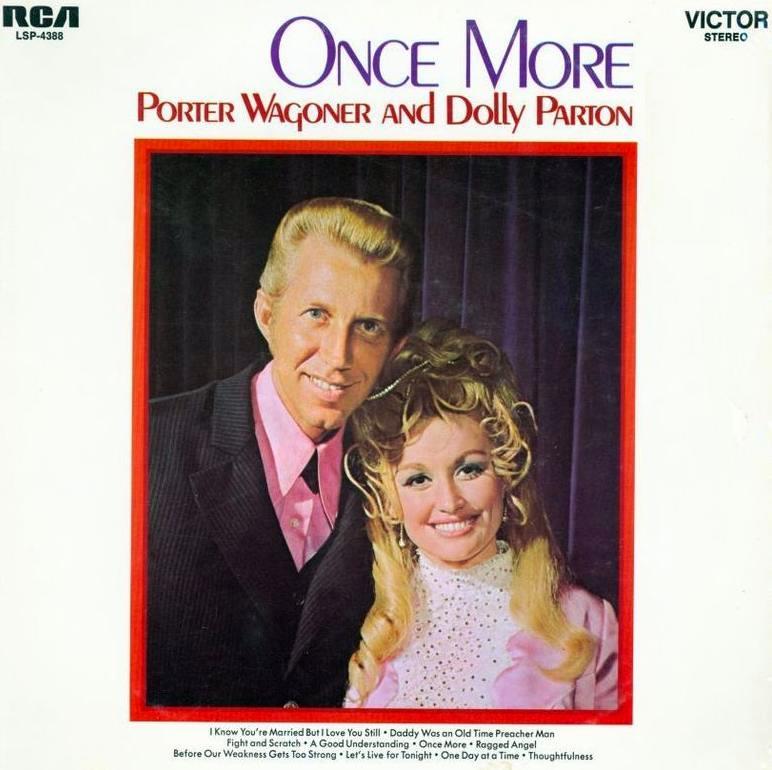 clothing that were at tremendous odds with her conservative family's viewpoint. (I do love the simple look she's sporting on the above left cover, though. What cute, short hair! Click to enlarge.) By her own admission, she'd as a young child seen a painted up floozie walking the streets one time, shocking the adult women she was with, and thought to herself that the trollop was just about the greatest thing she'd ever seen in her life! She would progressively adopt bigger, blonder hair and tighter, flashier clothes, the further she went in life.Wagoner and Parton began recording duets in addition to performing together on the show and found significant success. In time, the vastly different, but arresting and – most importantly – genuine, Parton was accepted by his audience and eventually
 grew to be quite popular in her own right. For six years, the two released albums of duets, many featuring some now-amusing cover portraiture, which were very popular in the country music field. They were never a couple in the romantic sense, but were closely associated with one another in listeners' minds. Wagoner, with an interest in her career that was also financial, tried early on to launch Parton as a solo act, but could never come up with anything that clicked.
 In 1970, she recorded “Mule Skinner Blues” on a lark and it was a hit. Thus, she was able to continue the Wagoner duets while pursuing her solo career. Hits like “Joshua” and “Coat of Many Colors” came in this time period, followed by her first real smash “Jolene,” in 1973. A dichotomy existed that continues to this day in that Parton looked like the most done-up, artificial, superficial lady imaginable and yet possessed the most down-to-earth, sincere, self-effacing personality imaginable, a rarity then and now. She might look like a colossal joke to those judging her only on her mode of hair and dress, but her songs and personality betrayed a heartfelt, thoughtful persona that was infectiously appealing.
 Soon, Parton stopped appearing on The Porter Wagoner Show (having stayed two years beyond her initial five-year deal), though they still sang duets up until 1975. The prior year, Parton penned and sang “I Will Always Love You” as a poignant memento of her departure from his program. They had enjoyed a popular and profitable collaboration, but it was clear that she was ready to spread her wings and fly (and look at the big hair on the solo album cover above left!) Unfortunately, Wagoner felt
  that he had created this songbird (who'd been hatching since she was a preteen!), had her tied up contractually and sued her for a share of her income!
Thus, things got ugly and ended badly, but Parton struck a deal with him rather than become mired down in the courts. She wrote songs and sang, performing in concert, often on the road, in order to raise the money to complete the settlement agreement with him and, in essence, be rid of him. Around this time, she made a fateful decision, too, that would impact her life tremendously later. Her song “I Will Always Love You” had caught the ear of The King, Elvis Presley,
 and he wanted to record a rendition of it. Thing was, it was his manager Colonel Tom Parker's policy to have any song Elvis recorded become half his from then on! Parton resisted, not an easy thing to do in these early years, because she wanted to own her own material flat out. Decades later, when Whitney Houston sang a reconditioned version of the song in The Bodyguard, also releasing it as a single, Parton made millions of dollars in the bargain.
In the wake of her burgeoning solo success,
 Parton made a couple of attempts to cross over to the pop charts. In 1976, she went under the management of Sandy Gallin, who's other clients at one time or another included Cher, Barbra Streisand, Michael Jackson, Neil Diamond and others. Her first attempt at crossing over was not successful (perhaps hampered by an album title with the word “harvest” in it?!) However, 1977's Here You Come Again was a rip-snorting hit and included “Two Doors Down” in addition to the title track.
 From here, there was no looking back, really. She had a popular TV variety show called Dolly!, which she had to give up after one season due to vocal strain. She was interviewed by Barbara Walters at a time when such a thing was an event, not an eventuality. She found herself in demand all over the place, be it TV specials with Cher or Carol Burnett, concert venues or special occasions such as a 1979 tribute to contemporary country music, which was attended by then-President Jimmy Carter.
The next mountain to climb was the film business. In 1980, a script was developed about three put-upon female office workers
 who have endured the tyranny of their domineering, sexist, uncaring boss for long enough. Through a series of mishaps and ironic circumstances, they wind up keeping him captive in his own home and proceed to take over the running of the office themselves.
The movie, 9 to 5, marked Parton's first foray into movie-acting. Teamed with Oscar-winning actress Jane Fonda and esteemed comedienne Lily Tomlin, Parton knew that she would have to be on her game in order to keep up with that company. One thing that helped was that her character, Doralee, was similar in background
 and look to the curvaceous singer. Another thing that helped her stay above water was that, in her eagerness to be prepared and her lack of knowledge about how movie-making worked, she had memorized the entire script from start to finish, including the lines of her costars!
Parton's character didn't sing in the film, but she was commissioned to write an opening credits theme song that captured the basic essence of the ladies and their life as office workers. While brainstorming over the song (and Parton claims to have written some sort of song – or at least explored an idea for one – almost
 every day of her life!), she realized that running her acrylic nails back and forth against each other generated a sound similar to that of a typewriter. This gave her the basis for what would become an enormous hit and the title number played over shots of women getting ready for work in the morning, effectively setting up the environment for the movie. The song was nominated for a Best Song Oscar (losing the the equally catchy title track from Fame) and Parton, in her debut role, was nominated for a Best Actress-Musical or Comedy Golden Globe (losing to Sissy Spacek for Coal Miner's Daughter.) A later TV series adaptation starred Parton's younger sister Rachel.
 Now considered a screen personality as well as a music industry chart-topper, she signed on for what seemed like a winner: The Best Little Whorehouse in Texas. The property had been a hit musical on Broadway from 1978 to 1982 and was now being turned into a film. Burt Reynolds was cast (how he got anywhere near a musical after 1978's At Long Last Love is anybody's guess! The original release only featured his singing in one duet, though a solo number – written by Parton – later popped up in the television version.) He and Parton (who was cast after original considerations Barbara Mandrell and Crystal Gayle were passed on) made an appealing pair on the poster (which also featured Parton's own appealing pair!)
The filming of Whorehouse was tumultuous and unpleasant. Reynolds had been suffering from physical ailments as well as the recent demise of his relationship with Sally Field and Parton was in agony and distress over some female problems she was having as well. When she innocently remarked to the press that she and Burt would get on well because they “both wear wigs and high heels” it caused friction between the two, though eventually they got on okay, mostly because they were both miserable and could commiserate with each other in the face of endless rewrites and a generally unhappy set.
 Parton rerecorded “I Will Always Love You” for the film, leading some people to think that she wrote the song at that time as a valentine to Reynolds, which is certainly wasn't.
A film with a title like that was a major-league hard sell in 1982, especially to parts of the country similar to where Parton was from, and the title was sometimes changed, obscured or bleeped in advertising. Nevertheless, it was considered a hit and Parton came out of the experience unscathed in the critics' and audiences' eyes. Thing was, the process of making the film, itself, led her to question her desire to pursue acting in movies.
 In 1983, she teamed up with Kenny Rogers to record the explosive hit “Islands in the Stream,” a number written by Barry Gibb and worked into a duet for the two country superstars. The song showed off their remarkable chemistry together and won them multiple awards. They would pair again two years later for a Christmas special (Once Upon a Christmas) and tie-in album as well as one more duet, “Real Love,” in 1985.
In 1984, Dolly entered the world of movies once more when she signed on for Rhinestone.
 The story was about a country singer locked into an unwanted performing contract who bets her boss (played by Ron Leibman) that she can turn anyone of his choosing into a real live country singer in two weeks in order to be freed (if she loses, she has to go to bed with him!) It all might have looked good on paper, but the result was something of a disaster.
To play the poor schlub, a New York taxi driver, who is earmarked for transformation, the producers hired that master of song, Sylvester Stallone. (Granted, the man isn't supposed to be a singer, but one likes to hope that there's a pot of gold at the end of the movie's rainbow
 and with mumbling, curled-lipped Stallone in the role, there's no chance!) Stallone allegedly turned down both Romancing the Stone and Beverly Hills Cop in order to take this part (and then rewrote it to suit him to the point where the screenwriter nearly took his name off the project, something he probably should have done!)
The movie underperformed at the box office, failing to make back all of its budget, and was nominated for eight Razzie Awards, “winning” two! Miraculously, considering the wave of disdain for the film, Parton escaped being nominated for her own acting performance, though two of her songs were.
 She and Stallone had gotten along well during filming. He even cited her as his favorite female costar to work with to date (though he'd really only worked with a handful of them by that time.) At least the soundtrack album yielded Parton two top ten country singles. In this way, she's been similar to Olivia Newton-John in that audiences might be fickle about what they wish to see her in, but even when they avoided certain movies, they still usually liked the music.
In what would be a recurrent theme in her life, she had new lands to conquer anyway.
 In 1986, Miss Parton purchased Silver Dollar City Tennessee, a theme park that had existed since 1961 under several names and incarnations near her birthplace in the Great Smokey Mountains. She re-christened the park Dollywood and set about making the place a larger, more appealing, more successful venture. Her goal with the attraction was to generate jobs in her part of the country and she achieved that in spades, adding more and more to the park with each passing year, such as rides and performance venues. Next spring, Dollywood will see its most expensive investment yet with the addition of Wild Eagle, a $20 million-dollar steel roller coaster.
 This physical return to her roots continued in her music. In 1987, she collaborated with Linda Ronstadt and Emmylou Harris on a project called Trio. The album put forth several harmonic hits for the ladies and won them a Grammy as Best Country Performance by a Duo or Group with Vocal. (They regrouped in 1999 for a follow-up album, Trio II. Parton would also team with Loretta Lynn and Tammy Wynette in 1993 with Honky-Tonk Angels.)
  Also in 1987, she made a second attempt at a TV variety show with Dolly, a highly-touted and expensive project that started strong, mostly due to curiosity and heavy promotion, but soon began a ratings decline that it never recovered from. It lasted only 23 episodes despite many format changes, much hard work from its star and a wealth of guests stars, some of which were pals of Parton and some of which were foisted on her by the network. She cried all the way to the bank thanks to a reported $44 million-dollar two-year contract.
  My own belief is that people didn't cotton to a newly svelte, scrawny actually, Parton at a time when such a thing wasn't as “in” as it is now. She had recently discovered an eating plan that worked for her: several tiny meals a day of whatever she wanted, but no big plates and no gorging. Her styling was also scaled down to include less flash and bric-a-brac and more solid colors and black.
 1989 brought what would become a memorable role for her, that of Truvy, the sassy, but caring, beauty salon owner in Steel Magnolias. A powerhouse cast was assembled for this film adaptation of Robert Harling's play. Sally Field, Shirley MacLaine, Olympis Dukakis, Darryl Hannah and a relative newcomer named Julia Roberts were the primary stars of the film. Unlike the stage play, men were also present here in the form of Tom Skerritt, Dylan McDermott and Sam Shepard (who played Dolly's down-on-his-luck husband.) One unusual aspect of this movie was the prolific use of publicity photos, even including the film's poster, that depicted the ladies as they looked in real life rather than the clothing and hairstyle-altered way they actually appeared in the film!
 The story primarily concerned Roberts' bout with diabetes and the hubbub of her impending wedding followed by the fallout of her deciding to have a child in spite of doctors' recommendations. The six featured ladies laugh, cry and chit-chat in snappy homespun dialogue that has since become, for whatever reason, the object of many a gay man's worship. (“Honey, time marches on and eventually you realize it is marchin' across your face,” “All gay men have track lightin'. And all gay men are named Mark, Rick, or Steve,” and “When it comes to pain and suffering, she's right up there with Elizabeth Taylor,” to quote a few. You've all heard them!)
Unfortunately for Parton, filming Magnolias was not a very pleasant experience. The director Herbert Ross, who had previously done The Turning Point, The Goodbye Girl and Footloose (as well as foisting Goodbye, Mr. Chips – the musical -
 and Funny Lady onto viewers) looked her right in the face near the start of filming and told her that she was “no actress.” She informed him that she was well aware of that, but that it was his job to make her look like one! He also made life hell for Roberts because he had wanted Meg Ryan for the role instead. Dolly and Julia turned to each other for support during the dicey shoot. (Roberts was vindicated when she won a Golden Globe as Best Supporting Actress and proceeded to earn the film's sole Oscar nomination, losing to Brenda Fricker in My Left Foot.)
Parton had, at times, dark blonde hair in Magnolias, about the darkest it had been seen in decades, which was, perhaps, part of a concerted effort to tone her character down, though there was no reason to even try.
 The character was written to be tacky in hair and dress. Actually, she took what easily could have become merely a string of one-liners and injected real heart into it. One of my own favorite moments of hers in the movie is not from the original play. It's when her downtrodden husband, who has hardly given her the time of day throughout the story, picks up a stick with hot wax on it and asks her what it is. She tearfully states, “It makes you pretty,” which adds a whole new dimension to Truvy: that she has painted, polished and poofed herself up for years in order to try to look attractive to her man and the whole matter has barely registered with him at all.
  Fortunately, in a happy, but contrived, final move, he surprises her with a second salon and they appear to have reached a more promising place.
At the premiere of Steel Magnolias, Parton showed up in what might be the all-time most eye-popping get-up when it comes to boobage. He famous chest was just downright obnoxious this night! Like everything else, however, she's always managed to laugh at herself and at them. Once, she said, “I don't know if I'm supporting them or if they're supporting me” and another time, “I was the first woman to burn my bra – it took the fire department four days to put it out!”
Parton continued what had become an unintentional
 trend of pairing herself with unlikely male costars when she made 1991's Straight Talk opposite James Woods. In it, she played a country-fried gal who stumbles into the job of a Chicago radio advice show hostess, advertised as Dr. Shirlee. Woods plays a reporter determined to look into her background and reveal her lack of credentials, but who becomes captivated by her himself in the meantime.
 Straight Talk was not much of a hit, coming and going from theaters rather swiftly, though, once again, her own contributions were mostly heralded. The endlessly creative, busy bee Parton found that working as the star in a movie was, to her, a most tiresome and unpleasant process with all the production hassles, waiting, interpersonal issues and so on. She got on well with Woods, but the tedium was ultimately too much for her and this would be her final feature film as the leading character. She would primarily do cameo roles or voice work from here on out with regards to the movies.
In 1993, her album Slow Dancing With the Moon featured a variety of guest artists, one of whom was
 Billy Ray Cyrus of prior “Achy Breaky Heart” fame. He provided vocals on her song “Romeo” and was featured in the video as well. Coming from similar backgrounds (his father was a Pentecostal preacher), they had been friends prior to this and Parton was even the godmother to his daughter Miley, born in 1992 (how's that for some trivia?!) In the years to follow, Parton made several appearances on young Miley Cyrus' Disney Channel series Hannah Montana as the character's
  “Aunt Dolly.” (And that is all I will probably ever write on this site about Miley Cyrus!) Incidentally, I did once see Billy Ray's infamous mullet in person. He was at a CD signing held in an outlying department store in southern Ohio in the mid-'90s and as I was shopping, I saw a swarm of tacky people forming a mob. Through the cracks of space in between their heads, I was able to spot the back of his head; the long, wavy locks cascading down towards his belt as the rabble yelped and waved their arms. This testament to trashiness went over splendidly in the region I happened to be living in at the time.
In 2006, Parton scored one more Oscar nomination for her song from Transamerica,
 “Travelin' Thru.” It lost to that American Songbook standard, “It's Hard Out Here for a Pimp” from Hustle & Flow... Over the years, Parton has done much to help support her alternative lifestyle fans, from co-producing the Oscar-winning documentary feature Common Threads: Stories from the Quilt to lending her talent to the aforementioned gender-switching film Transamerica to supporting various HIV/AIDS charities. (She has occasionally referred to herself as a female drag queen!) There has been speculation about her own sexuality, especially when confronted with her closest female friend, an ex-soldier named Judy who has, at times, lived with her and who by Parton's own admission has jogged naked with her through the woods at night (can you even imagine?!) Just as Parton rarely reveals very much about her marriage or her alleged straight dalliances over the years, she has never officially outed her friend, coyly working around that issue in her autobiography.
 I like this quote of hers: “All these fine Christian-type people that seem to think they know what God wants for all of us, that's certainly more of a sin then anything they would claim about us. To judge people is one of the greatest sins.” Yet, she also takes pains to stay out of politics directly, feeling that affiliation with a particular party interferes with her ability to speak her mind as she sees fit and to do things the same straightforward way she always has. She has been given not only a Kennedy Center Honor, but also The National Medal of Arts, our country's highest honor in that field, among many other accolades.
 What I admire most about her is her literacy program, Dolly Parton's Imagination Library, which instigates a desire in children to read. With this program, every registered child receives a free, age-appropriate book every month until he or she is five years of age, resulting in roughly a 60-book library by the time kindergarten comes. This began in Sevier County, but now extends to 36 U.S. states and even parts of Canada and England. More than 2.5 million books are distributed annually at no charge to the recipients. This has earned her a special place in the hearts of some teachers, librarians and parents as well as a place of honor in The Underworld.
 At age sixty-five as of this writing, Miss Parton never stops. She doesn't want to! She wrote a raft of songs for a stage musical version of 9 to 5, which ran on Broadway. There's always a new tune, a new look, a new challenge. Her goal is to keep at it until she just falls over, having never stopped doing what she loves. She's always been candid about the plastic surgery she has embraced (sometimes to a rather extreme degree. Once, she said, “If I have one more face-lift, I'll have a beard.”) and some of her looks over the years haven't been as successful as others (this one here scares me!), but she has perfected the ability to continually refresh and reinvent herself.
Once in an old TV interview (it was either with Barbara Walters or, most likely, a 60 Minutes profile)
 she outlined the way she had once set out with a plan to become a millionaire within five years. Of course, she achieved it. She's rarely been thwarted at achieving her goals. On yet another personal note, I remember my own father being awe struck by her determination in that interview and he decided to do the same thing. He, too, became a millionaire within five years. (Don't panic that I'm some rich kid toying with the Internet for kicks! I no longer see him and haven't for close to a decade and do not share in the wealth! You see, he lost – or never had – one other component that Parton possessed and that is a generosity of spirit. He was inspired by her money, but not by the joy, fun and humanity that she has always paired with it.)
So, here's to Dolly Parton, one of the most unique and most uniquely successful women ever to hit show business!


 The story goes that Mr. Wayne, who had one remaining


 Part of Wayne's plan for regional domination includes pairing up with wealthy, obese Khan Thomas Gomez. This meeting affords us the chance to enjoy one of those loony, 1950s palace dances


 Hayward had worked in two prior films with Wayne herself, Reap the Wild Wind in 1942 and The Fighting Seabees


