
 a scant 45 years (!) after the release of the blockbuster film. In true Poseidon fashion, I was annoyed that she kept bellowing that she had “the ENTIRE cast” there when, in fact, the young man who played Rolf the telegram delivery boy (Dan Truhite) is still alive and well and Eleanor Parker who was Baroness Elsa Schraeder is still with us (in God knows what condition, but…) Even if they couldn’t be there, a mention or a shout out might have been nice, especially to Miss Parker.
The occasion was a special one, though,
 because it marked the first time that Julie Andrews and all seven children were reunited with the actor who played Captain Von Trapp, Christopher Plummer. Plummer had a longstanding disdain for the musical film that he felt eclipsed all the other movies he’d done, not to mention a lifetime of staggering work on the legitimate stage. In recent years, however, he has come to appreciate its merits as so many people had all along. Now 80, he still manages to cut a dashing figure despite a lifetime of booze-swilling fun! More on his role in Music in a little bit. First, let’s start at the very beginning, a very good place to start…
Arthur Christopher Orme
 Plummer was born into a well-to-do family in Toronto, Ontario, Canada in 1929. His grandfather on his mother’s side was a Canadian Prime Minister! Unfortunately, soon after he was born, his parents divorced. He was raised by his mother at a family home outside Quebec and spoke English and French fluently. As a teen, he read John Barrymore’s biography Good Night, Sweet Prince and was enthralled. Arts were encouraged in his family and he developed an erudite taste for music and drama. Another inspiration came with Laurence Olivier’s 1944 film Henry V that helped ignite Plummer’s love of Shakespeare.
A stint with the Canadian Repertory Theatre
 gave him plenty of experience and he honed his vocal talent on Canadian radio dramas (one of his cohorts at this time was William Shatner, younger by a year and a half.) By the time Plummer was thirty, in 1959, he had played all the major leading Shakespeare roles on stage. By that time, too, he had already worked in six Broadway plays of varying success. The names of some of his costars at this time include some very impressive names: Mary Astor, Tyrone Power, Claude Rains, Julie Harris (shown here in The Lark), Raymond Massey, Boris Karloff and the legendary Katherine Cornell.
 From 1953 through the early 1960s, he worked in television anthology programs, enacting titles as diverse as Dark Victory (opposite Sylvia Sidney) and Cyrano de Bergerac (not as the title character – that was Jose Ferrer – but he would later do the role several times himself.) He also had the title role (dual roles, of course) in The Prisoner of Zenda, with a cast that included Farley Granger and Inger Stevens.
 In 1958, he began making motion pictures, a reluctant way of padding out his bank account in between theatrical pursuits and the TV gigs. Appropriately enough, his first film was called Stage Struck, a reworking of the play (which had been a 1933 movie starring Katharine Hepburn) Morning Glory. Already adopting the sort of debonair quality he would be known for later, he took on the role which had been played by Douglas Fairbanks Jr. in the original.
  Next was Wind Across the Everglades, more of a departure being an outdoorsy drama, all about bird poachers and the game warden (Plummer) who takes them on. Plummer sported free-flowing, longish hair in a 19th Century setting. The colorful film also had a rather colorful cast including Burl Ives, famed clown Emmett Kelly and Gypsy Rose Lee.
Several Hallmark Hall of Fame appearances, along with other television fare, continued until he found himself amongst the cast of one of Samuel Bronston’s mammoth epics. The Fall of the Roman Empire was a gargantuan
 epic that starred Sophia Loren, Stephen Boyd, Alec Guinness, James Mason, Omar Sharif and other distinguished actors. An ancestor of the later smash hit Gladiator, it concerned Boyd’s travails in the time of Marcus Aurelius and the devious, demented Commodus, portrayed by Plummer. (Richard Harris, the initial Commodus, departed the production over “artistic differences” and would later play Aurelius in Gladiator!)
This is the persona that would later net Joaquin Phoenix an Oscar nomination as Best Supporting Actor,
 but Plummer, who was certainly riveting in the part, was not so lucky. The film was a dismal failure, despite its opulence, and it virtually ended the career of its producer Bronston. Boyd (who inherited his role when Charlton Heston declined to work with Loren again) also felt that his career momentum was sorely damaged by the poorly received film, though it has since begun to reclaim some positive attention. The acting, along with the staggering pageantry and scenery are being far more appreciated in this widescreen, high-definition TV age.
Plummer’s next film role would be the one he would be remembered for always, no matter how many times over the years he wished he could forget it. The tuneful, but sickly sentimental, Broadway show The Sound of Music was being made into a film and, after weighing a variety of options that included Yul Brynner, Sean Connery and Richard Burton, the director granted the part
 of the stern, emotionally detached Captain Von Trapp, whose ice is melted by his novice nun governess, to Plummer.
Plummer, at about thirty-five years of age, was barely old enough to portray the father of seven children (one of whom is sixteen!), but was given a dot of grey at the temples to help the illusion. Recognizing that the show’s book offered next to nothing for an actor to play other than two dimensions, he was thrilled when screenwriter Ernest Lehman expanded the dialogue (at the cost of one song) in order to flesh out the role and infuse it with wit, sarcasm, angst, romance and irony, all things that Plummer enacted with extraordinary skill and grace, making him the idol of millions of female moviegoers.
Music is the first film I can recall seeing in a theater and I made my mother sit through it almost twice! As with so many things, the perceptions change over the course of a lifetime. As a kid, I thought the Captain was severe and unappealing. Now, I see him as using his demeanor as a form of defense against the pain of losing his first wife. Even with that, Plummer is so charming in his scenes with Eleanor Parker and, in time, Julie Andrews, and so steadfast in his sense of honor,
 that its easy to see why he won over so many people. And when he does finally melt, the scene is played exceptionally well. Plummer’s vast experience served him well when it came to presenting multiple dimensions to a one or two note character.
In 1995 (at the age of 27!), I got to play Captain Von Trapp in a rickety community theatre production and I can tell you that the difference between the movie and the play is significant. Once the Captain introduces the children to Maria, they never meet again until the confrontation over the play clothes. Then they have merely the Laendler in which to fall in love before the wedding! Plummer had the benefit of a beautifully enhanced screenplay in which to flesh out the part (including the argument after My Favorite Things, the dinner table scene and the singing of Edelweiss prior to the finale, something that is only referred to in the play.) The play has since been augmented substantially to be more in line with the structure of the movie!
By 1995, I practically worshipped Christopher Plummer and I’m sorry to say that, as a new actor with only two previous roles to my credit, I cribbed many things from him in my performance because, frankly, I didn’t feel that anything he did could be topped! His Captain was (and still is) to me, the epitome of elegance,
 class and honor and beyond all that he was handsome to hell and back. I even made myself a medal with the red and white Austrian stripes on it to wear to the ball because I think I wanted to be Christopher Plummer more than I wanted to be Captain Von Trapp! Fortunately, in the public’s perception, they were one and the same anyway by then.
(Incidentally, I have since played Uncle Max, too, and that is a role I could play with delight for the rest of my life. He has a raft of great lines in the play and two lively songs.)
Plummer was severely disappointed when the producers refused to allow him to use his own voice in the film, though he eventually had to concede that it would be best in this case to use another vocalist. (Bill Lee, the dubbed singer, had also provided Lt. Cable’s singing in South Pacific.) He would later get to sing on Broadway,
 however, in the musical Cyrano and won a Tony for Best Actor in a Musical in the process!
Neither Plummer nor Andrews were securely established film stars at the time of their casting, so Eleanor Parker, who’d been a leading lady for a couple of decades and was thrice nominated for the Best Actress Oscar, was cast as a bit of insurance, receiving prestige billing. Plummer enjoyed tremendous chemistry onscreen with both ladies, though his initial reaction to Andrews was the complaint that she was too nice, “like being hit on the head with a Valentines card.” In fact, he wrote the entire enterprise off as “The Sound of Mucus” for many, many years.
 His next project had him portraying a Hollywood studio executive who has to wrangle with a highly talented and successful, but also deeply troubled, star in Inside Daisy Clover. With Natalie Wood as the title figure, he engineers a marriage for her to fellow actor (and closeted homosexual) Robert Redford (!) and tries to wring all that he can out of her before she loses her grip.
He then starred in Triple Cross, a WWII era film loosely based on fact that had his amoral character weaving between the Allied and the Axis powers.
 Costars included Romy Schneider (which whom he allegedly created little, if any, chemistry), Trevor Howard and Yul Brynner. Directed by frequent James Bond helmsman Terrence Young, the cast also had Bond vets Gert Frobe and Claudine Auger in it and a mod theme song sung by Tony Allen.
1967 brought Night of the Generals, another star-filled, WWII film, in which he played Field Marshal Rommel. The starring players were Omar Sharif, Tom Courtenay, Donald Pleasance, Joanna Petit, Coral Browne and a truly waxen (you gotta see it to believe it!) Peter O’Toole. The story, originally a stage play with many male actors in it, concerned an investigation into the murder of a prostitute in Nazi occupied Poland.
 Oedipus the King, in 1968, was a filmed version of one of Plummer’s favorite roles/plays. He portrayed the famous title character who, through a series of events, winds up married to his own mother (played here by Lilli Palmer.) Castmates included Orson Welles and Donald Sutherland (whose voice was dubbed by another actor.) Plummer showed a little of his chest here, frequently swathed in a one-shouldered, white toga.
That same year, he teamed with Rod Taylor in The High Commissioner (and was again married to Lilli Palmer!) He played the title character who is under investigation by policeman Taylor for a long ago murder. T
 he slick, beautifully appointed film also starred the beautiful ladies Camilla Sparv and Daliah Lavi (shown here with Taylor and Plummer. This site has a tribute to her if you click her name in the right column.) The look and expression Christopher has in this lobby still is just the sort of debonair, austere quality that I love about him!
Plummer, in trying to escape what he considered to be the stigma of The Sound of Music, played several villains or questionable types and looked for unusual projects that bore no relation to the mega-success Music enjoyed. Lock Up Your Daughters! was a period piece about a man called Lord Foppington who was trying to shield his girls from a passel of sailors who’ve recently arrived. The rollicking and ribald film was indeed different from his perceived arena at the time, though the film is very obscure now.
Still partaking in epic, all-star war films, he was one of many, many stars in Battle of Britain all about the British
 Air Force’s attempts to protect the nation from Germany during WWII. Then there was Waterloo, the mammoth spectacle directed by Sergei Bondarchuk, where he played The Duke of Wellington opposite Rod Steiger’s (very indulgent) Napoleon Bonaparte. Plummer’s wife was played by Born Free’s Virginia McKenna and Orson Welles had another of his cameo roles in the staggeringly expensive film that failed miserably at the box office. I used to work for a man who had a featured role in this movie and (since he was an utter bastard to deal with) used to watch, over and over again, the scene in which he is shot to death from his horse.
In between these big films, Christopher Plummer filmed Royal Hunt of the Sun, an adaptation of a Broadway play in which he’d starred. The interesting thing is, in the play, he’d been given the lead role of Francisco Pizarro opposite David Carradine’s
 Incan god Alahualpa, a bird-like, barely-English speaking man who is eventually destroyed by the explorers of his country. For the movie, Plummer opted to play Alahualpa and Robert Shaw was cast as Pizarro. Plummer found the chirping, innocent, unusual character far more interesting to portray.
Fans of Plummer owe it to themselves to see him in this part, even if it isn’t their cup of tea. For one thing, he is half naked through most of it, wearing only a headdress, long wig and a gold-encrusted loin covering. Yes, his abs are enhanced with makeup, but he is still a fit and sexy-looking man (and this is four years after his role of Von Trapp.) The acting choices he makes are bizarre and not befitting the handsome way he looks, but it was yet another
 way to break away from the Music attachment (that film having been the most successful of all time to that date.)
Also in the cast, and shown here with Plummer, was young Leonard Whiting, famous for his role as the male half of Franco Zeffirelli’s Romeo and Juliet opposite Olivia Hussey. His screen career only had a few scant years left before petering out. In any case, Royal Hunt of the Sun had a title that sounded like it might be a stirring adventure, but the movie couldn’t escape its stage roots and a large portion of it took place in one stone room. It was a box office misfire.
Plummer, when he wasn’t on the stage, soon began starring in Canadian-made movies such as 1973’s The Pyx, a mystery that costarred Karen Black and had to do with Satan worshippers looking for a proper sacrificial victim. He also worked in a British remake of the classic thriller The Spiral Staircase. The interesting cast included Jacqueline Bisset, John Phillip Law, Mildred Dunnock, Gayle Hunnicut and Elaine Stritch(!)
 1975’s Return of the Pink Panther had him sporting dark blonde hair and cavorting with Catherine Spaak when not fielding the questions of Peter Sellers’ Inspector Clouseau regarding the theft of the title diamond. His role had initially been offered to David Niven and then to Douglas Fairbanks, again, the perception of him being a man of elegance and cool refinement.
Another mystery amongst
 the military set was Conduct Unbecoming, concerning British soldiers in India who are caught in a trial over the assault of the widow one of their fellow men. Michael York, Richard Attenborough, Trevor Howard, Stacy Keach and Susannah York rounded out the cast.
Plummer’s aristocratic and distinguished profile made him a go-to guy for period pieces, often as people of authority or high means. In The Day that Shook the World, he portrayed Austrian Archduke Ferdinand, the man whose assassination kicked off WWI. He followed this up with a role in John Huston’s The Man Who Would Be King, which starred Sean Connery and Michael Caine, as writer Rudyard Kipling.
While continuing to work in the occasional film, Plummer returned to TV in the mid-70s to work on two miniseries. The first one, Arthur Hailey’s The Moneychangers, was a sprawling,
 multi-character drama about the banking industry with Plummer as a bank officer tempted by hedonistic activities (including skinny dipping partygoers, one of which was Joan Collins.) He took home an Emmy Award for his performance. (He would later win a second Emmy for his voiceover work in Madeline.) The other miniseries offered him the part of Herod Antipas in Jesus of Nazareth.
 1978 found him working with Tatum O’Neal in the belated sequel to National Velvet, International Velvet. His role of O’Neal’s father takes a bit of a backseat once her taskmaster of a trainer (Anthony Hopkins) comes onto the scene. The role of Velvet, essayed more than thirty years prior by Elizabeth Taylor, was played here by Nanette Newman (whose husband was the director.)
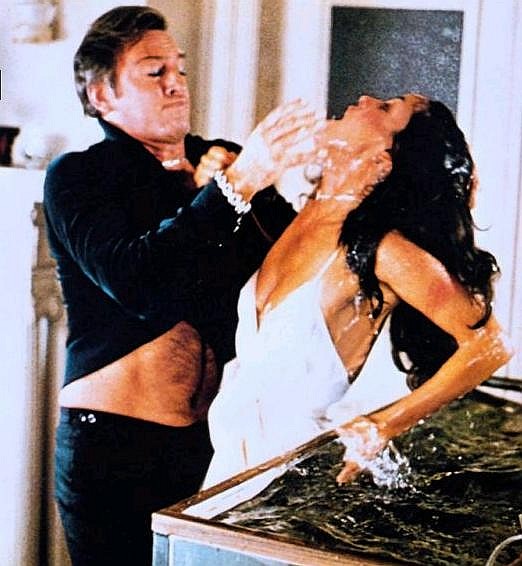 Some of his Canadian films in this period were The Assignment, The Disappearance and, notably, The Silent Partner. The last one had bank teller Elliott Gould becoming aware of a bank robbery scheme and deciding to pocket the money himself ahead of time, leaving only crumbs for the robber. The robber (Plummer) then goes all out to stalk Gould and reclaim the money he feels is owed him. (Note how hairy Chris's belly is here versus the shaved look he sported in Royal Hunt.)
 The twisty, very violent film also starred Susannah York and has become the favorite of a small cult of movie fans. Plummer is particularly nasty, cunning and clever and he plays cat and mouse with Gould. For one scene, Plummer’s real life wife at the time, Elaine, suggested he go into disguise as a female in a Chanel suit, which he does.
 Along the way there have been some seriously campy missteps, despite his incredible resume of acting work. Once such gem is the utterly insane, Italian-made The Adventures of Stella Star (later retitled Starcrash) with this jaw dropping cast: Caroline Munro, Marjoe Gortner, Robert Tessier and David Hasselhoff! He has a cameo as Emperor of The Universe.
 Though he could usually still command top-billing in the Canadian
 films, he was now more of an established supporting actor in most Hollywood movies. In 1979, he played the husband of Lesley-Anne Down in Hanover Street, a throwback wartime romance that starred Harrison Ford as Down’s lover. (Ford has claimed that he never saw this movie and will not watch it until at least fifty people have told him that they liked it!) He also played the controlling manager of actress Jane Seymour in the time travel romance Somewhere in Time, which starred Christopher Reeve.
 By 1981, he was 52 and turning gray, but could still pull off being the fiancée of much younger Sigourney Weaver in Eyewitness, a thriller that starred William Hurt. Leading roles had to come from the stage or from TV, such as when he did a remake of Dial M for Murder with Angie Dickinson (!) and Michael Parks or The Scarlet and the Black, in which he played a head of The Gestapo opposite Gregory Peck’s Italian friar.
  He played a priest himself, one of several such occasions during his career, in the highly successful miniseries The Thornbirds, as mentor to Richard Chamberlain. Even as late as 1984, he was still doing shirtless bedroom scenes such as in this shot from the 1984 TV movie Lily in Love, with Maggie Smith, in which his character masqueraded as another man.
As Mr. Plummer aged,
 the demand for his services as a character actor increased. He was reunited with his old Canadian pal William Shatner in Star Trek VI: The Undiscovered Country as a grizzled, but very erudite Klingon general, adding a sort of faux-Shakespearean air to the role. He was placed under heavy makeup and decked out in heavy costuming for the showy role.
 Top directors continually sought his services in their movies. He appeared in successful projects as diverse as Spike Lee’s Malcolm X starring Denzel Washington, Mike Nichol’s Wolf starring Jack Nicholson and Michelle Pfeiffer (he’s pictured here with James Spader) and Terry Gilliam’s Twelve Monkeys, which featured Bruce Willis and Brad Pitt.
 Taylor Hackford cast Plummer in the much-underrated Dolores Claiborne as the police detective who ages along with Kathy Bates as he tries to figure out who is responsible for the deaths of her husband (David Strathairn) and her employer (an extraordinary Judy Parfitt.) The one debit of the film is an annoying performance by the mumbling Jennifer Jason Leigh.
Michael Mann cast him in the featured role of Mike Wallace in the Al Pacino/Russell Crowe film The Insider. P
 lummer would later work with Crowe again in A Beautiful Mind, directed by Ron Howard. Oliver Stone used him as Aristotle in his extraordinary mess Alexander, which he has recut at least three times in attempts to make the public accept it, which most have yet to do. He also appeared in the film Syriana with George Clooney and the Pixar hit Up (and people play Six Degree of Kevin Bacon?! Chris has worked with almost everyone in the industry!)
In 2009, after more than ninety movies in a career spanning five decades, Christopher Plummer was given his VERY FIRST Oscar nomination (in the Supporting Actor category), for his work as heavily bearded Leo Tolstoy in The Last Station, costarring Helen Mirren. Unfortunately for him, it was the same year that Austrian actor
 Christoph Waltz took more than two-dozen awards (including all the major ones) for his role in Inglourious Basterds.
He has led an adventuresome life, admittedly filled with women and booze, at least up until his current (and presumably final) wife, semi-retired actress Elaine Taylor, married him in 1970, encouraging him to let up on his strong fondness for alcohol. Unlike many other tormented acting souls (including his costar Heath Ledger, with whom he was working on The Imaginarium of Doctor Parnassus at the time he died), Plummer never claimed to drink out of any reason such as to escape personal demons. He just loved to indulge out of the sheer joy of it. He greatly enjoyed late-nights in as many Austrian pubs as he could find during the location filming of The Sound of Music (when he wasn’t going to be called to work, that is. Plummer has never been anything less than a professional when it came to his craft.)

 His Barrymore-esque lifestyle did hasten the end of his first two marriages, one to Broadway star Tammy Grimes from 1956 to 1960 and to Patricia Lewis from 1962 to 1967. With Ms. Grimes, he fathered the decidedly outré actress Amanda Plummer, who has become famous in her own right, though they had precious little contact in her formative years. Fittingly, he is working on filming a version of the play
 Barrymore, in which he found an opportunity to pay tribute to his initial source of inspiration nearly sixty-five years ago! He won the 1997 Tony for Best Actor in a Play with this role. It would be neat if he could end his screen career with such a piece, though he’s still in such high demand by most of the leading directors of our day that he may not be permitted to retire even if he wished to! Here’s saluting a great and surprisingly versatile actor who has yet to be paid his full due by the Academy of Motion Picture Arts and Sciences.


 He was the original choice to play James Bond in Dr. No, but didn’t accept the role


 John Huston used Boyd for a very brief role in his doomed epic, The Bible: In the Beginning. The


 In Assignment K, he played a toy company owner who is actually a British spy. Enemies kidnap his beautiful girlfriend Camilla Sparv in order to make him reveal the identities of his fellow agents. He then appeared in Shalako, a very different type of western s


