Here we are again with the second
installment of a three-part series. The fifteen-hour, 1978 miniseries
Greatest Heroes of the Bible has been partially released to DVD
(broken up into hour long segments, four to a disc) and so here we
come to disc two.
It kicks off with “The Story of
Moses,” though this is actually part two of a two-hour segment
devoted to him. We already saw “The Ten Command-ments” on disc
one, which came after this (!) and now we get this section, which is
missing the first hour of build-up! Messy packaging and presentation.
Anyhoo, the stars include Julie Adams as Pharaoh's wife, Robert Alda
as his advisor, Lloyd Bochner as his chief henchman and Frank
Campanella (!) as Pharaoh. Could there be any less likely people to
be found in ancient Egypt??
Even more bizarre is Anne Francis,
chiefly because there is not one single (makeup-free!) frame of her in this
hour-long story. Moses' wife (the role she was assigned) is absent
entirely from this storyline of Moses coercing Pharaoh into freeing
the Hebrew slaves. Did she die? (All I know is that in
The Ten
Commandments, 1956, Yvonne de Carlo was still in the thick of things
at this point!) Then there is Frank Gorshin (The Riddler himself!) as
a Hebrew still loyal to Egypt and, once again, John Marley as Moses.
Just as in “The Ten Commandments,” it is highly jarring to hear
Marley's New York accent spout the faux-Biblical dialogue (and this
time it's matched by other NYCers like Campanella and Alda!)
Demonstrating significantly more
opulence than some of the other stories in the series, this is still
feebly papier-mâché when compared to the famous Cecil B. DeMille
epic. How could it not be? The very idea of lanky Campanella in what
was Yul Brynner's part is amusing enough before you add in the
nipple-revealing togas and gaudy headgear. Likewise, the normally
covered-up Bochner is handed outfits that are cut up practically to
his ball sack. At least Ms. Adams is glammed up and hilariously
bewigged, though her role is bereft of the heated romantic elements
and delicious campy dialogue than Anne Baxter got to spout. Al Ruscio
appears as Moses' brother Aaron, though he was inexplicably replaced
by Richard Mulligan in the very next chapter!
Other familiar faces (not worthy of
billing in the opening credits) include staggeringly busy character
actor Bernard Behrens as an outraged Hebrew slave and Ron Rifkin
(later a costar of Alias and Brothers & Sisters) as one of
Marley's fellow oppressed cohorts.
The now-familiar story of Marley
imploring Campanella to free his people or else feel the wrath of God
kicks off with a rendition of Marley temporarily turning his staff
into a serpent. Later, he comes to Campanella's outdoor arena and
changes the water there (and everywhere) into blood. Not entirely
convinced, Campanella saunters over and sticks his finger in it to
taste it.
Get a load of some of the outfits that
Campanella was forced into. The fifty-four year-old actor was caught
with his belly button peering out and was also slipped into what
looks like a large diaper... Don't miss, too, Ms. Adams' sizeable
wig! It must be a requirement for Pharoah's son to always be played
by a highly-annoying child actor. Just as it was in the old DeMille
epic, this kid is one you'll be hankering to spank hard.
The plagues continue, be it frogs
landing all over the palace floor or – as shown here – a massive
swarm of locusts who only bother Egyptians, not Hebrews. As they are
represented 100% by tiny animated dots on the screen, the cast is
forced to continuously swat away at absolutely nothing while these
teensy dots flit about, usually in the center of the picture and
nowhere near the actors who are flailing desperately! Irwin Allen
must have been drooling over this section as he was preparing his
anti-blockbuster
The Swarm (1978)!
The back and forth battle between
driven Marley and stubborn Campanella continues as the Egyptians are
then plagued by boils on their faces. Campanella makes promises, then
reneges on them. The biggest mistake he makes, of course, is deciding
that all firstborn Hebrews must be slaughtered, since that turns on
him and all firstborn Egyptians die instead, including his bratty
son.
The camp highlight of Campanella's
already crazed wardrobe comes when he darts into his son's room
wearing a white habit, a white shawl and a white loincloth, putting
us in the mind of something a Mother Abbess might wear in the back
yard of her convent if she were desperate to increase her vitamin D
intake!
So he finally relents and allows Marley
to take his people out of bondage, but still-spiteful Bochner talks
Campanella into going after them all and killing them on sight.
That's just what he sets out to do, pinning them against The Red Sea,
but God has other plans and sets up a walkway for the Hebrews (which
comes crashing back down on the Egyptians when they set forth upon
it.) This is the point at which the story continues into “The Ten
Commandments,” which we've already seen (and recapped) in the prior
post.
Next up is “Joshua and the Battle of
Jericho,” featuring Robert Culp as the title figure. Also on hand
in the male-heavy cast are William Daniels (later of
St. Elsewhere)
as a shifty city official, omnipresent supporting actor Royal Dano
and John Doucette, a veteran movie actor, often as a henchman, who
proceeded to appear on almost every conceivable TV western. The
latter two portray Culp's fellow Israelites.
Rounding out the credited cast are
Sydney Lassick (of One Flew over the Cuckoo's Nest,1975, and Carrie,
1976) as Jericho's decadently evil and flamboyant ruler and Cameron
Mitchell as his right-hand military man.
Culp and his sizeable group of
followers are camped not far from Jericho, a city full of sin and
corruption, which he is bent on wiping out. As a precaution, he has
sent all the children of his tribe to a special containment at the
rear of his base of operations. He also sends two young gentlemen
into the city as spies, telling them to pose as merchants, in order
to determine the settlement's strengths and weaknesses. (These
actors, Brad David and Rand Bridges, have significant parts, but
didn't warrant up-front billing.)
This was the last on-screen role for
Bridges, who'd previously landed bit parts in a few movies and on TV.
David's career was more substantial, though he was chiefly known for
effectively playing strung-out hippies and other troubled young men.
As tastes shifted, he found himself only in bit parts before stepping
out of the biz in the mid-1980s.
You could search the world and still
have difficulty coming up with two bigger hams than Lassic and
Mitchell in their scenes together. Lassick parades around in a series
of glittery muumuus, flaming out uncontrollably and surrounded by
nubile young things. Some token girls are around, but generally there
are scantily-clad men, some of them chained up for his (God only
knows) bidding! Mitchell, for reasons unknown, has some pasted-on
eyebrows that make him look for all the world like one of the
Klingons from the original
Star Trek!
Like many of the stories told in this
series, there is a battle filled to the brim with young men careening
around in skimpy togas, often riding up to reveal anything from tiny
gym shorts to black briefs. This snap depicts one of the “up the
skirt” moments that occur from time to time during the fight
choreography.
Another key role, un-billed in the
opening credits, is that of a Jericho prostitute who is in the street
when all the children from Culp's compound are captured and dragged
to a holding cell. Played by Sondra Currie, she helps one of the
little girls up who's been knocked to the ground and we see that
she's beginning to rethink the vicious behavior of her hometown.
Later, Currie is called upon to dance
at a human sacrifice and is unnerved to see that several of the
children she's just seen are on the menu! A truly creepy-looking
executioner comes out and hacks away at the little ones, including
the one (natch!) that Currie helped to pick up off the ground (and
who also happens to be the little sister of David and Bridges!)
At the time of this miniseries, Currie
had carved out a niche for herself as the star of several
sexploitation drive-in movies with titles like
Mama's Dirty Girls
(1974) and
Fugitive Lovers (1975), so it stands to reason that she
would be cast as a whore, but fans of
The Golden Girls should
instantly recognize her as the younger woman who married Blanche's
father Big Daddy the time that David Wayne played him! She has also
more recently found her way into the series of
The Hangover movies as
“Linda.” Currie had the same basic hairstyle back then and,
apparently, wears it that way still now!
Once Culp finds out that Lassick has
been killing off his tribe's children just for the fun of it (it's
actually to deliberately goad him into fighting instead of lingering
outside the city), he thanks his two spies for the work they've done
and then suits up for battle.
In a rather impressive (for this
program) display of scenery, the walled city of Jericho is shown up
against an impenetrable mountainside. Culp and his men march back and
forth in front of the city for several days, finally returning to
blow their fabled horns and hop in place until “the walls come
a'tumblin' down!” (Actually, they're helped by some fortuitous
blasts of lighting, courtesy of the Almighty.) Unintentional hilarity
ensues when the towers break apart and send soldiers scrambling
upside-down and sideways to the ground below.
Culp and his followers proceed to kill
everyone visible in the city with the exception of Currie and her
family, who had helped to shield David and Bridges when they were
being hunted down by Mitchell's soldiers. Mitchell himself is
dispatched by Culp while Lassick is felled by a falling statue (some
sort of appropriately fat animal like a bull or a pig!) during all
the disastrous goings on.
Our third presentation is a real hoot.
“The Story of Esther” gives us one Miss Victoria Principal (!) as
the famed queen of Hebrew descent who puts her life on the line with
her husband King Xerxes in order to spare her people from slaughter.
Noah Beery is her Jewish cousin Mordechai, Michael Ansara is the
King's duplicitous second-in-command and, as the King, we have Robert
Mandan of
Soap!
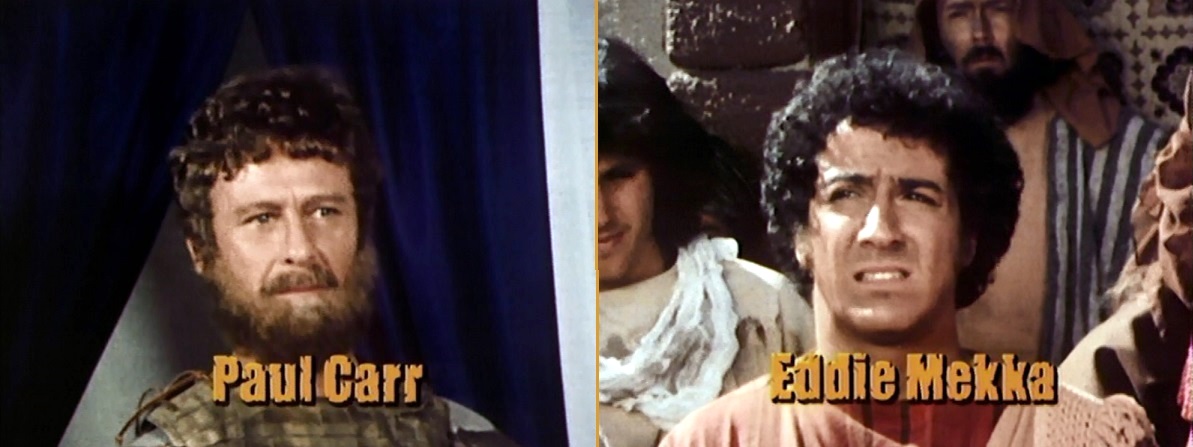
As Ansara's chief henchman, there is
ever-busy utilitarian actor Paul Carr and, in a special dollop of
camp hilarity, we are presented with Laverne & Shirley's
lantern-jawed Eddie Mekka as a rebellious Hebrew whose heroic
behavior kicks off a potential bloodbath.
Thanks to the royal aspects of the
story, this installment has a certain amount of grandeur to it with
regards to the sets. Though nothing about this miniseries can touch
the classic Hollywood designs of other countless epics, at least
someone out there in the desert was working hard to try to cough up
some sort of imposing structure.
As the story opens, there is heavy
unrest between Mandan and the Hebrews living in his kingdom. His
soldiers are constantly harassing them and destroying their property.
When Mekka resists and antagonizes some of the soldiers, he becomes a
hunted fugitive. An old man of the village goes to see the King on
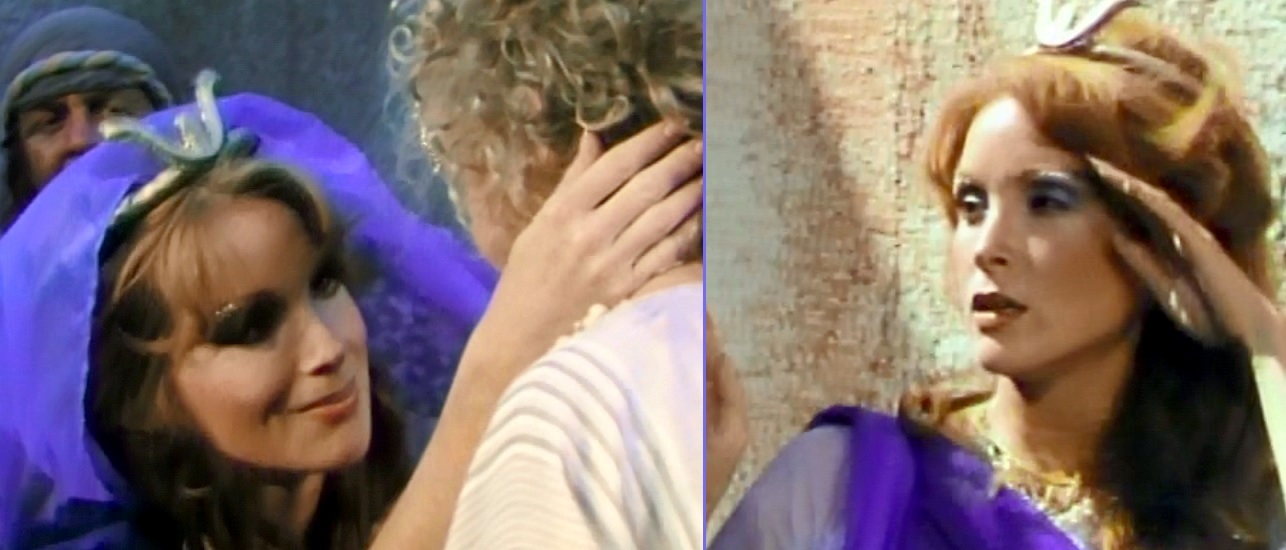
his behalf and, for his trouble, is hanged! Principal, decked out in
some outre makeup and costuming, wouldn't be out of place on
Space:
1999 in this sequence!
It is declared that all Hebrews of the
city will be slaughtered on a particular day. Principal, whose Jewish
heritage is unknown to her husband Mandan, sneaks out with one of her
trusted handmaidens, to warn her cousin Beery of the impending doom.
A young boy, Mekka's brother, poses as a trinket dealer and acts as a
go-between for Principal and her relatives. Principal has a hilarious
come-and-go accent that suggests a Dallas, Texas beauty queen
contestant reciting Shakespeare as her “talent.”
Mandan, often guilty of campy
overacting in other projects, doesn't disappoint here. Outfitted with
a leisure-time piece of headgear that looks like a gold lamé shower
cap surrounded by rows of cat ribs, he stews and grimaces and mugs
his way through the story. Meanwhile, the imposing Ansara doesn't
twirl his mustache, but looks like he may have twirled his curly
beard.
It fascinates me that Queen Esther is
played by soon-to-be prime-time soap queen Principal (
Dallas hit the
airwaves this same year), especially since her ratings rival Joan
Collins of
Dynasty also played the same role in 1960's
Esther and the
King, opposite Richard Egan. This “Pam Ewing in the Desert”
presentation allows Principal to display her usual type of look along
with some glamorous get-ups and make-up schemes.
But I digress... After the old man
mentioned earlier is killed by the King, his son emerges with revenge
on his mind. Previously a loyal member of Mandan's army, he now wants
blood because of the way his papa was cruelly offed. He meets
uneasily with Mekka to forge a murder plot. (Note the expansive
scenery which goes a long way to enhance this sequence.)
The son is played by Michael Anderson
Jr., who had once been a burgeoning film actor, but now, despite a
sizeable role, didn't even rate an opening credit!
The convoluted murder plot is thwarted
by Beery and Mekka, who decide to save the King and expose the fact
that Ansara is actually bent on killing him himself, but things
backfire and Beery is held captive, soon to be executed. A frantic
Principal turns to her faithful handmaiden for solace. The girl is
played by Bonnie Ebsen, the not-too-successful-actress daughter of
Buddy Ebsen!
Principal begs Mandan to rethink
executing Beery, claiming he actually saved the King's life, and
tricks Ansara into honoring the man by parading him around town in
the royal cloak atop one of his majesty's horses.
Next, Principal has to expose Ansara
for the scheming scoundrel he is, so she arranges for him to visit
her in her private chambers while Mandan is away. She fans the flames
of a seduction, counting on Ebsen to bring Mandan to the room at a
key moment, which she does. She also convinces Mandan to allow the
Hebrews to arm themselves against the preordained massacre that he
isn't able to halt. Thus, it winds up happily ever after (for most of
the people!)
The last segment on this disc,
“Abraham's Sacrifice,” stars Gene Barry (of
Bat Masterson and
Burke's Law) as the devout leader. Also on board are his sworn enemy
Andrew Duggan, his elderly, barren wife Beverly Garland (positively
buried in age makeup) and Ross Martin as a disloyal member of his
tribe.
Once more ticking off the camp Richter
scale is the presence of Lainie Kazan as one of Barry's servants who
has borne him the (illegitimate) son that Garland could not! Rounding
out the cast is singer-actor Ed Ames (of Daniel Boone), playing
Barry's right-hand man.
The story begins with sheep czar Barry
being threatened by a hostile neighbor Duggan, who wants Barry's
herd. Duggan's sneering son heads into the fray to take control of
the situation and in a bit of a scuffle lands directly onto Barry's
ginormous javelin!
With his prized son now dead, Duggan
swears revenge on a troubled Barry, who hadn't intended to kill the
young man.
Then we meet Kazan, Barry's slave
“girl” who resents the second-class treatment that her son
receives from his father (not being named heir to the estate because
of his illegitimacy, even though he was procreated at Barry's own
request!) Kazan is but one of countless New York actors in this
project whose jarring accent is completely at odds with the Biblical
setting. She plays her part as if she's some back alley call girl
from the streets of the Bronx.
She carps and complains like a fishwife
while Barry's “real” wife Garland peers out timidly from their
tent. Her uncle, Martin, can't wait to plot against Barry and,
through the son, take control of everything once the kid has been
pronounced legal heir.
Then three angels appear out of nowhere
and come into Barry's tent. They tell a shocked Barry (and an even
more stunned Garland) that he will soon have a legitimate son via his
elderly, long-barren wife Garland.
Sure enough, despite her doubts,
Garland soon reverts to the blossom of her youth (complete with
glamorous press-on nails and a Loretta Lynn wig) and becomes “with
child!” It isn't exactly clear if this was all miraculous or if
Barry helped sow the seed himself. Presumably, once she peel back the
years, he peeled back the covers on their marriage bed once more!
I'm not really the praying kind, but I
must say that I'd be happy to get down on my knees for the angel on
the far right! This trio states that they'll return upon the birth of
the son, but, sadly, we never see them again in the show.
Martin is aghast that a newborn son and
legitimate heir has been born, so he arranges for Kazan and her boy
to leave the land for a time, during which he'll dispose of the new
kid. Then, when he's sure that Garland can't pop out yet another
child, Kazan can return and claim the inheritance for her boy.
About a hot minute after Garland's boy
is born, she begins to, as the narrator Victor Jory says, “wither”
back into her craggy, wrinkled former self. Martin kidnaps the child
and takes him to Duggan to be done in, but winds up being executed
himself by the villain for his trouble.
Duggan lures Barry and his men to an
ambush, using the boy as bait, but before he can wipe all of them
out, The Almighty intervenes and uses lightning and an avalanche to
kill Duggan and all his men. But he's not done. As a test of Barry's
recently-faltering faith, he orders Barry to kill his own son in
sacrifice! Just as he's on the threshold of doing just that, God
relents and allows him to proceed with his life, free of any more
troubles.
Thus ends this second look at this
irresistibly loony miniseries. The third and final part will be
unfolding sometime soon!


 RUTH WARRICK: "Initially, there was great interest in Arch of Triumph (1948.) It was from an internationally popular Erich Maria Remarque novel...Well, the picture was a complete disaster, a victim of terrible miscasting. Ingrid Bergman was the first one cast-that should have warned people off the bat. Like everyone else then, I admired her as an actress but here she was supposed to be playing this frail, poor little Parisian drifter. This big, blonde, healthy Swedish girl! And in the most glamorous Edith Head gowns! In the opening scene, when she's on the bridge contemplating suicide, and Charles Boyer comes up to her-well, he comes up to about her nose! Then there was a scene in the script where they go to her apartment and was was supposed to carry her up the stairs. At least they realized this would have been totally ridiculous, so it was not filmed...Most of my scenes were with Boyer...Now in Hollywood during those years not that many actors were adept at using props to call attention to themselves. But Boyer was a theater man, too. I remember one scene we had together in the cafe. We rehearsed it; our director Lewis Milestone said, 'Fine, let's shoot it.' When the cameras began to roll, Boyer suddenly pulled out this huge silver cigarette case that had been nowhere in sight during rehearsal. He lit his cigarette, puffed and puffed and blew the smoke all around my face! I laughed! I just laughed! Then I said, 'Now I know what they were talking about.' That calmed him down...There was about a 45-minute episode involving me in the hospital where I was dying with cancer. Arch was shot in 1946 when cancer was like AIDS-no one discussed it. So they felt my whole hospital segment would be a good one to discard (from the then nearly four-hour cut of the film.)"
 VINCENT PRICE: "We knew during the filming that The Story of Mankind (1957) was heading downwards; the script was bad to begin with and it worsened with daily changes. I remember one puzzled visitor asking Ronnie Coleman, 'Is this picture based on a book?,' and he replied in that beautiful, soft diction of his, 'Yes. But they are using only the notes on the dust jacket.'"


 JEANNE CRAIN: "I may have been in it, but wild horses couldn't drag me to see a movie called Hot Rods to Hell (1967.) As it turned out, most people felt the same way."