
Anyway, back to the subject at hand. It might surprise my loyal readers that I would profile such a figure as Frank Gifford
 (even though I did do a little tribute not too long ago to the wonders of baseball player Jim Palmer.) Most folks nowadays probably think of Gifford, if they think of him at all, as the aged husband of Kathie Lee Gifford who got caught in the mid-'90s with a skeevy airline stewardess and who watched his image and hard-earned reputation swiftly swirl down the toilet. I'll touch on that later, but first I want to visit the early years of Mr. G. Prior to all the scandal he lived through, he was, in turn, a handsome, athletic youth, a gleaming example of football playing at its finest, a charismatic television personality and an expert sports commentator.
 Born Francis Newton Gifford in Santa Monica, California on August 16th, 1930, he was the middle child of an oil driller. As a result, the family moved around quite a bit in order to be near work. (A man from people with simple backgrounds, his parents names were Weldon and Lola Mae, his siblings Waine and Winona.) He took pleasure in playing ball as a kid and eventually proved to be exceedingly good at it during his years at Bakersfield High School. Already, his devastating looks were showing through, with a strong chin, seductive eyes and thick, pouty lips.
 Unable to secure a scholarship at the University of Southern California due to mediocre grades (and lacking the funds to attend otherwise), he instead went to Bakersfield Junior College where he made the Junior College All-American team. Still, he studied hard enough to improve his GPA and make it into USC after all. There he continued to excel at football and became an All-American. He stayed there until graduation in 1952. This picture at left, by the way, is from his early pro-career.
Also, while a student in California, he made occasional forays into movie-making, appearing in bit parts or as a football player in films like 1951's That's My Boy
 (A Dean Martin-Jerry Lewis comedy), 1952's Sally and St. Anne (a tender comedy involving Catholicism in which he played John McIntire's son) and The All American (released in 1953, with Tony Curtis.) He even appeared in 1952's Bonzo Goes to College, a sequel to the infamous Ronald Reagan hit Bedtime for Bonzo. That's Frank teaching Bonzo the proper stance to the right!
 He was in the first round of draft picks to the NFL in 1952 and was chosen by the New York Giants. Thus began a stellar career in the game that resulted in eight trips to the Pro Bowl and five appearances at the NFL Championship Game. (This was before The Super Bowl, which debuted in 1967.) He also married for the first time in 1952, at the age of twenty-two, to a Maxine Ewart and they would proceed to have three children together. In 1956, he was named Most Valuable Player of the NFL in a championship win against the Chicago Bears. His skill as a runner even taught esteemed, legendary Green Bay Packers coach Vince Lombardi a thing or two, causing him to rethink his approach to defense.
 That same year, he appeared on the game show What's My Line?, not as a celebrity guest in the blindfolded final segment,
  but just as a regular one, signing his name as F. Newton Gifford. Remarkably, the panel wasn't immediately able to identify a star player on a team that played in New York, where WML was filmed! In fact, he had come to the studio from playing a game that very day. His impressive build and drop dead looks had the audience howling already (and Dorothy Kilgallen even mused that he might be a football player before abandoning the idea), but it was Arlene Francis who really became enthralled. Perhaps a bit jaded by the not so sexy presences that were usually around her on the show, she leapt to attention when Gifford appeared and proceeded to purr about him during all of her time opposite him, making no bones at all about the fact that she found him deliciously handsome (her husband, Martin Gabel, be damned!) It's hysterical to watch her practically drool over him. This appearance gave viewers a chance to see the polite, demure, soft-spoken athlete out of his helmet.
 During his career with the Giants, the only professional football team for which he ever played, he perfected three different positions – defensive back, running back and wide receiver. This final position was obtained after he suffered a traumatic, potentially career-crushing tackle in 1960 that left him with a severe concussion and led to eighteen months off the field, during which he contemplated retirement at the age of thirty-one. Instead, he came back, learned the new position and was selected to play in the Pro Bowl once more. In 1964, he retired from playing. His number (#16) was subsequently retired as well, a mark of his impact on the team.
 In the off-season, Gifford had occasionally
 continued to make feature film appearances. He was one of many young men in the 1958 William Wellman WWII drama Darby's Rangers, starring James Garner, but his most prominent film performance came the following year in Up Periscope, a WWII submarine drama that also starred Garner. The color production depicted a plethora of tan, gorgeous men crammed into the guts of a sweltering submarine, necessitating them to remove their shirts frequently. There were several hunks on board, and Garner was certainly no slouch at this stage, but Gifford still wins points as the hunkiest
 of them all. In one sequence, he's injured in the leg and he's laid to rest, shirtless, on a cot with his pants cut open to the thigh. Someone wisely chose this moment for promotion on a lobby card, though it was so heavily doctored it almost looked like a painting! You can compare the art with the real thing here. Gifford also worked in the insurance business in the off-season, this being prior to the days of superstar salaries that sportsmen now command.
 Once his playing career was over, Gifford segued into announcing with relative ease. His voice was so soft and gentle and soothing,
  a perfect companion to that chiseled, yet somehow still fleshy face. As a sports announcer, Gifford met many of the top people available, not the least of which was baseball legend Mickey Mantle, who is shown with him here.
Gifford also continued to perform, though not with the drive of someone pursuing an acting career. He worked on a 1963 episode of the Shirley Booth sitcom Hazel as himself. The episode was called “Hazel and the Halfback.” He appeared on the show as expressing interest in investing in a bowling alley in Booth's neighborhood. (Here, below left, the two grapple with his balls.) It was just a piece of stunt-casting, perhaps
 during a sweeps period, something that TV shows did before and that they still do now to lure in more viewers. He was, however, approached in 1965 to be the latest movie Tarzan (can you even imagine?!?), but ultimately the role went to darkly good-looking and hirsute Mike Henry, another ex-football player.
The first time I, myself, can ever remember hearing his name was in the 1974 movie Earthquake when Charlton Heston and Ava Gardner were squabbling over Heston's deceased football career. Heston was about to take an autographed football to the son of young widow Genevieve Bujold and, demonstrating no illusions about his own lack of popularity, said, “It's the ball Frank Gifford signed. That's the signature he really wants.” Because I love Earthquake and that scene, the name stayed in my psyche.
 He also popped up on the popular game show Password and it is due to reruns of that colorful, classy and delightful show that I fell hard for Mr. Gifford. Search the world all you want. You will be hard-pressed to find a more gallant, well-mannered, thoughtful, classic-looking gentleman than this. (Hugh O'Brian was of a similar sort as well.) In spite of his slow-start towards education, he was articulate and knowledgeable, too. Every time the camera would cut to him, I was close to whatever the male equivalent of swooning is! (A blackout??) He's just simply the most humble, charming, dead-sexy thing imaginable. Apart from that, it's such a contrast
  to the type of football players we (mostly) see now. Gifford was from a time when ball spiking, celebratory ignorance, off-the-field arrests and so forth were practically unheard of. I'm a football fan, as a matter of fact, but I think we lost something when we began to idolize thugs, whiners and showboaters instead of players with a strong sense of sportsmanship.
In 1968, he and his then-wife Maxine appeared as themselves in the Alan Alda football-oriented film Paper Lion,
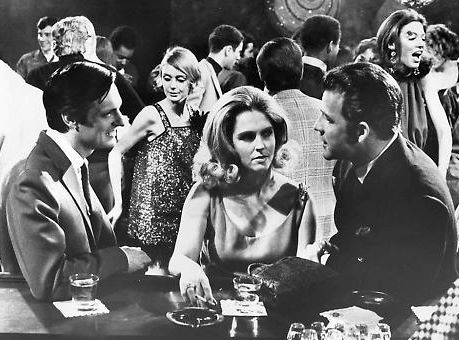 all about Alda, a reporter, spending time as a player with the Detroit Lions in order to do an in-depth story.
To continue with the Charlton Heston connection for just a second, Gifford also appeared briefly as himself (as a commentator) in 1976's Two Minute Warning, a disaster movie that takes place at something vaguely resembling The Super Bowl (the producers weren't able to get the rights to use that name...) There was also a guest shot as himself on The Six-Million Dollar Man that same year. The two-part episode was about a young paralyzed boy who is given bionic legs, with his personal hero Gifford on hand to cheer him on to his own career as a player following the operation.
 He also penned more than one book and was the subject of a few as well. As far back as 1956, a book had been written on him called Frank Gifford, His Golden Year. Then in 1960, his (premature) biography was released. (Then again, when people today like Miley Cyrus and Justin Beiber have biographies in the stores, I guess it isn't that unusual!) In 1977, he wrote Gifford on Courage, something he would have much need of as the decades passed! In 1995, he wrote his own autobiography called The Whole Ten Yards. In 1978, he married his second wife Astrid, who he was with until 1986. (I'm sorry, but I don't know when his first marriage ended.)
 Gifford's continuing expertise at play-by-play and interviewing eventually led (in 1971) to his being added to the line-up of Howard Cosell and Don Meredith on Monday Night Football, an immensely popular program that saw many of its glory days when these three men worked on it together. He began as a play-by-play announcer, though, not a host. It was after the departure of first Cosell and then Meredith that Gifford became a color commentator in 1986. He remained a commentator of the seasonal weekly broadcast until the blow-up of the mid-'90s which led to his being relegated to a less prominent hosting spot in 1998 before departing altogether.
 During these years, he also served as a reporter for Olympic games, golf, snow-skiing and even filled in occasionally as a guest host on Good Morning America. One stint on GMA would have a life-changing effect on him as it led him to meet a freshly-divorced singer and TV personality named Kathie Lee Johnson. Johnson (nee Epstein) was a former teen beauty pageant entrant (who had once worked for a summer as a babysitter/assistant to Anita Bryant!) who became a born-again Christian and rose to fame on Name That Tune as “The La-La Girl.” She was so-called because when it fell upon her to sing a song, she had to leave the name of it out so that contestants could “name that tune!” Thus, she might sing, “Big wheels keep on turnin'. La-la-la keep on burnin'.” (The answer, of course, being Proud Mary.)
Born Jewish, she was struck by the idea of Christianity at the age of twelve when she saw the 1965 film The Restless Ones,
 a film with Johnny Crawford and Kim Darby that was produced by and even starred Billy Graham. She then attended Oral Roberts University, married Christian songwriter Paul Johnson and appeared nightly on Name That Tune, sporting one of the most perfected Dorothy Hamill wedges ever seen. She then made the rather surprising decision to work on the inherently trashy (and thankfully short-lived) corn pone comedy Hee Haw Honeys in 1978. By the time she met Gifford, though, she had reinvented herself as a talk show personality and was on the cusp on entering her most famous phase, that of co-host of Live with Regis and Kathie Lee. Gifford's divorce from Astrid was finalized the same year (1986) that he and Kathie Lee wed.
The phenomenally successful morning chatfest Live with Regis and Kathie Lee introduced audiences to a whole new version of Mrs. Gifford. She was a lot of things, not limited to zesty, zany, opinionated,
 sentimental, vehement and brash, but she had a legion of fans in any case. Where she really started to lose ground in some circles was when she began to brag incessantly about her marriage and family. She and Gifford had two children, Cody (born in 1990) & Cassidy (born in 1993), and she babbled nonstop about the wonders of them all. It fed a backlash that started to get rather ugly. She became fodder for the tabloid press, papers like The National Enquirer, The Star and The Globe, who delighted in running unflattering pictures of her along with snarky stories.
The deck of cards Kathie Lee had built, in which she proclaimed the perfection of her home life (something Frank did as well in his 1995 book, a portion of which practically paid gooey worship to his wife according to many of those who read it), came crashing down in an unbelievable thud when, first, her clothing line reaped accusations of using underpaid, mistreated workers in Honduras. Then, The Globe broke a story about how sixty-six year old Frank and an airline stewardess had spent time in a motel room getting it on. They even had photographic and audio proof of the affair. A firestorm of scandal and controversy
 broke out, resulting in abject humiliation for Kathie Lee, who still had to go one the air nearly every day, and Frank, who wound up losing his position at Monday Night Football over it.
Thing was, it was later believed by many that the entire thing: the seductive blonde lady (trashy and leathery as she was), the conveniently procured evidence, the inside story, et al, was completely orchestrated by The Globe from start to finish. In other words, a trap set to ensnare Gifford for the sole purpose of tearing down his (what many thought to be) obnoxious wife. The stewardess (whose name I know, but I will not print because I do not wish to give her a sixteenth minute of fame, her fifteenth coming when she posed nude for Playboy after the story broke) was paid a mammoth sum in order to play her part. Kathie Lee cried a lot of tears, many in public. Frank was in the doghouse for a good long while, as well he should be.
Their marriage somehow survived the maelstrom, though it was very rough going. Frank's longstanding reputation as an honored, esteemed football player, announcer and spokesperson took quite a beating. Considering that he was, by now, getting on in years, he came out of the whole mess looking quite foolish, regardless of whether
 or not he was set up. I recently read that there are many men who seem to find any blonde, tan woman attractive, no matter what else may be wrong with them. I'm starting to think there may be something to that, especially when I see some of the hard trash out there who somehow seem to attract a lot of (sometimes affluent and powerful) men.
In any case, the Giffords reunited and proceeded to try to repair the damage to their careers and images. She left Live in 2000, replaced by Kelly Ripa, and began concentrating on her singing career. Later, she joined the morning show Today as a cohost. A celebrity ambassador for Childhelp, she has worked with that charity which targets child abuse prevention. She and Frank also raised money to create and sustain two New York City shelters for the support of HIV and crack babies (though she, or they, were unable to resist naming the establishments after their two children, Cody and Cassidy.)
 As of this writing, Frank Gifford is eighty years old. Somewhere along the way, he began to lose that wondrous wave of thick, brown hair and there are the effects of sun and cigarettes on that once awe-inspiring face.
  Then again, he is EIGHTY, mere days away from eighty-one, in fact! (By the way, do not miss the caption on this old promotional card on the right!) When I did my posting on Jim Palmer, I ended it with a string of photos of him in those sexy underwear ads. Today, I'm going to leave Frank with a bunch of the print ads he appeared in through his long career. He was a Jantzen swimsuit and sportswear model for about a decade and he looks mighty good in these clean, sharp, classic pieces of clothing (the more abbreviated the better!) I love not only the way he looks, but also the intimate, chummy way he is posed with his pals in some of the shots. As always, click to enlarge! There's also a later ad below that has a bunch of people grabbing for his nuts! See if you don't find Frankie baby just a little bit sexier than you might have expected before you waded through all this.


 Hollywood Squares was another outlet
 Match Game, especially in its earliest seasons when regulars Brett Somers, Charles Nelson Reilly and Richard Dawson were

 Regular readers of this blog

 As a kid, I used to daydream about my family being on Family Feud and would work out which five of us would be on it and in which order. Now that I’m older


 Tattletales was barely even a game, really. More a chance for three showbiz couples to answer questions about one another in order to win a little money for their respective sections of the studio audience. This show was unique in that it offered the public a chance to meet the spouses of the celebrities. Yes, there were quite a few celebrity couples, but often there were comedians or actors who brought their non-celeb


