The 1966 psychological thriller
Picture Mommy Dead begins and ends with fire. However, there was a conflagration of a sort before the movie had barely begun filming that today wafts around the movie and in a way changed the course of one movie star's filmography. In short, it ended it! Movie bit part actor turned TV writer Robert Sherman (later a key contributor to
Barnaby Jones, 1973-1980) wrote a screenplay concerning the fiery death of a glamorous socialite, the mystery being who caused her to perish that way. Low-budget horror movie director-producer Bert I. Gordon was preparing the film and, in line with recent trends, sought to populate it with some Hollywood royalty a bit past its "sell by" date.
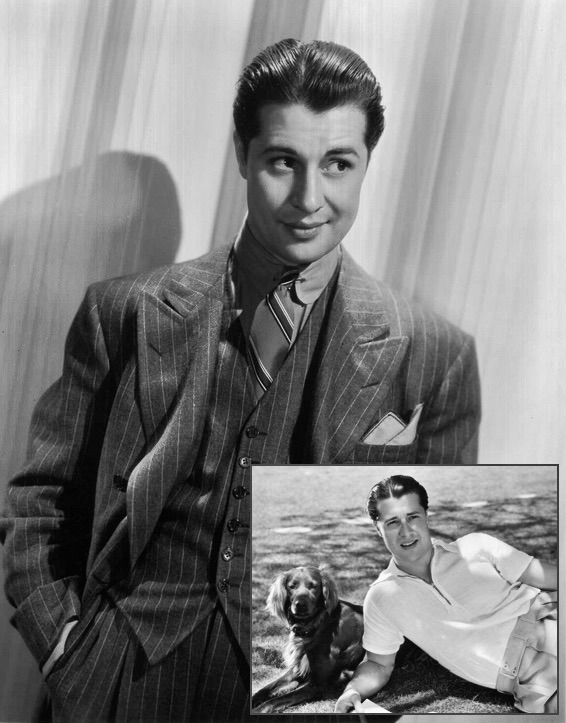
Don Ameche, after some coaxing (he had just relocated to the east and was reluctant to come right back to California for filming) was set to play the dead woman's widower. Gene Tierney (who'd starred with Ameche in
Heaven Can Wait, 1943) was announced to costar as his new wife, the former governess to his young daughter. Tierney wound up taking an early hike and, after Merle Oberon declined to appear in her place, the comparatively younger Martha Hyer was cast as the new step-mom. One time British matinee idol Maxwell Reed was hired to play a forbidding-looking relative and hanger-on.
Then a trio of other names were enlisted to provide brief cameos; Signe Hasso, Wendell Corey and Anna Lee. And as the murdered glamour puss, Hedy Lamarr, long touted as one of the screen's most all-time beautiful ladies, was cast. (One exception to Gordon's casting concept was for the role of the teenage girl of the story. The role went to his own eighteen year-old daughter Susan Gordon!)


Lamarr posed in a satin and fur-trimmed gown for an all-important portrait to be used in the film. Then something dreadful happened. She, under a significant deal of stress over the possible drafting of her son into the Vietnam War, left a department store with $86.00 worth of merchandise that she had not paid for. After her arrest, she protested that is was a misunderstanding and even produced movie residual checks in her purse in the thousands. The case eventually went to trial in a splashy barrage of flashbulbs and outre fashions. Her son testified that she had also been emotionally disturbed that her looks were no longer what they had been (!) on the day of the incident. The charges were finally dropped.
Unfortunately, by then, the star had also dropped from
Picture Mommy Dead. Press releases had earlier trumpeted Bert Gordon's declaration of support for her regardless of the arrest, but just before the trial began, she was found unable to effectively work on the film due to nervous exhaustion and was terminated.
Gordon had to act fast in order to salvage his project and so Zsa Zsa Gabor, for whom portraying a tantalizing, jewelry-covered socialite would prove no great stretch, was hastily brought in to take over the role. Her face was painted over Lamarr's on the already-completed portrait, with everyone hoping that no one would notice the rail-thin, demurely-endowed, taller body that now had Zsa Zsa's suddenly-narrower head on it! (No such luck, folks, your pal Poseidon - and many others - could discern this with ease!)
The cast finally set, filming could proceed and, thus, so will we.
Picture Mommy Dead opens at an imposing mansion (the real life Greystone, where many a TV and film project has been filmed) that has one of its rooms afire. A canopy bed is roaring with flames and at the foot of it, on the floor, is a woman's body.
Turns out this woman is Zsa Zsa Gabor, lying still on the floor while flames lap around her. Someone removes a glittering diamond necklace from her throat while a child's voice is heard singing a rhyme about worms crawling in one's stomach and out the mouth. Then we see the fire lap at her shoes and legs.
Cut to a mountain convent where Don Ameche has come to collect his teenage daughter Susan Gordon, who's been under the establish- ment's psychiatric and recuperative care for three years. Nun Signe Hasso bids them farewell and good luck, though warns Ameche of Gordon's nightmares surrounding the night her mother perished, a night she recalls precious little about.
We then meet the new Mrs. Ameche, Martha Hyer, who was formerly Gordon's governess and worked her parents. Gordon received Hyer in a chilly fashion, complete with a snarled look we will see more of as the movie progresses.
Hasso encourages Ameche and Hyer to have patience with Gordon and Ameche assures her that his still rather unstable daughter will receive the best of care.
The trio heads to the mansion, where none of them have resided since the fateful demise of Gabor, and head up to the gnarled iron gate of the front entrance. That gate is nothing compared to the gnarled features of family cousin and general hangabout Maxwell Reed. Reed suffered serious burns to his face on the night of the fire. (Was he trying to save Gabor or trying to ensure that she didn't survive?)
Next they parade through the cavernous estate (which is populated with a bevy of antiques that the director secured from the Hearst Castle) and enter a room that, at first glance, seems to contain the motionless corpse of a dead man! Turns out it's the next best thing, Wendell Corey, in a cameo as the family attorney.
Corey, affecting a hooty accent that is craggy, smoky and southern, informs Gordon of the convoluted dictates of her late mother's will. Something about how Gordon can live there if she wants, but the house has officially been willed to the state and she cannot touch her sizable inheritance until she is twenty-five. The furnishings and artwork, however, belong to her father Ameche.
Ameche informs Gordon that he has to sell the contents of the house in order to live. It seems he has already burned through his own $100,000 inheritance, mostly trying to keep Hyer in luxury. Ameche has, in fact, already set up the estate sale for the very next day. Corey spews out information and insults in equal mention. Meanwhile, Reed is still stewing about his own measly $500 bequest.
After getting reac- quainted with some of her old dolls and ugly toys, Gordon roams the halls of the mansion until she comes upon the portrait of her mother. She's enraptured with the painting, which has been set-up almost as a shrine.
Ameche is horrified by the fact that the picture has been put up this way. Reed explains that the next day is the anniversary of Gabor's death and so he thought it would be appropriate!
Next, Reed begins to whisper all sorts of horrible details into Gordon's ear about the fiery death her mother exper- ienced, insinuating that she had something to do with the killing.
Hyer is no saint, either, and soon begins to plot against Gordon. She informs Ameche that if he'll only have his daughter re-committed to a mental institution, everything will revert to him (i.e - them.) Hyer's makeup looks great throughout, but I especially love this shot of it, which affords us a nice view of her smoky, mascara-laden eyes.
Gordon is exper- iencing horrible nightmares and/or hallu- cinations and soon departs from her bed and heads back to the painting, which holds a fascination for her. She can't quit staring at the necklace in the portrait and reaches up to touch it, scraping her fingers across it until they bleed (?!) across Gabor's throat.
Horrified, she stumbles into Gabor's old room where she is confronted by her mother, with arms outstretch- ed. As she looks on, Gabor begins to become engulfed in flames, leading Gordon to collapse to the floor in terror.
The next day at the sale, Gordon comes upon a trio of Gabor's ritzy friends and hilariously insults them for having the gall to attend the liquidation of all her effects. (I LOVE the lady in yellow's hair just over Gordon's shoulder.) This whole sequence seemed so familiar to me and I realized that in the ill-advised
Dynasty: The Reunion (1991) a similar scene took place, with the Carrington belongings being off-loaded, right down to being shot in the very same mansion!!
This is when Anna Lee's cameo comes into play. She portrays another one of the late Gabor's friends, full of chattiness and cattiness, who points out that someone has "vandalized" Gabor's portrait with those red streaks across its throat.
Later that day, we find Reed working with a falcon out on the grounds. We half expect to see Jane Wyman come padding out to greet him, but in fact it is Hyer who meets him out there. Unsatisfied with how her schemes are being met by Ameche, she starts to work on Reed as a possible accomplice to her plans to get rid of Gordon.
Gordon comes upon Hyer rooting through a wicker storage bin that has a dress of her mother's in it. It's apparently the exact same dress that Gabor posed in and then died in! Gordon tells Hyer that this was the original dress which, because it was torn, was reproduced a second time in order to be worn again. (Because fabulously wealthy socialites are always eager to wear the same thing again and again... I guess this is before secondhand shops like The Way We Wore and A Star is Worn could make use of old gowns...)
She mentions something that sounds to Hyer an awful lot like Gabor's missing diamond necklace, which gets Hyer all lathered up. Hyer is still bent on getting rid of Gordon so that she and Ameche can inherit all that lovely money, but he isn't interested.
Stymied by Ameche's lack of scheming sportsman- ship, Hyer turns instead to ex-lover Reed. She heads to his room and begins to seduce him into helping her achieve her plans for independent wealth. Apparently unfazed by his disfigurement (or perhaps she turned off every light), they get down to business.
Gordon is continually drawn to her late mother's portrait and stands before it with her arms extended as she tries to recall what happened. Picture. Mommy. Dead. Get it?
She experiences yet another series of disturbing hallucinations, this time involving Reed's falcon (or is it a hawk.) Upon awakening, she thinks she sees Gabor entering her room. Or is it Hyer dressed as Gabor? Reality and fantasy are beginning to blend for the young girl.
Now we are treated to flashbacks of Gabor on the fateful night of her death. We also get to see a rare shot of Reed without half his face melted away. Gordon relives the whole evening from start to finish until we at last find out just what happened to her departed mommy.
The end credits of the film are my FAVORITE kind. Each star appears on-screen with his or her name depicted along with it! So that is how I will run through them here. Ameche, who'd been a popular movie star in the 1930s and '40s, was suffering a bit of a career lull. He'd been appearing in some television, but had been absent from movie screens for five years. (Hysterically, as a kid I used to hear my family talking about old stars and I could never figure out who in the hell Donna Meechee was!) I have always had a bit of trouble connecting the handsome star of
In Old Chicago (1937) and
The Story of Alexander Graham Bell (1939) with the one of
Cocoon (1985), his Oscar-winning comeback role (which had been preceded by the hit
Trading Places, 1983), but this movie helps bridge the visual gap a little. Once he reclaimed his spot in the movies, he remained busy up until his death at eighty-five of prostate cancer in 1993.
It wasn't my intention to feature movies with Hyer almost back-to-back (
The Best of Everything, 1959), but it just turned out that way. At this stage, Hyer was actively winning a variety of supporting and leading roles, albeit in films of variable quality. There were
The Sons of Katie Elder (1965),
The Chase (1966),
The Night of the Grizzly (1966) and
The Happening (1967) in this general time frame. Her frosty, plasticine demeanor actually worked pretty well in this rare villainous part.
Gordon had been quite a busy child actress from 1958 on. By this time (her last movie and almost her last on-screen role) she was eighteen and had not grown beyond 5 feet in height, one thing among several that limited her prospects as an adult actress. Her expressions may have been limited in variety, but she was a pretty good screamer in this at least. Sadly, she was felled by thyroid cancer at only age sixty-two in 2011. Her father is still alive today at age ninety-three! He later went on to produce and direct the camp riot
Empire of the Ants (1977), which starred Joan Collins.
Speaking of Collins, Reed was her first husband, one who she claimed not only raped her prior to their marriage, but who also tried to rent her to an Arab sheik on their honeymoon! A British movie actor from the mid-'40s through the mid-'50s, he eventually moved to the U.S. and starred in the TV series
Captain David Grief (1957-1960.) He reportedly requested the burn makeup for this movie in order to make him appear more sinister and diminish what he believed was his "good side." This was his final film. He died of cancer in 1974 at age fifty-five.
Corey was a not particularly handsome actor who nonetheless enjoyed a steady, successful career in films from 1947 through the late-1960s. Some of his better known films include
Harriet Craig (1950) with Joan Crawford,
The Furies (1950) with Barbara Stanwyck,
Rear Window (1954) for Alfred Hitchcock and
The Rainmaker (1956) alongside Burt Lancaster and Katharine Hepburn. Like Ameche, who also battled alcoholism, Corey had trouble with the bottle and died in 1968 of a liver ailment at only age fifty-four.
Hasso was a Swedish actress with a strong stage background. Her first Hollywood movie was actually Ameche's
Heaven Can Wait (1943), though she proceeded to better parts in
The Seventh Cross (1944) and, in particular,
A Double Life (1947), which is one of her best-remembered movies. Her acting career diminished a bit in the mid-'50s and the car accident death of her only child in 1957 caused her to care little about that. She began writing song lyrics as a rewarding alternative, though she did continue to act occasionally on TV and the occasional film. She lived until 2002 when pneumonia claimed her at age ninety-one.
Considering that she played one in
The Sound of Music (1965) right before this, it's surprising that British actress Lee wasn't the nun in this movie and Hasso the society friend! Lee began working in movies in 1932, eventually working with eminent director John Ford on several occasions, including
How Green Was My Valley (1941) and
Fort Apache (1948.) She ultimately became best-known for her long-standing work (1981-2003) on
General Hospital as Lila Quartermaine. She had a seventy year career, passing of pneumonia in 2004 at age ninety-one.

When it comes to this movie (and in general!) the real longevity comes in the form of Gabor. One of the earliest examples of someone "famous for being famous," the 9-times-married showbiz personality and actress is ninety-nine of this writing, though she has been in arduously awful health for some time. With a social life that seemed forever in either a whirl or a crisis, she has weathered tumultuous divorces, countless tragedies, lawsuits and an arrest for slapping a police officer across the face when he pulled her over for a traffic violation. The lady who once declared that eventually a gal had to choose between her face or her fanny when it came to body maintenance, had to suffer the loss of a leg in 2011 due to infection. One of her more amusing quotes was, "I am a marvelous housekeeper. Every time I leave a man, I keep his house," though her type of persona is now gone, with only pale imitators in her wake.


As for the departed Hedy Lamarr, she lived until age eighty-five, dying of natural causes in 2000. Because she didn't make this movie,
The Female Animal (1958) had to serve as her cinematic swansong. She vowed she would never act again and she didn't. Her autobiography "Ecstasy and me" (named for her most famous film Ecstasy, 1933), came out the same year as
Picture Mommy Dead and created a sensation, though she later claimed that most of it was ghostwritten and much of it untrue! When
Blazing Saddles was released in 1974, she sued over the (mis)use of her name, settling out of court.
In 1991, she'd been accused once more of shoplifting, this time pleading "no contest" and allowing the charges to be dropped after a year of breaking no laws had passed. This tainted to a small point one of her other achievements, which was her series of inventions. (Beauty had a brain, too.) After tinkering with traffic lights and carbonated beverage tablets, Lamarr collaborated on wartime technology later led to the development of Wi-Fi and Bluetooth technology.
You can see Ms. Lamarr
here in a rare appearance on
To Tell the Truth alongside her son Anthony (whose father was actor John Loder.) Even if you don't happen to care for her, the episode is very enjoyable to watch for the panelists and some vintage commercials! Though she later mangled her face with some really inadvisable cosmetic surgery, she looks and seems happy here and I hope she was.