Showing posts with label Ruth Gordon. Show all posts

Thursday, September 16, 2021

Reunited: Abe and Mary in "Action!"

In 1938, the Broadway stage saw the debut of what would become a Pulitzer Prize-winning play by Robert E. Sherwood, Abe Lincoln in Illinois. The three-act play focused on the famous President's life from childhood up to his final speech before heading off to the White House. A resounding success, it starred (somewhat controversially) Canadian actor Raymond Massey, seen here with on-stage wife Muriel Kirkland as Mary Todd.

Massey inhabited the part, not based on any extensive research into Abraham Lincoln, but rather using the script's characteristics in order to bring the man to life. Playwright Sherwood refused to sell the film rights to the play unless Massey was contracted to revisit the role on film. (Hilariously, Massey portrayed Lincoln a few times thereafter on stage, on film and on TV - even doing occasional personal appearances in costume - till George S. Kaufman remarked that he identified with the part so much that "Massey won't be satisfied until someone assassinates him!")

The real Mr. Lincoln.

Raymond Massey made up (with bump on his cheek) for Abe Lincoln in Illinois (1940), in which he was able to reprise his stage success. Though there is a certain resemblance, most notably in the tall, lanky frame, Massey had very dark eyes while Lincoln's were pale.

Though his Broadway costar Kirkland had appeared in a number of early-1930s movies, the role of Mary Todd did not go to her in the film. Instead, another actress made her "talkie" cinema debut in the part.

Essaying the role of future Mary Todd Lincoln was Miss Ruth Gordon! She'd done a few silent bits in 1915, but otherwise had not been seen on screen. The prolific stage actress had come to Massey's rescue in 1936 when he was in danger of losing the role of Ethan Frome opposite her because of his British-Canadian accent. She helped convince the powers that be to allow him time to shake it. In fact, her invitation to playwright Sherwood to see this play led him to think of Massey for his upcoming piece on Lincoln!

Ruth Gordon and Raymond Massey in the 1936 Broadway production of Ethan Frome. He was a towering 6'3" to her 5' even stature, but somehow they made it work.

The two became friends and thus enjoyed being reunited on Lincoln.

Gordon, who'd gotten her start as a lighthearted Lost Boy in Maude Adams' rendition of Peter Pan, was now portraying the driven, sometimes severe Mrs. Lincoln.

Costuming helped to put the illusion across, though the real deal was a bit more, shall we say, hearty...

Despite the play's success, the movie adaptation was a considerable box office fizzle. James Wong Howe's cinematography was Oscar-nominated (losing to Rebecca) and Massey was granted a Best Actor nomination, but James Stewart won that year for The Philadelphia Story. (Stewart had been beaten the prior year for his iconic work in Mr. Smith Goes to Washington.)

One reason for the movie's lackluster performance could be that the year before it was released, John Ford's Young Mr. Lincoln (with Henry Fonda in the lead) was a huge hit and so much of the material had already been covered at local movie houses.
Cut now to 1943. America is at war and Hollywood is turning out morale-boosting efforts one after another. Humphrey Bogart, fresh off the staggering popularity of Casablanca (1942) is headlining Action in the North Atlantic (1943), costarring Raymond Massey.

The two portray first mate (Bogart) and captain (Massey) of a merchant marine vessel transporting fuel.

In a dazzling opening sequence, a German U-boat torpedoes Massey's ship, creating a cataclysm of water and fire throughout.

Before long, it's clear that the only option is to abandon ship.

Surviving crew members begin lowering themselves in lifeboats.

Once they believe they are the last remaining men aboard, Bogart and Massey head to the last remaining boat, which is already being lowered. The actors had been discussing whose stunt double was the bravest and before it was all said and done...

...the two performers did their own leaps across to the lifelines, with fire licking the skies behind them!

The ship is sunk, but the Germans aren't done. They proceed to ram the lifeboat, too, causing the men to have to swim through fiery ocean water to a nearby raft. Here, they drift for eleven days! (These aren't necessarily "spoilers." All this takes place within the first half-hour of the film.)

After finally having been rescued after this harrowing ordeal, a gaunt Massey returns home for the first time in a while. There to greet him is his wife...

... li'l Miss Ruth Gordon!

The happy couple is elated to be once more in each others' arms. She is wearing fairly high heeled slingbacks and still struggles to reach her hubby's face.

Gordon is one of those people who seems never to have been young, but she does have an appealing, impish quality in her smile here. Both performers (born only months apart) were about 46 at this time.

I was struck by the peculiar was Gordon's hair was parted here (in what is really just an extended cameo despite her fifth billing.

Massey enjoys a hot, soapy bath...

...and then is tucked into bed by his adoring wife for a good long sleep.

The chemistry between these two performers is palpable and they share a couple of heartfelt kisses in the scene.

As a longtime lover of dogs in the movies, I was touched also by the scene of the family canine leaping over a fence, trotting up the stairs to get into Massey's room and finally taking his place under the bed to ensure that no further harm came to his master.

Massey is definitely not one of "my" actors, meaning I haven't ever felt particularly drawn to him nor intentionally followed his career. He seemed so often to be a sour, dour coot with the only variance from his frowning expression to be whatever makeup or costuming was applied. But he really was more than that in the final analysis. And his "type" was valuable in many movies.

This younger shot of him reveals a gentle handsomeness. Two of his children were performers in their own right, Daniel and Anna. One fascinating fact is that his real life divorce from their mother Adrianne Allen served as inspiration for the movie Adam's Rib (1949.) The Massey's ended up marrying his or her own divorce lawyers, who were themselves wed at to one another at the time! That last union continued up to his death of pneumonia in 1983 at age 86.

And who penned the script for Adam's Rib? None other than Ruth Gordon and her husband Garson Kanin! They were Oscar-nominated for their script, which tweaked the real life details of the situation to fit the pairing of Spencer Tracy and Katharine Hepburn. The statuette went to Sunset Boulevard that year. It was one of several such collaborations the couple worked on.

The highly unique (no, Linda Hunt, you ain't her!) Gordon wasn't seen in another movie after Atlantic for more than 20 years. When she came back, though, she came back strong. After her part in The Loved One (1965) was snipped from the release print, she played Natalie Wood's mother in Inside Daisy Clover (1965) and was nominated for an Oscar (losing to Shelley Winters in A Patch of Blue.)

Then in 1968, she won the little gold man for her remarkable role in Rosemary's Baby. Her memorable acceptance speech included the hooty remark from the then-72 year old, "I can't tell ya how encouragin' a thing like this is." But it was. She proceeded to other memorable work including Harold and Maude (1971) and Every Which Way But Loose (1978.) Adored by her costars, she became close to Natalie Wood (seen at the 1966 Golden Globes in the lower right) and was Natasha Gregson Wagner's godmother. Gordon passed away of a stroke in 1985 at age 88, two days before Massey's birthday. All the connections I've mentioned between Raymond Massey and Ruth Gordon could be enough to end this post here, but there's still one more moment left!

In 1971, Gordon was the subject of the famous show This is Your Life, in which a celebrity is unexpectedly confronted with a career retrospective and a series of important guests. Massey, then 75 as was Gordon, was on hand to show his affection for his dear friend. Grinning from ear to ear the entire time, it was clear how much he utterly adored his diminutive pal. If you wish to view this program (which I recommend! I always love it), click here. Till next time!

Tuesday, August 9, 2011

Let's Hop on the "Bus!"

Even though I don't go on about them to quite the extent I did when I first presented Poseidon's Underworld, I am still a total freak over 1970s disaster movies. Like a vampire in need of blood, sometimes I just HAVE to put one in the DVD player and absorb it in order to continue with life! Nearly all of them have been profiled here, but today I'm going to cast a glance at a somewhat lesser known spoof that was released in 1976. It was greatly eclipsed by (the hysterical) Airplane! in 1980 and, because it was not a success upon release, it slid into obscurity, developing a small, but loyal, following on pay cable. I got the chance recently to see it in widescreen high-definition and, though it still doesn't knock my socks off, there were attributes to it (the all-star cast, the subject matter, the style of the poster) that qualify it for some attention here!

The movie is called The Big Bus. On the heels of successes such as Airport and Airport 1975, The Poseidon Adventure, Earthquake and The Towering Inferno, it drew inspiration for its wacky storyline from the formula used in those pictures. Inherently ridiculous, it tells the story of a company called Coyote Bus Lines who have developed a (beyond!) state-of-the-art luxury cruiser named Cyclops (so called because of its one gigantic headlight) that is nuclear powered and provides nonstop service from New York to Denver (!)

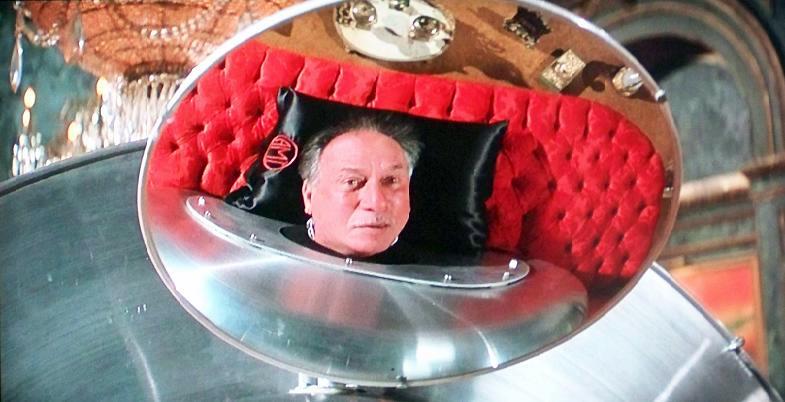
Chief scientist Harold Gould has developed the revolutionary vehicle with the help of his daughter Stockard Channing, though they are under constant threat of sabotage from a disabled oil tycoon (Jose Ferrer) who barks order to his sheik brother (Stuart Margolin) from his iron lung! Margolin is almost like Wile E. Coyote, trying everything he can think of to mess up the inaugural journey of the big bus, while also trying to make it look like it's faulty design, thus the need for crude oil won't be affected by the use of nuclear power. Ferrer's magnificently appointed mansion features paintings on the wall in gold leaf frames of such lovely subjects as fiery conflagrations, train wrecks and the like! (Incidentally, when TCM recently had their month of films concerning the stereotypical Arab image, they'd have done much better to run this film than to try to search for obscure bits of implied racism in other movies.)

Before the vehicle has even left the hanger, there is an explosion that leaves Gould incapacitated on the ground of a parking lot. His doctor (Larry Hagman) exclaims that he “can't be moved,” so there he stays through heat, rain and whatever else! Keen eyes will spot another play on this gag later in the movie.

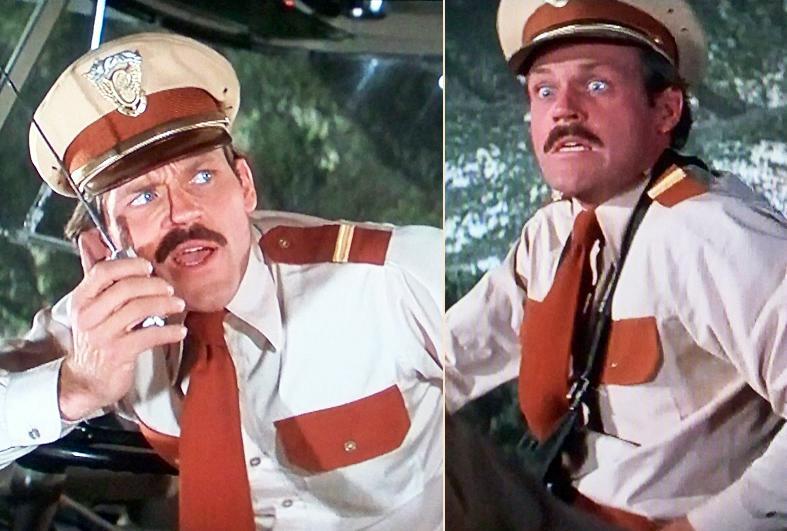
With the driver and his assistant both out of the picture thanks to sabotage, it is up to Channing to find replacements (from the short list of qualified bus drivers) quickly. She reluctantly recruits her old lover Joseph Bologna, a once-great driver who fell into disfavor when he crashed a busload of passengers into a remote mountain area and was one of only two survivors. (He was accused of eating them to stay alive, gaining about fifty pounds in the time between the crash and rescue, but claimed that it was his co-driver who did so, with himself eating only the seats, floor mats and luggage – and one foot that happened to be in some stew, unbeknownst to him!)

Bologna is shown in a seedy bar that's frequented by lots of drivers and, of course, he is an outcast. A fight breaks out (with one weapon forged out of a broken paper milk carton!) and he is aided by a fellow driver, handsome John Beck. Beck has his own share of issues, however. Not only is he nicknamed “Shoulders” because he tends to drive onto the shoulder of the road, but he also has narcolepsy! He falls asleep at the wheel sometimes without notice... just what you would look for in a driver!
Nevertheless, both Bologna and Beck are hired on to pilot Cyclops. At the opening ceremony, complete with brass band, Channing and the crew emerge and she's obliged to bring out with her a live coyote, the bus line's mascot!

In true disaster movie fashion, the parade of passengers is then shown boarding and we are introduced to them all. The stereotypical bickering couple, in love one moment and seething with rage the next (sometimes blending the two emotions!) is played by Richard Mulligan and Sally Kellerman. A priest who has lost his faith in the church (shades of the recent hit The Exorcist) is portrayed by Rene Auberjonois.
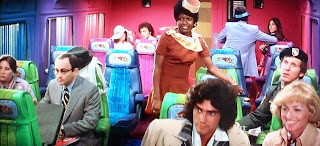
Bob Dishy plays a veterinarian whose career is in the toilet. Richard Schull is a meek man with only months left to live. There's a flamboyant, nymphomaniacal fashion designer played by Lynn Redgrave. In Helen Hayes-ish inspired stowaway style, Ruth Gordon pops up, dotting various dialogue exchanges with her “shocking” remarks. There's also a smarmy piano player (Murphy Dunne) who provides running commentary as he tickles the ivories and a blonde, curvy attendant (or whatever a bus line's equivalent to a stewardess would be) named Mary Jane Beth Sue (played by Mary Wilcox.) The announcements at departure include the demonstration of an insulated suit that drops from the ceiling in the case of a nuclear power leak!
Rounding out the cast are two technicians, Ned Beatty and Howard Hesseman, who squabble with each other over the best way to remedy the endless situations taking place on the bus. Their spats and reunions begin to take on a nearly marriage-like quality. Vic Tayback (Mel from TV's Alice) has a bit part as a belligerent bus driver and the ubiquitous Vito Scotti shows up briefly and Ferrer's barber (shown above earlier, with Ferrer.)
Just as Paul Newman, part of the truly mammoth assemblage of stars in The Towering Inferno, said, “We all know who the star of this picture is. That damned fire!,” in this movie the true star is the bus itself. While it is sheer lunacy to develop a nuclear-powered bus that still has to ride the expressways of America where it might be stuck behind some granny driving in the fast lane or get caught in a wolf pack of rush hour commuters, the vessel itself is quite a sight to behold. More than two stories high (watch out for those underpasses!), it uses an airline staircase to board some of the passengers and is the length of two large buses fused together! It's debut on-screen is impressive indeed (Trailways bus line helped to make the vehicle, a true drivable machine.) It's eased out of the hangar like an aircraft by a small tow tractor. (Somehow, between being pulled out of its housing and the time it is viewed full on, it has gained an extra top level solarium section!) If the film fails at anything else, it succeeds in the creation of the title vessel.
One of the other chief assets of the movie is the deliberately (?) tacky 1970s design and décor. Hot colors at this time included the bold rusty orange and golden yellow that accent the bus itself, but the inside of the bus is where things really get interesting. The passenger areas have incredibly garish rainbow colors on the walls and seats, there's a hysterically bad private dining room done in bicentennial furnishings and wallpaper from hell (complete with a waiter dressed as George Washington) and there's an Oriental-themed piano bar in the front with as much bric-a-brac as could be built in. Then, there's also a glass-enclosed swimming pool on the top of the bus, a mini-bowling alley and a private bathroom, complete with tub, all done in black and gold. Naturally, because this is, after all, a bus which must fit into a single highway lane, everything it amusingly scaled-down and cramped!
The vehicle has a variety of wild features such as a tire changer that can replace a flat while the bus is still moving! Likewise, a gigantic roller brush and foaming soap can be called upon to give the exterior a wash while it is en route to its destination.

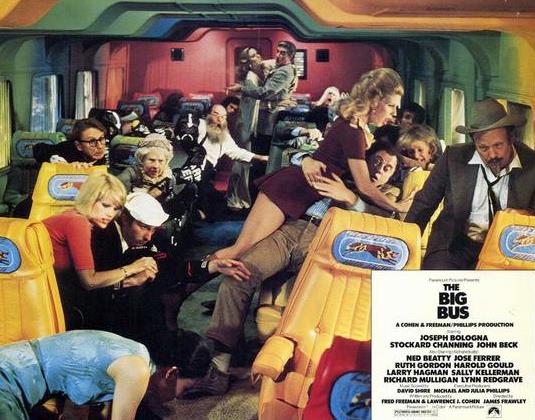
The passengers carry on with their various personal inter-reactions while Margolin plans to bomb the bus, causing Bologna and Beck to jump into action. That crisis is eventually averted, but pales next to the biggest emergency when an old pick-up truck with a hillbilly family becomes lodged in the front of the bus and the bus teeters over the side of a cavernous canyon. Then Channing soon has a major league problem of her own in the kitchen when, as part of a rescue strategy, the soda fountain starts spewing soft drinks, several flavors at once, into the small galley, nearly drowning her! Somehow, in these days long before CGI, the makers truly did teeter the gargantuan bus, with actual people in the front of it, on the edge of a precipice, amidst a vast landscape of rocky terrain, trees and valleys. It's a rare case when a film's poster depicts something that really does occur in the movie! Again, I must stress that in pan and scan, this couldn't possibly play as well as it does in high-def widescreen. While I'm sure the drop-off isn't actually as severe as it looks, this entire segment of the movie looks surprisingly dangerous.

Thanks to the injection of cold mountain air into the passenger cabins, Redgrave has to dole out her chiffon and feather-laden fashions – her new spring line - so that people can stay warm (even though these are not materials known for their thermal qualities!) Thus, Auberjonois winds up in green satin and Mulligan has on a wedding dress complete with veil and Redgrave fusses around to make sure everyone's done up just right!

Since it's all in fun, I don't have to tell you that the situation is resolved. However, the movie ends with a bit of a cliffhanger (more than a bit, actually), so we never do learn for certain if Cyclops makes it to Denver unscathed...

There are elements of the then-popular disaster movies being spoofed, of course, throughout The Big Bus, but what's most interesting to me is how this 1976 film somehow foreshadows the later Airport '77 in its overall scheme. There's even a sequence with passengers looking out the windows as the driver/captain, outside of the vessel, attempts a rescue. More than that, however, is how incredibly similar the plotline of this film is to 1980's Airplane!, a film released by the same studio (Paramount), but by completely different hands (Jim Abrams and The Zucker Brothers.) Airplane! features a once-capable pilot, now down on his luck after a controversial incident, who finds himself flying a plane alongside his former girlfriend, a woman who has lost her faith in him. The pilot, in flashback, is also present at a crazy bar fight. Also, the girlfriend, who is helping to guide the plane is sexually accosted by the inflatable autopilot. Here, Channing is done similar damage by an asleep at the wheel Beck, whose arms are still about her as she drives! The similarities are quite intriguing, even considering the narrow subject matter from which these spoofs could draw their plot lines.

Even the promotional photos seemed to be handled by someone in the know. Look how this cast shot mirrors one from 1960's The Crowded Sky, a flick about a navy jet ramming a passenger liner, right down to the placement of the crew and passengers! While the highly successful Airplane! seemed to clamp the lid on the genre for more than a decade, The Big Bus came out right in the middle of the disaster craze's heyday. Perhaps people were still getting enough legitimate enjoyment out of the various big-screen cinematic catastrophes that they weren't yet ready to see them made fun of. Upon release, The Big Bus barely made a dent at the box office. It wasn't until several years later on cable that it really began to amass the fans it now has. It goes without saying (even though I keep saying it!) that, if you're going to see it, see it in widescreen since the bus is so long!

Bologna, not the very first name who comes to mind for this sort of thing, had previously scored a hit as a playwright (along with his wife Renee Taylor) with the 1968 Broadway show Lovers and Other Strangers. That was adapted into a film in 1971 and was a big hit. He and Taylor followed it up with Made for Each Other, this time writing and starring in the movie. He later won acclaim for his role in My Favorite Year opposite Peter O'Toole and was featured in Stanley Donen's final feature, the lascivious Blame it on Rio with Michael Caine. He still acts today, though he is in his late seventies, and has been married to The Nanny's Taylor since 1965. (By the way, check out the amusingly tacky – and oh-so-'70s – carpeted spiral staircase behind him in the cockpit/driver's area!)

Channing is certainly a familiar face to most people thanks to her iconic role as Rizzo in Grease and many other projects. This was two years before Grease and she appears fleshier and more mature than she would in the hit musical. In fact, for whatever reason, she's decked out throughout The Big Bus in clothes that evoke a 1970s Elizabeth Taylor, with hair to match! A Broadway actress from 1971, she had garnered attention for the 1973 black comedy TV-movie The Girl Most Likely to..., directed by Joan Rivers, and costarred with Warren Beatty and Jack Nicholson in 1975's The Fortune. She continues to act in film and on stage today and enjoyed a fairly high profile stint on The West Wing for several years.

A stage actor from the age of sixteen (six if you count his earliest school performances), Auberjonois, a highly distinctive looking actor, seemed to be everywhere in the 1970s, be it in movies like The Hindenburg, King Kong and The Eyes of Laura Mars or onstage opposite Katharine Hepburn in Coco (for which he won a Tony Award.) He later appeared as a regular on Benson and assured himself a place in the sci-fi cult community when he took on the role of Odo in Deep Space Nine, a gig that lasted from 1993 to 1999. After that, he worked on Boston Legal from 2004 to 2008. He continues to stay busy on TV, sometimes using only his voice.

Beck won his film professional screen credit when he guest-starred on an episode of I Dream of Jeannie in 1965. Many film and TV roles followed, notably Woody Allen's Sleeper in 1973 and the harsh, futuristic Rollerball, with James Caan in 1975, thus by the time of The Big Bus, he'd covered both the spoofy comedy and the sci-fi action genres separately already, giving him the experience to tackle his role here. Having worked with Larry Hagman on Jeannie and in the 1974 TV-movie Sidekicks, prior to this, he would do so again from 1983 to 1986 when he played Mark Graison on the popular nighttime soap opera Dallas. Now pushing seventy, he only appears sporadically these days.

In his day, Ferrer had been one of the most celebrated actors around, winning the first ever Best Actor Tony Award for Cyrano de Bergerac in 1947 and then an Oscar for the film adaptation in 1950. By this time, he was entering something of a schlock phase with The Sentinal, Crash! (in which he also played an invalid) and The Swarm coming soon after. Things got even worse as the '80s dawned with Bloody Birthday and Blood Tide. He died in 1992 following a bout with colon cancer.

Elderly Gordon had made her first film (albeit as an extra) way back in 1915! Her impressive career on the professional stage began that same year. Having made only a limited number of appearances in the cinema, she took the world by storm as a crafty old biddy in Rosemary's Baby in 1968 and copped an Oscar. This led to a substantial rebirth as opinionated and amusing old lady character actress, with her largest roles being in What Ever Happened to Aunt Alice? and Harold and Maude, but also including the Clint Eastwood orangutan comedies Every Which Way But Loose and Any Which Way You Can. She was still working in films when she died at eighty-eight in 1985.

Gould was a very familiar actor in many films and multitudinous episodes of popular television series. Already a veteran of countless roles by 1976, he was starring with Stefanie Powers on The Feather and Father Gang while also portraying Valerie Harper's father in a recurring role on, first, The Mary Tyler Moore Show followed by Rhoda. He also made sporadic appearances later on The Golden Girls as Betty White's love interest Miles.

Beatty, who made such a memorable debut in 1972's Deliverance, worked on two subsequent films with costar Burt Reynolds and then appeared in both Nashville and M*A*S*H. 1976 was a good year for him as he had featured roles in not only this minor movie, but also Mikey and Nicky, Silver Streak, All the President's Men and Network, for which he earned an Oscar nomination. Two years later, he worked on the first of a few Superman movies as Lex Luthor's sidekick. He continued to give masterful supporting performances and still does now, though, like some others, he sometimes uses only his voice.

Hesseman had been kicking around for close to a decade in film and TV roles, but would soon score quite a hit with the 1978 series WKRP in Cincinnati. That gig lasted until 1982 when he began recurring on One Day at a Time and then in 1986 was the teacher on Head of the Class, staying there until 1990. Still an active performer, he is seventy-one as of this writing.

Mulligan was another actor who'd appeared on I Dream of Jeannie. One of those faces (like many in The Big Bus) who seemed to be everywhere at the time, he went the year afterwards into the hit sitcom Soap for four years. In the late '80s, he was able to take part in a Golden Girls spin-off called Empty Nest that ran from 1988 to 1995. Since shortly after that show's cancellation, he's been in semi- retirement and is now sixty-seven.

Though she hit her stride in the early '70s, Kellerman had been acting in movies and on television since the late '50s. 1970's M*A*S*H gleaned her an Oscar nomination (as Hot Lips O'Houlihan), which led to other work, though some of it (like 1973's Lost Horizon) constituted more of a disaster than a sabotaged nuclear bus! Like Redgrave, she sports some fun '70s duds here, changing for nearly every scene! Now in her mid-seventies, she still works, including a couple of appearances on the revamped version of 90210.

Dishy has worked on Broadway in many productions spanning 1955 to 2004. His face might be most familiar to fans of The Golden Girls since he guested on one of that hilarious series most annoying episodes, playing Mr. Terrific, a wacky boyfriend of Rose's. His busy career as a character actor included sporadic appearances on Law & Order and appears to have dwindled since about 2008. Schull was another Broadway actor (though a stage manager at first) and was hot off a Tony nomination for Good Time Charley in 1975 when he was cast in The Big Bus. Afterwards, he starred in the brief TV series Holmes and Yo-Yo and gave many further TV, movie and stage performances. He died of a heart attack while appearing in a Broadway play at age seventy.
Redgrave, apart from some rather yellow teeth, looks pretty smashing here and is more than likely my favorite performer in the film. Love the dark hair and heavy makeup! None of the supporting parts is particularly large, but she seems to be having fun at playing a vampy, over-the-top persona and I tend to go in for those. As one of the members of the legendary Redgrave acting family, she had a lengthy roller coaster career, not quite reaching the level of her sister Vanessa, but certainly making a mark of her own. Just a year or two prior to The Big Bus, she had worked with Ruth Gordon in the Broadway play Mrs. Warren's Profession. She had also just played the title role in The Happy Hooker... Both she and Sally Kellerman worked on the mammoth miniseries Centennial in 1978. She got a fair amount of attention for 1998's Gods and Monsters, something of a comeback for her, though she hadn't gone away. Sadly, she was taken away from us in 2010 from breast cancer at the age of sixty-seven.
Piano-playing Dunne is probably quite familiar to fans of The Blues Brothers and its sequel, Blues Brothers 2000. Margolin is probably best known for his Emmy-winning recurring role on The Rockford Files with James Garner. He appeared 40 times on the show between 1974 and 1979 and even returned for a series of TV-movie updates in the mid 1990s. He remains busy as a supporting actor in films even now at the age of seventy-one.

Needless to say, Hagman, who was in a career transition at this time from his role on I Dream of Jeannie to roles in movies like Harry and Tonto and Mother, Jugs and Speed. Within two years, he would land the part of a lifetime as J. R. Ewing on Dallas, a part that made in an international household name and led to many years of money-making success. In fact, he is slated to appear in his old part again next summer in the 2012 edition, which will focus on the youngest generation of Ewings, born during the series original run!

I cannot recommend The Big Bus as a screamingly funny laugh riot (I don't know if I so much as chuckled out loud during a recent viewing! Maybe once or twice...), but I can recommend it as an interesting time capsule and the chance to see a lot of familiar faces working together in zany circumstances. Someone out there in cyberspace wrote that the problem with this film versus Airplane! is that we already expect most of the people in this movie's comedic cast to say and do something ridiculous, but where the latter film excels is that it put people who were more known for their serious work into the loony situations and that's what helped make it so funny. I think that's about right. Nothing in The Big Bus is necessarily roll-on-the-floor, but there always seems to be something going on, at least. I can tell you that when I saw it the first time in the late '80s, I hated it, but now I don't. I found myself enjoying it, surprisingly enough. It now seems sort of clever and it's comfortably brief as well, in any case.