
 “Man's Best Friend.” I am a dog lover from way back. As an uneasy, conflicted, black sheep, gay boy in a closed-minded small town, there were stages in my life when I seemed to have not a friend in the world except for my beloved dog. My dog, to me, was a source of endless unconditional love and acceptance and provided such enjoyable company as well as fun. But this is a site devoted to show business and pop culture, not the violin music-riddled woes of my youth! Thus, today I'm going to touch base with some movie dogs, some famous and some rather obscure. I won't hit them all, but I'll try to provide a variety. You can tell me if there's a movie dog you loved who got left out!
Doggies have been part of the world of the cinema pretty much from the start. There are hundreds and hundreds of canine actors at imdb.com dating from the present to way, way back.
 Most of the earliest dog stars were featured in short films. Then again, most films were short films back in the day! The first dog star was likely Blair, better known as Rover. Blair appeared as “Large Dog” in the 1903 short Alice in Wonderland. Two years later, Blair starred in Rescued by Rover, a short about a dog who helps lead its owner to a kidnapped baby girl. The sensationally popular film led to the oft-used name of Rover for dogs and Blair made two more such films, Rover Takes a Call (also 1905) and The Dog Outwits the Kidnapper (1908.) In this last film, Rover “drove” a car! So the outlandishness was already upon us even in those early days. Here, we have a shot of another early dog actor, Jiggs, “driving” a car. Love that face...
 The IMDB is filled with names upon names of dog stars, often with “the Wonder Dog” attached to their name, be it Teddy, Flash, Rex, Bullet or Chinook. Sometimes a variation such as “the Marvel Dog” might be used. Dog stars number in the hundreds, and that's just the credited ones! One of the most popular was Brownie the Wonder Dog. While his screen career might only have lasted from 1919 to 1923, he made 48 films in that time!
 Comedians learned early on the value of an on screen canine companion. Look how happy this poor ol' soul is sitting with the legendary Charlie Chaplin. Chaplin seems to be enjoying the dog's attention every bit as much.
Fatty Arbuckle utilized his own dog Luke in several of his movies. From 1915 to 1920, Luke figured into ten of Arbuckle's films in varying degrees of prominence. If you wish to see Luke in action, click on this link for a little tribute with music:
http://www.youtube.com/watch?v=3Iz9ELYR7cg
 I don't think I have to elaborate much on how incredibly challenging it had to be to train a dog to do everything on cue before a silent movie camera, hoping that he would come through just as planned, in frame and at the right time. He obviously did his job well or there wouldn't have been any more movies with Arbuckle and him, due to trouble and expense!
Another very prominent early dog star was Strongheart. His origins were eventful to say the least. Bred from a long line of fine German Shepherds and trained by the German police as an attack dog, he was utterly fearless. However, once bought by his trainer and taken to America, specifically to work in motion pictures, he required months of intense training in the area of socialization. In 1921, at the age of four, he made his debut in The Silent Call. He was an absolute sensation. He was said to have tremendous instinct
 with people and even would sometimes pursue a person he'd just come into contact with only to have authorities discover thereafter that the stranger was a criminal of some sort! His trainer had great pride in him and said, “His human counterparts on screen were pleased with Strongheart, for even though he tore their clothes to shreds, he never left a mark of fang or nail on any actor.”
A real and true star in the movies, he was given a place on The Hollywood Walk of Fame and soon earned a leading lady, both on screen and off, with Jule in The Love Master. Unlike some of his predecessors, he was starring in feature films including White Fang (1925) and North Star (also 1925.) He even paired up with Chester Morris' running character in 1927's The Return of Boston Blackie. Sadly, in 1929, while working on the set of what would have been his next film, he slipped and was burned badly by a studio light. A tumor formed and killed him. He did leave the legacy of his bloodline in other dog stars, his owner wrote books about him and there was even a dog food named for him that is still sold today!
 The dog who would replicate and even exceed Strongheart's success had a similar background.
  He was plucked from a litter (along with a sister who didn't live long) out of a bomb-damaged French kennel by an American serviceman who was there during WWI. Initially named Rintintin (later changed to Rin Tin Tin), he went from performing in local dog shows to taking part in motion picture tests to finally standing in as a wolf in the film The Man from Hell's River. This set him on the way to stardom as he was soon snatched up by Warner Brothers and in just a few years he was the world's biggest box office draw! Rinty made close to 30 films and was treated like a king. (He should be since his 1926 salary was $6000/week – a downright fortune!) He dined on tenderloin as classical music played to ease his digestion, had 18 stand-ins to ensure he wasn't overworked and allegedly died at just under fourteen while cradled in the arms of his across-the-street neighbor Jean Harlow! What a way to go...
A prominent (though not simultaneous)
 father-son act took place when Pal, who had been working steadily in Buster Brown films as “Tige” since 1925, was hired on to play the role of Pete in 1929's Noisy Noises. This was an Our Gang comedy and Pal, who already had a sort of ring around one eye, was made up even further by none other than Max Factor himself. He played both Tige and Pete for a while until working strictly as Pete in Our Gang shorts. In a shocking, horrible, ever-unsolved event in 1930, someone on the set fed Pal (now known as Pete) meat that had ground glass in it, killing him!
His son Pete the Pup then inherited the role.
 He simply had a ring painted onto him with dye in order to further resemble his father. Shown here in the top photo with child star Dickie Moore in A Lad an' a Lamp, he filled the part admirably, though the children of the series were crestfallen by the murder of the original Pete. (Incidentally, I think I have Pal shown in the bottom photo to the left while Pete is in the one above, from a later time.) Moore, by the way, was a beautiful child and landed many great roles, but unfortunately was never happy acting and looks back on his days in the business with a lot of bitterness and regret, only moderately tempered by his lovely wife Jane Powell (whose own memories of Hollywood in her youth are much brighter.) Incidentally, there was another Pal the Dog, who worked to great acclaim with silent actor Wallace Reid. He worked for close to a decade and died a natural death at age fourteen.
 Many versions of Jack London's The Call of the Wild have been filmed. There was even a 1908 rendition directed by D. W. Griffith. The 1935 one with Clark Gable sort of pushed the focus away from the St. Bernard Buck (played by a dog named Buck as well) and more on love interest Loretta Young (whose character wasn't even in the source novel.) In this shot, Buck is lying between them, though that wasn't the case all the time as the costars eventually began a sexual relationship during this film shoot that resulted in a pregnancy and an elaborate subterfuge. Young came down with an “illness” several months after this which required her to temporarily leave film-making, then before
 too long she “adopted” a baby girl who had Clark Gable's ears! The whole story is revealed in Judy Lewis's book about her mother, Loretta Young. For his part, Buck went on to make several more films before retiring in 1938. The color shot is from the 1976 TV version, which starred John Beck as Buck's new owner. The St. Bernard playing Buck here was, despite being in nearly every scene, not credited!
In the early '30s, another significant dog star came along, and while he was very popular and beloved, he was not a headliner like Rin Tin Tin had been.
 Skippy, a wire-haired terrier, was cast as the pet of Nick and Nora Charles (played by William Powell and Myrna Loy) in the elegant 1934 mystery The Thin Man. His character was named Asta and eventually, he went by the name Asta as well. There were three more films in the series, though Loy apparently didn't take to Skippy as much as others did because he bit her. Asta was only played by the first “real” Skippy in the first two films.
 Skippy/Asta also branched out into other films, two notable ones would be The Awful Truth
 in 1937, with Cary Grant and Irene Dunne (in which he was the subject of a custody dispute between the divorcing couple!) and Bringing Up Baby the year after that, with Grant and Katharine Hepburn. In both comedic films (considered treasured classics now), he took part in one antic or another, such as in the latter running off with a priceless dinosaur bone! He retired from the screen in 1939 after the film Topper Takes a Trip.
Surely one of the most famous Hollywood dogs to come to mind when discussing such a topic is Lassie. Originally (like so many!) named Pal, he inherited the role
 (and eventually the name of ) Lassie when a female collie working on the film Lassie Come Home wasn't able to perform a certain water stunt. Impressed studio head Louis B. Mayer signed the collie up for a contract and the newly-dubbed Lassie went on to make Son of Lassie, Courage of Lassie and several other films before retiring and allowing his offspring take the part over for years and years (up to about 1997, and always with a male dog playing Lassie, ironically enough!) Elizabeth Taylor and Roddy McDowall are only two stars who appeared opposite Lassie, both when they were children.
In an “it can only happen in Hollywood” scenario, Pal (now called Lassie), who had previously played Lassie in Lassie Come Home, wound up playing the title role in Son of Lassie (as Laddie) while another dog played the part of Lassie! Confused yet?! Lassie, by the way, is often credited with changing the perception of the American dog from an outdoor animal to a household pet who eats, sleeps and lives inside with its master.
 Probably the next big doggie headliner came in 1974 with the movie Benji. Benji was played by Higgins, a cocker spaniel, poodle, schnauzer mix who was rescued from impending death out of an animal shelter and trained for work in TV and movies. He worked primarily on Petticoat Junction, as Uncle Joe's furry sidekick, until he made Benji, the tale of a resourceful pooch who roams the city, having an adventuresome time, before helping to rescue two kidnapped children (as you can see, this concept dated back to 1905, so it was hardly new, though unknowing audiences flocked to it nonetheless!) Higgins died in 1975 at the age of seventeen.
For the sequels For the Love of Benji (in which he gained a love interest, Tiffany), the TV-movie Benji's Own Christmas Story and Benji: The Hunted, among others, Higgins' daughter Benjean was used.
 (Her billing in the media and on screen was as Benji.) She looked quite a bit like her father but for a bit of white around her nose and thanks to her youth was able to make more films than Higgins. In 1980, she costarred in Oh Heavenly Dog, a comedy with Chevy Chase and Jane Seymour about private investigator Chase being killed and coming back as a dog. He attempts to solve his own murder. The publicity photos were allegedly meant to evoke memories of William Powell, Myrna Loy and Asta, though they really don't.
 This switcheroo thing of a man inhabiting the body of a dog was not new either. In 1948, the (now practically forgotten) comedy Let's Live Again told the story of a man who dies and comes back to earth as a dog in order to protect his nuclear scientist brother whose life is in danger. Famed character actor and acting teacher Jeff Corey had a small role as a bartender and is shown on the right in the top picture.
 1959 brought The Shaggy Dog from Disney, in which a young boy – through the aid of an enchanted ring – is transformed into an English sheepdog. Tommy Kirk, as the boy, keeps transforming in and out at various inopportune times and is eventually caught up in an espionage plot! The enduring success of this film led to a few feature and TV-movie sequels and (naturally) a computerized 2006 remake.
 To switch gears for a bit, I'll now look at a few one-shot doggies who have caught my attention recently. Not long ago, I did a post on the silent movie Sunrise. In that film, George O'Brien is plotting to row his wife Janet Gaynor out into the middle of a lake and toss her overboard, drowning her. As they are leaving the shore, her loyal and true dog starts barking madly, obviously sensing something wrong, and breaks free of its chain to leap into the water and swim out to the boat, where she pulls him in. O'Brien takes him back and secures him more effectively before rowing out again to complete his plan. (Fortunately, he sees the error of his ways and doesn't follow through.)
 When Humphrey Bogart made High Sierra (1941) with Ida Lupino, he used his own dog Zero as Lupino's character's dog Pard. Pard plays a part in the climax of the movie when his barking draws Bogart's character out from a rocky hideaway in the mountains. Little Zero was good enough an actor to be used again the same year in Law of the Timber, but after that he stayed home and let his master Bogart bring home the bacon.
 The Story of G.I. Joe, an excellent account of war correspondent Ernie Pyle and the soldiers he encounters during WWII, came out in 1945. There's a soldier played by Freddie Steele who has received a phonograph
  record of his never-before-seen young son's voice, but he has no way to play it. During his desperate search for a record player, he is accompanied by a precious little dog who he carries around, almost like a surrogate child. He finally tracks down a battered phonograph in a dilapidated building and tries to listen to the record as his little furry pal watches. I can't possibly express how much I love little scraggly ragamuffin mutts like this one. You know how some child actors are cuter than others because they are so unaffected? It's sort of that way with dog actors sometimes, too. The more unassuming and real the dog is, sometimes the sweeter it is.
 Later, the pup, who has become a mascot of sorts for the beleaguered soldiers, disappears from the movie, presumably killed in the many shell blasts taking place all around. Or has it survived? I'll never tell. Sadly, Ernie Pyle himself (played in this film by Burgess Meredith) was killed before this movie even hit theaters, making it something of a cinematic eulogy for him. Robert Mitchum, cast as a lieutenant and a liaison for Pyle, received his only career Oscar nomination for his, as Best Supporting Actor (it went to James Dunn for A Tree Grows in Brooklyn.)
 The 1953 John Wayne western Hondo (the film debut of Geraldine Page and a film that was shot in the then-trendy 3-D format) featured a dog named Sam. Sam had no name in the movie, but was steadfastly attached to Wayne at all times. Their peculiar relationship was such that Wayne's character never fed him or really did anything to aid him. He was able to fend for himself and yet was very protective of Wayne. He had a scar down the front of his face, this was no cuddly pooch, and was capable of violence when it was called for, but he could be called upon for help when needed.
Dogs have often been inserted into films in order to add tenderness, sentiment or humor. In a recent viewing of 1959's John Paul Jones,
 there is a brief shot of a dog standing upright as the British national anthem is played! This pup was never seen beforehand or after this, but by golly he's there for a quick, senseless chuckle. Sometimes dogs may be added just to be a "character" to root for so that you'll be crushed when something happens to him or her! You might recall all those horror movies where the family dog was killed in order to make the villain that much more reprehensible. I try to avoid those.
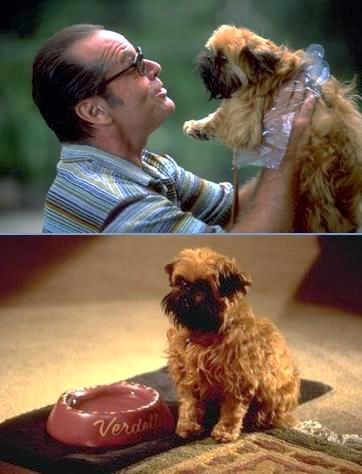 A somewhat more recent dog star was Jill the Dog. Jill helped win Jack Nicholson another Oscar in 1997's As Good as It Gets! As Verdell, the tiny Brussels Griffons that belongs to gay artist Greg Kinnear, Jill melts Nicholson's heart as he is forced to take care of her (playing a him!) in the wake of an emotionally and physically crippling incident. The role of Verdell was actually portrayed by six different dogs, but Jill was the chief one. This was just before CGI started to take over animal performances in the movies. While Jill wasn't enhanced, there were some tricks used to help her do what was required in the script (for example, in order to avoid stepping on cracks of the sidewalk the same way obsessive-compulsive Nicholson does, little obstacles were
  put in the cracks that were later edited out digitally. I think it goes without saying that I have less than zero interest in the current crop of animal films that use computers to give them expressions, move them, make them do this or that, etc... I'm more than happy to watch old movies in which the dogs are really doing things that a trainer has spent hours with them on and to see expressions that they have conjured up on their own.
Though the dog-as-accessory was a tried and true concept long before, (I always think of the little Chihuahua
 that Barbara Jo Allen carries around in a plastic purse in 1956's The Opposite Sex) this practice might have reached its zenith in 2001 when Reese Witherspoon made Legally Blonde and carried around her fashionably dressed pup Bruiser. In the sequel, Bruiser is discovered to be gay (!) which could be something of a first if you ignore the (implied) gay dog that George Clooney “played” in voice-over on South Park.
Depending on when one was raised, certain dogs or dog stories emerge as the most cherished above all others.
 1957's Old Yeller is one that is often cited as a seminal film in a certain generation's upbringing. The story of a Golden Labrador/Mastiff mix dog who manages to win a place in the hearts of a poor rural family has emerged as a litmus test for finding out whose heart is made of stone. Old Yeller protects the family from a rabid wolf, but pays a terrible price for his bravery. He was played by Spike, rescued from an animal shelter for $3.00 and trained into becoming the lovable star that brings even grown men to tears.
 My own generation seemed to gravitate towards 1963's The Incredible Journey, the story of two dogs and a cat who travel the Canadian wilderness to try to reach the family that owns them. I remember other kids at my school bragging about having read the paperback book that was in our small library, though I never read it myself. In fact, I have yet to see the movie! However, most of my fellow students had seen the movie and loved it at the time. This film has narration, not voice-over work, and is a serious approach to the material.
In 1993, it was remade as Homeward Bound: the Incredible Journey, this time featuring different breeds and names and with human voices assigned to them. Michael J. Fox, Sally Field and Don Ameche provided the animals voices and a more light-hearted approach was taken to the story.
 I can remember seeing this in the theater at age twenty-six with a female friend and fellow dog-lover and hideously falling for a plot thread that had one of the dogs killed! I hadn't seen the original and had no clue what might happen. Here were the two of us nimrods sitting there with tears in our eyes, crying, all the while laughing at the fact that we were two adults crying at a dog movie! Humiliating...
Speaking of dogs with voice-over, there was also the 1975 film A Boy and His Dog, all about a post-apocalyptic world in which a young man (played by Don Johnson)
 scrounges around for food and sex while telepathically communicating with his faithful dog Blood. Eventually, they head below the surface where such things are plentiful, but at a price. Blood's voice was provided by Tim McIntire, the son of John McIntire and Jeanette Nolan, who had a promising film career until drugs and alcohol lead to a heart problem which killed him at the age of forty-one in 1986.
This off-the-leash bit of canine randomness comes to a close with, perhaps, my own favorite movie dog. I may not be alone in this, in fact I suspect I am joined by many cinephiles out there. My own favorite pooch is none other than a certain little Cairn Terrier named Terry. What do you mean you don't know Terry?! Perhaps if I tell you that she was billed under a stage name for one of her most famous roles, that will help. In The Wizard of Oz, she played (and was credited as) Toto.
 Born in 1933, Terry was already working in the movies by the following year in a film called Ready to Love. This was followed by Bright Eyes,
  in which she played Rags, the pet of little Miss Shirley Temple. Temple has to defend the right to keep her against costar Jane Withers' objections. Interestingly, Temple's name was bandied about for the role of Dorothy in Oz, which would have meant a reunion for the two, but it didn't come to pass in the end.
More serious fare followed, including 1935's Dark Angel (with Fredric March and Merle Oberon), 1936's Fury (with Spencer Tracy and Sylvia Sidney), Cecil B. DeMille's The Buccaneer (1938) and Stablemates (also 1938) with Wallace Beery, Mickey Rooney and, believe it or not, Margaret Hamilton.
1939 was a banner year for Terry because not only did she figure prominently in The Wizard of Oz,
 but she also had parts in Bad Little Angel (with child star Virginia Weidler) and The Women (along with a raft of other “bitches!”) The Wizard of Oz was her only credited role and, as I said, she went by Toto. In 1942, her name was officially changed from Terry to Toto, but, sadly, she would be dead by 1945. She made six more films before her 1942 retirement, though, including the amusing Jack Benny film George Washington Slept Here and Tortilla Flat, which starred Spencer Tracy (both 1942.)
As a dyed in the wool softy (despite my cynical and crunchy outer core), I turn into a blubbering mess over Toto in Oz. There's something so perky, frisky and yet delicate about her and such a charming dynamic between Judy Garland's Dorothy and her. I could go on and on about my favorite parts (one being when she reacts to the steam coming out of the Tin Man's hat!), but will settle on two.
 One is when Garland is singing “Over the Rainbow” in the opening section and Toto faithfully follows her around, listening, eventually hopping up onto the seat of an old combine or something. At one point, Garland is singing and Toto puts her paw out on cue. I get all choked up right then. (Is there ANYTHING gayer than what I am writing?!?!)
The other big moment is later when Toto escapes from the Witch's castle and goes to find Dorothy's trio of friends, jutting down a craggy mountainside, despite any danger. I'm gone by then... As a kid with a dog, we always like to think that they will do something
 to save us if we ever need them to. This plays on that feeling of a dog as protector, no matter how diminutive he or she is.
Unlike some of Hollywood's major dog stars, Terry practically always did all of her own stunt work. She nearly had to be taken off the film at one point when one of the Winkies (the Witch's guards) stepped on her and broke her foot! She took two weeks off to recuperate (allegedly at Garland's house, leading to a strong personal attachment between them) and ultimately got to come back and complete the movie. Her salary on the film was higher than some of the human adults who worked on it!
 This past spring, a life-sized statue of Terry/Toto (whose grave was razed in a bit of freeway reconstruction!) was erected at the Hollywood Forever Cemetery. I guess it's forever unless a new interstate needs to come barrelling through! LOL The headstone reads in part: We give you this new home 53 years later, as “There's No Place Like Home” Rest in Peace, Dear Friend. Bless her little heart. She and other movie dogs gave so much pleasure to audiences through the years. I always brighten up when I'm watching an old movie and see one of those charmingly trained dogs doing his or her thing!


