Showing posts with label Dorothy McGuire. Show all posts

Friday, April 8, 2016

Dipping a Toe into the TV-Movie Time Tunnel!

Thanks to the prompting from a recent comment by a visitor to The Underworld, I did something that I haven't done in a little while. I ventured close to the vortex of 1970s made-for-TV-movies and fell in again briefly! You might recall previous trips that I took here, here and here. This time, it began with my wanting to take a look at the recently departed Patty Duke in one of her many teleflicks, She Waits (1972.)

Like many others of its time, the story is compact and told in 74 minutes (which equated to a 90-minute time slot with commer- cials.) The story begins with Dorothy McGuire being awakened in her large house by what seems to be the ghost of someone called Elaine. McGuire is halted in her late-night quest by her longtime housekeeper and companion Beulah Bondi. Classic movie fans will recall that these two appeared together earlier in the scenic melodrama A Summer Place (1959.)

Next we meet newlyweds David McCallum and Patty Duke, who have just arrived at McGuire's house. He is her son (though why he has a British accent and she doesn't is never elaborated upon!) Even though he made hotel reservations, he's opted instead to come to his old house, though his mother preferred that he didn't for some reason. Before long, we find that Elaine was his first wife, now deceased. The movie has faint echoes of Rebecca (1939), though this time the housekeeper (Bondi) is generally good-natured and friendly while McGuire is the one who is less-welcoming.
Duke tries to remain upbeat about the situation while also being more than a bit confused by all the mystery. Tight-lipped (and tight-faced) McCallum doesn't offer much beyond telling Duke that after this first day they will be able to spend more time together and also that, aside from a brief introduction between the two, he'd like her to avoid being around his mother. When McGuire and Duke do meet, it's amiably, though McGuire still wishes that the couple hadn't stayed in the house against her better judgment.
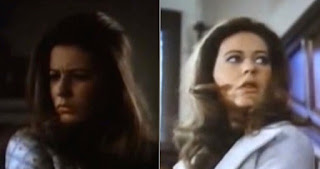
Duke experiences a variety of strange happenings. She hears voices, such as a woman on the telephone, yet when she enters the room there is no woman there and the phone isn't even connected! There are also regular opportunities for the wind to suddenly blow into a room, making the sheers billow. (ALL of the houses in these old movies have sheers hanging in the windows! How can we even tell nowadays, that those are sort of "out," that we may have a ghost wafting around?!) Duke also keeps hearing a haunting melody from a music box that was Elaine's.

Amazingly, while she is out wandering around the neighbor- hood, she spies the very same music box in a store window and steps in to examine it further. It plays a different melody, which the shop owner explains is due to the two having once been a set, with one happy tune and one melancholy. He also claims that he hadn't had the box for sale until just a few minutes before she walked by and saw it! (The tune she keeps hearing "Elaine's Theme" was composed by Morton Stevens and it must be said that his surprisingly rich score to this movie is one of its chief assets!)

Duke continues to be disturbed by voices and happenings within the house until finally she has something of a breakdown and is looked over by McGuire's doctor, played by movie veteran Lew Ayres. Why is Duke, who ultimately becomes practically possessed by the spirit of Elaine, being targeted this way and what is the goal of the ghost, if there is one? Well, you'll just have see for yourself if you're interested!

Also popping up a couple of times in She Waits is James T. Callahan, a frequent television series guest from the 1960s on and a regular member of the cast of Charles in Charge (1987-1990), albeit with white hair. The Golden Girls fans will also recall him as the former teacher of Dorothy's, Mr. Gordon, who she harbored a longstanding crush on and who exploited her services as a result. Ayres, a movie star of the 1930s & early-'40s whose career lapsed when he took a conscientious observer stance during WWII, was finding himself in demand as a character actor in both TV programs and the occasional feature. It should be noted that Mr. Ayres did serve in WWII as a medic in the line of fire. He simply didn't have the capacity to kill after having starred in All Quiet on the Western Front in 1930.

These TV-movies were a great haven (and source of income) for stars like McGuire and Bondi and gave viewers an opportunity to see them once their time in the spotlight had shifted. McGuire had not acted on television for fourteen years (having, in fact, done anything on-screen but one movie since playing the world's oldest Mary in The Greatest Story Ever Told in 1965! In that one, she was a nearly "Fifty Year-Old Virgin!!") Soon, she would be taking part in Rich Man, Poor Man (1976) and a 1978 rendition of Little Women. Bondi, a highly-dependable character actress, was twice nominated for an Oscar. There was The Gorgeous Hussey (1936) which went to Gale Sondergaard in Anthony Adverse and Of Human Hearts (1938) which went to Fay Bainter in Jezebel. This was close to her last acting role, but she did make two appearances on The Waltons between 1974 and 1976 and took home an Emmy for her trouble.

Following the cancellation of The Man from U.N.C.L.E. (1964- 1968), with which he will forever be identified, McCallum enjoyed a brief spate of feature film movie roles, but by 1971 he was almost exclusively back to television be it in TV movies, guest roles or series (like the acclaimed Colditz, 1972-1974, or the not-so-acclaimed The Invisible Man, 1975-1976.) As of late, McCallum has found a recurring home on NCIS and NCIS: New Orleans. In this (and in several other things in which he's appeared) he so often seems to be either looking down or facing away from the camera, almost to a distracting degree.

Ms. Duke was capable of a wide array of emotions and in She Waits, we see her play everything from happy to romantic to terrified to assertive and even dangerous. For someone that petite (5' even), she could pack some very commandeering punch into her small frame. This minor thriller is but a blip on her resume, but allowed viewers to see a name cast go through the machinations of a mystery thriller.

Watching the first movie inevitably led me to click on another one. You'll Never See Me Again (1973) centered on a missing person case with confounding mystery elements. The thread of someone vanishing into virtual thin air without explanation has been the subject of many a TV show and movie over the years.

We are introduced to a loving pair of newlyweds, David Hartman and Jess Walton, enjoying one of those idyllic, grassy knoll picnics that seemed to pop up consistently during the 1960s and '70s. They are happy as clams until they arrive home later that evening.

Once back to their house, Walton finds a letter in the mailbox from her mother and step-father about how they will be heading out of town soon. As Walton has been estranged from them for a little while, she tries to call them, to no avail. She then gets it in her head to drive to their home in another town right there and then in order to see them before they depart on their trip. Hartman, an architect who has to work the next day, is adamantly against this.

He finally relents to accompany her, but by now she's all fired up and doesn't want him to go. They argue heatedly until she bites his hand and he reflexively slaps her face, which sends her to the floor. She angrily leaves the house, proclaiming, "You'll never see me again!" In her haste, she's left her luggage and even her wallet behind. Seeing this, Hartman expects that she'll be returning before long.

The next day he reports to a job site and relays to his coworker Colby Chester that Walton never came home. Chester jokingly tells him that she spent the night at his place, but the joke fizzles for the dejected Hartman. (Macho man clone Chester, by the way, is a member of the Disaster Movie Club for his appearance in 1975's The Hindenburg.)

When Walton is STILL missing that evening, Hartman begins to become unglued with concern. He heads to the bus terminal where the clerk reports having seen her, but because she had no money, watched her attempt to hitchhike to her destination. He later heads to the police station to file a missing persons report, but they are little to no help.

Next Hartman begins to wonder just how much kidding was going on with ladies' man Chester. He calls him and can hear a female voice in the background, though Chester claims to be alone! Hartman goes there to confront Chester, who acts extremely evasive and doesn't want to let him in the door.

Finally, Hartman opts to drive to Walton's parents' house and see if they know anything (though he'd called there earlier and been told that his wife had never arrived. On the way, he stops for gasoline and gets a weird vibe from the filling station attendant (Bo Svenson.) Svenson denies having seen her, as does the mechanic on site, but still something seems off.

Now at Walton's mother's home, Hartman meets her step-father Ralph Meeker and her mother Jane Wyatt. Meeker suggests that Walton will turn up and is just blowing off some steam after their disagreement while Wyatt is understandably fretful about her whereabouts.

Still getting nowhere, Hartman returns home, dejected and depressed about the entire situation only to find out that the police (led by detective Joseph Campanella) are now considering him a suspect in Walton's disappearance and possible murder! The beige turtleneck dress that she was last wearing has been found with blood stains on it in his car! Hartman has to fight off Campanella and the police in order to remain free enough to track Walton down and find out for certain what has happened to her. You can find out, too, right here.

It's interesting to witness Hartman (who was later paid to be amiably low-key as the host of Good Morning America from 1975-1987) go through the gamut of emotions from anger to despair, becoming more and more desperate and disheveled with each new development. Never the most expressive or engrossing (or I dare say handsome) of actors, this does serve as a showcase for his range (but few actors ever ran in such a funny, off-kilter, side-to-side way!)
Walton was a burgeoning starlet at the time of this telefilm, having had a couple of bits in feature films and some TV guest work from 1969 on, but in 1988 took on the role of Jill Foster Abbott on The Young and the Restless, eventually becoming one of the last-standing daytime divas in a genre that is in constant threat of extinction.

As mentioned earlier, one of the great joys of these TV-movies is getting to see former stars trucked out for another go 'round. Meeker turned Broadway success into an active film career, but, though busy for many years and effective in quite a few projects, never really got the attention he deserved. Wyatt, who was ten years Meeker's senior, had begun film work in the mid-1930s and starred in the classic Lost Horizon (1937) before later making a name for herself on Father Knows Best (1954-1960.)
Campanella was an astonishingly busy character actor from the 1950s on. Though he and Hartman were in separate segments, they costarred in the series The Bold Ones (1969-1972) and Campanella was a memorable guest on The Golden Girls (alongside George Clooney) as a policeman who falls for Dorothy. He earned his Disaster Movie Club stripes with 1979's Meteor.

Svenson had been working steadily in TV projects since the mid-'60s and even had a recurring role on Here Come the Brides (1968-1969), but couldn't even rate billing for his vaguely sinister turn here. Later he rose to a certain level of fame as inheritor of the Walking Tall sequels (1975 & 1977) and brief television series based upon it (1981.) He still works steadily today and even had a small part in 2009's Inglourious Basterds, having first done the original The Inglorious Bastards in 1978.

The third and last of our telefilms is called The Strange Possession of Mrs. Oliver (1977.) It kicks off with images of a rip-snorting house fire followed by dreamy, gauzy images of a couple on their way to a bizarre funeral. The couple, Karen Black and George Hamilton, approach the casket only to find out that the body in it is Black's!
Turns out the whole thing was just a nightmare, but mousy Ms. Black's real-life existence isn't a great deal more happy. The twenty-six year-old (ahem... Black was thirty-eight in real life!) wife of wealthy Hamilton feels suffocated, bored and oppressed by her mundane daily routine. Hamilton, a real gem, wants her to stay home practically all the time and is highly insistent upon them having a baby as soon as possible.

One day while shopping at the mall, Black is drawn to the store window of a Frederick's of Hollywood (at one time THE place to locate tawdry, figure-hugging, figure-enhancing duds and accessories.) The dowdy woman stares at one of the scantily-clad, party-loving mannequins and is compelled to step inside.

Once there, she selects a low-cut red top and tries it on, at once stunned by her curvaceous appearance, yet repulsed by the notion of it.

Next, she heads over to the wig counter (!) and selects a voluminous, long blonde one. Trying it on, she is fixated by her own image. (Black does a lot of staring into the mirror in this movie and is granted countless close-ups, always with a fascinating expression to go with.)

The clerk tells her that she looks incredible - a new woman - and encourages her to purchase the wig and the top. A close look at the saleslady (portrayed by Gloria LeRoy, a burlesque performer turned busy character actress) reveals why she thinks the look is just right for her. (And though I usually do not prefer Black as a blonde, I have to say she does look great in this guise, but maybe it's because the brunette frump look is so awful!)

Black purchases only the blouse and leaves in a bit of a tizzy. However, after another evening of dealing with the downbeat, inattentive Hamilton, she heads back to the store and this time buys not only the wig, but some red lipstick and set of sexy hoop earrings!

She decides to surprise Hamilton with this new image and comes slinking down the steps of their mansion. His reaction, however, is far from thrilled and sends her careening into the bathroom to take everything off. It is then revealed that Black has been taking birth control pills all along while Hamilton has been urging her to get pregnant! He urges her to see a doctor about her recent series of mental issues, but she cannot proceed with the appointment.

Instead, while hubby is out of town for the night, she decks herself out in her new trappings and heads to the beach where she's rented a little cottage along the shore (for $290/ month!) She meets a dog who is only too happy to tag along with her on her new adventures.

Now feeling free and thrilled with herself, she heads to a local dive bar and, taking a cue from the place's name, calls herself Sandy. Things get weird, though, when the bartender addresses her as Sandy even though she never told him that was her name! Then she proceeds to order a drink that he says Sandy always ordered!

She is confronted by a man who claims to know her, though she protests that she is not the lady he believes her to be. She is next asked to dance by a hunky young stud in a tank top (played by Asher Brauner.) Brauner would soon be part of the hysteria of General Hospital when he played mobster Roy DiLucca, one of Bobbie Spencer's lovers, from 1978-1979.)

After catching the other man (Robert F. Lyons) rooting through her purse, she leaves in a flurry, but later, back at the cottage, she and her new canine companion feel threatened. She crouches in fear as someone seems to be trying the door on her new place. I wouldn't dare reveal the secret of this story or tell how it ends. You can find out here. Lyons may be a familiar face thanks to countless TV and film appearances, though he really was never associated with one particular show or role.
Two other folks making an appearance are Jean Allison and Lucille Benson, as residents of a house near Black's beachfront cottage. Allison was a busy, all-purpose TV actress from the mid-'50s to the mid-'80s. Benson's career covered the same time frame, though she is more well-known thanks to her wondrously distinctive way of looking and, especially, speaking.

Hamilton isn't given a great deal to do in this one beyond disapproving of most anything Black wants to do or say. One of the film's mysteries is why his rich, handsome character was drawn to a wife who (heretofore) insists on making herself look as dreary as she possibly can! He's obviously into her, though, since he dislikes the remade version and is forever trying to get Black impregnated.

Anyone who is even a moderate fan of Karen Black needs to sit down and watch this not-very-long movie. She IS the movie and offers up the many and varied lunatic expressions which have endeared her to so many fans. Shot after shot closes in on her face as she works through the details of this personality overhaul/ possession. Needless to say, Black is a Hall of Famer in the Disaster Movie Club thanks to her role as stewardess in distress Nancy Pryor in Airport 1975 (1974.) During this time period, she was working in many high-profile films while also enjoying TV-movie showcases like this and the more celebrated Trilogy of Terror (1975.) We'll likely be returning to the tunnel for more TV-movie fun thanks to the generous souls of youtube.com who allow us to see them (albeit often in a less than pristine state.)

Thursday, April 28, 2011

Suddenly "Susan"

Mmmm... We just love our splashy, colorful, overripe melodramas here in The Underworld and today we're going to examine a real screamer. Infamous as John Waters' favorite movie (and you can actually see its influence in some of his early cinematic efforts, albeit ramped up and trashed up as much as possible), the movie in question is 1961's Susan Slade. The story concerns a young girl who experiences first love and then is nearly ripped apart by it until the chance to be repaired comes in the form of a caring outcast.
In the early '60s, Warner Brothers had a whole stable of young, attractive contract players who were kept employed in both the TV department and in films. The longstanding belief that people wouldn't pay to see in a movie theater those stars who were on television for free didn't apply in the case of many of these stars, likely because a) TV was only in black & white then and the films were usually in glorious color with stunning scenery and sets and b) the movies allowed for more suggestive themes and situations that couldn't yet be explored on the more family-friendly television. Of course, this being 1961, there were still plenty of things that couldn't be depicted completely, so writers and directors had to continue to creatively present and/or skirt some details along the way.

Earlier in 1961, the film Parrish had been released to audience's delight. The stars, Troy Donahue and Connie Stevens, were thus quickly re-teamed in this picture, based on a book called The Sin of Susan Slade. Parrish's success was noted in the film's advertising, including the trailer and in this lobby card. Though Troy was given top-billing for Slade, it's really Connie's story and she dove into the role with relish.

Stevens is a seventeen year-old girl who lives with her doting parents in Chile. Her father, Lloyd Nolan, is a devoted mining engineer whose work has kept the family there for a decade. Her mother, Dorothy McGuire, is a former fashion model who is about fourteen years younger than Lloyd. As the film opens, the trio is readying to return to the U.S. after ten years and take a plane to the port where they then embark onto a luxury liner.

They've scarcely boarded the ship before naïve Stevens catches the attention of handsome playboy mountain climber Grant Williams. He's in between expeditions and, kind and considerate as he is, soon decides he'd like to get between Stevens' legs and do some exploring there! The speech he gives her about virgins (referring to mountains that haven't been topped yet) has to be heard to be believed! We're instructed to accept that, because she's been tucked away in a small Chilean village, she's too innocent to fully understand the ramifications of fooling around with an experienced boy like Williams. In a heart-to-heart with McGuire, that comes a tad too late, Stevens is given some advice about love and love-making.

Since this appears to be the all-time windiest cruise ever, with the gusts able to move even Williams' slicked down hair and Stevens' bouffant 'do, and with her chiffon head scarves billowing away like flags on a beach, the only safe thing to do, really, apart from an occasional attempt at shuffleboard, is to go to his room and get it on. The semblance of propriety is suggested with a group of people present (to the strains of Max Steiner's massive hit, the theme from A Summer Place!), but once they are dispatched, the young lovers can make their connection. Here and throughout, cinematographer Lucien Ballard's camera lingers softly over Stevens' face, giving her the kind of close-ups that aspiring actresses dream of. (Even though she was just twenty-three playing seventeen, she is sometimes shot so gauzily that it's not easy to make her out! And when it comes to McQuire, it sometimes seems as if she filmed her scenes in pre-morning London on a moist day!!) And look at the sharp line of Williams' cheek, accented with a row of thick eyelashes.

As the cruise is about to end, Stevens is delighted to find out that Williams, scion of a prominent San Francisco family, is willing to marry her. She loves him with every fiber of her being and he seems to feel the same way. However, he won't allow her to announce the engagement until he's back from his next expedition, climbing to the top of Alaska's Mount McKinley, where he intends to write their love in stone. The dreamy Williams seems to have an odd fascination with the dangers of climbing along with a disturbing connection to a gaggle of friends who didn't make it out of their last attempt at scaling a peak.
Once in California, the lovers separate and we meet Lloyd's boss, Brian Aherne and his wife Natalie Schafer along with their son, Bert Convy. (On what planet could Aherne and Schafer mate and produce Bert Convy?!) Aherne, in gratitude to Lloyd for his superior mining skills, has gifted him a stunning, oceanside house which Schafer has happily decorated and furnished according to McGuire's tastes. In a hilarious moment, she wafts through the courtyard, hands above the elbow as always with that unmistakable voice, and states, “I know how you love Oriental things” only to turn the corner and present McGuire with an Asian maid named Lily!! Now that is thorough! (And, by the way, was there ever a more saturated fuschia than the hue found in Ms. McGuire's coat?) The house is all done up in sliding doors that recall The Orient and with plenty of windows, but, oddly, Lloyd's laboratory/workshop is directly across from Stevens' fully open and visible bedroom, giving the whole setup an unintentionally uncomfortable feel.

Stevens' birthday rolls around and she is awakened that morning by her parents, who take her out to the staggeringly beautiful coastline and introduce her to her present, a gorgeous horse. Throughout this sequence, for some side-splitting reason, McGuire is holding one of those cameras that you hold at waist level and look down into. That in itself is fine, but why is she constantly aiming it at either the horse's behind or Connie's?!?! Look at this and see what sort of pictures you think she is taking?!?! Wouldn't she be behind Lloyd, so she can get the faces of the horse and her daughter? It's riotously funny without intending to be.

Anyway, the horse is boarded by Troy Donahue, who is a societal outcast because his father was accused of stealing from the same company that Lloyd works for and that is owned by Aherne (small world!) He hates Aherne and his family and has a contemptful attitude towards Stevens as well that can only mean one thing: that they'll eventually fall for one another.
Costumer Howard Shoup creates some lovely items for this film, but one of his absolute misses is the grotesquely unappealing, unflattering and downright bizarre horseback-riding ensemble he whipped up for Stevens. She wears it several times in the film and it's ugly each time. A taupe, two-piece, leather-like get-up with knitted cuffs and a big cowl neck, she looks like she's serving as the costume model for the later film Planet of the Apes! Not helping matters is the unintentionally hysterical way Connie runs in it when she goes to fetch her horse from Donahue's barn. (Editor's Note: I recently discovered that this piece was actually not original to this movie and had been worn first by Sandra Dee in Portrait in Black the year before!)
Meanwhile, she waits and waits and waits for Williams to send word that his Alaskan climb is over. Trouble is, he isn't even started yet because of weather conditions! He tries to call her (Alaska represented by a cozy phone booth, with Williams enveloped by a massive fur coat, probably left over from Warner Brothers' 1960 epic Ice Palace!), but she doesn't answer, apparently due to the fact that she's constantly out by the mailbox, waiting to hear from him in a letter. Note the Asian-influenced mailbox with the name Slade in a Chinese restaurant-style font. This being the days before answering machines, if she isn't there to take his (infrequent) calls, she has no knowledge that he's ever made them.

She has reason to worry, too. It turns out that their shipboard trysts have led to an accidental pregnancy. So now she's barely eighteen, unmarried and about to give birth to a baby! She yearns and yearns for him to come home, so that they can rush into a wedding and legitimize their unborn child. Things go from bad to worse when, one night during a glitzy party at her parents' house, she gets a call informing her that Williams isn't coming back. Period. Here, Miss Connie gets to enact a brief, but fun, meltdown, pressing her hands to her face, ripping her dress open, tugging at her hair and letting out a memorably loud and emotional scream.

Then, beside herself with angst, she rides her horse furiously through the woods and to the ocean where she hops off and prepares to swim to her death. Fortunately, Donahue, who is an aspiring writer and is up late doing so, hears her get the horse and trails off after her, jumping from his horse into the surf to go out and retrieve the distraught girl.
After much despondency, humiliation and soul-searching, it is determined that Stevens and her parents will go away on a new mining job in Guatemala for two years, during which time, Stevens will have her baby and McGuire will pass herself off as the mother! Before they leave, McGuire hilariously begins to plant the seeds of deception to her society friends (who are led, of course, by Schafer) when she confesses to puking up her breakfast and feeling sick in the morning. Not content to let it go at that, she admits to eating an entire dill pickle before bedtime! Stevens has, by now, developed a level of affection for her savior Donahue and, in another laughable moment, waves and waves goodbye to him from the departing plane, even as the steps collapse up and the door is shutting, the engines roaring for takeoff as her face peeks out!
The Slades comfortably nestled in Guatemala, Stevens feels the need to dress in colorful embroidered outfits and wear her hair as if, in between feeding and diapering, she either has to carry water on her shoulder or else dance before the locals in a festive program. Things go on swimmingly until the baby is born and Aherne and crew drop in for an unexpected visit. Stevens hysterically keeps referring to her baby, then swiftly adding the word brother to the end of sentences. Everybody seems to want her to wed the dimpled Convy (who after two years must have the patience of Job!), but she just can't seem to work up enough interest in him.

When it's time to return home, Schafer has put her home décor skills to work again, this time turning Stevens' room into a nursery, the baby boy close to his “mother” McGuire's room, and shunting Connie off to what used to be her father's laboratory, but is now an apartment fit for a teen. (Not only is is unwittingly cruel to make her look down at her now forsaken baby's room, but the last thing formerly knocked-up teenage Stevens needs is a private apartment!)

The baby looks like it was fed heavy cream from birth, it's such a bruiser, but he's cute nevertheless. I love his little curl on the top of his head. Lloyd's character's name was Roger, so little junior is amusingly referred to by everyone as Rogie! A lot has changed in fifty years, though. McGuire, during a conversation with Stevens over Rogie, proceeds to light a cigarette right there in his nursery!

The shock of that is nothing compared to what follows soon after. Now, I am not someone who is against spanking (nor am I for child abuse and endangerment.) I sort of fall into the belief that, for most kids, if they get a good spanking, thereafter just the threat of another one will usually be enough to keep them in line. It was that way with me. My mother kept a paddle on top of the refrigerator and if she so much as seemed like she was reaching for it, I was suddenly a model child! I knew better than to force her to actually use it. But, here we have Rogie sitting on his bedroom floor, playing happily with a silver object. Turns out, it is McGuire's lighter! (Why she keeps it on a low end table that is perfectly within his reach is another story...) She takes it from him and says, “no, no!” Okay, fine. Then she slaps his hand AND swats him on the behind!!!! I mean that the REAL Dorothy McGuire slaps and spanks the REAL kid playing Rogie, taking him from a content, smiling, unknowing baby to a red-faced, bawling mess in a couple of seconds flat. Can you even imagine such a thing occurring in today's Hollywood?!?! I found this whole thing to be jaw-dropping. No wonder the poor kid never worked in films or TV again after this.

As the story winds its way to the big finish, Stevens is still not quite over Williams while being wooed heavily by Convy and yet falling slowly in love with Donahue. However, she's got this secret baby to worry about and, if that isn't enough, there's even the scandal that, for whomever she should wind up with, she will not be a virgin on her wedding night! (And from the looks of 11 pound, 5 ounce Rogie, I don't think it's something she could fake!) So the angst continues, with her feeling like she can't be with any man.

It takes a major emergency to shake everyone out of their status quo and see what this is doing to her. Check out this amusing still photo of Troy putting out a fire that has taken place at Connie's house. The flames and smoke are FAKE! The smoke is airbrushed on and the flames are animated! What a hoot...

One either likes these types of movies or not. I can't get enough of them! The combination of colorful design and scenery, delightful Max Steiner music, glorious Lucien Ballard photography and deluxe costuming coming to bear on a pulpy and amusing script enacted by thespians doing all they can to sell it is cinema magic to me.

Donahue and Stevens had been appearing together on the TV show Hawaiian Eye and would show up in another film as well, Palm Springs Weekend in 1963, though they were paired with different lovers in that one. He had only a couple more years of employment with Warners until his type of screen persona (pretty, but pretty un-dynamic) fell out of favor. Though he did continue to work here and there right up until 2000, things were never the same and he deteriorated pretty badly. For a good decade and a half, he was in the grip of alcohol and drugs, but finally got some help in 1982. Francis Ford Coppola, a childhood friend from a military school they attended together, gave him a role in The Godfather: Part II, but it didn't lead to any similar ventures of prestige. He died September 2nd of 2001.

Miss Stevens is still with us, of course, a well-preserved seventy-two thanks to her exceedingly successful Forever Spring skin care line, which has turned her into a considerable businesswoman. She makes infrequent appearances as an actress, mostly on TV, but primarily concentrates on her business ventures. Susan Slade is most likely one of the most significant roles of her career and she approached it with gusto. There are times here when she really is genuinely touching. Her little girl voice limited what projects would be offered her (most notably My Fair Lady, a film she wanted desperately to star in, though it could never have worked...) Nevertheless, she stayed a popular film actress for a time before moving to more frequent TV roles.

McGuire enjoyed a long career with quite a few memorable films, not the least of which is A Tree Grows in Brooklyn in 1945. Other notable roles came in The Spiral Staircase, Gentleman's Agreement, Three Coins in the Fountain, A Summer Place and, later, the TV miniseries Rich Man, Poor Man, among others. A busy and effective, yet demure, actress, she was dealt two bad hands at the very end. First was having the misfortune to die (eleven days after Troy Donahue) on September 13th, 2001, when America was still shattered by the World Trade Center attack, she then was omitted from the following year's Oscar memorial tribute. A former nominee, she was kicked to the curb to make room for people like Aliyah, a singer who appeared in two films in her life, one which hadn't even been released yet.

Nolan had been a busy, reliable character actor for many years with a memorable turn in Peyton Place being only one of his strong parts. Here, he was given one of his most sensitive and tender sort of roles, though he could very easily portray a meanie as he did the prior year in Portrait in Black. He was also part of Diahann Carroll's ground-breaking TV series Julia. He has a nook in The Underworld dedicated to him for his roles in Airport and Earthquake, of course. He died in 1985 of lung cancer, just a short time after appearing on Murder, She Wrote, an actor till the end.

Aherne, once the husband of Miss Joan Fontaine, had been acting in films since 1924(!), earning an Oscar nomination as Best Supporting Actor for 1939's Juarez. The year after his divorce from Fontaine, he married again and would remain with that wife for forty years until his death in 1986 from heart failure at age eighty-four. By this time, he was firmly a supporting actor, having done the deliriously fun The Best of Everything in 1959 and would only make three more films before retiring in 1967. I couldn't possibly love this publicity photo of Aherne and Schafer any more.

Schafer, naturally, is legendary as Mrs. Howell on Gilligan's Island. That persona grafts itself onto everything she did beforehand when viewed now, though there was usually not a lot of difference amongst her roles. She was just, simply put, a fascinatingly unique screen presence and vastly underrated for the flavor and tone she brought to films. She worked with Joan Crawford twice (in Reunion in France and Female on the Beach) as well as films with Bette Davis (in Payment on Demand), Hedy Lamarr (Dishonored Lady), Ingrid Bergman (Anastasia), Janet Gaynor (Bernardine) and Susan Hayward (Back Street.) She even worked on Lana Turner's disastrous foray into TV, Harold Robbin's The Survivors! She continued to act until 1990, passing away the next year at the age of ninety. Oh, what a book she ought to have written...

Williams is profiled here elsewhere, so I won't go on about him further. You can click on his name to the right for his tribute.

Susan Slade is a chance for fans of Bert Convy to see him without that trademark head of full, fluffy curls. He's all patted down and parted here. This was near the start (and, to be truthful, near the end!) of his career in feature films. He would work extensively on TV, however, and eventually become a very popular game show host with Tattletales and Win, Lose or Draw as a couple of his hits. Sadly, he was taken from us far too soon when a malignant brain tumor claimed him in 1991 at only age fifty-seven. His life not without some melodramatic twists of its own, he pleaded with his wife of thirty-one years, from whom he'd been bitterly separated, to grant him a divorce so that he could marry another woman mere months before his death.

This film makes a great companion piece to the other films offered with it in a boxed DVD set: Rome Adventure, Parrish and A Summer Place. All of them were produced, written or co-written and directed by Delmer Daves, a man who obviously liked working with Donahue when so few others sang his acting praises. Before specializing in these lush dramas, he had directed tough westerns such as Broken Arrow, Drum Beat, The Last Wagon, 3:10 to Yuma and The Hanging Tree. He'd been a prop boy at age nineteen on the 1923 silent The Covered Wagon, which ignited a love of the genre in him. His success as a writer and director meant he never had to use the law degree he'd earned at Stanford University!

This is one of those movies that fans remembered fondly for years and years, yet could rarely get their hands on until recently when it was unearthed again. Though major inroads have taken place with this sort of thing, especially due to the Warner Archive burn-to-order plan and similar programs, it can be a very long wait if you happen to like a film that (seemingly) few others do! It's so great when a favorite film comes out of the vaults, especially when it's in widescreen DVD format and not grainy pan-and-scan as we may have only seen previously.