In The Underworld, we LOVE
Valley of the Dolls (1967) and revel in the slick, shellacked, colorful, over-the-top delicious tackiness of it all. Jacqueline Susann, author of that film's source novel, was and remains a brazenly polarizing figure in published fiction. Loved by as many readers as she is hated for her explicit, outrageous storylines (which were nonetheless often based on real people and situations!), no one can deny that she was a staggering success.
Dolls only partially followed Susann's book and, bizarrely, abandoned the two-decade time span of the story, compressing it all into one brief period. She wrote two subsequent books that were also adapted into movies, each film promising to hew closer to her plots, characters and sensibilities, but with neither one actually winding up doing so. Today we will look at the third one, 1975's
Once is Not Enough (with 1970's
The Love Machine sure to be the subject of a future post as well!)
With the passage of time (and the camp value assigned to the movies that sprang from them), it's sometimes easy to forget just how successful Miss Susann's tomes were. Valley was a phenomenon (with The Love Machine considerably less so) and Once is Not Enough was the #2 selling book of 1973. Had it not been for the author's illness and subsequent death, she might have continued a long string of bestsellers (her mantle having been taken up, in any case, by Jackie Collins and others like her.)
The novel Once is Not Enough was quite a scorcher, with everything from drugs to orgies to homosexuality to near-incest to nun rape! By 1975, the movie industry standards had dipped low enough that most, if not all, of this could be played out on the screen with few, if any, ramifications. Yet, in the end, the movie
Once is Not Enough wound up coming off more than a little staid and quaint, even with the few dillys that made their way into the picture. Certainly, the film's poster promised doses of skin and sex that the finished product really didn't even come close to offering!
I usually feature a movie's primary poster when I pay tribute to a movie here, but this is one time when I went with a secondary one because
Once's chief poster gives away one of what I consider to be one of the movie's most delicious secrets! In fact, advertising for the film prior its release also made no bones about it even though the movie itself sets up the twist extremely effectively. So even though almost everyone knows about it, I will not reveal it here because I dislike spoilers in general, especially when they rob a viewer of a fun little kick during the movie. Perhaps a newcomer to
Once will get to watch it with clear eyes and be able to savor the eyebrow-raising story thread.
Our story begins with once- successful film producer Kirk Douglas waking up to the morning greetings of his engagingly cranky longtime maid. She and Douglas have a funny give and take to their dialogue as she lobs remarks at him and he volleys back. So comfortable with each other by now are they that he shucks down and takes a brisk (and messy!) cold shower right in full view of her. He's in the midst of trying to cut a movie deal, but is having a rough go of it.

We next get a glimpse of his adoring teen daughter Deborah Raffin, who is enduring a long series of grueling operations. In a flashback, we see that she'd earlier been along for the ride with her father on location for one of his films. I say along for the ride, which in this case happened to be on a motorcycle clutching the back of a young suitor. When she was informed that her (single) father was likely holed up in a hotel room with one of the movie's actresses, she encouraged the biker to speed there frantically. This resulted in a serious accident that caused Raffin to be placed in an exclusive hospital for a long recovery period.


Cut to her imminent release and return to the U.S., where Douglas is preparing to welcome her back and shower her with the love and lifestyle she's always been accustomed to. Unfortunately, his career has been in the toilet for a while now and the medical bills from her accident have helped to bleed him dry. He has immense trouble getting a project off the ground.
Solace comes in the form of a haughty, plain-speaking, extraordinarily wealthy heiress (Alexis Smith) who goes through husbands like each one is stamped with an expiration date. Wooed by Douglas, yet hardly fooled by his tactics, she agrees to wed him and keep him and his young daughter firmly entrenched in their high-style of living... so long as he promises to stay out of the movie business. She prefers not to risk her money on such unreliable enterprises as the cinema (a feeling Paramount Pictures could probably relate to after this movie hit the streets!)


Raffin returns to her father, now residing in a grand apartment in New York City, and can't wait to slather him with puppy love. They share a champagne toast and he even hires the Goodyear blimp to welcome her back! He's uneasy, however, and encourages her to get some rest after her lengthy flight. Awakening later that night, she proceeds to the refrigerator for a can of Coke and is startled to hear a woman's voice. Smith is home and is amazed that Douglas hasn't broken the news to Raffin that they are married.


Raffin is horrified that daddy has a spouse and proceeds to fret (in the room that Smith has so carefully designed to be an appropriate one for a young lady like her.) Raffin can hardly bear to live under the same roof as Smith, despite the fact that Smith is rarely anything but generous and considerate to her, buying her an entirely new wardrobe, and decides to get a job – and an apartment – of her own. She hears from an old school chum (Brenda Vaccaro) who happens to be the editor of a successful magazine, and is swiftly hired as a contributor thanks to the social connections her father and stepmother provide.


Vaccaro is a rarity in this film in that she has energy, verve, a sense of humor and also happens to be sexually voracious, not to mention blunt. She also tosses out one of the film's best lines when recalling one of her lover's descriptions of her: “You have ten fingers like a mouth and a mouth like ten fingers! Now, you couldn't ask for a better reference than that, could you?” After hearing Raffin go on and on about the merits of her beloved father, she finally tells Raffin that she ought to just sleep with him and get it over with!
Smith, however, has other plans. She has a single, suave cousin (George Hamilton) who she thinks would be perfect for Raffin and proceeds to arrange a date for them. The sheltered, unsophisticated Raffin practically bewilders the cosmopolitan Hamilton with her naivete. He, a major league ladies man (who gets a drink in the face during their first date from a spurned ex), tries to win her over, but she's highly disinterested, not to mention inexperienced.
Eventually, though, she decides that it's high time she lose her virginity and Hamilton is chosen as the one to do it. He takes her to his sprawling, state-of-the-art (and very red!) bachelor pad and settles in to take care of business. (None of the actual act is shown. Despite the poster featuring two nude, enraptured lovers on it, the sex and nudity factor is low in
Once is Not Enough. Raffin, in what was something of a first in this new era of unrestrained film-making, had a “no nudity” clause in her contract. A rather undermining sort of condition for the leading lady to have in a movie based on a scorching Susann novel! She did submit to a body stocking worn behind a gauzy shower curtain for one scene.)
Even after becoming a woman with the ever-slick Hamilton (who is also the frequent escort of reclusive, mysterious movie star Melina Mercouri), Raffin really only has eyes for her father Douglas. Douglas has his own troubles, too, as he's becoming quite restless as the kept husband of a jet-setting socialite. Smith doesn't seem to care all that much how he is feeling, preferring to dart off frequently in order to satisfy her backgammon obsession with a friend.


Douglas, Smith, Raffin and Vaccaro all meet for dinner one night (dig the $0.90 chicken liver omelet!) and are confronted with a belligerent writer (David Janssen) who verbally assaults Douglas for having butchered one of his novels in transition to the big screen. Only the intervention of Janssen's ex-astronaut friend (Gary Conway) prevents a scuffle. Afterwards, Janssen and Conway connect with Vaccaro and Raffin, with Vaccaro eager to try Janssen on for size. Trouble is, he is far more taken with Raffin. Conway, feeling no need to pursue either lady, heads home which, for him, is on the beach.


Faced with the prospect of hard- drinking (and, as it turns out, a still-married father) Janssen as a suitor, Raffin apparently decides that since she can't have her daddy all for herself, she may as well take the next best thing. The two embark on a whirlwind romance of bike rides and other staples of 1970s cinematic love. But, as luck would have it, there's a fly in the ointment. For one reason or another, Janssen is impotent. In these pre-Viagra days, it's impossible for him to bring David Jr to the table in their relationship.


Fortunately, Raffin is so desirable, Janssen is able to bounce back from the abyss and begin a sexual relationship with her. She begins to accompany him on his (dull for her) book tours. When Douglas finds out about this relationship, he is beside himself with rage. He bursts into the couple's hotel room and proceeds to whallop Janssen mightily. After handing Janssen his ass, he tells Raffin he will be waiting for her in a nearby restaurant. When Janssen threatens to end their relationship if she goes, she reluctantly allows Douglas to seethe all by himself before giving up.


With the strain of Janssen's estranged wife and family colliding with her own boredom and unrest, Raffin finds herself without the man who came between her and her father. Conway, ever the upright and noble friend tries to help them work out their differences, but is unable to make much headway. (What he does provide earlier, however, is the delicious and very welcome sight of him jogging along the beach in some cut-off sweatpants!)
Meanwhile, Douglas and Smith have arrived at the realization that things might have come careening to a halt for themselves as well. Douglas has been secretly trying to secure a movie deal in order to become a self-sufficient man once more and Smith wants no part of either venture. They conclude that a divorce is the proper resolution of their too-convenient marriage.
After one final head-to- head, a dejected, rejected Raffin meanders the streets of New York, nearly being run down by a taxi cab (driven by Phil Foster, the man who subsequently played Penny Marshall's father on
Laverne & Shirley!), until The Mancini Singers begin to chime in with the movie's theme song, accompanied by clips from the previous two hours! Try as they might, viewers probably hadn't forgotten any of the scenes revisited here, so there was little to no need for a recap at this late stage.
The movie then just sort of peters out, rather differently from Susann's novel in which the heroine, drugged and dazed from a night of LSD and group sex, traipsed out into the ocean to her presumed demise!
The title of the movie does appear within a line of dialogue near the end, but it's real life inspiration came from a conversation that author Susann had with the singer-comedian Joe E. Lewis (whose life was eventful enough to inspire a book and a movie called
The Joker is Wild, 1957) while he was slipping into the abyss of death. In an effort to lift his spirits, she said to him, “Come on, Joe. Didn't you always say 'you only go around once, but if you play your cards right, once is enough'?” He reply was, “I was wrong, Jackie. Once is not enough.”
Once was directed by Guy Green, an Oscar-winning cinematographer (for 1946's
Great Expectations) whose work for David Lean inspired him to begin taking the helm of movies himself in the mid-'50s. He'd guided Stuart Whitman (in 1961's
The Mark) and Elizabeth Hartman and Shelley Winters (in 1965's
A Patch of Blue) to Oscar nominations (with Winters winning hers), as well as Vaccaro here, before this film practically slammed the lid on his big-screen career. (That's him in the trench coat with
Blue's Hartman and Sidney Poitier.)
A refined Brit with considerable taste was probably not the one to direct this potentially tawdry potboiler. A little of the zest and guts from
A Patch of Blue would have been welcome here! It's doubtful that the later, prime-time TV broadcast had to undergo a tremendous amount of censoring when it aired. After one German movie two years in the wake of
Once, Green retreated to movies made for television until his 1986 retirement. He passed away in 2005 of heart failure at the age of ninety-one.
At this point in his career, Douglas was still a considerable movie star with box office clout, but had not had a significant hit in several years (nor did he possess even one Oscar, unlike his character who had two!), thus he was well-cast as a once-great Hollywood figure struggling to regain a foothold in the business. He'd recently starred in a couple of foreign-made movies such as 1971's French
To Catch a Spy and 1972's Italian-German
The Master Touch, followed by 1973's Yugoslavian
Scalawag. The 1974 western
Posse signaled a return to the U.S.
After
Once, he would make several more big screen films of varying success such as Brian De Palma's
The Fury (1978), the western spoof
The Villain (1979), the WWII fantasy
The Final Countdown (1980) and one last teaming with frequent costar Burt Lancaster in
Tough Guys (1986), which featured Alexis Smith as a leading lady. A severe 1995 stroke slowed down, but didn't stop the very active actor who is ninety-seven at present.
When
Miss Smith took this part, it had been fourteen years since her previous feature film (1959's
The Young Philadelphians!) Hardly idle during that time, she had done some TV work and honed her skills on stage, the most remarkable example being her triumphant 1971 Broadway appearance in Follies, which landed her on the cover of Time magazine and netted her a Tony award.
The Alexis Smith who showed up in
Once and who figured into her subsequent film
The Little Girl Who Lives Down the Lane (1976) was a quantum leap from the reserved, serene, stately type who worked at Warner Brothers for so long in the 1940s. She now had delicious dynamism to her work, though film and TV appearances would still be rather limited. She did score an Emmy nomination for a 1990 guest role on
Cheers, but the award went to Swoosie Kurtz for an installment of
Carol & Company. Sadly, she passed away in 1993 of brain cancer at age seventy-two, having just done a supporting role in
The Age of Innocence for Martin Scorcese. Every single moment of her screen time could be spliced into a loop and played for me over and over, I love her approach to this that much!
Janssen, who'd become a household name on
The Fugitive (1963 – 1967) was in the midst of another moderately successful TV show (
Harry O,1973 --1976) when he took this role. He'd won a Golden Globe for
The Fugitive, but never the Emmy despite three nominations (losing to Dick Van Dyke of
The Dick Van Dyke Show, prior to them splitting comedy and drama apart, and then twice to Bill Cosby of
I Spy.)
Having bared his behind (to better effect) in 1969's
Where It's At, he did so again here, which was less welcome (especially in a movie that also featured Douglas, Hamilton and, particularly, Conway!) He also makes the hilarious acting choice of, when his character is struggling to get it up for Raffin, standing in the bathroom and looking down at his private parts as if to say, “What's the matter with you?!” Note the way the still photo below is from a rehearsal, in which he's wearing briefs.
He balanced film and TV work of varying prestige until 1980 when he died of a heart attack at only age forty-eight. A heavy drinker and smoker (and workaholic), he rarely remained idle during his demanding career. His last role was in the notorious
Inchon, released after his demise in 1981.
Ever-tan, ever- elegant Hamilton was in the midst of a career lull, having followed up a supporting role in the troubled 1973 western
The Man Who Loved Cat Dancing with the less-than-spectacular
Medusa (1973.) He worked on TV some, but his next two feature films were 1977's
The Happy Hooker Goes to Washington and the 1978 train wreck
Sextette, which starred Mae West. Fortunately for him, his 1979 comedy
Love at First Bite not only jump-started his career again, but made him barrels of money. Now seventy-four, he has continued to work, though rarely in projects of a high caliber. His autobiography had the rare distinction (for me, anyway) of making him seem even more shallow and less admirable than his already paper-thin public persona!
Gravel-voiced Mercouri had been something of a cinematic sensation in the 1960s with
Never on Sunday (1960) and
Topkapi (1964) among other films, but was grossly underused here. (
Never on Sunday won her an Oscar nomination, but Elizabeth Taylor won that year for
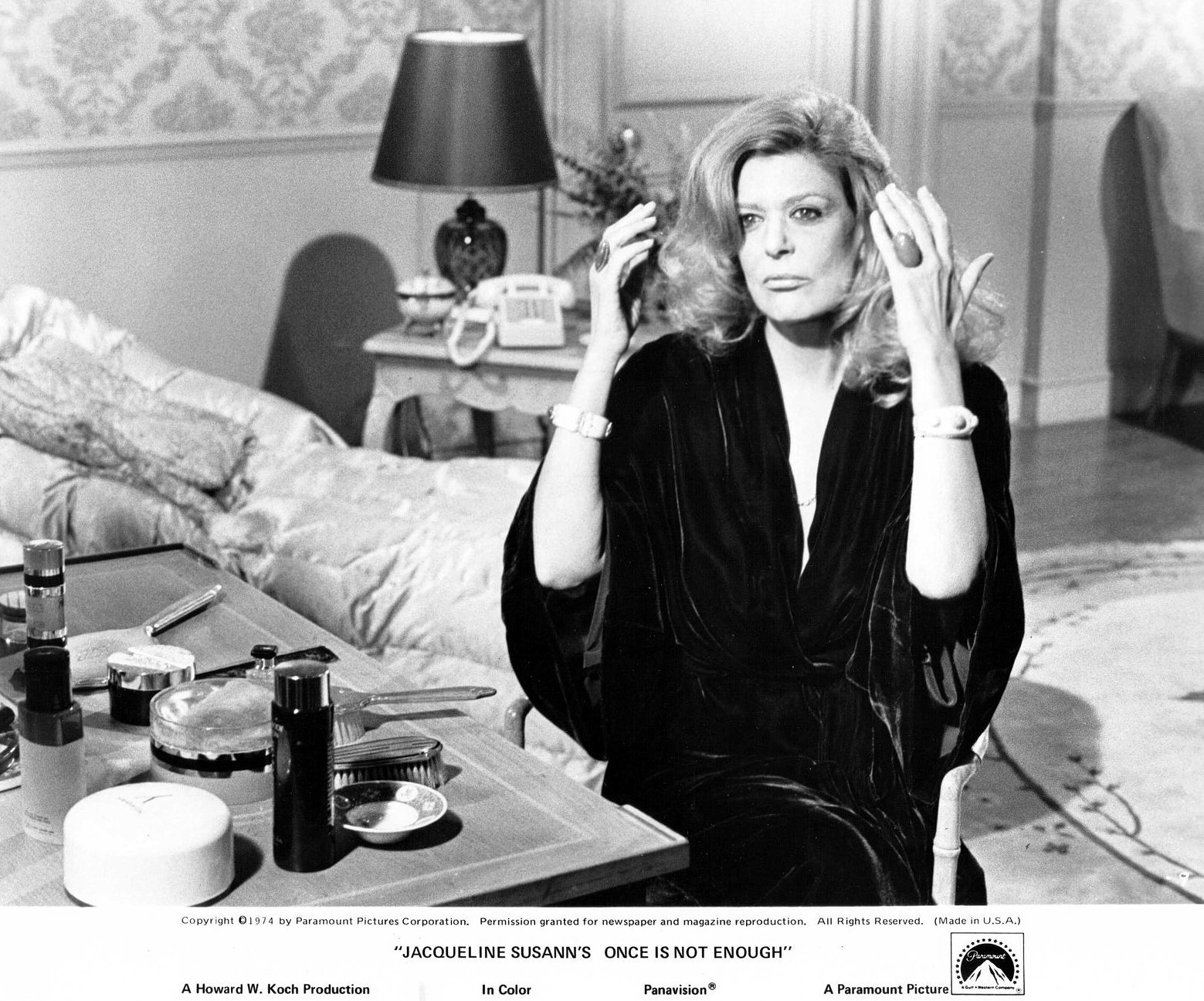
BUtterfield 8.) Her character in the novel had a far more detailed background and was more heavily featured. In the movie, a love scene with Hamilton was trimmed out prior to release and her role wound up as mostly an eye-opening cameo. She did appear braless in a tight top, her breasts looking remarkably pert for her age.
She had been nominated three times for a Golden Globe, too, for
Phaedra (1962),
Topkapi (1964) and
Promise at Dawn (1970), but lost to Geraldine Page in
Sweet Bird of Youth, Julie Andrews in
Mary Poppins and Ali MacGraw in
Love Story. She only worked on screen twice after
Once, retiring in late 1997 to successfully enter Greek politics and government. A very heavy smoker, she succumbed to lung cancer in 1994 at age seventy-three.
Successful stage actress Vaccaro had entered TV in 1961 and films in 1969 with
Where It's At (which starred Janssen) and
Midnight Cowboy, but by 1972 was primarily on TV again. She won the Golden Globe for this movie and had been nominated for one for
Cowboy, too (losing that year to Goldie Hawn in
Cactus Flower for a role Vaccaro had originated on Broadway!) Her Oscar nomination for
Once helped to reignite her movie career and she costarred in several films over the next decade or so, including
Airport '77 (1977),
The First Deadly Sin (1980),
Zorro: The Gay Blade (1981), which starred Hamilton, and
Supergirl (1984.) She lost the Oscar for
Once to Lee Grant in
Shampoo, but when they costarred in
Airport '77, she got to punch Grant in the face, dropping her to the floor! Still at it, in a variety of acting mediums, she is currently seventy-four.
We love
Gary Conway in The Underworld, but he was given almost nothing to do here. The way his role comes off in his scant scenes, it wouldn't have been a stretch for the character to be gay, but it apparently wasn't the case, nor was it so in Susann's novel. It's just a case of a sketchily-drawn part with no real relevance leaving room for unwarranted speculation. He seemingly was, at some point, meant to have a bit more storyline as some posters featured him and referred to his character's ex-wife, but other posters covered up his face on the poster with a shot of the book!
Earlier a physique model-turned-Warner Brothers contract player, Conway eventually starred for two seasons on
Land of the Giants (1968 – 1970), but afterwards found acting work scarce. In 1973, he posed seminude for Playgirl in an attempt to change his image and
Once was likely part of that same plan, but his undemanding (and sadly underexposing) role didn't do it. After the self-produced revenge flick
The Farmer (1977), he only acted a few more times before turning his attention to wine production with his wife Marian, a former Miss America. He'll be turning seventy-eight in a few weeks.
The intended centerpiece of
Once is Not Enough is Deborah Raffin, a comparative newcomer alongside the rest of the cast. Having been discovered on the verge of twenty while riding an elevator with a film executive, she landed the role of Liv Ullmann's daughter in
40 Carats (1973) and then a costarring part in 1974's
The Dove, about a young man sailing around the world. Almost universally panned for her work in
Once (even her own husband called her performance “wooden”), it must be said that the part would have been tough on even the most ingratiating and skilled actress.
Her film career never really recovered from this, though she did work in (exploitive, low-grade) fare like
God Told Me To (1976) and
The Ransom (1977), with
Death Wish 3 (1984) a particular low-point. Her manager-producer husband used her in many of his projects including the 1979 TV-movie
Willa and the movies
Touched By Love (1980) and
Dance of the Dwarfs (1983.)
Love garnered her a Golden Globe nomination, but she lost to Mary Tyler Moore in
Ordinary People. The intensely sentimental drama also won her a Razzie nomination which she (gladly, I'm sure!) “lost” to Brooke Shields in
The Blue Lagoon. In more recent years she had a recurring role on
7th Heaven. Sadly, she died altogether too young at fifty-nine of leukemia just this past November.
Raffin's father was a restauranteur and her mother was a busy supporting actress of the 1940s and '50s named Trudy Marshall. Marshall had been off the screen for more than a dozen years, but was given a walk-on role as one of Janssen's admiring readers at a book signing. She is bedecked in one of the hilarious signature get-ups (a big hat paired with a fur-trimmed coat) that could also be found on Smith earlier in the movie. Costumer Moss Mabry (whose work I nearly always enjoy) went a touch "out there" in some of the clothes for
Once, but it was the mid-'70s after all!
Many folks find
Once is Not Enough dull and bland, and I have a little bit of trouble arguing with that, but for some reason I can't help liking it! I love Jacqueline Susann, love sumptuous, real-life location work (meaning non-CGI!), love all-star casts, love unintentional humor and find Alexis Smith just downright fascinating in this. Try it and see if once is plenty for you. For me, it could never be enough!