It might seem from that subject line that we're going to time-warp back to the '80s or something, but no. We're actually going back even further than that to take a peek at an actor who seemed as if he was going make a dent in the Hollywood firmament, but who instead wound up on the sidelines after being ground through the gears of a sometimes-brutal Tinseltown. Born James Westmoreland on November 25th, 1935, he would spend the better part of a decade under another name entirely – Rad Fulton.

Westmoreland was born and raised in Dearborn, Michigan, just west of Detroit. Feeling adventuresome after graduation from high school, he, with parental consent, left for New York City to strike out and see what sort of life he could create for himself. He had saved enough money up to last for six months. In an unbelievable twist of fate, he went from his plane to bar in Manhattan to take advantage of the lower drinking age and happened upon two female models who joined him for drinks and conversation.
By the end of the night, he was living with them for one third of the rent (and taking turns sleeping with them!) They introduced him to their agent who quickly found the young man work as a male model. He swiftly began to make what was good money at the time and was enjoying a free-wheeling life with cash in his wallet and two luscious women at home. Eventually, though, they referred him to Henry Willson, one of Hollywood's most successful (and notorious) agents.

In 1954, Westmoreland moved to Los Angeles where he signed with Willson and proceeded to take acting lessons while working a construction job during the day to earn a living and help cover the expenses of new clothing. Willson had a propensity for taking handsome, but raw, young men and grooming them into striking, mannerly, poised actors with catchy, unusual names. Rock Hudson was one of his chief clients as was Troy Donahue. (Willson is in the middle here, with Jack Warner, Natalie Wood, his former secretary Phyllis Gates and Hudson. Gates, in one of Willson's major publicity schemes, became Hudson's wife for a while to fend off rumormongers.) Other names on the roster at one time or another included Dack Rambo, Guy Madison, Tab Hunter, Rory Calhoun and Ty Hardin, among others. He also discovered some high-profile female talent including Rhonda Fleming and Lana Turner.

Whether they actually were in fact or not, most of Willson's actors had to accept that within the industry they were presumed to be either homosexual, bisexual or pansexual enough to exchange favors for the shot at quality acting gigs. This wasn't always the case, but was true enough at various times for the rumors to have staying power. They often looked and, with Willson's new monikers, sounded like prototypical gay porn stars! Here we have Chad Everett, Troy Donahue, Van Williams and John Saxon, who looks mighty like Westmoreland in this shot. Many young men, after getting their start through Willson and obtaining a career foothold, left him behind as an agent and scarcely, if ever, looked back.
Willson had particular connections with David O. Selznick and Warner Brothers and Universal Studios. Westmoreland's first gig in Hollywood was on a Selznick-produced TV special called
The Eddie Fisher Hour in which he danced with a young lady as Fisher crooned on lovingly. Not long after, he was renamed "Rad Fulton" in the Willson tradition and found himself presented to actor/producer Steve Cochran for a role in one of his upcoming movies. The 1956 film
Come Next Spring marked the big-screen debut of Rad Fulton. He was sharing the screen with no less than Cochran, Ann Sheridan and, of particular note, three-time Oscar-winner Walter Brennan, who treated him with great kindness and played his father in the movie.
He also got to know Cochran (a voracious ladies man) quite well and enjoyed sharing in the crazy movie star lifestyle that Cochran existed in. (Cochran is on the right in the top photo and in the middle of the lower one, with Sonny Tufts at the far right.) Cochran was fond enough of Fulton to want him under personal contract for future projects, but Willson felt that Fulton had a better shot at individual stardom if he were placed under contract at a major studio. After a successful screen test, he was signed on at Warner Brothers. He popped up in unbilled parts in 1956's
Toward the Unknown with William Holden and
The Girl He Left Behind (a Tab Hunter-Natalie Wood vehicle.)
Occasionally, he'd see his new name in the credits (such as with the non-prestigious
The Women of Pitcairn Island in 1956), but more often than not he was toiling in parts that offered no billing and little, if any, challenge. He was one of the countless recruits in William Wellman's
Lafayette Escadrille (1958), an actor reading the part of Romeo opposite Natalie Wood in
Marjorie Morningstar (1958) and a student in the campy
High School Confidential! (1958), which starred the hooty cast of Russ Tamblyn, Jan Sterling, John Drew Barrymore, Mamie Van Doren, Jackie Coogan, Michael Landon and Jerry Lee Lewis!
There were also TV appearances on the Chuck Connors cadet-driven drama
West Point, a
Lux Playhouse installment with Anne Baxter and a couple of
Alfred Hitchcock Presents, one of them with Ralph Meeker. He also played an air force inductee in the Andy Griffith comedy
No Time for Sergeants. In just two years from 1956 to 1958, he'd landed a fair amount of work, but with virtually no recognition or publicity-centered reward for it.
There were, of course, plenty of studio-arranged dates as well as ones engineered through Willson. He met sultry starlet Sally Dodd the latter way and the two were in a heated relationship for several months. That's her Christmas tree he's trimming at left. He also dated Natalie Wood, Terry Moore and even Margaret O'Brien among a wealth of other Tinseltown tootsies.
At last he was given a featured role in a movie, albeit a low-budget, exploitation drama called
Joy Ride. In it, he played a young tough who terrorizes a couple played by Regis Toomey and Ann Doran. This was one of many films to ride the wave of the far more skillful and insightful
Rebel Without a Cause from 1955. Drive-Ins teemed with movies about reckless, thoughtless teens causing problems for adults and other kids alike.
Such a minor movie, while it offered him a far meatier part than usual, didn't wind up leading to much more, so he continued to toil on television (in
The Restless Gun,
Bronco,
Laramie and even
The Many Loves of Dobie Gillis) and as a ticket agent in Paul Newman's
The Young Philadelphians (1959.) A better break of sorts came when he won fifth-billing in the Audie Murphy western
Hell Bent for Leather in 1960. He played a deputy sheriff duped into pursuing an innocent man (Murphy.)
Also in 1960, he had yet another uncredited role in
The Crowded Sky, playing an air traffic controller. Solace came in the form of a featured role in the already crowded
The Last Sunset (1961.) Rock Hudson and Kirk Douglas starred in the lusty western, which also starred Dorothy Malone, Joseph Cotten and Carol Lynley. Fulton's old
Joy Ride costar Regis Toomey was also in the cast and Fulton portrayed one of three bad guys, the other two essayed by Neville Brand and Jack Elam.
Sporting a beard for the first time, he welcomed the chance at an unusual sort of role opposite some great acting talent and some major movie stars, though the role was not a primary one. Interestingly, upon arriving in Mexico for location shooting, he was ushered into a mansion-like house to be shared with Hudson while his fellow actors Brand and Elam got little more than dormitory-like bunks to sleep in! Regardless of Hudson's well-documented life as a homosexual (or at most, an occasional bisexual), Fulton always maintained that there was nothing between them but a couple of very sexy female dates, one of whom was glued to Hudson for much of his time there.
The camaraderie he established with Hudson was short-lived when Hudson, in an example of professional leverage and perhaps fear of working alongside a handsome, decade-younger actor, quashed his upcoming role in Hudson's next film
Come September. Bobby Darin was placed in the part instead (and wound up falling in love with and marrying his love interest in the movie, Sandra Dee!) It was not the first, nor would it be the last, time a fellow actor or a producer had thrown Fulton under the bus for his own ends.
Instead of
September, Fulton was trucked off to Italy for a role in an adventure film called
Journey Beneath the Desert, directed by veteran Frank Borzage, an Oscar-winner for both
Seventh Heaven (1927) and
Bad Girl (1931), but who was by this point in the twilight of his career (and life!) In fact, he fell ill and couldn't complete the movie, dying in 1962 of cancer.
As one of three men crash-landed in a helocopter and faced with the turmoil of the lost city of Atlantis, Fulton was clearly being used for his obvious good looks and trim physique.
It was shown off in the movie to good advantage as his shirt was turned to shreds.
The leading lady of this movie (playing the Queen of Atlantis) was Haya Harareet, who'd just come off a major success in Ben-Hur two years before. Her costumes here were a far cry from the discreet cloaks and full-coverage of the earlier Biblical epic!
In the wake of Borzage's illness, the already dubious film was placed into lesser hands and became a hopeless, tacky debacle. The silver lining of that dark cloud came when, during the filming in Rome, he was introduced to the producer and director of an upcoming British film to star Michael Redgrave and, in her movie debut, Juliet Mills.
No, My Darling Daughter! was a gentle comedy about Fulton whisking away Mills for a whirlwind romance against the wishes of her father Redgrave and her father's assistance Michael Craig, who she has romantic inclinations towards as well.
As rewarding as this experience was (and it was for him), things at home were about to head south. After eight years with Henry Willson (at right), the two had a falling out and things escalated until Fulton decided he wanted to sever their ties to one another. In a burst of controlling mania, Willson exclaimed that Fulton was free to go, but that the name “Rad Fulton” was his own creation and he wasn't going to let the actor continue using it! Never all that fond of it to begin with, Fulton agreed and from then on reinvented himself as James Westmoreland (again!)
Without his established screen name and without even an agent, Westmoreland went without work for a while, but finally managed to secure a meeting with a casting agent he knew. He landed a minute role in a very low-budget biopic called
Harlow (1965.) This was one of two such films that came out that year. One was bigger budgeted and starred Carroll Baker, but this one was shot in black and white over the course of eight days (!) and starred Carol Lynley, his old costar from
The Last Sunset.
He had managed to get a leading role as a detective trying to figure out what has happened to an assortment of beautiful women who've gone missing only to later be found dead. One of the victims was his own secretary. A little over half of the way through the filming (which was a four-week schedule to begin with!), an incident occurred at a baseball game during a traffic jam and Westmoreland's reaction to some punks mistreating his father led to the producer (who was also there) to rail against him for fighting and nearly causing a delay on the low-rung picture. The animosity built until Westmoreland was fired and the film was later patched together, it's title and plot line changed, to become
The Undertaker and His Pals (1966), a hopeless mess.
Still handsome at just thirty years of age, he scrambled for work in TV. He had a bit role in the comedy series
Hank and played the henchman son of Boris Karloff in an episode of
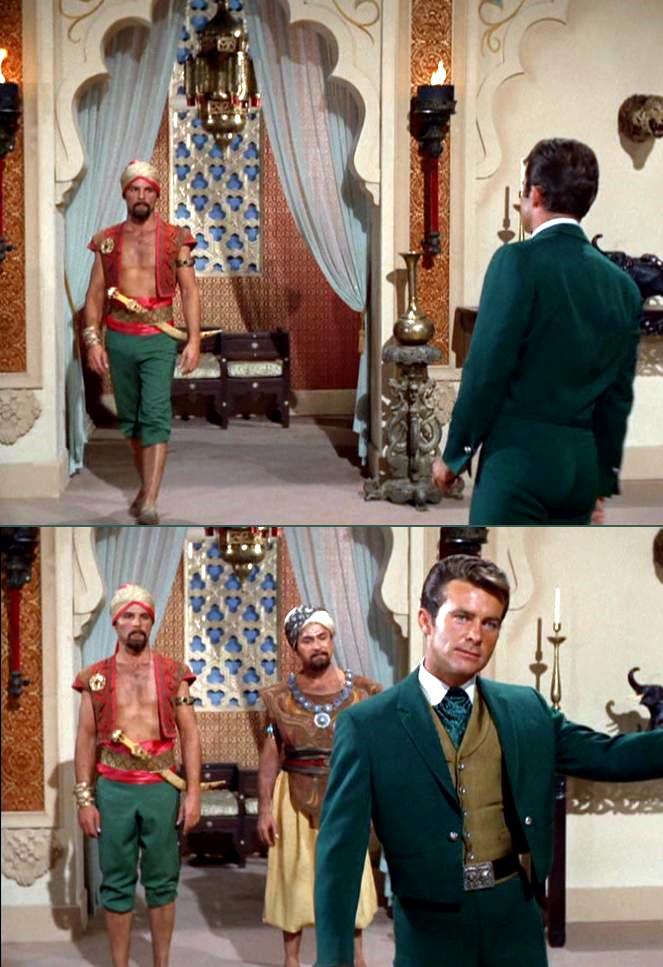
The Wild Wild West. There was nothing spectacular about his part, but at least it afforded him the chance to meet and act with Karloff, a legend in movie monsterdom.
Here we see Westmoreland attempting to steal focus from the amazing ass and face of the series' star Robert Conrad. (Conrad's character's name was, ironically enough, James West.)
The role required practically no acting, but at least he looked good in his period finery. This was the second episode of the series in color and the art directors outdid themselves trying to ramp up both the colors and the details of the sets and set dressing.
Westmoreland had always been in shape and had participated in various activities from weight-lifting to sit-ups and, particularly, golf. He ended up in a foursome one day with a man producing a new western series and the man, sizing up his tall, handsome golf partner, decided to test him for a role. The 1966 show was called
The Monroes and it concerned a family of pioneering settlers, the parents of which die on their way to the new land leaving five children on their own. Michael Anderson Jr was cast as the lead, with Barbara Hershey as his sister and three other young'ns to fill out the rest.
Westmoreland won the role of a slightly older, more experienced man who could aid Anderson while providing romantic interest for Hershey. Filmed chiefly on location in Grand Teton National Park, the series was beautifully appointed with much actual outdoor scenery, a departure from some of the almost stage-bound TV westerns of the time. As the season drew close to being over, a behind-the-scenes quagmire involving misappropriation of funds by the man who'd hired him led to the mistaken belief that he'd been somehow involved and he was unceremoniously fired. The expensive show, in any case, failed to make it back for a second season.
In one of several instances throughout his career (another one being when John Smith fought to make sure he was not the costar of
Laramie), there were behind the scenes machinations on
The Monroes as well. According to him, the producers had earlier tried to squeeze out Michael Anderson (seen here - and below - in one of their scenes together) from the show and make Westmoreland the new head of the family through his relationship with Barbara Hershey, but he refused to do such a thing.
Next, he guest-starred with his old pal Walter Brennan on
The Guns of Will Sonnet, a show that also featured the delectable Dack Rambo. He then lost out on a lead role in
Bracken's World because of his new agent saying he wasn't available (as part of yet another instance of backstage favoritism.) Having witnessed such
Rome-like intrigue and more in even the presumably benign world of community theatre, I have no trouble believing any of the stories that Westmoreland relates during his time in the dog-eat-dog world of TV and movies. This would mark a lengthy spell away from the cameras while Westmoreland faced the writing on the wall about his acting career.
Faint solace came in the form of a severance check for the remaining run of his (now-former) show
The Monroes, augmented with additional money for first-time re-reruns. (It was customary at the time for actors to only be paid for only the first, or just a few, re-runs rather than for all time thereafter, which is why so many famous TV stars wound up getting shafted financially when their shows ran for decades and decades after cancellation. This has since been remedied for contemporary actors and includes home video residuals for most folks as well.)
At this point, he moved to Rancho Mirage, California and began to play golf, first as a hobby, but eventually for money in a series of tournaments and matches. He began to let his acting career slide into little more than a memory as he morphed into a pro golfer. In 1970, a bizarre blip occurred for the always heavy-duty ladies man. He married young actress Kim Darby, then at her career peak from 1969's
True Grit opposite John Wayne.
Having met only two weeks prior to the wedding during dinner at Michael Anderson Jr's house, her divorce from James Stacy was only finalized the day before the ceremony! The sudden marriage made the pages of magazines everywhere in the U.S., but the union lasted only six weeks, dissolving before anyone could even get used to the idea. With her acting career at full-throttle and his on life support, they scarcely had a chance. It was Westmoreland's only recorded trip to the altar (though there is one source that lists a previous eight-year marriage to someone... WHO?)
As time wore on, Westmoreland began to teach golf at country clubs and believe that, perhaps, he wouldn't act again, but eventually he was approached about a role on the daytime soap opera
General Hospital. He was cast as a deathly ill Vietnam veteran who'd contracted hepatitis from unclean heroin needles. You can spot him just right of center here in all his hairy-chested, swingin' '70s glory. This was 1972 and he stayed on the show as an attractive male love interest until a real life illness caused him to vacate the role after less than a year.
After his recovery, he continued life as a golf instructor, with occasional forays into the acting world. He had the ability to juggle his clients around the odd TV or movie shoot (one being a 1977 appearance on
Emergency!) In 1980, he landed the leading role in a cheap horror thriller called
Don't Answer the Phone! He played a police detective who's trying to close in on a psychotic strangler (who taunts the public by repeatedly calling in to a radio psychologist's program.) The already low creative expectations for the movie meant that all it had to do was turn a profit and that it did.
From here, Westmoreland only appeared sporadically on TV. He had a brief stint on
The Young and the Restless in 1982, popped up on a 1984 episode of
T.J. Hooker (using his former moniker Rad Fulton as a lark!) and made his final appearance in 1987 on
The New Mike Hammer, which starred Stacy Keach.
In the years since then, he has continued to pursue his career in golf, teaching clients and even making an instructional video. He also penned a novel in 2000 called The Milk Man, The Connection, which is full of romantic and sexual shenanigans no doubt based upon his years as a young, single hopeful in Hollywood. Though he wasn't able to attain any significant level of stardom as an actor, he does have a cult following of fans who have enjoyed his handsome face and physique and wish he'd gotten to do more. He also must be close to setting some sort of record for appearing in the most TV shows and movies whose titles ended with an exclamation point!




 In the book, Zimbalist had a caring mistress waiting for him as he flies from the west coast to Washington, D.C. In the film, he is merely a cuckolded


 Finally, top-billed Andrews makes his appearance and is shown to be a stern, egotistical stuffed shirt.


 He met (and soon married) Saundra Edwards during the filming of this movie. She is the brunette stewardess and was a burgeoning


 The lobby cards and stills on this page do not really capture how beautifully the film is shot, in general. The colors are so vibrant and the people are frequently captured in hazy, gauzy glory that would make even Lucille Ball stand up and take notice.


