I mentioned lately in a comment section or two that I've recently been watching a pretty rare 1968-69 half-hour talk show hosted by Joan Rivers. Called That Show, it featured Ms. Rivers delivering a brief monologue that poked a little fun at the chosen topic of the day, followed by a discussion involving one "expert" guest, often an author, businessperson or doctor, and one celebrity guest. Then at the end there was often a Q & A involving members of the small studio audience.
It's been fascinating to see Rivers at this stage of her career and also to see what public attitudes were like in this era (the look of which happens to be a great favorite of mine, albeit this is towards the tail end of it.) Topics ranged all over the place from child-rearing to cuts of meat to vacationing in Jamaica to nudism! There were also fashion shows, often including fur.
Initially, I was only going to run photos of Rivers in her various clothing and hairstyles because that late-'60s look is irresistible to me, so there aren't many photos of her guests. I didn't begin to collect any of those until after having watched for quite a while. However, her celebrity guests included the likes of Marty Allen, Johnny Carson, Jerry Lewis (who rigidly advocated corporal punishment), David Susskind, Roger Smith, Jordan Christopher, Rocky Graziano, Shecky Greene and many others. They were always welcomed with the most glowing, gracious and heartfelt of introductions from their hostess.
In the episode depicted here, guest Nancy Walker discusses the topic of house-keepers and how they should or should not be treated. It's interesting in that Walker was chiefly working on Broadway at the time (not having acted on TV since 1960) and had yet to enjoy her television career resurgence on The Mary Tyler Moore Show (followed by Rhoda), nor McMillan & Wife, for which she would receive three Emmy nominations and two Golden Globe nominations for playing... a maid! Soon after this appearance, Walker began her two-decade stint as diner waitress Rosie on TV ads for Bounty paper towels, a gig that led to the major upswing in her acting career. Walker, like the vast majority of guests on the program, smoked cigarettes throughout; an ashtray provided on set for that very purpose. (Walker died in 1992 at age sixty-nine of lung cancer.)
Also appearing as guests were a rather young Dr. Joyce Brothers and the durable comic actor Orson Bean (who still works occasionally these days at age eighty-eight.) This particular episode had to do with speed-reading. (Have you taken note yet of the hysterical microphones that are attached to each chair and jut up towards the subject's face from the side?)
Still another episode dealt with "high society" and Cliff Robertson was the celebrity guest. Robertson's then-wife, heiress turned actress Dina Merrill (who's still with us now at ninety-three!), was born to it, yet dropped from the once-famed social register of New York City thanks to her marriage to Robertson.
Here we see Rivers interviewing Pat Montandon, selected by Esquire magazine as one of the Top 19 party hostesses of the time. She wrote a well-received book called "How to Be a Party Girl." Needless to say, we're most drawn to her fall of blonde tresses! She proceeded to write several other books over the years as well and was briefly married to famed attorney Melvin Belli.
On that same show, Johnny's wife Joanne Carson was the celebrity guest. She was a heralded party-giver in her own right, though not so much due to the frequency as to the creativity of each one. She almost resembles a young Miss Jane Seymour in the lower-right shot, doesn't she? When Johnny and she divorced in 1972 after a decade of marriage, she got half a million dollars in cash and art plus $72,000 per year until Johnny's death in 2005. (His third marriage turned out to be far costlier, however.)
This is Mary Travers of Peter, Paul & Mary fame. Her episode was about the changing nature of teenagers and how much more advanced (and in some cases trouble- some!) they'd been becoming as the conditions and attitudes had changed so rapidly during the 1960s. She doesn't look much unlike Janice, the lead guitarist of the band on The Muppet Show!
Here we see Rivers welcoming a floral design "expert" (the centerpiece - made up of pieces of fresh fruit and covered in scary, craggy black branches with thorns - was positively atrocious!) along guest Diana Sands.
Rivers and Sands were put through their paces as makeshift floral designers with Rivers, naturally going for laughs. Sands, a very successful Broadway actress who transitioned to television and film, was claimed by a rare form of cancer at only age forty. She was set to star in Claudine (1974), but had to drop out. Her friend Diahann Carroll took on the role and gleaned an Oscar nomination for it. (Ellen Burstyn won for Alice Doesn't Live Here Anymore.)
Rivers' audiences tended to love her corny jokes. Her humor, known for its outrageous- ness, was still rather tempered here. She's talk about her crazy "cousins" Sheila or Hubie or her hairstylist "Mr. Phyllis" and poke fun at her own shortcomings. Every once in a while it might get the teensiest bit risque (such as when she claimed to have bought a Venus Fly Trap, but it's "fly" was always open!), but generally it was soft and her audience demonstrated tasteful decorum. The lady below nearly ruptured herself during Joan's shenanigans, however.
Eventually, the artist-rendered opening titles for the show (which featured a caricature or two of Rivers) were replaced with a more colorful intro, in which the text glowed brighter every second or so before going dim again.
These episodes also featured a longer, slightly more relaxed hairstyle for Joan (though it was still shellacked with hairspray, thank God.) It has become a weekday treat to see what dapper little drip-dry or woven number she's going to be sporting, what piece of jewelry is selected and how her hair will be done as I check out these old programs.
Earlier eps had seen her experimenting with long falls situated under her own comparatively short hair.
The makeup is more than a tad clown-like! She fiddled with this scarf endlessly, something I could still catch her doing sometimes decades later when she became a fashion maven on E! Entertainment Television through shows like Fashion Police.
Here, she was in a midway period, growing her hair longer from the shorter bouffant she started off with. Almost a Bea Benaderet thing going on this time!
It's so much fun to see her wear a coordinating or contrasting bow with each of her delightful 1960s get-ups.
Even more fun, though, was when guest Carol Lawrence came by and was wearing a huge Grecian goddess hairpiece!
Her episode was about the pros and cons of natural childbirth. As the mother of two boys with then- husband Robert Goulet, Lawrence had gone through one natural birth and one Caesarean when it was determined that delivery the traditional way was impossible in that case.
I have, for unknown reasons, almost universally been drawn to any woman named Joan. It's downright strange. Though not everyone was fond of Joan Rivers, I adored her. I loved her gusto, her guts, her determination and her never-ending ability to laugh at life, even in the face of tragedy. I feel that on more than one occasion she was given the short end of the stick, but somehow she always persevered.
(I was never able to transfer my affection for her to her daughter Melissa, however, who was an infant when this show was produced and who looks so much like her mother in many of these pictures.)
Rivers had already had work done on her nose at this point and vociferously supported cosmetic surgery on this program for those who wished to have it performed on themselves. While it might not be right to call her a pretty woman, she did have a certain sense of elegance, even when manically darting around the set and goofing for the cameras.
There has been a DVD release of some of the episodes of this obscure show, which, as I say, is an amazing time capsule of of a long-gone era, one that was in considerable social flux.
I don't know where our Miss Joan is now, but I do hope wherever it is there is peace and plenty of laughs!
Showing posts with label Cliff Robertson. Show all posts
Thursday, May 4, 2017
Thursday, June 6, 2013
On The QT About "PT"
This post finds me in a most peculiar position because I had DVR-ed PT 109, believing that, based on its cast, color cinematography, year of issue and subject matter, it would be perfect fodder for examination in The Underworld and yet when I actually got down to watching this 140-minute 1963 movie, I found myself eventually losing interest to the point where I began “checking out” right as it was ostensibly beginning to get exciting, and I like war movies! (I have to admit that in reviewing it later, I wasn't as bored as I was upon initial viewing. Maybe I was tired!)
Thus, I'm still going to take a look at PT 109, but primarily I'm only going to focus on that which truly held my attention, which, in this case, was the men! (Actually, certain men. Apart from one cheesecake illustration pasted inside a cabinet door, no females appear in this movie whatsoever!)
To back pedal for a moment, PT 109 was based on the exploits of a young naval lieutenant during WWII who, because of his personal health and family connections, easily could have ridden out the war comfortably at home, but who instead opted to see action in the Pacific, ultimately emerging as a hero to his men and others. The lieutenant? John Fitzgerald Kennedy, a man who later became a U.S. Senator and eventually President of The United States of America.
Despite a bad back, he convinced his superiors to let him work in the Pacific theater and even command a small, more easily-maneuverable-than-bulkier-vessels, boat: PT 109. The ship had seen hard action and needed to be repaired and restored, but he and his small crew did so, eventually putting the vessel back into service where it could be used in rescues, cover, distractions and so forth.
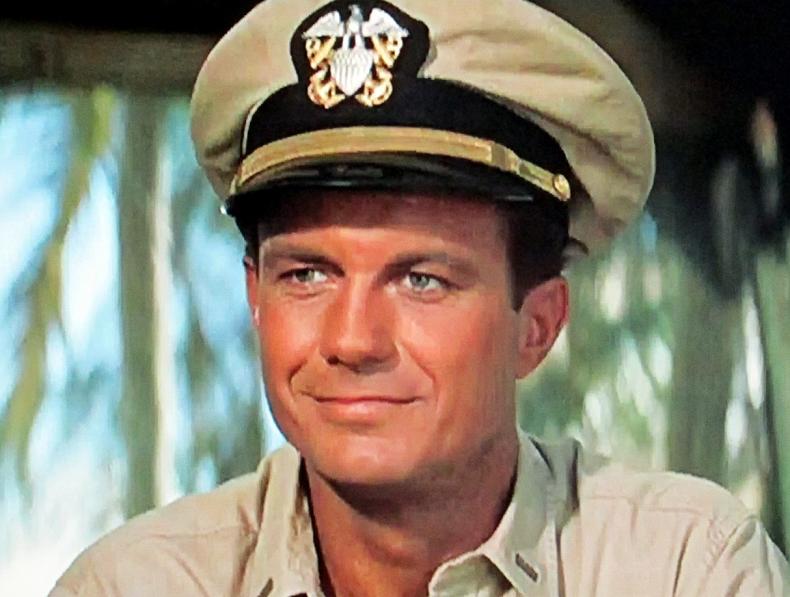
The beginning of PT 109 focuses on young Kennedy (as portrayed by Cliff Robertson) coming to the islands and requesting command of the boat. Then, after the assemblage of his crew, he's shown working on getting it put back together again properly and ready for action.
Among his motley crew are none other than Robert Blake and Norman Fell! Blake, a child star who segued into adult roles with success, including In Cold Blood (1967) and Electra Glide in Blue (1973), would enjoy fame as TV's Baretta (1975-1978), though his biggest notoriety came when he was accused of killing his wife! He was acquitted in the murder trial, but found guilty in a separate civil case and wound up in career and financial oblivion (his acting career had come to a close a half a decade prior to the killing.)
Fell was a longstanding character actor best known for playing the persnickety, nosy landlord Mr. Roper on Three's Company (1977-1979) and its short-lived spin-off The Ropers (1979-1980.)
There is also a row of sailors shown showering with makeshift tanks and nozzles amusingly labeled with the names of various alcohol types. It's a brief sequence, but the location pops up twice (the second time during an air raid, which sends the presumably nude – but obscured - men scampering for cover.)
The man Robertson reports to is played by the beautiful Grant Williams (best known as The Incredible Shrinking Man, 1957), who makes a rather unforgettable entrance in the movie. Robertson enters his tent to find him stretched out (in wide-screen Panavision!) asleep on a cot with just a t-shirt and some skimpy boxer shorts.
Let me say that again and offer a closer look... Dreamy Grant Williams asleep on a cot!
After being roused by Robertson's arrival, Williams turns over onto his stomach and arches his back, pushing his butt up slightly (which ought to be standard operating procedure in my armed forces rule book! Ha!)
Sadly, it becomes obvious that Williams is wearing some sort of very tight, compressive briefs under his boxers (I spit on you, costumer Alexis Davidoff!!), but nevertheless Williams is looking terrific in body and face. (I especially like his hair mussed like this, versus neatly combed.)
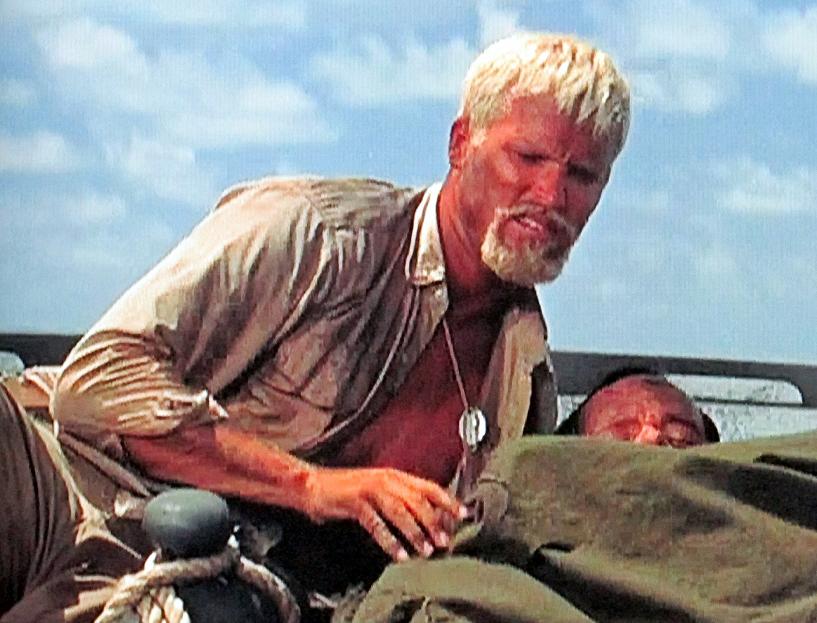
In a true gift to moviegoers everywhere (especially ones who like beefcake!), Ty Hardin (of TV's Bronco) was hired to play Robertson's second-in-command, a tall, strapping, tan, white-blonde god with a curious mustache and goatee combo.
If for no other reason, fans of hunky Hardin owe it to themselves to sit through (or perhaps skim through) PT 109 just to see him alternately lumbering and high-tailing it around. He's GORGEOUS (and very amiable, reliable, loyal, etc... as well.)
Hardin was typically very fit, but lean, and in this movie he is far more bulked up than most fans are probably used to. His burly, solid frame and chiseled features make him look like the type of sailor that would make even notorious artist Tom of Finland standup and take notice!
I have no clue what caused Hardin to adopt this platinum hair and accompanying facial hair (I am not aware of a crew-member on the real boat looking like this, though I'm certainly no expert), but it's incredibly striking.
The first time I saw it, I nearly burst out laughing, but trust me, when you see him in action, it grows on you...
Solid, ever-curmudgeonly character actor James Gregory appears throughout as Robertson's cranky, but caring commander.
Showing up rather late in the proceedings is Robert Culp as an old buddy of Robertson's who winds up serving on the boat with him. He brings a certain level of confidence and swagger that by this point in the movie is most welcome.
Culp had been in TV since the mid-'50s, but 1963 was the year he debuted in films, with this, Sunday in New York and The Raiders offering a triple play in that arena. He would soon star in I Spy (1965-1968) before hitting a movie milestone in Bob & Carol & Ted & Alice in 1969, with many more roles on the big and small screen to follow.
Publicity at the time heralded the presence of three second-generation celebrities working on the picture. Tony Hope (son of Bob) was an associate producer while David Whorf (son of a film producer) and William Douglas (son of a Supreme Court justice) had featured roles as seamen. Whorf, a busy actor as a youth, later went on to an assistant directing career (including, ironically, A Woman Named Jackie (1991, about President Kennedy's wife) and Marilyn & Bobby: Her Final Affair (1993, about Kennedy's lover and his brother, who was also involved with her!) Douglas' career as an actor was over practically before it began.
The White House was directly involved with several aspects of the making of PT 109. By-then President Kennedy had some stipulations regarding the movie. One was that it be an accurate portrayal of the events (which it was, to a point.) Also, the profits had to be dispersed to the survivors of the doomed boat and their families. He also had the power to veto famed director Raoul Walsh after viewing Marines Let's Go (1961) and loathing it. Veteran director Lewis Milestone was selected instead, who had helmed All Quiet on the Western Front (1930), A Walk in the Sun (1945), Pork Chop Hill (1959) and the recent box office disaster Mutiny on the Bounty (1962), which went grotesquely over-budget and was legendary for the bad behavior of its star, Marlon Brando.
Milestone wanted a better script (and had to be out of his mind to do another picture on the water after Mutiny!), which was not forthcoming, and so he departed and was replaced by Warner Brothers television director Leslie Martinson. Thus, this somewhat expensive production, with glistening and lush cinematography by Robert Surtees, wound up in the hands of a less than brilliant moviemaker. This may explain the curiously uninvolving nature of the film and the sometimes McHale's Navy type of approach to certain scenes.
Kennedy also had final say in the casting. An early contender was Peter Fonda, but he became miffed during a screen test over being asked to replicate Kennedy's Boston accent. Jeffrey Hunter was another option, though Jackie Kennedy was pulling for Warren Beatty.
Probably one of the most apt contenders, at least physically, was Edd Byrnes (shown here), who had the lean, slight build of a young JFK, similar facial characteristics and an unquestionably prominent (and famous) thatch of hair that would have helped put the casting over. However, Byrnes was known as a swaggering sort of novelty character called “Kookie” on 77 Sunset Strip (1958-1963, still on the air at the time) and such a persona was a hurdle to him being taken seriously as a heroic future President.
Finally, Kennedy settled on Robertson, who only vaguely resembled him, was too old for the part, had a very hairy chest and made no attempt at an accent at all! To compensate, he posed for a lot of shots in the film that had him pleasantly smiling beatifically, giving the “character” of Kennedy and sheen of goodness and idealism that was very likely nothing like the rambunctious, confident and highly energetic and competitive young man who made such a mark in the navy and in life! Better things were soon to come, though, when he won an Oscar for Charly (1968.)
Robertson got a major career boost out of this, being photographed with a scale model of the title boat....
...hobnobbing with Rose Kennedy, the famous mother of the person he was portraying...
...and even becoming immortalized at the Movieland Wax Museum in a vignette based on PT 109.
The movie does contain several attack sequences, multiple bits of sea action and a vivid collision between PT 109 and a Japanese destroyer, which turns fiery. Here, the photography is painterly and almost too pretty at times to be appropriate for what is going on, but Hardin sure looks good during it (and is very considerate of a fellow sailor who is badly burned.)
Once the men are shipwrecked on an uninhabited island, they loll around discontentedly while Robertson attempts to find food and help, wondering what on earth they ought to do to pass the long, boring days. This is where I could have given them a few suggestions! Ha!
What would you find to do if you were stranded in the middle of nowhere with a tan, blonde, built Ty Hardin??
Robertson eventually gets help in the form of two native men who take an unripe coconut with a message carved in it to a U.S. Naval station, where a rescue plan is put into place. (Here is where the facts get fuzzy as to who's idea it really was to use that famous coconut and also regarding the fact that in the movie the navy keeps looking for the men of PT 109, but in real life they were presumed dead and a memorial service was even held!)
You know I rarely miss the chance to highlight any bulge potential (even in a movie with bilge!), so now I give you the unconscious Robertson lying on deck after the PT 109 collision.
Throughout the movie you can spot Robertson dressed left in his khaki uniform. In this sequence, in particular, it's more noticeable than in some others.
Listen, as well-meaning as this movie was (and it became even more of a reverential tribute to JFK after the fact of his assassination five months after its release), it could be less than dazzling to sit through certain stretches of it, so we have to find our entertainment in it any way we can! Take what good you can find and like it.
Thus, I'm still going to take a look at PT 109, but primarily I'm only going to focus on that which truly held my attention, which, in this case, was the men! (Actually, certain men. Apart from one cheesecake illustration pasted inside a cabinet door, no females appear in this movie whatsoever!)
To back pedal for a moment, PT 109 was based on the exploits of a young naval lieutenant during WWII who, because of his personal health and family connections, easily could have ridden out the war comfortably at home, but who instead opted to see action in the Pacific, ultimately emerging as a hero to his men and others. The lieutenant? John Fitzgerald Kennedy, a man who later became a U.S. Senator and eventually President of The United States of America.
Despite a bad back, he convinced his superiors to let him work in the Pacific theater and even command a small, more easily-maneuverable-than-bulkier-vessels, boat: PT 109. The ship had seen hard action and needed to be repaired and restored, but he and his small crew did so, eventually putting the vessel back into service where it could be used in rescues, cover, distractions and so forth.
The beginning of PT 109 focuses on young Kennedy (as portrayed by Cliff Robertson) coming to the islands and requesting command of the boat. Then, after the assemblage of his crew, he's shown working on getting it put back together again properly and ready for action.
Among his motley crew are none other than Robert Blake and Norman Fell! Blake, a child star who segued into adult roles with success, including In Cold Blood (1967) and Electra Glide in Blue (1973), would enjoy fame as TV's Baretta (1975-1978), though his biggest notoriety came when he was accused of killing his wife! He was acquitted in the murder trial, but found guilty in a separate civil case and wound up in career and financial oblivion (his acting career had come to a close a half a decade prior to the killing.)
Fell was a longstanding character actor best known for playing the persnickety, nosy landlord Mr. Roper on Three's Company (1977-1979) and its short-lived spin-off The Ropers (1979-1980.)
There is also a row of sailors shown showering with makeshift tanks and nozzles amusingly labeled with the names of various alcohol types. It's a brief sequence, but the location pops up twice (the second time during an air raid, which sends the presumably nude – but obscured - men scampering for cover.)
The man Robertson reports to is played by the beautiful Grant Williams (best known as The Incredible Shrinking Man, 1957), who makes a rather unforgettable entrance in the movie. Robertson enters his tent to find him stretched out (in wide-screen Panavision!) asleep on a cot with just a t-shirt and some skimpy boxer shorts.
Let me say that again and offer a closer look... Dreamy Grant Williams asleep on a cot!
After being roused by Robertson's arrival, Williams turns over onto his stomach and arches his back, pushing his butt up slightly (which ought to be standard operating procedure in my armed forces rule book! Ha!)
Sadly, it becomes obvious that Williams is wearing some sort of very tight, compressive briefs under his boxers (I spit on you, costumer Alexis Davidoff!!), but nevertheless Williams is looking terrific in body and face. (I especially like his hair mussed like this, versus neatly combed.)
In a true gift to moviegoers everywhere (especially ones who like beefcake!), Ty Hardin (of TV's Bronco) was hired to play Robertson's second-in-command, a tall, strapping, tan, white-blonde god with a curious mustache and goatee combo.
If for no other reason, fans of hunky Hardin owe it to themselves to sit through (or perhaps skim through) PT 109 just to see him alternately lumbering and high-tailing it around. He's GORGEOUS (and very amiable, reliable, loyal, etc... as well.)
Hardin was typically very fit, but lean, and in this movie he is far more bulked up than most fans are probably used to. His burly, solid frame and chiseled features make him look like the type of sailor that would make even notorious artist Tom of Finland standup and take notice!
I have no clue what caused Hardin to adopt this platinum hair and accompanying facial hair (I am not aware of a crew-member on the real boat looking like this, though I'm certainly no expert), but it's incredibly striking.
The first time I saw it, I nearly burst out laughing, but trust me, when you see him in action, it grows on you...
Solid, ever-curmudgeonly character actor James Gregory appears throughout as Robertson's cranky, but caring commander.
Showing up rather late in the proceedings is Robert Culp as an old buddy of Robertson's who winds up serving on the boat with him. He brings a certain level of confidence and swagger that by this point in the movie is most welcome.
Culp had been in TV since the mid-'50s, but 1963 was the year he debuted in films, with this, Sunday in New York and The Raiders offering a triple play in that arena. He would soon star in I Spy (1965-1968) before hitting a movie milestone in Bob & Carol & Ted & Alice in 1969, with many more roles on the big and small screen to follow.
Publicity at the time heralded the presence of three second-generation celebrities working on the picture. Tony Hope (son of Bob) was an associate producer while David Whorf (son of a film producer) and William Douglas (son of a Supreme Court justice) had featured roles as seamen. Whorf, a busy actor as a youth, later went on to an assistant directing career (including, ironically, A Woman Named Jackie (1991, about President Kennedy's wife) and Marilyn & Bobby: Her Final Affair (1993, about Kennedy's lover and his brother, who was also involved with her!) Douglas' career as an actor was over practically before it began.
The White House was directly involved with several aspects of the making of PT 109. By-then President Kennedy had some stipulations regarding the movie. One was that it be an accurate portrayal of the events (which it was, to a point.) Also, the profits had to be dispersed to the survivors of the doomed boat and their families. He also had the power to veto famed director Raoul Walsh after viewing Marines Let's Go (1961) and loathing it. Veteran director Lewis Milestone was selected instead, who had helmed All Quiet on the Western Front (1930), A Walk in the Sun (1945), Pork Chop Hill (1959) and the recent box office disaster Mutiny on the Bounty (1962), which went grotesquely over-budget and was legendary for the bad behavior of its star, Marlon Brando.
Milestone wanted a better script (and had to be out of his mind to do another picture on the water after Mutiny!), which was not forthcoming, and so he departed and was replaced by Warner Brothers television director Leslie Martinson. Thus, this somewhat expensive production, with glistening and lush cinematography by Robert Surtees, wound up in the hands of a less than brilliant moviemaker. This may explain the curiously uninvolving nature of the film and the sometimes McHale's Navy type of approach to certain scenes.
Kennedy also had final say in the casting. An early contender was Peter Fonda, but he became miffed during a screen test over being asked to replicate Kennedy's Boston accent. Jeffrey Hunter was another option, though Jackie Kennedy was pulling for Warren Beatty.
Probably one of the most apt contenders, at least physically, was Edd Byrnes (shown here), who had the lean, slight build of a young JFK, similar facial characteristics and an unquestionably prominent (and famous) thatch of hair that would have helped put the casting over. However, Byrnes was known as a swaggering sort of novelty character called “Kookie” on 77 Sunset Strip (1958-1963, still on the air at the time) and such a persona was a hurdle to him being taken seriously as a heroic future President.
Finally, Kennedy settled on Robertson, who only vaguely resembled him, was too old for the part, had a very hairy chest and made no attempt at an accent at all! To compensate, he posed for a lot of shots in the film that had him pleasantly smiling beatifically, giving the “character” of Kennedy and sheen of goodness and idealism that was very likely nothing like the rambunctious, confident and highly energetic and competitive young man who made such a mark in the navy and in life! Better things were soon to come, though, when he won an Oscar for Charly (1968.)
Robertson got a major career boost out of this, being photographed with a scale model of the title boat....
...hobnobbing with Rose Kennedy, the famous mother of the person he was portraying...
...and even becoming immortalized at the Movieland Wax Museum in a vignette based on PT 109.
The movie does contain several attack sequences, multiple bits of sea action and a vivid collision between PT 109 and a Japanese destroyer, which turns fiery. Here, the photography is painterly and almost too pretty at times to be appropriate for what is going on, but Hardin sure looks good during it (and is very considerate of a fellow sailor who is badly burned.)
Once the men are shipwrecked on an uninhabited island, they loll around discontentedly while Robertson attempts to find food and help, wondering what on earth they ought to do to pass the long, boring days. This is where I could have given them a few suggestions! Ha!
What would you find to do if you were stranded in the middle of nowhere with a tan, blonde, built Ty Hardin??
Robertson eventually gets help in the form of two native men who take an unripe coconut with a message carved in it to a U.S. Naval station, where a rescue plan is put into place. (Here is where the facts get fuzzy as to who's idea it really was to use that famous coconut and also regarding the fact that in the movie the navy keeps looking for the men of PT 109, but in real life they were presumed dead and a memorial service was even held!)
You know I rarely miss the chance to highlight any bulge potential (even in a movie with bilge!), so now I give you the unconscious Robertson lying on deck after the PT 109 collision.
Throughout the movie you can spot Robertson dressed left in his khaki uniform. In this sequence, in particular, it's more noticeable than in some others.
Listen, as well-meaning as this movie was (and it became even more of a reverential tribute to JFK after the fact of his assassination five months after its release), it could be less than dazzling to sit through certain stretches of it, so we have to find our entertainment in it any way we can! Take what good you can find and like it.
Labels:
beefcake,
Cliff Robertson,
Grant Williams,
PT 109,
Robert Blake,
Robert Culp,
Ty Hardin
Subscribe to:
Posts (Atom)