It really wasn't our intention to head right back into the TV-movie time tunnel again directly after our latest post about
Death at Love House, but it so happened that the high-def movie channel that rescued it from the murky depths has gone and done so with another long-buried gem. Today's telefilm,
Black Noon, is from 1971 and has it's own set of charms (and chuckles.)
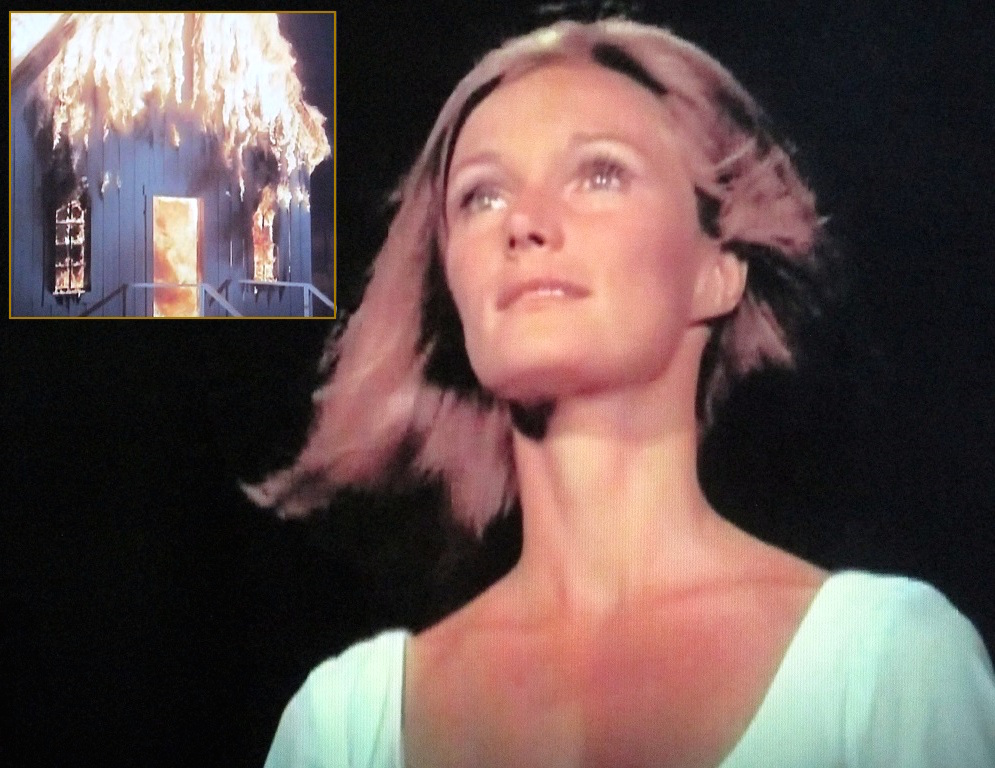
It kicks off with the ferocious burning of a church while a rhapsodic Yvette Mimieux looks on dreamily and approvingly. As the moment progresses, she eventually holds a golden cat in her arms during the pyrotechnics.
Next we come upon Roy Thinnes, a young minister crossing the desert who has lost a wheel off his wagon and is out of water completely. Oh, and his horse is dead, too! Under a makeshift shelter, Thinnes' wife Lyn Loring is passed out and severely sunburned from what has clearly been an arduous trek.
Things are looking up, though, because just when Thinnes has collapsed, a passing wagon comes upon the scene. In it are Ray Milland, the afore- mentioned Mimieux and Hank Worden. They stop and assess the situation.
While the men look over Loring, realizing they've come just in the nick of time, Mimieux tends to the parched Thinnes. When a rattlesnake suddenly appears and coils up to strike, the blonde beauty merely gives it a mildly determined stare and it changes its mind, sauntering away.
Now safely back among civilization, Milland takes in the young couple. Thinnes recovers rather swiftly, but Loring is still in question- able condition and must remain in bed.
Milland reacquaints Thinnes with his would be Samaritan Mimieux, whose name in this story is Deliverance! The lovely young thing can hear and understand everyone, but is unable to speak herself...
Out amidst the townfolk, Milland explains to Thinnes how he and his fellow citizens built their town in the style of their New England homeland and have continued to live by the ways they were used to there (including the habit of carrying no firearms.) Thinnes also meets a young boy who cannot walk without crutches following an accident.
Next Milland shows Thinnes the remnants of their church, which was burnt practically to the ground in another incident. Logic follows that Thinnes might stay on and become the town's new pastor, but he was already on his way to another assignment in Saguaro and feels compelled to keep that commitment.
Just then, evil rides in to town. Henry Silva is a black-clad baddie who comes into town every so often to wrest a share of gold from the inhabitants in exchange for not killing them all! Milland has paid him all along, thinking it was worth it to avoid bloodshed but, as luck would have it, the mine has proven bereft of any further gold and they plan to close it permanently.
An outraged Silva, angered over the loss of any future income from them, lassos poor old Worden and drags him down the town street! Thinnes attempts to rescue him with only marginal success. Notably, the then seventy year-old Worden performed at least part of this stunt himself!
Thinnes (sporting a wound on his face from the incident with Silva) tries to encourage Milland and his fellow townspeople to stand up to Silva. They are a meek and nonviolent group and cannot see their way to doing in the villain.
You may have noticed a blonde woman tending to Loring in an earlier pic. Recognize her now? She comes downstairs to inform Thinnes that his wife is now conscious again and is "asking" about him (which she strangely pronounces "osking" - ha ha!) Anyway, it's Gloria Grahame, a long way from her days as a sultry femme fatale in the cinema.
Loring still isn't great. She's suffering from heatstroke, sunburn and general malaise, yet is eager to get well so that they can be on their way to Saguaro. Thinnes and Loring were married in real life at this time, so their scenes together as man and wife ring pretty true.
Mimieux enters Loring's room with a (huge!) candle she's made. It's her hobby. Though Mimieux doesn't speak and basically acts pretty sweet and innocent, Loring has her number from the start and is barely polite to her.
She has good reason to feel that way...! Out in the shed, Mimieux is busy forging a wax statuette of Loring, complete with a piece of the skirt she was wearing when they brought her in from the desert!
Thinnes is recruited to provide a church service the next Sunday, though there is no church available. He gives a sermon on the mound out back of Milland's place. All the residents turn out in their Sunday best to hear his theological musings.
Even Loring manages to get herself gussied up for the occasion, with her caregiver Grahame close by. (One has to assume that the producers threw Loring this bone, allowing her to look nice for a hot minute, since her character is ill for much of the program's running time.)
Thinnes' sermon, it must be said, is horribly delivered and is really nothing but a string of blurted Biblical platitudes without a lot of point to them. In the congre- gation is one particular towhead, though, who would later become quite famous for a while: Leif Garrett!
Thinnes eventually gets on to a topic rather than a recitation and it does have an effect. The little crippled boy is suddenly able to get up and gingerly toss away his crutches, finally walking on his own steam! Even Loring, whose adoration of her husband knows few bounds, is stunned by this development.
That night, Thinnes stops by Mimieux's workshop, where phallic candles dangle all over (which her cat contin- uously knocks into, giving them an almost wind-chime effect!) She shows him some of her handiwork, though not the one she's been working on based upon his lovely wife!
She manages, though her semi sign language, to ask him if he thinks he might be able to restore her speech the way he caused the little blonde boy to walk again, but Thinnes has to explain that he doesn't feel as if he did anything directly with the boy. It came from within him.
Loring still feels low and is suffering from burning headaches, fatigue and tension. She tells Thinnes she wants to get out of the town and head to Saguaro as soon as possible. Thing is, he's beginning to really like it (and the people) there...
As Thinnes heads over to the washstand, he takes a look in the mirror and is thunderstruck by what greets him. Looking back at him is a shirtless, bloodied man about his age!
He lies down next to his wife and soon is having dreams of this blood-splattered shirtless man running after him and trying to get his hands on him! (If you remove blood from the equation, I've actually had this same dream more than once in my life....!! Ha ha!)
 |
| "What...? It'll wash off!" |
Waiting for him amid some huge gates is the dreamy Mimieux, her arms extended to rescue him. of course, I can't really understand why the hell he's running away from the hunk with no shirt, but that's me...
Loring is awakened by a staggering headache, one caused by Mimieux out in
Santa's Satan's workshop as she deter- minedly presses her fingers into the temples of her wax voodoo-type doll!
Hearing voices, she creeps over to the window and spies four hooded youngsters singing a creep-out song as they surround a tree stump that has something covered by a black cloth on it!
Heading out of the house and into the night, she suddenly discovers that the children have disappeared but her newfound nemesis Mimieux is on the scene. (If I recall correctly, Mimieux is being blown by a heavy wind while Loring's locks hang still in place!) Loring pulls back the cloth to find a dead owl and promptly passes out cold.
Milland simply doesn't believe her and her husband wants to, but he also finds the whole thing incredulous, even after his own loony dream. I found the staging of the moment below to be a bit hilarious as Loring pleads with Thinnes to believe her. She almost looks like she's in one of those cars from a Chamber of Horrors ride, which is basically what she's in...
 |
| "How the hell do I get offa this thing?!" |
Thinnes looks for clues as to what happened the night before and then asks Milland exactly what it was that caused Mimieux's voice to disappear. He explains that she suffered from terrible nightmares as a child and one night after waking up screaming, she never spoke again. Mimieux looks on from her window as they converse, with her ever-present cat in her arms.
 |
| "What's this about Nine Lives?" |
Just then Worden comes bursting into town to exclaim that as he and another man were boarding up the old mine, one of the shafts collapsed, leaving a new, incredibly rich vein of gold exposed! Now the town will be wealthy beyond their dreams and Milland determines that the first thing they need is a new church.
Loring and Thinnes have a deep conver- sation about their future. She knows that he feels indebted to Milland and the others for saving their lives and wants to stay on there as a preacher, but she is still vastly uncomfortable with both the people and the place. He explains - to no avail - that an offer of a new house and a hefty salary has been given to him.
After their discussion, Thinnes heads to the washstand to get Loring a glass of water and once again is greeted in the mirror by his shirtless, bloody friend! This time the mirror falls off the wall (but thankfully doesn't break.)
The church is now being hastily constructed by the townspeople and promises to be a lovely temptation for Thinnes, but the happy day doesn't last long...
 |
| "Any similarity between this movie and High Noon (1952) is purely intentional!" |
Silva is back! And this time he doesn't care if there is gold or not, though Milland promises him a share of it.
 |
| "I'll have two peaches and a pomegranate. To go!" |
He decides he'd rather have Mimieux as his latest payment and grabs her angrily, tearing her dress in the process. No one will stand up to Silva at all, even after he tosses his gun into the dust and laughingly taunts them, daring them to try.
As he drags Mimieux down the street, Thinnes picks up the gun and (in and interesting point of view shot) shoots Silva in the back killing him!
For a preacher to take up a gun and kill someone is something that Thinnes can hardly bear. But there is another shock in store.
The whole ugly incident has resulted in such a trauma for Mimieux that she wends her way up to Thinnes and tremulously utters her first words in many years, "Thank you!"
 |
| "Jesus Christ! Now the bitch can talk, too?!" |
Now Milland is grateful to Thinnes beyond words and implores him to stay on. Thinnes still abides by Loring's express wishes and declines, but Milland asks him to at least stay until the church is built and preach the first sermon in it.
Loring is far from being well, though, and is actually getting worse instead of better, regardless of the attentions of Grahame. She finally goes off the deep end and, in a moment that predates
The Exorcist (1973) by two years, affects a throaty rasp and begins growling bug-eyed at her husband that she will never get well as long as they remain there.
 |
| "I'm ready for Mercedes McCambridge to take over now..." |
The formerly lame young boy can now walk completely on his own steam. He stops Thinnes in the street and - like everyone - asks him to stay on as their minister.
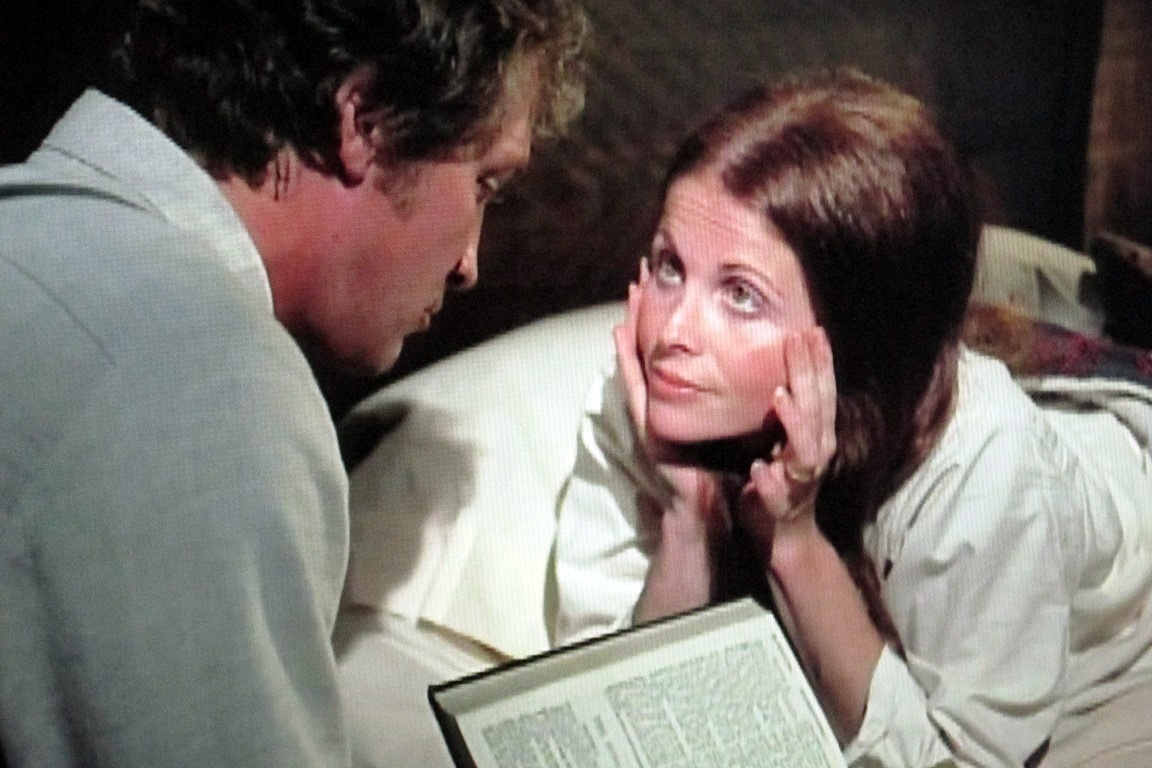
Thinnes is tormented with indecision. While cooling off his face in a nearby pond, he once again gets a glimpse of his ghostly friend in the reflection of the water. Mimieux shows up and begins reading sensuous passages from the Bible to him (!) before he finally opts to leave her and see how Loring is faring at the house.
 |
| Now it can be told. Yvette's hair on her head and on her pussy are the exact same color... (Sorry 'bout this one!) |
That evening, as Thinnes drifts off next to his wife, the dreams reappear.
I'd say nightmares, but how bad can it be with Mr. Humpy chasing after you?!?
This whole sequence is uninten- tionally (and amusingly) homoerotic (homo- phobic?) with Thinnes desper- ately trying to avoid the clutches of this barely-dressed stud who is running for his life to catch up to him!
This time in the dream, when Thinnes finally makes it to Mimieux and the gates, he is startled to find Silva there, snarling and laughing snidely as usual. He is able to shoot Silva in the dream, but it doesn't work!
Now awake, he heads to the cemetery to beg forgiveness of Silva for having killed him, monster that he was. But he's not alone. Mimieux has come there as well and this time she's going to get what she wants, which is Thinnes!
The next day Loring is more than ready to get outta Dodge (okay, not Dodge... San Melas, but you get my drift!) Just as she's packing to leave and finally dressed again, she is struck by a crippling pain in her head and collapses to the floor! Small wonder since Mimieux is playing with her wax doll again, this time complete with a lock of Loring's auburn hair!
 |
| "You, too, can have your very own Voodoo Doll Barbie! Supplies sold separately." |
With Loring back in bed and unable to travel, Thinnes is restrained from leaving and is able to preside over the very first church service in the spanking new building. He is a bit humbled, however, since first arriving, having now broken at least two commandments! I will not spoil the ending, but it is a loo-loo. Not only does it not cop-out, the way so many other movies do, but it also has a fun tag at the end, which takes place in 1971 rather than the old west.
 |
| Authentic old west hair and makeup, Hollywood style... Mimieux must've taken her lead from Audra Barkley! |
Prior to this Thinnes had made a mark on
General Hospital as Nurse Jessie Brewer's troubling husband Phil and been a regular on the TV series
The Long Hot Summer and
The Invaders (which remains a cult favorite for many.) He would go on to appear in two of our disaster flicks,
Airport 1975 (1974) and
The Hindenburg (1975) along with many subsequent television and movie appearances through the mid-2000s. For some unknown reason, I always think of him as being deceased even though he is alive at eighty-one! Maybe it was his getting sucked out of the cockpit all those years ago in
Airport 1975!
Mimieux was a go-to gal in the early-1960s for pretty blonde parts such as in
The Time Machine (1960),
Where the Boys Are (1962),
Light in the Piazza (1962) and
Joy in the Morning (1965.) She proceeded to a couple of disaster-type flicks as well like
Skyjacked (1972) and
The Neptune Factor (1973.) The TV-movie format was a friend to her in the 1970s and she did very many of them before retiring by the early-1990s. She is currently seventy-seven.
 |
| Publicity photos for this telefilm show plucky Mimieux handling the rattlesnake herself, an act that doesn't occur in the finished movie. |
Milland, a prolific Welsh leading man of the 1930s and '40s had just appeared in the smash hit
Love Story (1970) before this, yet somehow found himself in things like
Frogs and
The Thing with Two Heads by 1972! He balanced occasional movie roles (like
The Last Tycoon, 1976) with TV work (including
Mayday at 40,000 Feet!, 1976, and
Cave-In!, 1983 - but filmed earlier) until 1985. He died in 1986 of lung cancer at age seventy-nine.
Grahame had appeared in many films, some of them classics like
It's a Wonderful Life (1946),
The Bad and the Beautiful (1952, for which she won an Oscar) and
Oklahoma! (1956) before personal issues caused her career to hit the skids. (She had an obsession with her upper lip, constantly augmenting it to the point of near-paralysis and also married her step-son, with whom she'd allegedly had a sexual relationship with when he was a teen!) Still, she managed to work on TV and in the occasional movie until cancer claimed her in 1981 at only age fifty-seven. Her final years were depicted by Annette Bening in the unsuccessful 2017 movie
Film Stars Don't Die in Liverpool.
Loring practically grew up on TV, playing youngster Patti Barron on the highly successful soap
Search for Tomorrow for a decade. Many TV roles came after including series like
Fair Exchange and
The F.B.I., on which she worked for a dozen episodes. She also did
The Horror at 37,000 Feet (1973) with husband Thinnes. Had there never been a Stefanie Powers, her career might have gone even further. By the mid-'70s, she was ready to segue into producing, ultimately becoming president of MGM/UA Television Productions in the late-1980s, a rare feat for a woman at that time. She is seventy-five currently.
 |
| The seemingly happy Thinnes and Loring were wed from 1967-1984 and had two children together. |
With a face like his, Silva was born to play dangerous and villainous characters and began doing so in the 1950s.
The Tall T (1957),
The Bravados (1958),
Ride a Crooked Trail (1958) and
The Hills Run Red (1966) are but a few examples from his endless run of bad guys. Other notable films include
Ocean's ll (1960),
The Manchurian Candidate (1962) and
Sharky's Machine (1981.) He worked very prolifically up until the millennium before retiring and is still alive today at ninety-one.
Worden had been a real-life bronc rider in rodeos before being enlisted to perform in the Broadway play Green Grow the Lilacs (the inspiration for Oklahoma!) He also worked as an extra for Cecil B. DeMille in
The Plainsman (1936) and ultimately won roles in several Howard Hawks and John Ford films as well as further ones with John Wayne in them. He had a highly distinctive voice and manner, making him a memorable, if off-beat, character in films like
The Big Sky (1952) and
The Searchers (1956) among countless others. His last part was as a senile hotel waiter on
Twin Peaks in 1990 and '91 before he passed away in 1992 of natural causes at age ninety-one.
This was near the dawn of young Garrett's acting career and he had no lines apart from some singing. He'd done
Bob & Carol & Ted & Alice (1969) and a couple of sitcom episodes prior. A short-lived series called
Three For the Road when he was thirteen led to a teen following and soon he was a red-hot bubble gum pop sensation. by the end of the 1970s, however, his life fell apart following a violent car wreck, a serious drug problem and scads of financial woes. He has continued to perform in concert as well as the occasional acting role or appearance in reality TV, but without the searing fame that was his briefly. He is fifty-seven at present.

"The Man in the Mirror" was portrayed by one Stan Barrett, probably not a name that spills off your tongue every day because he was only an occasional actor. His biggest contribution to the screen came in the form of stunt work, so most of his roles involved that. He was Burt Reynolds' stunt man (for the things he wasn't permitted to do!) and later coordinator on many of the star's films. He also stood in for Paul Newman a few times. Apart from all this, he was unofficially declared the first man ever to break the sound barrier in a land vehicle and parlayed that notoriety into a second career as a NASCAR driver. Seventy-six today, he was still doing stunt driving for The Mentalist up until 2015 and separately his sons have taken up the same pursuits in movie work and racing/stunt driving with success. Coincidentally, a book about a fatal crash during the 1964 Indy 500 was also titled Black Noon.
 |
| Forty-five years later, western screenwriter Andrew Fenady turned his teleplay for Black Noon into a novel and released it. |
 |
| "All right... Fine. I give up!" |